Legal & Finance
Spain Property Tax for Co-Owners in 2026: ITP, IBI, Wealth Tax and What Foreign Buyers Need to Know
A clear-eyed guide to what owning Spanish property actually costs in 2026 — from the transfer tax that swings tens of thousands of euros across a regional border to the wealth-tax threshold catching more foreign owners every year — and why dividing the asset by eight changes the arithmetic.
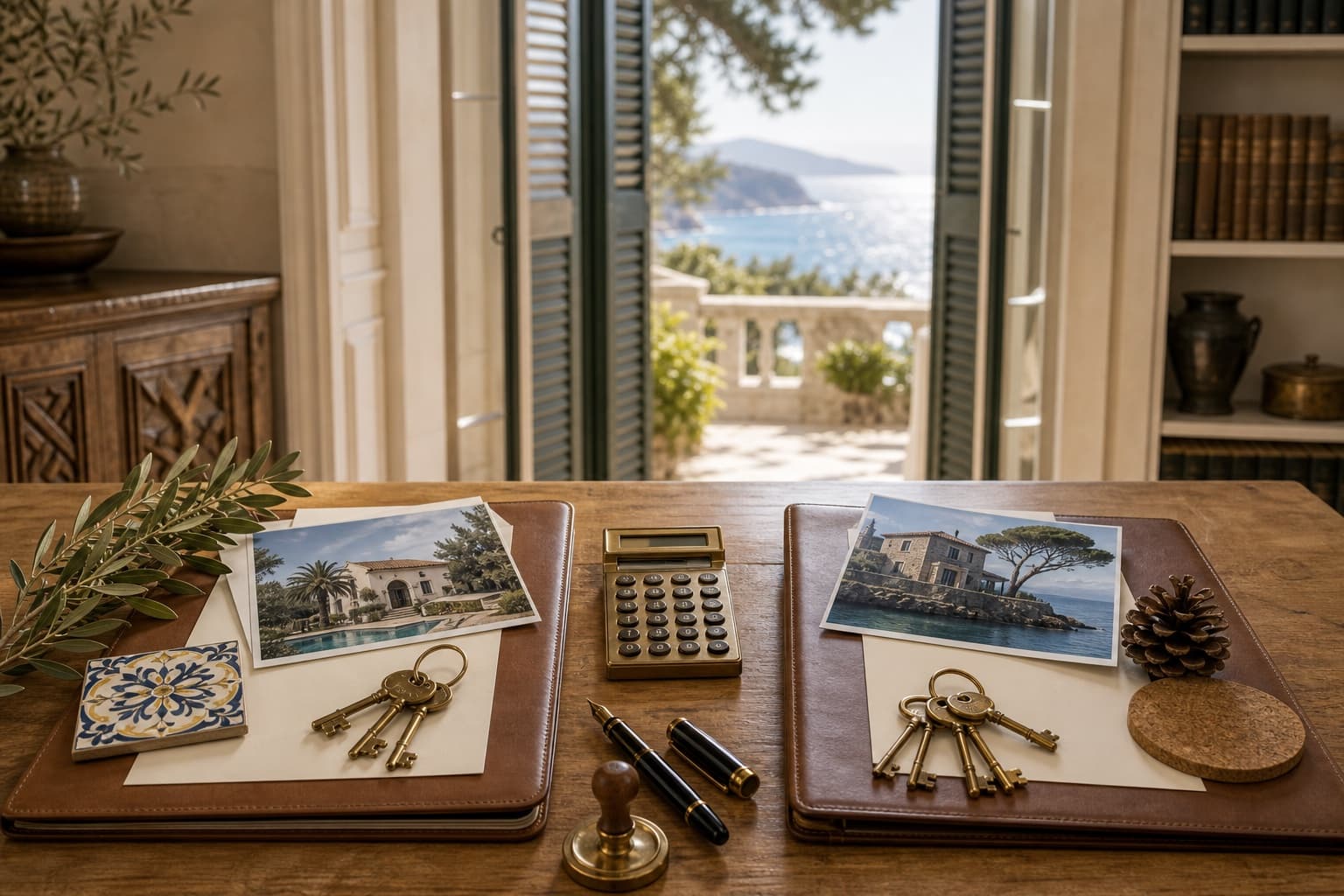
There are two villas, and for the purposes of the decision they are the same villa: four bedrooms, a pool, the same wide Mediterranean light, the same asking price of €1.2 million. One stands above the Costa del Sol in Andalusia. The other sits on a pine-backed slope of the Costa Brava, in Catalonia. The buyer has spent a pleasant month weighing the things that usually decide these matters — the drive from the airport, the village bakery, the angle of the morning sun on the terrace — when the lawyer's completion estimate arrives and quietly reorders the whole question. On the Andalusian villa, property transfer tax comes to €84,000. On the Catalan one, €122,000. Same house, same price, and a €38,000 gap before a single notary or registry fee is counted. Spain does not have a property tax. It has, for practical purposes, seventeen of them.
This is the first thing any serious buyer of Spanish property needs to absorb in 2026: the taxes that matter most — the transfer tax on purchase, the surcharges, the reliefs — are set not in Madrid but by each of Spain's seventeen comunidades autónomas, and they diverge sharply. Layered over that regional patchwork are three national developments that have reshaped the picture for foreign buyers in particular. The golden visa was abolished on 3 April 2025, ending the residency-by-investment route that had drawn a decade of property capital. A proposal to impose a punitive surcharge — described in the press as a "100 per cent tax" — on non-EU buyers of resale property has been working through parliament since May 2025. And the wealth tax, long treated by many overseas owners as somebody else's problem, reaches further into the foreign-owned market each year. This guide works through Spanish property tax as a buyer actually meets it — at acquisition, across the years of ownership, and at exit — and sets out where co-ownership through a structured LLC, the model COP is built on, changes the arithmetic in concrete, measurable ways.
Buying Into Spain: ITP, IVA and the Regional Tax Map
The largest single cost of buying Spanish property is the tax on the purchase itself. For a resale home — which is to say the great majority of the coastal and rural property international buyers actually want — that tax is ITP, the Impuesto sobre Transmisiones Patrimoniales, or property transfer tax. ITP is a regional tax, and the rate a buyer pays depends entirely on where the property sits. Madrid charges 6 per cent. Andalusia applies a flat 7 per cent. Catalonia charges 10 per cent on the first €1 million of price and 11 per cent above it. The Balearic Islands — Mallorca, Menorca, Ibiza — run a steep progressive scale that climbs into the 11-to-13-per-cent range at the upper price brackets, making the islands the most expensive region in Spain for transfer tax on quality property. There is no separate or higher headline rate for foreigners: a non-resident pays the same nominal ITP as a Spaniard. But the local reductions that exist — for first-time buyers, large families, the young — are almost always reserved for Spanish tax residents, so a non-resident should budget for the full headline rate of their chosen region.
New-build property follows a different route. Instead of ITP, a first transfer from a developer carries IVA — value-added tax — at a flat 10 per cent across the whole of Spain, together with AJD, the stamp duty on documented legal acts, which runs at roughly 1 to 1.5 per cent depending on region. Whichever route applies, ITP must be settled within 30 days of signing the escritura — the title deed — at the notary, and notarial, land registry and legal fees typically add a further 2 to 3 per cent. A buyer's all-in transaction cost on a quality Spanish property therefore runs to somewhere between 10 and 14 per cent of the purchase price — a figure that belongs in the calculation at the offer stage, not as an unwelcome surprise at completion. Our buying FAQs set out how these acquisition costs are structured and shared within a co-ownership transaction.
This is where the co-ownership arithmetic first becomes visible. Buying a €1.2 million villa outright on the Costa Brava means writing a cheque for €122,000 in transfer tax alone. Buying a one-eighth share of the same villa through the LLC that holds it means the acquisition tax — like the purchase price itself — is divided across eight co-owners. Each owner's proportional contribution to that €122,000 is roughly €15,250. The tax does not vanish; Spanish property tax is owed in full on the property regardless of how its ownership is divided. But it is shared, eight ways, alongside every other cost of acquisition and ownership.
The "100 Per Cent Tax" Proposal: What It Is, What It Isn't, and Where It Stands
No discussion of Spanish property tax in 2026 is complete without addressing the measure that has generated the most international alarm and the least international clarity. In January 2025, Prime Minister Pedro Sánchez announced that his government would explore a tax of "up to 100 per cent" on property bought by non-EU residents who do not live in Spain. The Socialist parliamentary group formally submitted a draft bill in May 2025. The proposal, as drafted, is best understood not as a literal doubling of a property's price but as a complementary state tax that would sharply increase the effective transfer-tax cost for non-EU, non-resident buyers of resale homes.
Two points matter for any buyer reading this in 2026. The first is that the measure is not law. It is a proposal, subject to full parliamentary passage, and the government does not command an absolute majority; several parties have already signalled opposition, and tax practitioners broadly regard passage in the original, severe form as unlikely. As of this writing, no surcharge on non-EU buyers has taken effect, and Spanish property tax for foreign buyers is, for now, exactly as it has long been. The second point is that even the draft, as written, would apply only to resale property bought by non-EU, non-resident individuals — new-build and off-plan purchases were carved out, and the residency and nationality tests are central to its design. Buyers should track the measure's progress and take current professional advice, but should not make decisions today on the assumption of a tax that does not yet exist.
Annual Holding Costs: IBI, Imputed Income and the One-Eighth Arithmetic
Once a property is owned, two recurring taxes apply each year. The first is IBI — Impuesto sobre Bienes Inmuebles — Spain's municipal property tax, the direct equivalent of France's taxe foncière, Italy's IMU and Portugal's IMI. IBI is levied by the town hall on the property's valor catastral, or cadastral value, which across most of Spain sits considerably below open-market value. Municipal rates typically fall between 0.4 and 1.1 per cent of cadastral value, with most established coastal municipalities — across the Costa Blanca, for instance — settling around 0.6 to 0.7 per cent. Because IBI is charged on the cadastral figure rather than the market price, the absolute sums are usually modest by the standards of prime property: a quality coastal villa will often carry an annual IBI bill in the low thousands of euros.
The second annual charge is the one most foreign owners never see coming. Spain levies a non-resident income tax — IRNR — on a second home even when it earns no rent at all. The logic is that the property represents a notional benefit to its owner, so the tax authority imputes an income to it: 1.1 per cent of the cadastral value where that value has been revised within the past decade, or 2 per cent where it has not. That imputed figure is then taxed at 19 per cent for owners resident in the EU or EEA, and 24 per cent for owners resident elsewhere — a distinction that, since Brexit, now places British owners in the higher band. On a villa with a cadastral value of, say, €400,000, imputed income at 1.1 per cent is €4,400; a non-EU owner pays 24 per cent of that — roughly €1,056 a year — purely for the privilege of owning a home they may visit for only a few weeks.
For co-owners on the COP platform, the property-level taxes — IBI and the property's annual tax compliance — are administered by the management company appointed by the LLC and allocated proportionally across the eight owners, who each carry one-eighth of the bill alongside one-eighth of insurance, maintenance, pool and garden upkeep and management fees. The tax treatment of property held through a corporate vehicle differs in its mechanics from direct individual ownership, and the precise position depends on the LLC's domicile and structure — an area where advice specific to the chosen vehicle is essential. What the co-ownership model removes, in practical terms, is the obligation to navigate Spain's Modelo 210 filings, regional deadlines and cadastral correspondence personally. A detailed breakdown of how running costs are structured and shared sits in our how it works guide.
The Wealth Tax Question — and Why Dividing the Asset by Eight Matters
Spain is one of the few European countries that still levies an annual wealth tax — the Impuesto sobre el Patrimonio — and it is the tax that most often catches foreign property owners unprepared. A non-resident is liable for Spanish wealth tax on their Spanish-situated assets, principally real estate, above a tax-free threshold of €700,000. Crucially, the additional €300,000 allowance that residents receive against a main home does not apply to non-residents, who by definition have no habitual residence in Spain. Rates run on a progressive scale from 0.2 to 3.5 per cent. Above and beyond this sits the Solidarity Tax on Large Fortunes — a national tax on net wealth over €3 million, charged at 1.7 to 3.5 per cent, which has now been extended indefinitely. The taxable value of a Spanish property for these purposes is the highest of its purchase price, its cadastral value, or the valor de referencia set by the cadastre.
Here the structure of ownership genuinely changes the outcome — though not in the way the persistent myths suggest. A common misconception holds that placing a Spanish property inside a foreign company removes it from the wealth tax net. It does not: a reform that took effect in 2022 specifically extended Spanish wealth tax to non-residents holding shares in foreign companies whose assets are mainly Spanish real estate. The LLC does not make the tax disappear. What co-ownership does is change the number that matters. The value attributed to each co-owner is one-eighth of the property. A non-resident who owns a €2 million villa outright is more than €1.3 million over the €700,000 threshold and squarely within the wealth tax. A co-owner of the same villa holds an interest valued at roughly €250,000 — comfortably below the threshold, on that asset, for most buyers. You are taxed on less because, quite simply, you own less of any single property.
Selling: Capital Gains, the 3 Per Cent Retention and Plusvalía
When a Spanish property is sold, two further taxes arrive. The first is capital gains tax. A non-resident seller pays a flat 19 per cent on the net gain — the difference between the documented purchase and sale prices, adjusted for allowable costs. To secure that liability, Spanish law requires the buyer to withhold 3 per cent of the sale price at completion and pay it directly to the tax authority on the seller's behalf, through a filing known as Modelo 211. This 3 per cent is not an extra tax; it is an advance payment against the 19 per cent. Where it exceeds the true liability — common where the actual gain is modest — the seller reclaims the difference by filing within four months. The broader mechanics of capital gains on shared property are covered in our guide to capital gains tax on fractional property.
The second is the plusvalía municipal — a town-hall tax on the increase in the value of the land a property occupies over the period of ownership, assessed separately from the bricks and calculated from the cadastral land value and the number of years held. It is owed by the seller, non-residents included, on the sale of urban property. Selling a property held directly is, in tax and administrative terms, a full conveyancing event: deed, registry transfer, retention, two separate tax filings. Selling a co-ownership interest is a different transaction — a transfer of shares in the LLC, governed by the co-ownership agreement — and its tax treatment can differ from that of a direct property sale depending on the LLC's domicile and the relevant double-taxation treaty. It is an area for specific professional advice, but a structurally simpler exit than the alternative.
The LLC Structure: What It Changes, and What It Doesn't
The thread running through all of this is the ownership vehicle. COP's co-ownership model places a single property inside a limited liability company; eight co-owners each hold a defined one-eighth share of that company, and the whole arrangement is governed by a co-ownership agreement that fixes scheduling rights, cost-sharing, maintenance standards and the procedure for selling a share. Holding prime Spanish property through a corporate vehicle is not novel — a substantial share of the luxury market above €1 million has long sat within companies, for reasons of privacy, succession planning and exit simplicity. Co-ownership formalises and democratises that approach, extending it to buyers acquiring one-eighth of a property rather than the whole of one. The structural logic is set out in full in our analysis of the LLC advantage.
It is worth being precise about what the structure does and does not achieve. It does not exempt the property from Spanish tax: ITP on purchase, IBI each year, capital gains and plusvalía on sale are all owed on the property in full, whoever holds it and however ownership is divided. What the structure does is, first, spread every one of those costs across eight owners; second, contain each co-owner's wealth-tax exposure to the value of a one-eighth interest; and third, simplify both succession and exit, since what passes to heirs or to a buyer is a holding of company shares rather than a fraction of Spanish real estate subject to local conveyancing and Spanish forced-heirship rules. For buyers whose planning horizon includes the next generation, that last point carries real weight; our guide to inheritance and estate planning for fractional owners covers it across the main European markets. None of this is a substitute for advice specific to a buyer's own residency and the particular property — but it is the architecture within which that advice operates.
The Case for Co-Ownership in Spain's Tax Landscape
Spain's property tax system in 2026 is not punitive, but it is layered, regional, and unforgiving of the buyer who arrives without having read it. The transfer tax alone can swing by tens of thousands of euros across a regional border. The imputed income tax bills owners who earn nothing from their home. The wealth tax reaches further into the foreign-owned coastal market each year, and the political conversation around non-EU buyers adds a layer of genuine uncertainty. For the buyer thinking only of the villa — the light, the terrace, the village — these are precisely the costs that can turn a dream purchase into an administrative weight.
Co-ownership does not abolish any of this. What it does is make it tractable. It divides the heaviest single cost — the transfer tax — by eight. It contains wealth-tax exposure to a one-eighth interest. It hands the annual filings, the cadastral letters and the Modelo 210 deadlines to a management company, and returns to each owner a single, itemised annual account. And it delivers, for an entry investment of roughly €150,000 to €200,000 per share, a deeded one-eighth holding in a property — on the Costa del Sol, in the Balearics, on the Costa Brava — that the same buyer could rarely access alone at the same quality, together with 44 to 45 days of use each year in a home that is maintained, managed and legally structured for the long term. The Spanish coast has always sold a particular promise: not a holiday, but a second life lived at a slower rhythm — the morning market, the long lunch, the sea still warm in October. The tax system is simply the toll road to that life. Co-ownership is the structure that makes the toll proportionate.
For buyers weighing Spain, the most useful next step is to look at specific properties and specific numbers. Browse current shares at our homes, see how the purchase and cost structure works in our how it works guide, or set Spain against the wider European picture in our country-by-country property tax guide for co-owners. When a particular property interests you, speak with our team directly: we work with tax and legal advisers across Spain and the principal buyer markets, and can introduce buyers to qualified professionals at the right point in their evaluation.
More from Co-Ownership Property


Kontakt aufnehmen
Sprechen Sie mit einem Experten
Sagen Sie uns, wonach Sie suchen, und einer unserer Miteigentums-Spezialisten meldet sich innerhalb von 24 Stunden bei Ihnen.