30A · Emerald Coast · Florida · USA
30A Fractional Ownership & Co-Ownership Properties
From a Rosemary Beach courtyard cottage steps from the Gulf to a WaterColor lakehouse on the edge of Western Lake — fractional ownership on Scenic Highway 30A means a real share of the Emerald Coast's most architecturally distinctive beach corridor, around six weeks of sugar-white sand and emerald Gulf water each year, and a fully managed home waiting whenever you arrive. Whether you call it fractional ownership or co-ownership, you own a real share of the home.
2 properties · from $1,255,000
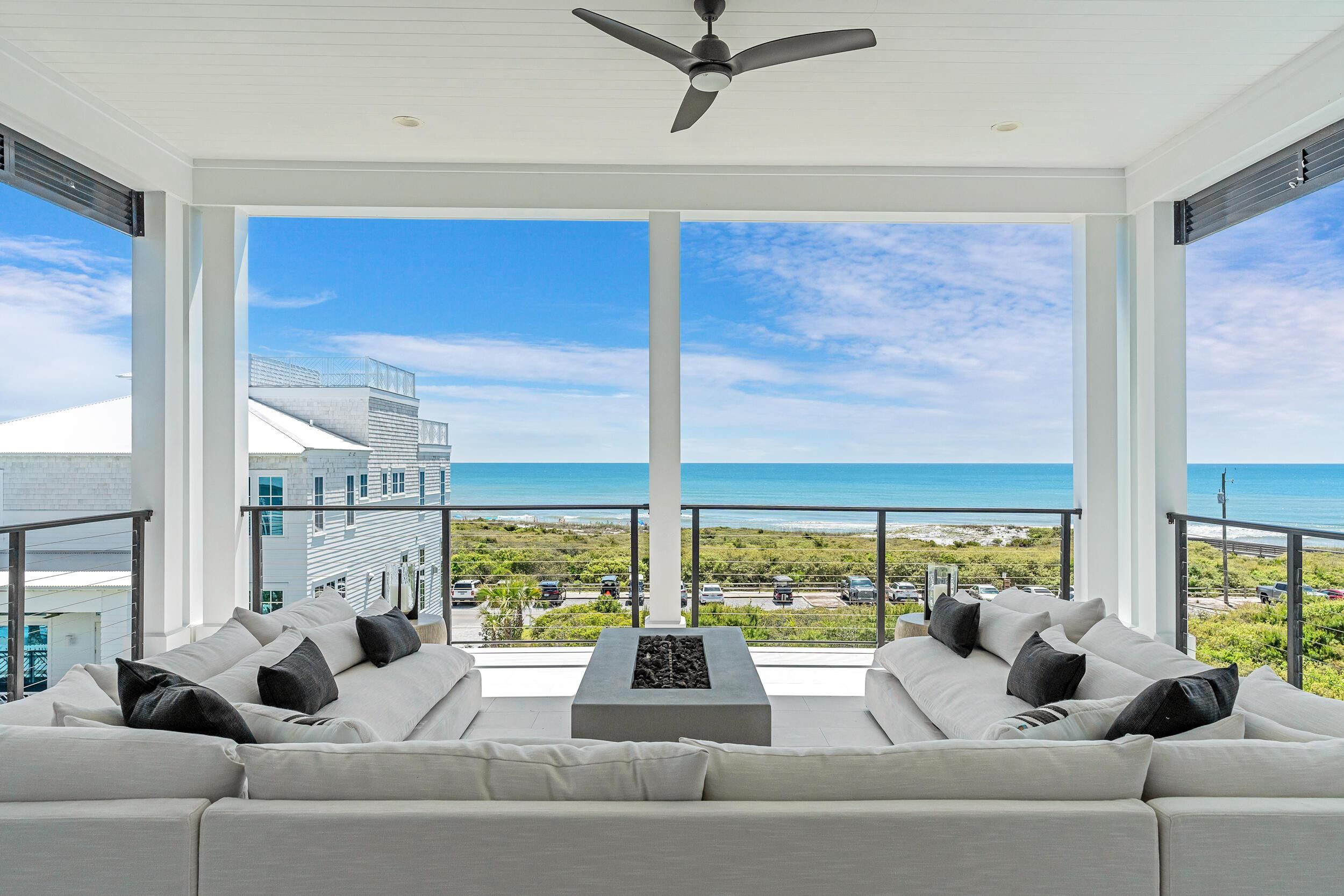
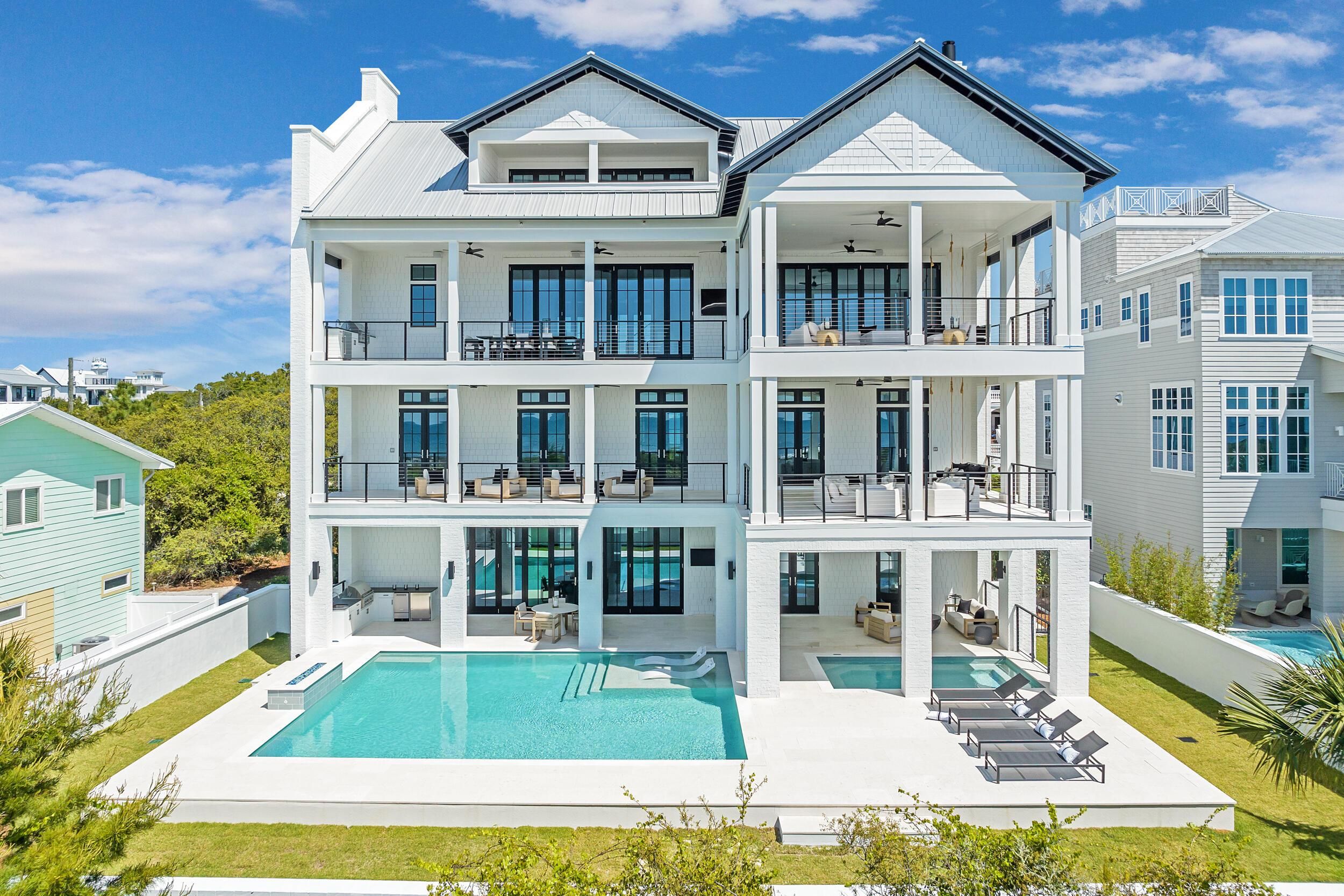
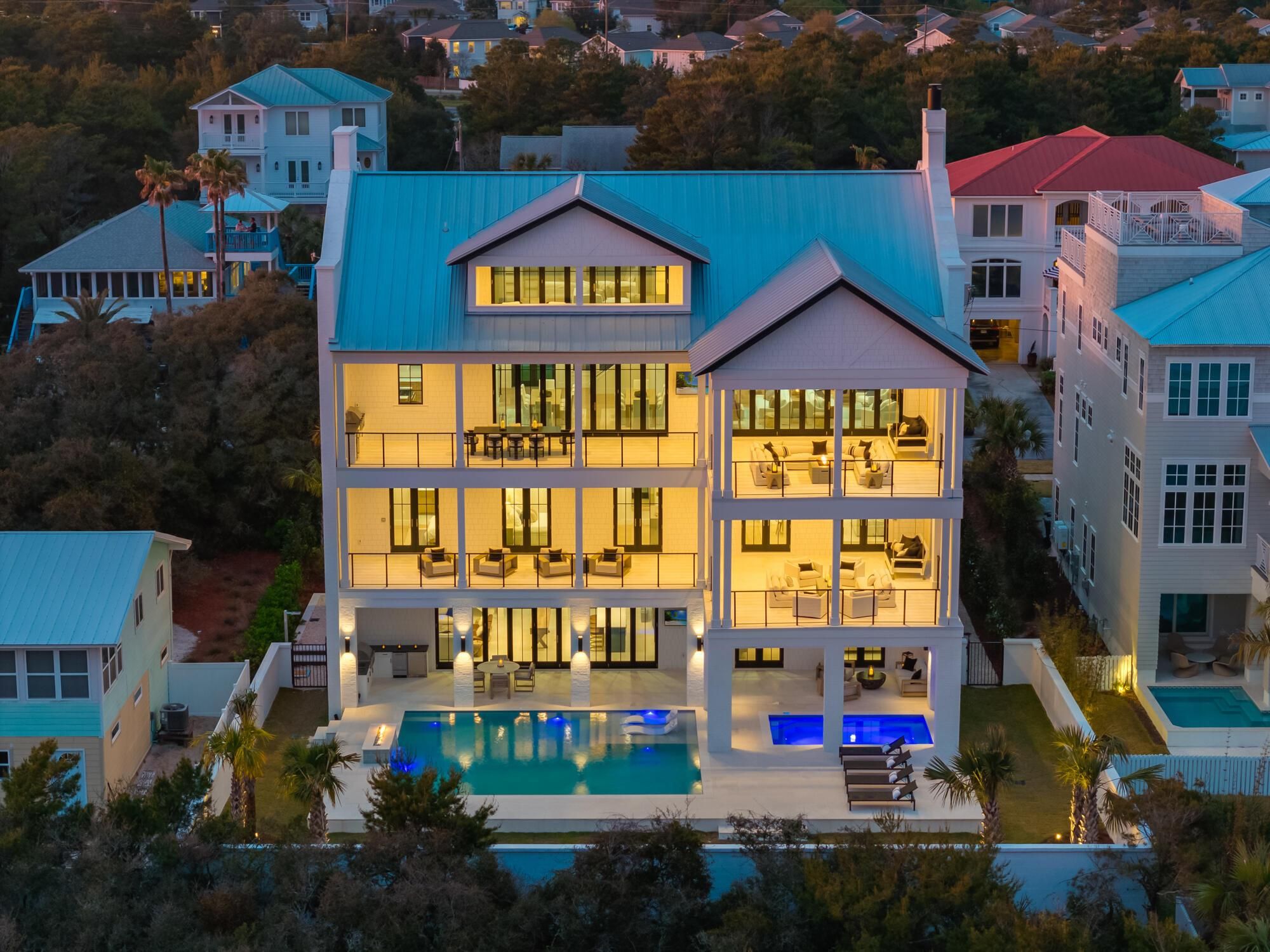
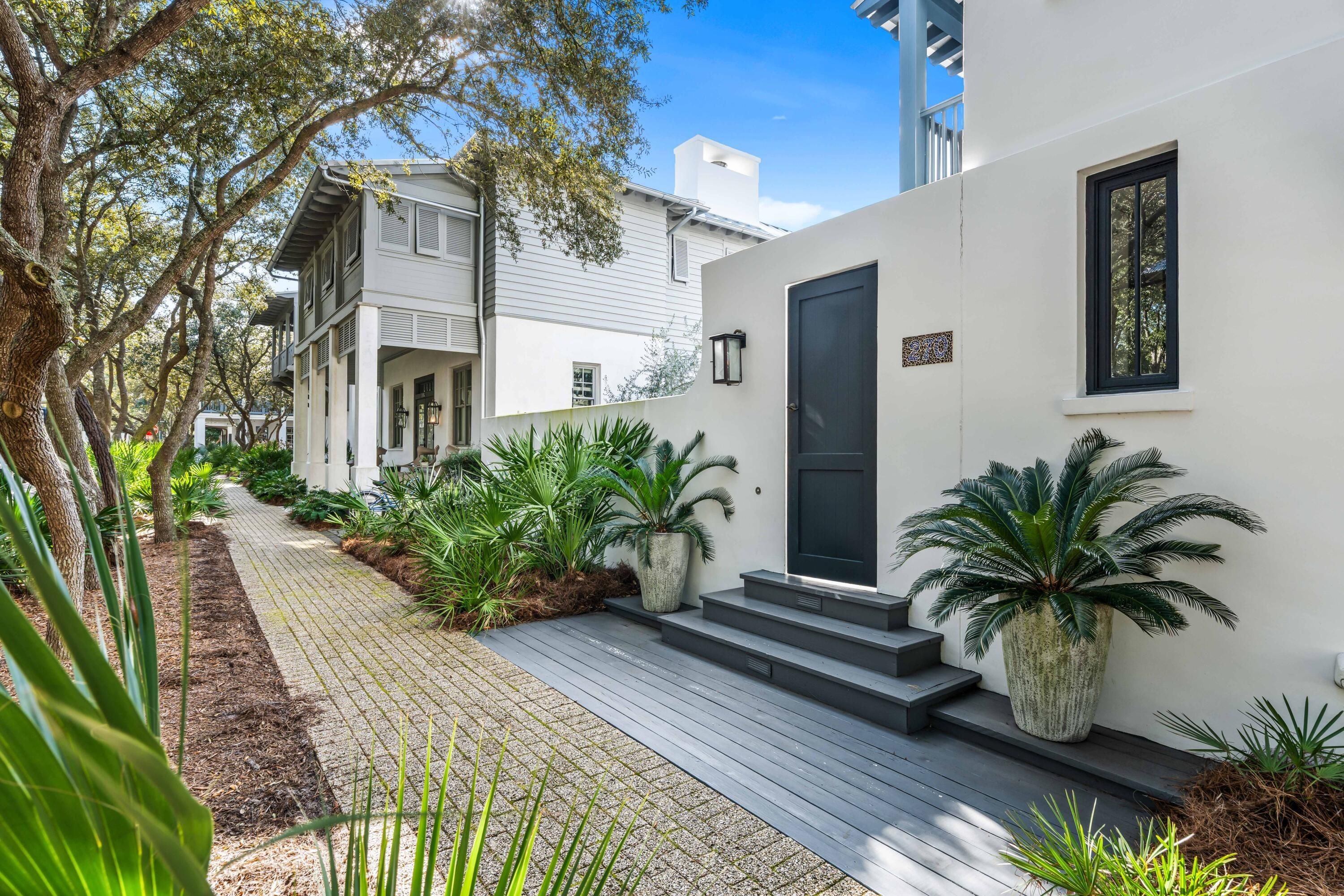
Inlet Beach, Florida, USA — 8-Bed Beachfront House With Gulf Views & Oceanfront Pool
$1,260,000
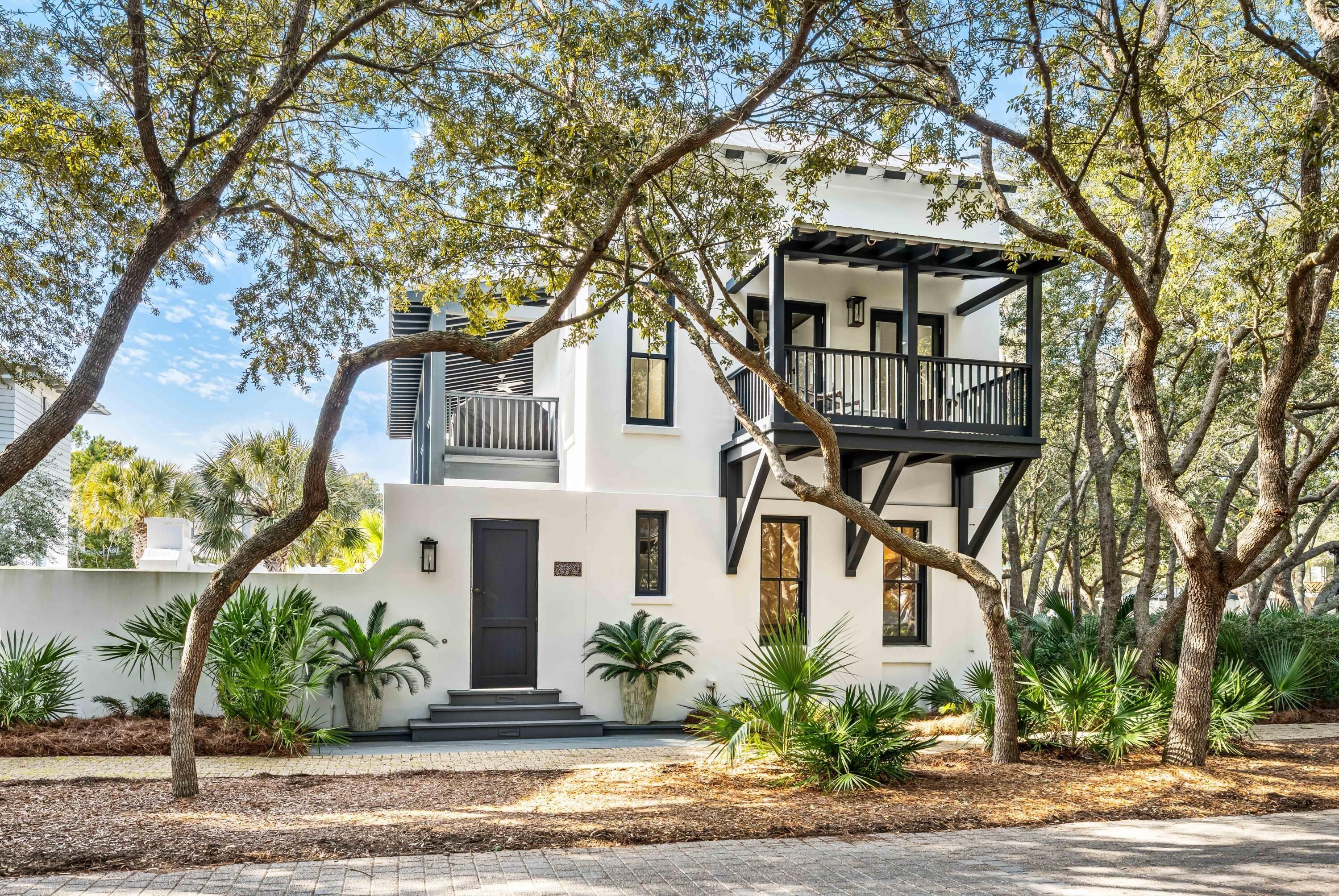
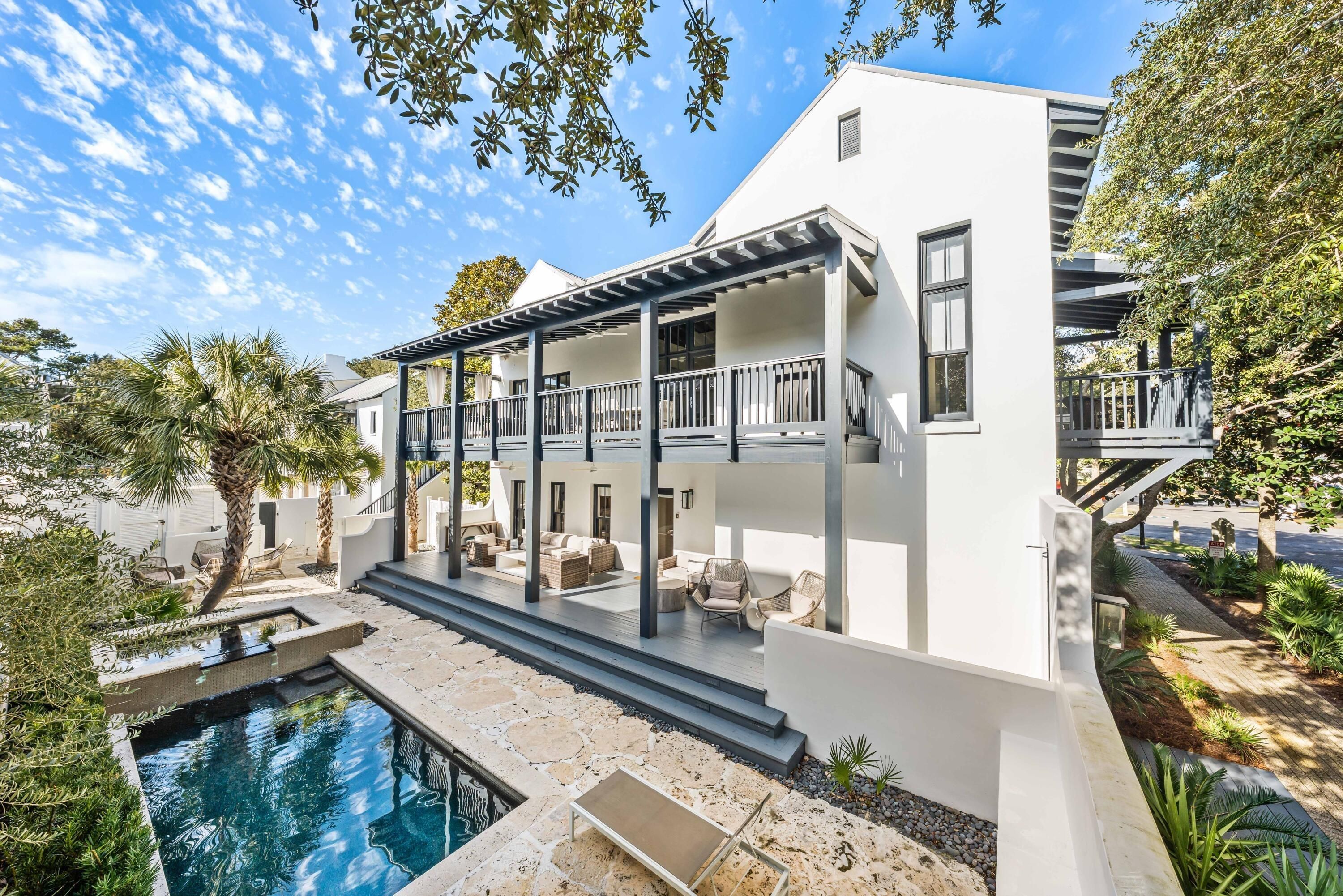
Rosemary Beach, Florida, USA — 4-Bed House With Pool
$1,690,000
30A's most coveted beach addresses, accessible through co-ownership.
Fully managed beach cottages, villas and townhouses across Rosemary Beach, Seaside, WaterColor, Alys Beach, Grayton Beach and Inlet Beach. Your 1/8 share of the home comes with around six weeks of personal use, a professional management team on call, and the long-term equity of one of the most supply-constrained beach corridors in the southern United States.
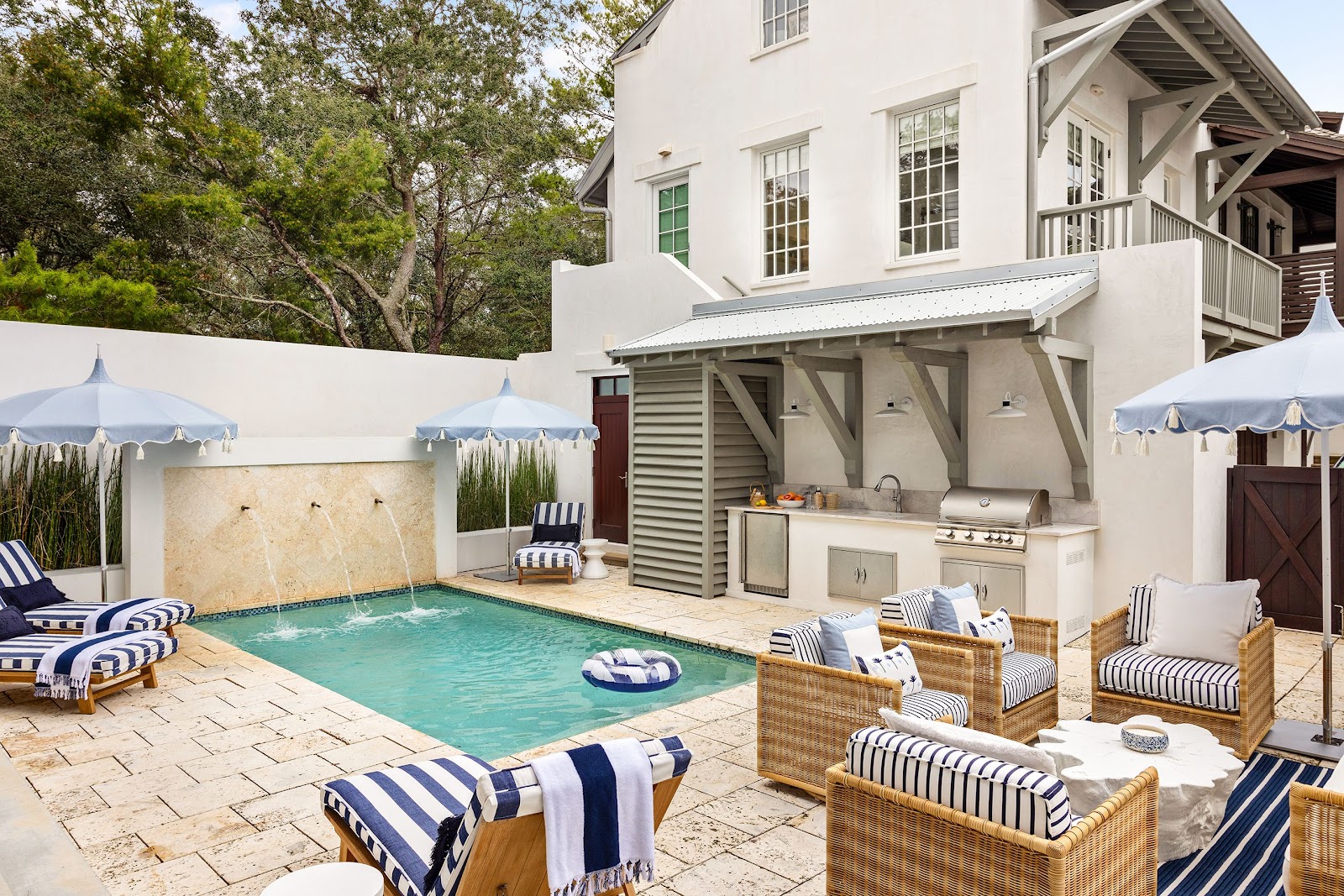
What is fractional ownership on 30A?
Fractional ownership on 30A means buying a real 1/8 share of a luxury Emerald Coast beach home, shared with up to seven other co-owners. Each owner receives around six weeks of personal use a year, depending on the home, through a fair-rotation calendar, with all property management, maintenance, taxes and operations handled by a professional team. It is real ownership of a share of the home — not a timeshare, not a holiday club.
Why 30A?
Scenic Highway 30A is, by the most credible measures, the single most architecturally refined and ecologically distinctive beach corridor in the continental United States. The road runs for 24 miles along the Gulf of Mexico shoreline of South Walton County, threading through sixteen named beach communities — from Inlet Beach in the east through Alys Beach, Rosemary Beach, Seagrove, Seaside, WaterColor, WaterSound, Blue Mountain Beach and Grayton Beach to Dune Allen in the west — all of them characterised by low density, architectural codes, and the natural frame of sugar-white quartz sand and water the shade of the Caribbean that gives the Emerald Coast its name. That sand colour is not metaphor: the quartz origin of the material — carried south by rivers from the Appalachian highlands over millions of years — means it stays white, cool and almost powdery underfoot even in the midday heat of July, a characteristic shared by fewer than a handful of beach destinations in the entire United States. The Gulf water, shallow and protected from the open Atlantic by the arc of the Florida Panhandle, runs at 26–30°C (high 70s°F to mid-80s°F) from May through October, and the combination of colour — emerald-green shallows over white sand, deepening to cobalt in the Gulf beyond — is consistently ranked among the most photogenic coastline in the country. No other American beach corridor pairs that natural endowment with the planning quality, architectural consistency and low-rise density of 30A.
Your 30A share is owned alongside up to seven other co-owners — a real share of the home, not a right to use it. It also pairs naturally with a second home elsewhere — say, a 30A Gulf beach share alongside a Colorado ski share for the winter months.
30A's particular structural advantage inside the American beach-home market is the combination of supply constraint, ecological protection and planning quality that no other comparable US coastal corridor has assembled. Grayton Beach State Park, the coastal dune lakes of South Walton, and the protected dune systems managed by the Florida Department of Environmental Protection together place a meaningful share of the corridor's backland in permanent protection, which caps supply in a market where demand has grown consistently for three decades. There are fifteen known coastal dune lakes in South Walton County — rare geologic features formed when freshwater runoff behind the coastal dunes periodically overtops the barrier and connects to the Gulf, creating a brackish-to-freshwater oscillation that supports a distinct ecology. They exist in only a handful of locations worldwide: Western Australia, Madagascar, New Zealand and this stretch of the Florida Panhandle. The lakes — Western Lake in WaterColor, Draper Lake near Blue Mountain Beach, Deer Lake and Campbell Lake further west — add a navigable freshwater recreational layer behind the beach, and their shorelines are counted among the most ecologically significant coastal habitats in the south-eastern United States. For a buyer buying a share on 30A, these protected features are permanent supply constraints: the ecology and planning regime that prevents development behind the dunes is not a temporary zoning decision but a multi-decade programme embedded in the Florida statute and in the county's land-use framework, which means the residential land that exists on 30A today is the residential land that will exist in 2035 and 2045. That permanent scarcity underpins the market in exactly the way that the White River National Forest underpins Aspen: there is no direction in which the 30A corridor can meaningfully expand.
The planning quality that distinguishes 30A from every other American beach corridor is inseparable from the history of Seaside, the town at the corridor's geographic and symbolic heart. Seaside was developed from 1981 by Robert and Daryl Davis on eighty acres of bare Florida Panhandle dune, to a master plan by architects Andrés Duany and Elizabeth Plater-Zyberk, and it became the prototype New Urbanist community — the first built demonstration that a pedestrian-scaled, mixed-use, front-porch-centric town could be built from scratch in the late-twentieth century United States. The principles embedded in the Seaside code — compulsory front porches, street-aligned setbacks, varied cottage heights, mixed residential-and-retail uses at ground floor, a town square that serves as the civic and commercial heart — were so influential that they became the founding charter of the Congress for the New Urbanism, the planning movement that went on to shape development codes across North America and Europe. You may recognise Seaside without knowing it: it was the filming location of the 1998 film The Truman Show, with Peter Weir choosing the town because its uncommonly consistent small-town architecture made it the most plausible vision of a constructed perfect community in the American landscape. The town's influence spread quickly east along the highway, with Rosemary Beach (1995), Alys Beach (2004), WaterColor (2000), WaterSound (2003) and other planned communities each adapting the New Urbanist playbook to different architectural codes — West Indies vernacular at Rosemary Beach, whitewashed Bermudian at Alys Beach, coastal modern at WaterSound — while maintaining the low density and pedestrian scale that Seaside established. The cumulative effect is a coastal corridor where architectural consistency is not a coincidence but a designed output, enforced through architectural review boards in each community, and where the resulting uniformity of character is itself a supply constraint: you cannot build a standard Florida beachfront condominium block inside any of these communities without violating their architectural codes, which means the property stock on 30A is permanently and distinctively different from the generic Florida Gulf Coast alternative.
The natural climate of the 30A corridor reinforces the year-round usability case. Northwest Florida's Emerald Coast enjoys an average of approximately 320 days of sunshine per year, with average January highs of 16–18°C (low-to-mid-60s°F) — mild enough for outdoor dining, golf and cycling through the winter months — and average summer highs of 31–33°C (high 80s°F to low 90s°F) moderated by the Gulf breeze. The corridor sits far enough north of the tropics to avoid the intense hurricane vulnerability of South Florida — major direct landfalls on this stretch of the Panhandle are historically less frequent than on the Atlantic coast — while far enough south to hold usable beach temperatures from March through November, a nine-month season that is materially longer than any comparable beach destination on the US East Coast. The Gulf water temperature runs above 21°C (70°F) from late April through mid-November, above 26°C (79°F) from June through September. Few American beach destinations pair that extended season with the planning quality, ecological depth and architectural consistency of the 30A corridor.
The fourth structural argument for 30A is the depth of its brand equity with the American domestic second-home buying population. The corridor has been attracting high-income families from the Southeast, Mid-Atlantic and Midwest for more than three decades, and Seaside, Rosemary Beach and Alys Beach in particular have the kind of nationally recognised destination identity that most Florida beach communities have not achieved. The South Walton Tourist Development Council consistently reports that a large share of visitors are repeat visitors — families who have been coming to the same village for ten, fifteen, twenty years — which is the single most reliable indicator of destination stickiness and long-term demand. For a fractional owner, that brand loyalty translates into a resale market with an established and emotionally committed buyer pool, rather than a speculative resort community whose appeal depends on the latest development project or marketing campaign.
Where to own on 30A
30A's sixteen communities each have their own architectural code, beach access pattern, price tier and buyer character. For the fractional buyer, the practical choice concentrates in four clusters that account for the overwhelming majority of premium second-home demand along the corridor: Seaside and WaterColor at the historic and ecological heart; Rosemary Beach and Alys Beach at the eastern end, the most architecturally refined; Grayton Beach and Seagrove in the quieter central section; and WaterSound and Inlet Beach in the less-visited eastern stretch. Together these four clusters trace the full range of what 30A offers — from the prototype New Urbanist town square at Seaside to the whitewashed compound privacy of Alys Beach to the state-park seclusion of Grayton Beach to the newer luxury residential fabric of WaterSound.
Seaside and WaterColor
Seaside, at the geographic midpoint of the 30A corridor, is the community that started everything — and forty years on, it remains the most recognisable and most imitated beach town in the United States. The town occupies eighty acres between Scenic Highway 30A and the Gulf, with its original Duany Plater-Zyberk master plan still governing every building decision: front porches mandatory, varied roof pitches and cottage heights required, street grid aligned to the Gulf breeze, a central town square with a pavilion stage and outdoor amphitheatre that serves as the community's social heart. The residential vocabulary is the Florida Vernacular Cottage — wood-framed, elevated on pier foundations, painted in the chalky pastels that have become the visual shorthand for 30A in magazine coverage and social media — and the architects who built in Seaside through the 1980s and 1990s produced a body of work that is now considered foundational to American residential design. The row of Airstream food trucks on the central square, the Perspicacious bookshop, the Bud & Alley's restaurant on the Gulf-front terrace, and the two beach pavilions framing the town's central beach access are the civic landmarks of a community that generated a genuinely distinctive local culture alongside its architectural legacy.

WaterColor, developed immediately west of Seaside from 2000 by St. Joe Company, extends the New Urbanist planning tradition while layering in the ecological character of Western Lake — the largest of South Walton's coastal dune lakes, occupying the backland immediately behind WaterColor's beach neighbourhood. Properties in WaterColor are divided between the beachside tier (facing the Gulf directly, the most premium addresses on the corridor), the lakeside tier (with direct water frontage on Western Lake, accessible by kayak and paddleboard through the dune-lake outlet to the Gulf), and the inland neighbourhood streets (heavily tree-canopied, with bike-path connections to the beach and lake). The WaterColor Inn and its Beach Club anchor the community's hospitality offer; the Camp WaterColor pool complex, the tennis and fitness facilities, and the pedestrian connections to the Seaside town square make WaterColor the most amenity-rich of the central corridor communities. The combination of beach, dune lake and a resort infrastructure that functions independently of the ownership calendar gives WaterColor the broadest activity range of any single address on 30A.
Best for: buyers who want the most historically significant address on the corridor — the prototype New Urbanist town in Seaside itself — or who value the rare combination of direct Gulf beach access and dune-lake paddling in WaterColor; couples and families drawn to the architectural heritage and the established cultural calendar of the central 30A corridor.
Rosemary Beach and Alys Beach
Rosemary Beach, developed on one hundred and seven acres at the eastern end of the 30A corridor from 1995, is widely regarded as the most architecturally refined community on the highway. The architectural code draws from Caribbean and West Indies Colonial vernacular — whitewashed stucco walls, dark wood shutters, elevated covered loggias, interior courtyards and carriage lanes running perpendicular to the main streets — and is enforced with exceptional consistency by the community's Architectural Review Board. The result is a townscape that photographs more like the old quarters of Barbados or St. Barts than a Florida beach development, with a visual coherence that visiting architects cite as the most successful implementation of the New Urbanist code anywhere in the United States. The community's town centre — Rosemary Beach Main Street, a pedestrian axis running from the highway to the Gulf — contains the kind of small-scale retail, restaurant and café mix that most American beach communities promise and few deliver: the Hidden Lantern Bookshop, the Vivo Restaurant, the Pescado seafood bar, and the twice-weekly farmers market are the commercial anchors of a town centre that has an authentic daily rhythm rather than a high-season-only commercial calendar.
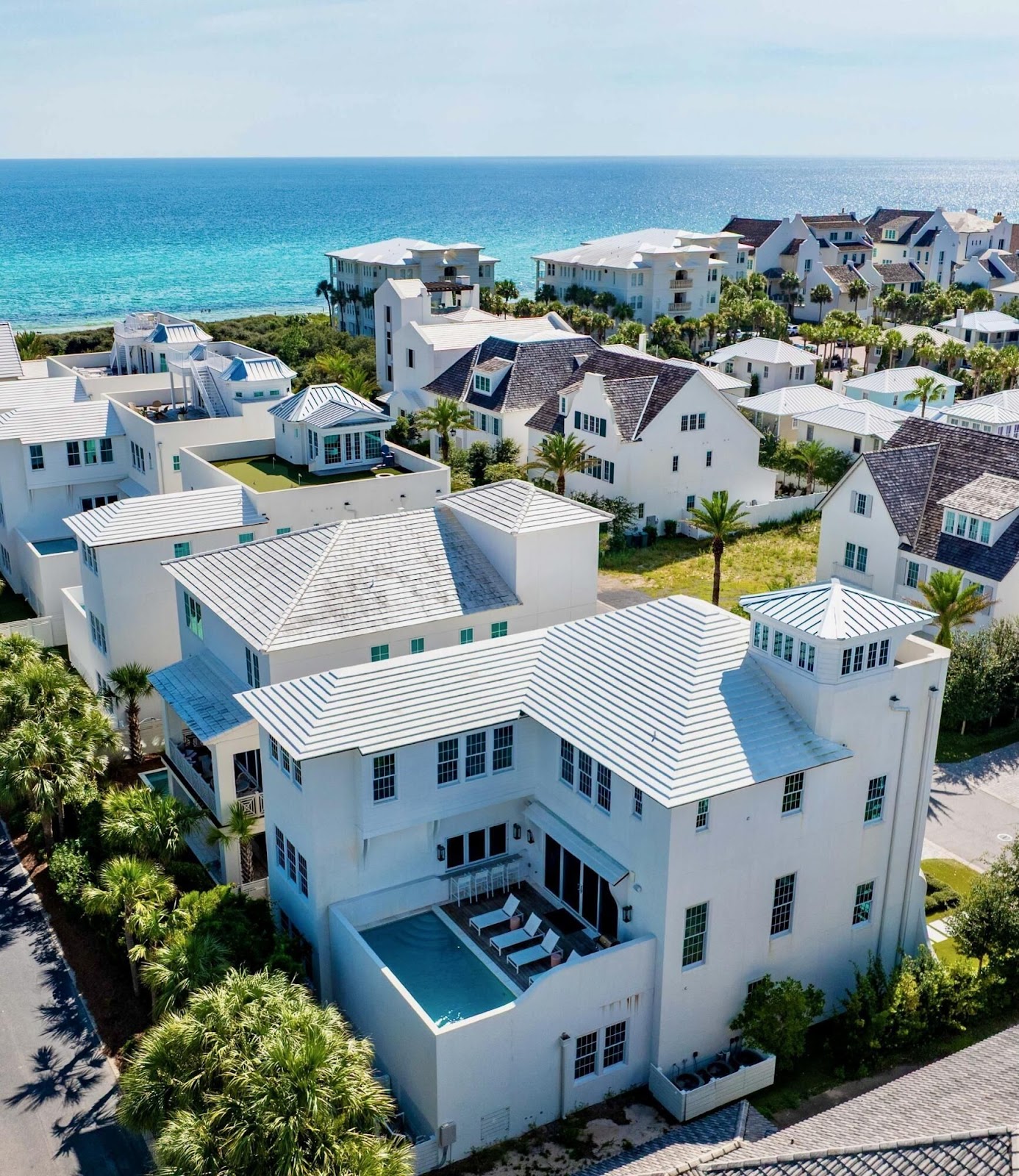
The beach access at Rosemary Beach is organised through a series of community beach boardwalks and two main public pavilions, and the community's private pool — one for the north-side residents, one for the beachside — gives owners a pool option even on the days the Gulf surf runs high. The price tier at Rosemary Beach reflects its prestige: per-square-foot values are among the highest on the corridor, and the waiting list for ownership at the top of the market is genuine rather than promotional.
Alys Beach, four miles west along the highway from Rosemary Beach, is the youngest of the major 30A communities — development began in 2004 — and the most architecturally distinctive. The master plan by Marieanne Khoury-Vogt and Erik Vogt draws from Bermudian and Moorish vernacular, with an all-white architectural code (no colour variation is permitted on exterior walls) that gives the community an otherworldly brightness in the Gulf light. Every house in Alys Beach is built around a walled courtyard — an outdoor private space shielded from the street — a typology borrowed from the courtyard houses of Bermuda and the whitewashed villages of Andalusia. The town's layout places pedestrian pathways and private courtyard gardens as the primary circulation network, with cars tucked behind the building frontage in a way that makes the community effectively car-free at its heart. The Alys Beach community has its own beach club, pool and restaurant; the annual Alys Beach Beats music festival each October draws regional and national acts to the amphitheatre at the town's centre.

Best for: buyers who prioritise architectural quality and design coherence above all else — the West Indies-and-Bermudian code of Rosemary Beach and Alys Beach is the most consistently executed on the corridor; design-led couples and families who want the most photographed and most architecturally awarded addresses on 30A; buyers who value the established commercial calendar and cultural depth of Rosemary Beach's main street.
Grayton Beach and Seagrove
Grayton Beach is the oldest community on the 30A corridor and in many ways its emotional anchor — a settlement that pre-dates the New Urbanism entirely, with beach cottages going back to the early twentieth century and the kind of unpretentious, slightly ramshackle character that places which have been loved by generations of locals tend to develop. The community's commercial heart is the Red Bar, a café, bar and live-music venue that has been a 30A institution for three decades and whose eclectic decoration — hand-painted canvases, found objects, fairy lights, mismatched furniture — is the antithesis of the architectural formality of the planned communities to the east. Grayton Beach State Park, immediately adjacent to the community, encompasses Western Lake's western shore, the tallest coastal dune system in Florida, and a beach on the Gulf Islands National Seashore corridor that is consistently rated among the top five beaches in the United States by the Dr. Beach annual rankings. The state park's trails pass through pine flatwoods, dune systems, and the lake shoreline before reaching a beach that has no commercial development in any direction.
Seagrove Beach, immediately east of Seaside, is the residential counterpart to Seaside's commercial character — a quieter, lower-density community of beach cottages and newer beach homes that benefits from immediate walking access to Seaside's restaurants, shops and town square without the peak-season visitor density of Seaside itself. The community has several direct Gulf beach access points and a number of Gulf-front parcels whose scale would not fit within Seaside's architectural code but which deliver the same sugar-white beach access at a slightly quieter pace. Seagrove's price tier typically sits below Seaside and well below Rosemary Beach, which makes it the most accessible entry point to the central corridor for buyers whose primary criterion is Gulf-front proximity rather than architectural brand.
Best for: buyers who value the established bohemian-local character of the original Gulf Coast beach culture over the planned-community formalism of the eastern corridor; families drawn to Grayton Beach State Park and the walking access to Western Lake; buyers seeking central-corridor location adjacent to Seaside's amenities at a lower price tier than the eastern villages.
WaterSound and Inlet Beach
WaterSound, developed by St. Joe Company on the eastern side of the corridor from 2003, is the most architecturally contemporary of the major 30A communities. Its master plan places premium on privacy — larger lots, deeper setbacks, more extensive canopy cover — and its architectural code emphasises board-and-batten and shingle-sided coastal modern rather than the cottage vernacular of Seaside or the whitewashed Caribbean of Rosemary Beach. The community faces Camp Creek Lake, one of the inland dune lakes, on its northern edge, and a private beach club gives WaterSound owners access to a dedicated stretch of Gulf beach. The community's premium tier is among the highest on the corridor, and its larger-lot, more private character suits buyers who value acreage and seclusion over the pedestrian density of the more town-like communities. The WaterSound Origins neighbourhood to the south, developed more recently, adds a mixed-residential character to the broader WaterSound tract, with the Origins Town Center and a Tom Fazio-designed golf course at The Club at WaterSound adding a country-club dimension to the community's offer.
Inlet Beach, at the eastern terminus of the 30A corridor where the highway ends at US-98 and the bridge to Panama City Beach, has changed more rapidly over the past decade than any other 30A community. The arrival of the Pier Park commercial district and the upgrading of the Northwest Florida Beaches International Airport (ECP) have drawn a new generation of residential development to the area, including the 30A Getaway community and a number of premium residential subdivisions on the Gulf side of US-98. The community is the most convenient of the 30A villages for arrivals at ECP — approximately fifteen minutes from the airport terminal — and its Gulf beach access, while sharing the same sugar-white sand as the western communities, is accessed through the area's mix of residential-and-dune rather than the purpose-built town-centre plazas of Seaside and Rosemary Beach.
Best for: buyers who prioritise privacy, lot size and architectural modernity over the pedestrian-scale community living of the more town-like villages; golf-and-country-club buyers who value the WaterSound Club's Tom Fazio course; buyers arriving regularly through ECP who want the shortest possible connection from terminal to beach.
A year in your 30A co-ownership home
Spreading owner nights that carry no set cap across a 30A calendar year requires thought — and one of the underappreciated aspects of this corridor is how genuinely good the shoulder and winter seasons are. The fair-rotation calendar ensures that all co-owners access their share of peak summer weeks, spring break, and the quieter winter months over the ownership period, and the owners who consistently report the highest use-quality from their 30A share are those who use the shoulder seasons with the same enthusiasm as the July peak.
Spring (March–May)
March on 30A opens with the corridor's first major visitor event: Spring Break. The beach communities, by deliberate planning choice, draw a different demographic from the Destin–Fort Walton Beach market to the west — the village character, the architectural codes and the pedestrian scale of Seaside, Rosemary Beach and Alys Beach have historically attracted families and couples rather than the denser party-tourism of more commercialised Gulf destinations — but the Spring Break period from mid-March to early April is genuinely busy, with beach access, town-square dining and bike-path cycling peaking in volume. Daytime temperatures in March run 16–21°C (low-to-mid-60s°F), the Gulf water is cool at around 18–20°C (mid-60s°F), but the bright sunshine and relatively calm Gulf give the beaches a full spring feel. The 30A Songwriters Festival, held in mid-January and extending its programming into spring, is the corridor's most significant cultural event — a four-day music festival across seventeen outdoor and indoor venues in Seaside and the surrounding communities, drawing nationally recognised singer-songwriters and a loyal audience from across the Southeast. Its intimate, beach-side format — artists playing sets on the Seaside amphitheatre stage, in café courtyards, on Beach Club terraces — gives it a character completely different from a standard festival booking, and it is one of the most sought-after weeks on the 30A calendar.
April and May deliver the corridor at its most generous. The Spring Break crowds have dispersed, the daytime temperatures climb into the 22–26°C (low-to-high-70s°F) band, the Gulf water approaches 22–24°C (low 70s°F), and the towns regain the daily rhythm — morning coffee on the Seaside green, midday beach, afternoon bike ride on the Timpoochee Trail, dinner at Bud & Alley's as the sun drops into the Gulf — that long-term devotees identify as the definitive 30A experience. May is consistently named by owners as the month they most want to repeat: the weather is close to ideal, the crowds are light, the restaurants are fully operational, and the Gulf water is warm enough for full swimming through the afternoon. The Grayton Beach State Park trail system through the dune lakes is at its most accessible and least crowded in late April and May, and the coastal dune lakes are at their spring-freshwater peak, with Western Lake and Draper Lake open to paddleboard and kayak from the WaterColor Beach Club and the state park launch points.
Summer (June–August)
June opens the high season on the Emerald Coast. Gulf water temperatures are above 26°C (79°F), the sand is fully white and deep, the beach communities fill with the core of their annual visitor population — primarily Southern US domestic families (Atlanta, Nashville, Birmingham, Charlotte, Dallas), with a growing wave of Midwest and Northeast buyers — and the daily summer rhythm of 30A establishes itself: early morning beach time before the heat builds, midday pool or dune-lake paddling, afternoon town-centre café and shopping, evening sunset on the Gulf terrace. The characteristic weather pattern in June and July involves clear mornings, high humidity building through the afternoon, brief afternoon thundershower activity by 3pm (shorter and less intense than the Miami summer pattern), and a clearing to long warm evenings with the Gulf returning to a flat, deep green. Daytime temperatures run 30–33°C (high 80s°F to low 90s°F), the Gulf sits at 28–30°C (high 80s°F), and the sugar-white sand stays cool underfoot despite the air temperature.
July is the absolute peak — school holidays from across the Southeast and Southwest United States converge on the 30A corridor, the Seaside town square is busy from morning through late evening, the Rosemary Beach farmers market fills the carriage lanes, and the beach access boardwalks queue at the most popular points from mid-morning. For owners who want the full 30A summer-social experience, this is the definitive week — the community pools are alive, the beach clubs at WaterColor and WaterSound are at maximum use, and the town-square music programme at Seaside delivers live performance every weekend through the month. For owners who prefer a quieter stay, late June or the first two weeks of August — when the Fourth of July crowds have dispersed and before the school-closing exodus consolidates — offer summer weather with marginally lighter commercial density. August closes the summer season on the same high note: the Gulf is at its warmest, the evening temperatures stay at 28°C (82°F) until well after dark, and the communities' high-summer restaurant calendar peaks. The Seaside Repertory Theatre, which runs a summer programme from June through August with productions in the outdoor amphitheatre, gives the corridor a genuine performing-arts dimension during the peak season that most American beach communities lack entirely.
Autumn (September–November)
September and October are, for many regulars, the favourite months on 30A. September is officially within the Atlantic hurricane-season peak — and the Gulf of Mexico is not immune to tropical storm activity — but the statistical probability of a direct Panhandle landfall in any given year is low, and the modern residential construction standards mandated by the post-1992 Florida Building Code in South Walton County give the purpose-built beach communities a structural resilience that the older Florida Gulf Coast stock does not share. The practical approach for 30A owners is identical to Miami: monitor the National Hurricane Center forecast, maintain calendar flexibility through the month of September, and rely on the professional management team to handle all preparation, evacuation and recovery coordination on the co-owners' behalf without any owner-side action required. With that understanding, September weeks on 30A are exceptional: Gulf water at 28–29°C (83–85°F), daytime temperatures at a comfortable 28–30°C (82–86°F), the summer crowds gone, the restaurants quieter, and the communities settled into the rhythm their year-round residents value most.
October is the locals' secret. The Alys Beach Beats festival in mid-October draws a devoted regional audience for a long weekend of music on the amphitheatre stage; the 30A Wine Festival, held each October across several community venues, is the corridor's leading food-and-wine event. Daytime temperatures run 22–26°C (low-to-high-70s°F), the Gulf is still above 24°C (75°F), and the afternoon thunderstorm pattern of summer has given way to the dry-air, clear-sky Gulf Coast autumn. The Grayton Beach Arts Festival in October is one of the Southeast's longest-running outdoor art shows, held in the state park's pine grove with juried fine artists and craftspeople exhibiting under the coastal canopy. For owners who can travel flexibly, mid-October to mid-November is the single most rewarding window of the 30A year: warm enough for genuine beach use, dry and clear, fully commercial but no crowds, and the autumn Gulf light — lower and more golden than the summer bleach — makes the sugar-white sand and emerald water its most visually extraordinary.
November is the transition month: daytime temperatures drop toward 17–20°C (low-to-mid-60s°F), the Gulf cools to around 20°C (68°F), the summer population has returned to Atlanta, Nashville and Dallas, and the corridor settles into its quietest mode of the year. For owners who use their 30A share primarily for the summer and autumn peaks, November is typically the month of lowest demand — which, inside the fair-rotation calendar, means it is the month whose weeks are most likely to be available on short notice for flexible owners. The mid-November 30A Songwriters Festival programming calendar creates a second cultural anchor event in the autumn transition window, pairing with the South Walton Beaches Wine & Food Festival as the corridor's two most-cited autumn events among the owner community.
Winter (December–February)
December through February is the 30A corridor's quietest season — and for a certain kind of owner, the most unexpectedly pleasant. Daytime temperatures average 15–18°C (high 50s°F to mid-60s°F) in December and January, with occasional cold fronts dropping overnight temperatures to near freezing for a day or two before the Gulf's thermal mass reasserts the mild baseline. The communities, stripped of their summer and autumn commercial energy, take on a particular quality in winter: the white-stucco fronts of Alys Beach are almost incandescent against the pale December Gulf sky; the Seaside green is empty except for a handful of cyclists; the Rosemary Beach carriage lanes belong entirely to the families who have made the winter long weekend a deliberate choice. The beach in January, while the Gulf is too cool for swimming, is at its most extraordinary visually: the sand white, the water a shifting mosaic of grey-green and turquoise, the sky the washed watercolour blue of the Florida winter, and the beach — one of the widest and deepest on the Panhandle — entirely, pleasurably empty. For owners whose primary home is in the Northeast, Midwest or a European city, a 30A winter week is a genuinely different experience from the summer peak: quieter, more personal, more about the natural character of the coast than the social energy of the communities. The Gulf water running at 15–17°C (59–63°F) in January is cold for swimming but perfectly fine for a long walk on the hardpack sand at low tide.
Christmas and New Year bring a modest return of activity — families with school-age children use the winter school holiday to combine beach and family time, and the communities' restaurants reopen to their full winter calendar for the festive period — but the density never approaches the summer peak, and the beach even at the Christmas-week maximum is uncrowded by any US coastal standard. Owners who allocate a December week often find that the combination of winter-mild beach weather, the community's decorative programming (the Rosemary Beach tree-lighting on the main square, the Seaside outdoor film screenings), and the absence of the summer social calendar makes it the most purely restorative week of the year. The Grayton Beach State Park trails, the dune-lake walking circuits, and the back-bay kayaking from WaterColor's Camp Creek access are all at their most uncrowded and most rewarding in the winter months.
Who buys on 30A, and why
The buyer mix on 30A is distinctively Southern and domestic in its core demographic, with a growing international and Northeast component that reflects the corridor's rising national profile. The dominant domestic buyer cohort is from the Southeast US — Atlanta, Nashville, Birmingham, Charlotte, Raleigh and the broader I-85 / I-65 corridor — buyers who have been driving to the Florida Panhandle for family beach weeks since childhood and who view a second home on 30A as the natural resolution of a long-standing emotional relationship with the coast. This cohort drives to 30A — the corridor is a comfortable four to five hours from Atlanta, five to six hours from Nashville, and six to seven from Charlotte — and the driveable distance is itself a meaningful structural advantage for a fractional second-home: owners who can reach the property in a half-day of driving use their weeks with a spontaneity that long-haul destinations do not encourage. The Midwest (Chicago, Indianapolis, St. Louis, Kansas City), the South Central (Dallas, Houston, Austin) and the Mid-Atlantic (Washington, Baltimore, Richmond) are the secondary domestic cohorts, all reachable by direct flight to the Northwest Florida Beaches International Airport (ECP) in Panama City Beach — approximately fifteen minutes east of the Inlet Beach end of 30A — or by two-stop routing through Atlanta, Dallas or Houston.
The international buyer mix on 30A is smaller but growing, concentrated primarily in British, Canadian and Northern European buyers who have discovered the corridor through family travel to the Southeast US. British buyers — particularly those with existing connections to the Southern US through work, education or family — are drawn to the corridor's combination of Caribbean-quality beach and the civilised architectural scale of the planned communities, which resembles what a very good European resort would look like if you removed the crowds and added an American scale. Canadian buyers, the traditional Florida snowbird base, have historically concentrated on the Atlantic coast (Fort Lauderdale, Naples, Sarasota) and Miami, but the Panhandle's quieter, lower-density character and the non-ironic quality of the beach-community architecture are increasingly drawing Canadian buyers who find the Atlantic and Gulf Coast metro markets too urban. German and Scandinavian buyers, whose domestic second-home markets are constrained by climate and supply, have been arriving in growing numbers over the past decade, drawn by the same quality of beach environment and the corridor's relative lack of the mass-market resort development that makes comparable US beach destinations feel generic.
Fractional ownership on 30A typically suits:
- Southern US families with school-age children — the corridor's combination of driveable proximity, village-scale pedestrian access, Gulf-front beach, bike paths, dune lakes and the community events calendar of Seaside and WaterColor creates a natural family second-home environment that is difficult to replicate elsewhere in the South. The fractional model handles the logistical reality that most families use a beach house for four to eight weeks per year, distributing the carrying cost across eight co-owners rather than concentrating it in one household for fifty-two weeks.
- Design-led couples in their 40s and 50s — buyers drawn to the architectural quality of Rosemary Beach and Alys Beach specifically, who understand the planning history of the New Urbanism, who value the West Indies vernacular and the whitewashed Bermudian codes as seriously designed environments rather than themed resort developments, and who want a second home whose built character is as considered as their primary residence. This cohort is the most overlapping with the European buyer demographic — the cultural literacy about architecture that makes Alys Beach legible as a serious place is the same literacy that draws a French or British buyer to Menorca or a German buyer to Lisbon.
- Gulf Coast repeat visitors building permanence — buyers who have been renting in Seaside, Rosemary Beach or WaterColor for ten or fifteen years and who want to convert a long-standing emotional relationship with the corridor into a property stake. This is one of the most emotionally motivated buyer cohorts in the fractional market anywhere: the buyer is not choosing a destination they don't know, they are formalising a commitment to a place that already has years of family memory attached to it. The fractional model's key advantage for this cohort is that it makes the right address — the community they've been renting in, not the second-tier alternative they could actually afford at whole-ownership level — financially accessible.
- Multi-destination portfolio builders — buyers who already hold, or are building toward, fractional shares in more than one location. The most common 30A pairing is with a ski share in Colorado (Aspen, Vail or Park City for the December–March quarter) or with a Mediterranean share (a Mallorca villa or Costa del Sol apartment for the European summer). The 30A share handles the Southeast US summer and the Gulf autumn; and the ski or Mediterranean share handles the winter and European-summer quarter. The fractional model makes this portfolio strategy practical: two 1/8 shares cost less than either of the equivalent whole properties, and the combined annual carry is still a fraction of what sole ownership of a single comparable property at either address would demand.
- Northeast US snowbird buyers — New York, New Jersey, Connecticut, Massachusetts and Pennsylvania buyers who are seeking a warm-weather winter base in the American South but who find Miami's urban intensity, Fort Lauderdale's condo density, or Naples's country-club uniformity less appealing than the village scale and the beach quality of 30A. The November-through-April mild climate on the Panhandle — average daytime temperatures of 16–22°C (61–72°F) through the winter months, frost-free in all but extreme cold snaps — is genuinely liveable rather than just tolerable, and the community character of Seaside, Rosemary Beach and Alys Beach provides the kind of walkable, human-scale environment that Northeast buyers accustomed to good urban design respond to immediately.
What unites these otherwise quite different profiles is the underlying calculation: the second-home weeks each of them actually uses in a year are within the around six weeks a 1/8 share delivers, and the operational overhead of running a 30A property remotely — hurricane monitoring, property-tax administration, HOA management in the gated communities, the pool maintenance and landscaping demands of a Gulf-coast subtropical environment — is non-trivial for a sole owner who uses the property for eight weeks per year. The fractional model distributes those operational burdens across eight co-owners and outsources the management entirely, turning what can become a second job for a sole owner into a genuinely passive second-home relationship. For buyers who have had experience with whole-ownership of a Florida Gulf Coast property and who have lived the operational reality — the hurricane-shutter preparation, the property manager calls, the HOA compliance letters — the move to fractional ownership resolves the friction they experienced rather than trading it for a different kind.
Practicalities: getting there and what you own
Getting there
Northwest Florida Beaches International Airport (ECP) in Panama City Beach is the primary and most convenient gateway for the 30A corridor, approximately fifteen to twenty minutes by car from the Inlet Beach end of 30A and thirty to forty-five minutes from the central corridor at Seaside and Rosemary Beach. ECP has grown substantially in the past decade, with nonstop scheduled service from Atlanta (ATL), Dallas/Fort Worth (DFW), Houston Intercontinental (IAH), Chicago O'Hare (ORD), Charlotte (CLT), Nashville (BNA), New York JFK, Boston (BOS), Washington Dulles (IAD) and Philadelphia (PHL) operated by American Airlines, Delta, Southwest, United and Spirit, and seasonal charters from the Northeast and Midwest at Spring Break and the July fourth peak. For buyers from the Northeast and Midwest, ECP is a genuinely practical connection: from New York or Chicago, the journey from door to 30A beach is under four hours door-to-door. For buyers from the Southeast, the drive from Atlanta is approximately 4.5 hours via I-85 and I-10, and from Nashville approximately 5.5 hours via I-65 and I-10 — a comfortable half-day drive that a significant share of buyers make as the default mode of arrival.
Destin–Fort Walton Beach Airport (VPS), forty-five minutes west of Rosemary Beach along US-98, adds capacity for the western end of the corridor — American, Delta and Southwest serve Dallas, Houston, Atlanta and Chicago from VPS — and is the natural gateway for buyers based in the western corridor communities. Pensacola International Airport (PNS), approximately ninety minutes west, carries a broader range of domestic connections including nonstop service from New York LaGuardia, Washington National and Charlotte, and serves as the practical international-connection hub for buyers routing through Atlanta or Dallas from European hubs. Direct international connections to the Panhandle are limited — most European buyers route through Atlanta (British Airways, Delta, Virgin Atlantic from London Heathrow, with onward delta connections to ECP or VPS), Dallas (American Airlines from London Heathrow with onward American to ECP) or New York (multiple carriers with onward service) — but the connection is seamless in current airline scheduling, and the total journey time from London to 30A via Atlanta runs approximately eleven to twelve hours door-to-door, comparable to a trans-Atlantic journey to the US East Coast more broadly.
Drive times from ECP to the main communities are straightforward: Inlet Beach and Alys Beach are fifteen to twenty minutes west on US-98 and 30A; Rosemary Beach and Seagrove are twenty-five to thirty-five minutes; Seaside and WaterColor are thirty-five to forty-five minutes; Grayton Beach and Blue Mountain Beach are forty to fifty minutes. Most owners arrive by private transfer from ECP pre-arranged through the property's management team; the fifteen-to-twenty-minute airport transfer from ECP makes the first-arrival experience unusually relaxed by American beach-destination standards.
Whole home or a share — the comparison that matters
The most relevant comparison for a 30A fractional buyer is not a hotel week or a rental property but the alternative forms of holding the same asset: whole ownership versus 1/8 fractional share versus long-term rental. The 30A market operates at a premium tier relative to the broader Panhandle market, with the planned-community addresses in Rosemary Beach, Alys Beach, WaterColor and Seaside trading at meaningful premiums to comparable-quality property outside the planning codes. The fractional model's financial argument is clearest when you look at the side-by-side carrying-cost comparison.
| Whole second home | COP 1/8 fractional share | Long-term rental | |
|---|---|---|---|
| Upfront commitment | Full property value | ~1/8 of the property value | First/last/deposit only |
| Equity in the asset | Full appreciation | ~1/8 of appreciation | None |
| Personal use | Up to 52 weeks (most 30A owners use 4–8) | Around six weeks a year, fairly rotated | Defined by lease |
| Operations burden | Owner-managed or hired staff | Fully included | Landlord-managed |
| Hurricane preparation | Owner-coordinated, every season | Fully handled by management | Landlord's obligation |
The carrying-cost comparison is where the fractional structure makes its most compelling argument for 30A specifically. A whole-property owner on the 30A corridor carries Walton County property tax, full building and wind/hurricane insurance (required and substantially more expensive than standard homeowners' coverage in any Florida coastal zone), HOA fees in the gated planned communities (Rosemary Beach, Alys Beach, WaterColor and WaterSound all have active HOAs with meaningful annual fees), full property-management retainer, pool maintenance, tropical landscaping maintenance (year-round in the Gulf coast subtropical climate), and a maintenance reserve — all for a property they will use, on a realistic estimate, for five to eight weeks per year. A fractional owner pays roughly 1/8 of that consolidated carry, for roughly the same number of weeks of actual use. The mismatch between whole-property carrying costs and whole-property actual usage is arguably more acute on 30A than in any other comparably priced American second-home market, because the dominant buyer cohort — the Atlanta and Nashville family — uses the property intensively for two or three weeks in the summer and sporadically at other points, rather than the multi-month winter-occupancy pattern that makes whole-ownership more defensible in a Miami or Coral Gables context.
What you actually own
Every 30A co-ownership property on COP is shared by you and up to seven other co-owners, each owning a real share of the home. Your share can be sold through our partner's resale process or to any qualifying outside buyer, and can be left to your children under your home jurisdiction's inheritance rules — not a timeshare use-right, not a points club membership, not a holiday-club subscription.
How fractional ownership works in Florida
The mechanics of fractional co-ownership on 30A are governed by three interlocking elements: the legal set-up arranged by our partner for each home, the Florida property-tax and no-state-income-tax framework, and the Walton County Clerk of Courts recording system that provides documentary title to the underlying real estate. Together, these three pieces make for a clear, predictable ownership experience.
What you own: a real share of the 30A home
You own a real share of the home — an eighth, a quarter — not a right to use it. You can sell it, pass it on to your heirs, and it grows in value with the house. Big decisions, such as selling the home or major works, are decided together by the co-owners.
Florida property tax and the no-state-income-tax framework
Florida's structural tax advantage for second-home owners is one of the most significant in the United States, and it applies in full on the 30A corridor. Florida has no state personal income tax — confirmed in the state constitution since 1924, with no state estate tax and no state inheritance tax overlay — and the Florida Department of Revenue generates state revenue through sales tax, property tax and tourism levies rather than income tax. The state tax advantage has driven a consistent wave of domestic buyers from the Northeast and Midwest to Florida second-home markets for decades, and it applies equally to international buyers who are not subject to the state-income-tax question at all (the relevant international tax considerations are at the federal level, not state).
Walton County property tax is the principal annual cost on the 30A property and is administered through the Walton County Property Appraiser. Property tax in Florida is assessed at the just (market) value under a millage-rate system applied by the county; in Walton County, the overall millage rate for residential property without homestead exemption runs at approximately 7–9 mills (millage rates in rural coastal counties are typically lower than in urbanised Miami-Dade), making the Walton County property-tax burden materially lower on a comparable-value property than in Miami-Dade or Palm Beach County. The Homestead Exemption, which reduces taxable value for primary Florida residents and caps annual increases under the Save Our Homes provision, is not available on a second home — the property is not the owners' permanent residence, which is the standard treatment for any Florida second home and is built into the annual carry calculation. The property tax is handled by our partner, and individual co-owners never deal with the county directly. For international buyers, the federal FIRPTA withholding provisions can apply on the sale of a US real-property interest; our partner sets out the tax position for your country before you buy.
Inheritance and transfer
Directly held Florida real estate on the 30A corridor is subject to Florida ancillary probate jurisdiction on the death of the owner, regardless of where the owner is domiciled. Your share passes to your heirs as part of your estate, and our partner sets out exactly how this works for your country before you buy.
The professional management model and how the calendar works
Every 30A property among the homes we list is professionally managed for its full operating life. The management team handles the full operational stack between owner visits: cleaning, linen, maintenance co-ordination, pool servicing, tropical landscaping, HOA liaison, hurricane-preparation protocol from the National Hurricane Center warning issue through the post-storm inspection, scheduling co-ordination between co-owners, and the concierge on call during owner stays. The fair-rotation calendar allocates weeks through a systematic process that ensures every co-owner accesses high-summer weeks, Spring Break, autumn shoulder weeks and winter quieter periods on an equitable basis over the ownership period — no co-owner is permanently allocated only off-peak time, and no co-owner monopolises the July Fourth and July–August peak. The scheduling protocol is documented by our partner; co-owners who wish to exchange weeks with each other can do so through the management platform. The result, from the owner's perspective, is that every arrival is a managed arrival: the property is cleaned, the beds are made, the pool is maintained, the management team is reachable, and the owner's responsibility begins and ends with enjoying the weeks they have been allocated.
The 30A corridor's HOA ecosystem deserves specific mention as one of the management model's most operationally significant elements. The gated communities — Rosemary Beach, Alys Beach, WaterColor, WaterSound — all have active homeowners' associations with architectural review boards, common-area maintenance programmes, beach-club access management, and compliance monitoring for rental and use standards. Managing HOA membership, attending the annual meetings, ensuring architectural compliance and handling the quarterly assessment payments is a meaningful operational burden for a sole owner dealing with it from out of state or from another country. The professional management team running a 30A fractional property handles all of that HOA administration on behalf of the co-owners, with co-owners receiving the outcomes (maintained beach club access, architectural compliance confirmation, annual budget summary) without the administrative overhead.
Resale: how to exit, typical timelines
When you decide to exit your 30A share, a professional resale process is in place, run by our partner, so you can sell your share without having to sell the whole house — whereas whole-property resales at the premium end of the Rosemary Beach and Alys Beach markets typically require six to eighteen months before completing. Shares sell: hundreds of shares in homes like these have already been resold—in just over three months on average, and nearly three in four for more than the owner paid. After a typical first-12-months holding period you set the price, and your co-owners get the first chance to buy. The buyer pool for a 30A fractional share is already familiar with the management framework and the community's character, and the carrying costs of holding a whole 30A property through a slow open-market sale — Walton County property tax, full hurricane insurance, HOA fees, management and maintenance on the full property value — can amount to a significant sum through a twelve-to-eighteen-month wait. For owners who want maximum flexibility on price and process, an open-market sale to any qualifying buyer remains an option; but most owners find the professional process faster, lower-cost and more straightforward.
The full mechanics of fractional ownership across all jurisdictions — usage calendars, exit procedures, rental income treatment, insurance, the transfer on death, the relationship with the management company — are covered in our co-ownership explained guide. For specific 30A property availability, browse the listings in the property grid above, or join our list for new-property alerts as they come to market.
Your ownership at a glance
- Real ownership of the home — a real 1/8 share of the home: transferable, inheritable, and it grows in value with the house. Not a timeshare, not a points membership, not a usage right.
- Fully managed throughout — the management team handles Walton County property taxes, insurance, HOA fees, hurricane preparation, scheduling, pool and landscaping maintenance, linen and the on-call concierge. You arrive, the property is ready.
- Professional resale support — when you decide to exit, our partner's resale process is in place, so you can sell your share without having to sell the whole house — whereas comparable whole-property resales on the 30A corridor typically take six to eighteen months.
- Designed for international portfolios — many owners combine shares across several COP destinations (a 30A Gulf summer share combined with a Colorado ski share, for example).
Questions & Answers
30A Emerald Coast Fractional Ownership — Frequently Asked Questions
Fractional co-ownership on Florida's 30A Emerald Coast gives you a real 1/8 share of a luxury beach home along this extraordinary stretch of Florida Panhandle coastline — in Rosemary Beach, Alys Beach, Seaside, WaterColor, or Grayton Beach. The legal set-up is arranged by our partner for each home and walked through with you before you buy. Your 1/8 share is genuine property equity — around six weeks per year on one of America's most beautiful and architecturally distinctive beach destinations.
30A (State Road 30A) runs through a series of carefully planned beach communities along the Florida Panhandle's sugar-white sand and emerald-green water coastline — protected by the Grayton Beach State Park and Point Washington State Forest, which permanently prevents the suburban sprawl that characterises much of Florida's Gulf Coast. Alys Beach's white stucco architecture, Rosemary Beach's New Urbanist design, and Seaside (the town made famous as the set of The Truman Show) have created a destination that attracts a highly affluent, design-conscious American buyer and visitor. Vacation rental rates on 30A are among the highest in the Southeast USA.
Your 1/8 share gives you around six weeks per year. 30A's peak season runs Memorial Day through Labor Day (late May–early September), with the summer beach season the most popular period. Spring Break (March–April) is also in high demand. A structured calendar manages peak summer allocations through a fair rotating priority system.
Yes — many of our 30A Emerald Coast properties welcome short-term rental of unused weeks, and it is an easy way to earn from the weeks you are not using. Your unused weeks can be listed on short-term rental platforms, with income paid directly to you after the platform fee — particularly rewarding in high-demand locations.
Each 30A Emerald Coast property listing shows whether short-term rental is available for that home, in line with local rules.
30A has been one of the USA's fastest-appreciating coastal markets over the past decade, driven by the state forest land that permanently prevents competitive new supply alongside the existing communities, growing national recognition, and consistent strong rental demand. The planned communities' architectural controls protect aesthetic quality and keep the coast's beautiful, low-rise character.
Selling is simple. When you decide to move on, your 30A Emerald Coast fractional share is marketed to buyers already looking for fractional co-ownership.
Our partner's resale process handles the sale for you, so you sell your share without the whole house having to be sold. After a typical first-12-months holding period you can sell whenever you choose, at the price you set — your co-owners get the first chance to buy. Hundreds of shares in homes like these have already been resold — in just over three months on average, and nearly three in four for more than the owner paid.
Browse COP's 30A listings, review the 1/8 share price and submit an enquiry.
Also Explore
Get in Touch
Speak to an expert
Tell us what you're looking for and we'll be in touch.