Co-Ownership Basics
The Annual Management Fee Explained: Everything Your Co-Ownership Property Costs to Run
A single consolidated charge, six transparent categories, and a figure that compares favourably to almost every alternative in luxury property — the annual management fee is the financial architecture of co-ownership, explained in full.
It arrives in late January, as it does every year — a single email from the management company with the annual accounts attached. The PDF runs to four pages. Page one is the summary: a single figure, the co-owner's one-eighth share of the year's running costs, broken into six line items with brief explanations beside each. Page two is the full-property account, showing what the entire LLC spent across the twelve months. Page three is the maintenance log — a record of every repair, scheduled service and seasonal preparation carried out at the property during the year. Page four is next year's budget forecast, with any planned capital expenditure flagged for co-owner discussion. The co-owner reads it over coffee, replies with two questions about a planned terrace reseal, and closes the laptop. This is the annual financial administration of co-ownership. It takes, on average, about twenty minutes.
The full-ownership equivalent of that morning is not a single email. It is a folder — physical or digital — of approximately forty documents: pool contractor invoices, the gardener's monthly bills from April to October, the insurance renewal from a broker who communicates exclusively by post, the taxe foncière notice from the French tax authority in an envelope that almost went in the recycling, the plumber's quote for the shower valve that failed in November when nobody was in the country, the management company's invoice for the emergency call-out, and the annual utility reconciliations that reveal the electricity direct debit has been set at the wrong amount for fourteen months. Full owners spend considerable time and mental energy managing not the property but the paper trail of the property. The core promise of co-ownership is not the shared entry price. It is the shared overhead — and understanding precisely what that overhead consists of is the starting point for any serious buyer. Our how it works guide explains the structure end-to-end, but this post goes deeper into the annual cost categories specifically.
The Six Categories of Running Costs
The management fee in a co-ownership property is not a single opaque charge. It is a consolidated presentation of costs that every property of this kind incurs — whether fully owned, rented out, or shared. Most co-ownership operators structure the annual charge around six primary categories: insurance, local property taxes, property management, housekeeping and changeover, pool and garden maintenance, and a maintenance reserve. Each of these exists in any well-run holiday home. The difference is that in co-ownership, each is handled by professionals, paid from a shared account, and reported transparently. The co-owner sees the total and their proportional share. They are not personally managing the relationships, the invoices, or the contingencies.
Insurance for a quality holiday property — one with a pool, a significant land area, and a replacement value above €500,000 — is not a commodity purchase. Premiums have risen materially across Southern Europe and the Alpine markets over the past several years, driven by increased climate-risk underwriting, rising construction costs for replacement calculation, and the withdrawal of some insurers from high-exposure coastal zones. A comprehensive buildings-and-contents policy for a quality Tuscan farmhouse or a Mallorcan villa with pool — covering all risks, third-party liability, pool liability, and structural defect — typically runs in the range of €2,500 to €5,000 per year for the full property. An eighth-share owner's contribution to that cost is €310 to €625 annually, a fraction of what the same person would pay as sole owner at the same coverage level.
Property taxes vary by jurisdiction but are unavoidable in every market where quality co-ownership properties are found. In Spain, the IBI (Impuesto sobre Bienes Inmuebles) is levied annually by the municipality on the cadastral value of the property, typically at rates between 0.4 and 1.1 per cent of that value. In France, the taxe foncière applies to all property owners and is calculated on a notional rental value set by the local authority. In Italy, the IMU (Imposta Municipale Unica) applies to second homes at rates set by each municipality, typically between 0.76 and 1.06 per cent of the declared fiscal value. These taxes are predictable, annual and wholly unavoidable — and in co-ownership, they are split proportionally. For a mid-range property in any of these markets, the one-eighth share of the applicable tax bill typically amounts to €400 to €1,200 per year per share, depending on the jurisdiction, the property value, and the applicable rate.
Property management covers the professional oversight of the home throughout the year: maintenance scheduling, contractor management, insurance renewals, regulatory compliance, utility management, and the day-to-day point of contact for co-owners, their guests and local service providers. For a quality holiday property managed by a specialist company, this typically amounts to 10 to 15 per cent of total annual running costs. As a standalone figure, it runs roughly €2,500 to €5,000 for the full property depending on size and location; the eighth-share contribution is €310 to €625 per year. This is the category that most underestimates first-time buyers of full holiday homes. The management company does not just field calls. It coordinates the pool contractor, books the gardener's quarterly visits, arranges the boiler service before each winter, manages the key handover for every arrival and departure, and deals with every administrative obligation — planning permissions, utility supplier queries, neighbour relations — in the local language. Outsourcing this to professionals costs money. Doing it yourself, from another country, in a second language, costs more — and takes considerably longer.
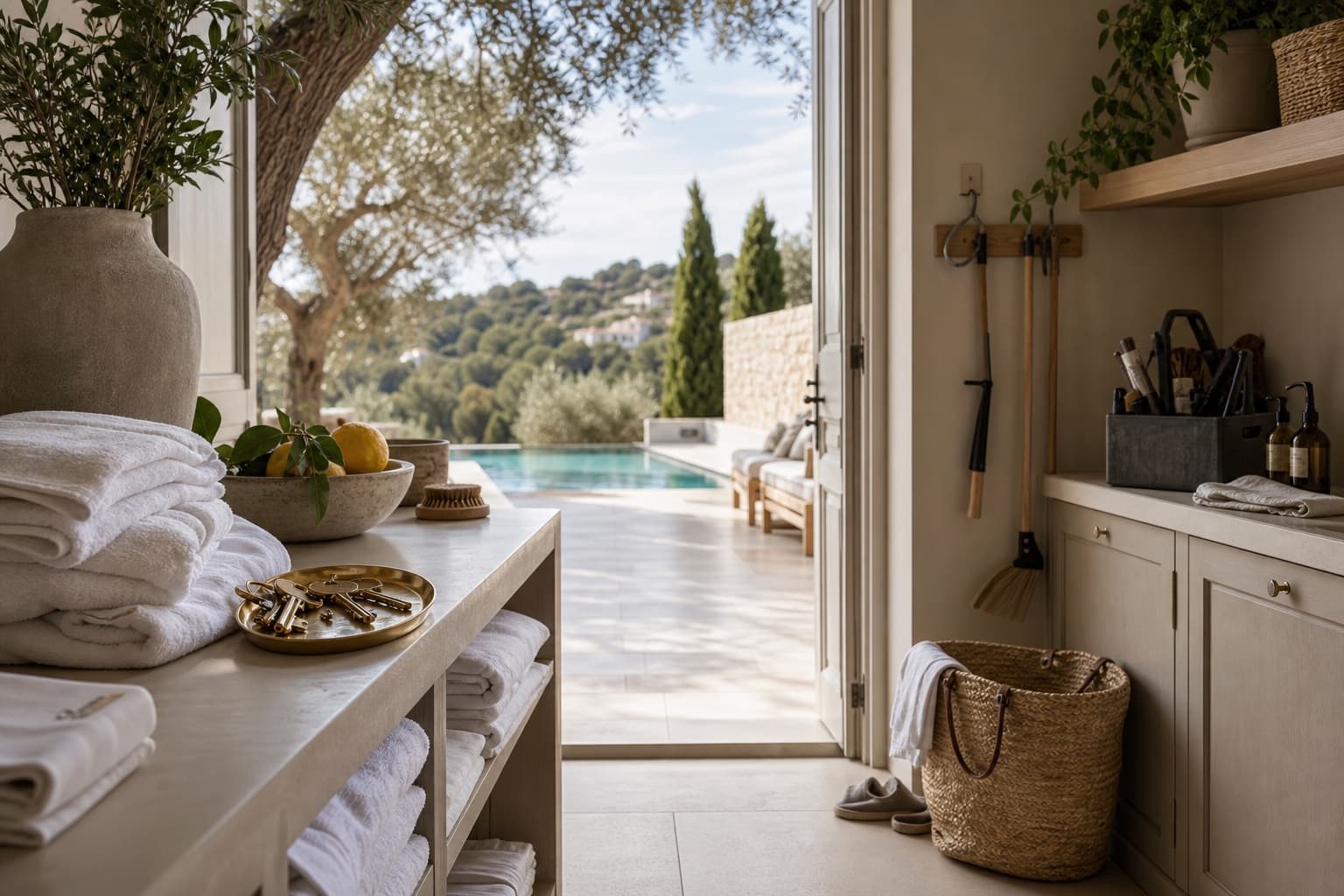
Housekeeping and changeover covers the professional clean and preparation of the property between each occupancy. In a co-ownership structure with eight owners, changeover events occur with some regularity across the year — and the quality of each arrival depends entirely on the quality of the preceding changeover. A thorough changeover for a four-bedroom villa with pool covers the full clean, fresh linens throughout, pool check and chemical adjustment, garden inspection and tidy, welcome preparation, and an inventory review. Depending on property size and location, the cost per changeover runs from approximately €200 to €450. Across a full year of eight-owner occupancy and any intervening maintenance-access periods, total annual housekeeping costs for the full property typically run €3,000 to €6,000. The eighth-share contribution is €375 to €750 per year. This is the cost that makes the arrival experience possible — the property freshly prepared, the pool ready, the basics in the fridge as requested. It is also the cost that full holiday-home owners either absorb personally or pay for at considerably higher per-event rates than a volume management arrangement secures. For more on the arrival experience, see our staying-in FAQs.
Pool and garden maintenance is the category that most surprises full property buyers when they see their first year's invoices. A pool used across a long Mediterranean or Alpine summer requires weekly water quality checks, chemical dosing, equipment servicing, seasonal opening and closing procedures, and periodic filter and pump maintenance. A garden with mature planting, lawn and hedging requires scheduled visits throughout the growing season — typically monthly at minimum, fortnightly through spring and early summer. Combined pool and garden maintenance for a quality four-to-five bedroom property with pool in Spain, France or Italy runs from approximately €4,000 to €9,000 per year for the full property. The eighth-share owner's annual contribution is €500 to €1,125. Spread across a year in which they are visiting the property for around 44 days, this averages to between €11 and €25 per day of usage — a line item that looks very different against the alternative of renting comparable properties per night.
The Maintenance Reserve — the Cost Every Full Owner Gets Wrong
The maintenance reserve — sometimes called the sinking fund — is the category that catches more holiday-home buyers off guard than any other, not because it is unusual, but because it is unfamiliar to buyers coming from a primary residential background. It is a proportion of the annual budget set aside as a capital reserve, to fund non-recurring but entirely predictable expenditure: a roof repair in eight years, a boiler replacement in five, a terrace reseal in three, a set of pool heating coils at some point. These are not emergencies. They are scheduled capital events that any property will require as it ages, and that prudent management anticipates rather than defers until they become urgent. Most co-ownership operators set the maintenance reserve at 10 to 20 per cent of total annual running costs, which typically equates to €1,500 to €3,500 for the full property in a standard year. The eighth-share contribution is €188 to €438 annually.
This is not a charge that disappears into an operator's margin. It accumulates in a ring-fenced account held within the LLC structure and is spent on the property itself — and only the property. When the roof is eventually repaired or the pool heat pump replaced, co-owners are not presented with a surprise special levy. The reserve was already there, already funded, by the proportional annual contributions of all eight owners. Full holiday-home owners accumulate the same capital need but, without the discipline of a managed reserve, tend to meet it in the worst possible way: an emergency repair commissioned at short notice, in a language they are not fully confident in, from a contractor they have not used before, with no established benchmark for fair pricing. The maintenance reserve, viewed properly, is not an additional cost. It is structural financial protection.
The Total, and What It Means in Practice
Adding the six categories together — insurance, property taxes, property management, housekeeping and changeover, pool and garden maintenance, and maintenance reserve — gives a full-property annual running cost for a quality three-to-five bedroom Mediterranean or Alpine holiday home of approximately €18,000 to €32,000 per year, depending on size, location, age and specification. An eighth-share owner's annual contribution falls in the range of €2,250 to €4,000. This is the figure that appears on page one of the January accounts email. And this is the figure that, in the experience of most co-ownership buyers, looks different from every expectation formed during a decade of owning — or thinking about owning — a holiday home outright. Our buying FAQs address cost structure in depth and are a good starting point for buyers doing the detailed comparison.
For context: two weeks in a rented luxury villa in Mallorca, Tuscany or the French Riviera during the summer season typically costs €5,000 to €12,000 for the rental alone, before flights, food or activities. A co-ownership share delivers 44 to 45 days of comparable quality for an annual management fee that is, in most cases, less than the cost of a single high-season fortnight in a rented equivalent — and which comes with deeded ownership in an asset, a property you know and return to, and an experience that is categorically different from checking in as a tourist. Our broader analysis of the true cost of full second-home ownership explores this comparison in detail, including the purchase price, stamp duty, and legal costs that rarely feature in the initial decision.
How Costs Are Approved and What Transparency Looks Like
The co-ownership agreement that underpins every property sets out the governance around costs explicitly. The management company presents the annual budget for the forthcoming year to all eight co-owners before it is committed. Co-owners have the right to review and query any line item. Material single expenditures above an agreed threshold — typically €2,000 to €3,000 — require a co-owner vote rather than unilateral management action. The sinking fund balance and the full annual accounts are presented transparently, and any co-owner can request the underlying invoices for any cost category at any time. This is not a system where the management company charges what it likes and sends a total at the end of the year. It is a structured, documented, co-owner-visible financial arrangement — and the governance behind it is one of the core distinctions between a properly structured co-ownership and a timeshare, where running costs are often set at arbitrary levels, rise without meaningful co-owner recourse, and cover expenses that are difficult or impossible to audit.
What the Management Fee Is Not
The management fee is sometimes confused, by first-time buyers, with two things it is not. The first is a hospitality service charge — a discretionary premium levied for the quality of experience, akin to the resort fee on a hotel bill. It is not that. Every line item in the annual fee represents a real, verifiable cost that the property incurs regardless of whether it is co-owned, fully owned or empty. The pool costs what it costs to run. The property taxes are set by the municipality. The insurance is quoted by the insurer at the market rate. The gardener charges what the local market supports. The management company is not extracting margin from these costs — it is managing them professionally, at scale, and presenting them in a single consolidated document that most full owners would consider a significant improvement on their own administrative experience.
The second confusion is with a timeshare maintenance fee, and the confusion is understandable given that both charges arrive annually and both cover the cost of using a holiday property. But the similarities end there. A timeshare maintenance fee is typically set by the operator without co-owner input, rises at a rate the operator determines, covers costs that are grouped together and rarely itemised, and is attached to an interest — the right to use a property for a specified period each year — that cannot be independently sold or valued in an open market. A co-ownership management fee is the inverse of this in every respect: it covers real, verifiable costs; it is governed by a co-owner agreement; it is reported transparently; and it underpins a deeded ownership interest in a specific property that can be resold independently, valued by a surveyor, and held as an asset on a balance sheet.
The Management Fee as the Architecture of the Ownership Experience
The annual management fee, understood correctly, is not a cost to be minimised. It is the mechanism by which a quality property is maintained at the standard that makes the ownership experience worth having — and by which the complexity of operating a luxury holiday home across languages, legal systems, contractor relationships and maintenance cycles is transferred from the individual co-owner to a professional team that handles it efficiently, at scale, and at a fraction of the cost each owner would bear alone. The co-owner's contribution is proportional to their ownership interest, transparent in its composition, and — when measured against the alternatives across the full spectrum from full ownership to luxury rental — one of the better-value propositions available in the premium second-home market.
There is also a less tangible dividend. When the pool contractor, the gardener, the cleaner and the property manager are someone else's professional responsibility, the co-owner arrives at the property not as an employer with outstanding invoices and an overdue maintenance list but as an owner with somewhere to be. The January accounts email that takes twenty minutes to read and close is not a minor administrative convenience. It is what twenty minutes of administrative time means when the alternative is an entire morning reconstructing what a full year of holiday-home ownership actually cost, and whether the numbers make sense, and whether the pool contractor is charging fairly, and whether the insurance broker remembered to update the valuation. That morning — saved, every year — is part of what co-ownership is for.
For buyers who want to understand the specific cost structure of any property currently available through COP — broken down by category, shown for the full property and for an eighth share — the detail is covered in our buying FAQs, in the how it works section, and directly with our team for properties of serious interest. Browse the current listings across our homes in Mallorca, Tuscany, Provence and the Alps, or speak with our team to walk through a specific property's annual management fee, line by line, before you commit to anything.
More from Co-Ownership Property

Kontakt aufnehmen
Sprechen Sie mit einem Experten
Sagen Sie uns, wonach Sie suchen, und einer unserer Miteigentums-Spezialisten meldet sich innerhalb von 24 Stunden bei Ihnen.