Properties & Destinations
Thirty Miles Out to Sea: Why Nantucket Is America's Ultimate Scarcity Market — and How Co-Ownership Opens It in 2026
Four decades of deliberate scarcity have turned an island thirty miles offshore into one of America's most expensive property markets — and made a one-eighth share the most rational way through the door.
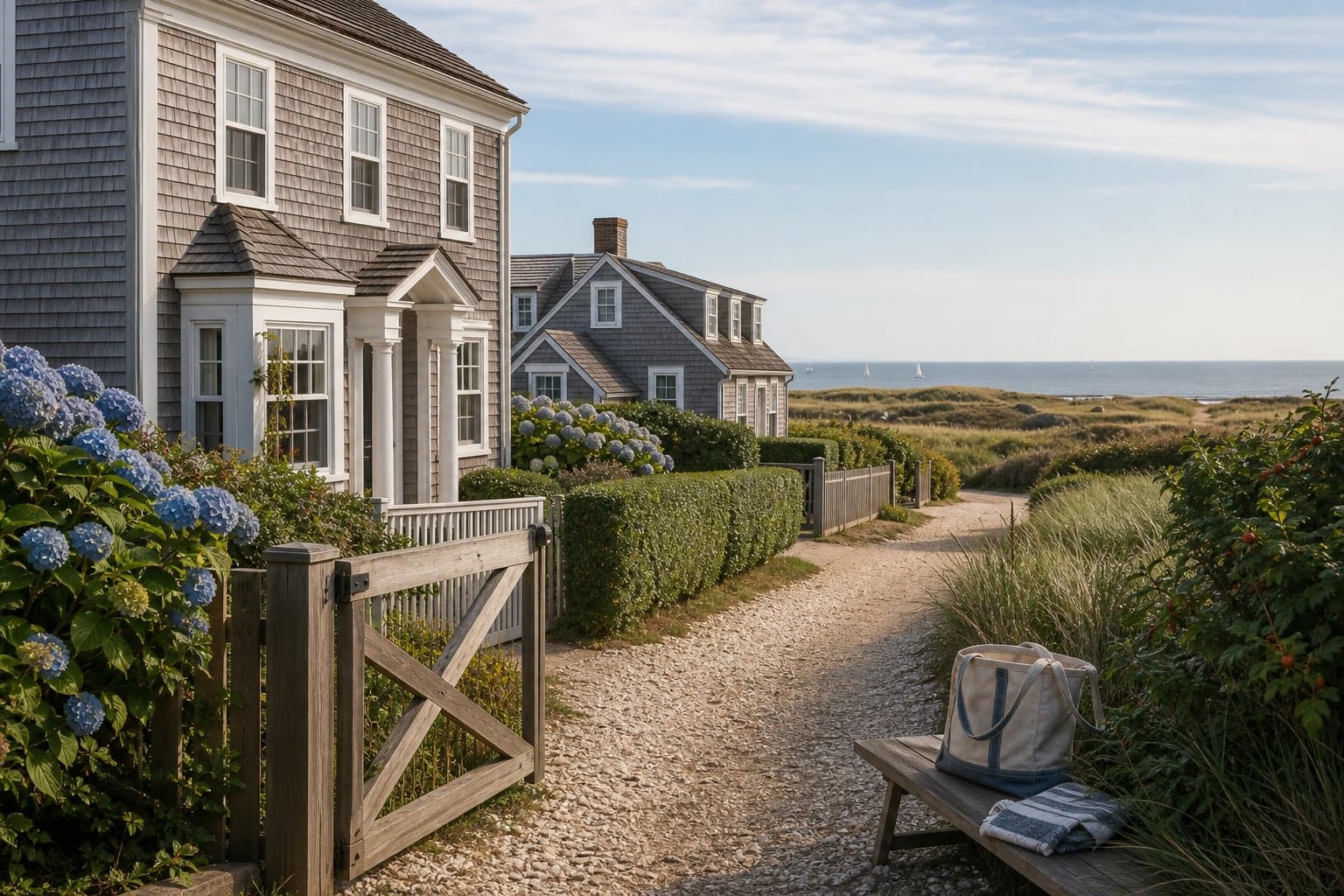
The largest National Historic Landmark district in the contiguous United States is not a neighbourhood of Boston, a quarter of New Orleans or a square mile of Washington. It is an island thirty miles out in the Atlantic, and the designation covers every acre of it — more than 30,000 acres of gray-shingled town, moorland, cranberry bog and beach, first listed in 1966 and extended in 1975 to take in the whole of Nantucket along with its satellite islands, Tuckernuck and Muskeget. The designation ratified something the island had already decided about itself. When the whaling economy collapsed in the middle of the nineteenth century, Nantucket was left too poor to rebuild, and the Federal-era town that whale oil built simply stood still. What poverty preserved, prosperity now polices: no place in America defends its own scarcity with more discipline, and no market rewards that discipline more generously.
The numbers describe the consequence. In 2025 the island recorded approximately $1.75 billion in sales across 406 transactions, with the median sale price settling near $3.3 million and the average approaching $4.7 million — a median that has nearly doubled since 2020. Roughly 14,000 people live on Nantucket year-round; in summer the population swells toward 80,000, and the houses that absorb that swell change hands rarely and expensively. For an international buyer, this is the familiar prime-market paradox in its purest form: the qualities that make the island irresistible — the protected moors, the unbroken shingle vernacular, the boat-or-plane remoteness — are precisely the qualities that make whole ownership punishing. Co-ownership, in the form COP structures it — one-eighth of a fully managed home through a dedicated LLC, alongside seven other vetted co-owners, with roughly 44 to 45 days of use a year — was built for exactly this kind of market. The mechanics are set out in our how it works guide, and COP's current Nantucket listing — a seven-bedroom compound with a main house, separate guest house, infinity pool and home cinema — makes the arithmetic concrete at $1,500,000 per one-eighth share.
The Anatomy of Scarcity: How an Island Engineered Its Own Shortage
Nantucket's supply constraint is not an accident of geography alone; it is policy, layered patiently over four decades. The Nantucket Islands Land Bank — the first institution of its kind in the United States — levies a 2 per cent fee on most real estate transfers and uses the proceeds to buy land out of the development pipeline permanently. It has acquired more than 3,400 acres on its own account, and together with the island's private conservation organisations, most prominently the Nantucket Conservation Foundation, it has helped place nearly half the island into permanently protected open space. Every transaction on the island, in other words, funds the removal of future supply. It is difficult to design a more elegant scarcity machine.
What conservation does to the land, regulation does to the buildings. The island's Historic District Commission — one of the oldest in the country — reviews the exterior of essentially every structure on the island, which is why Nantucket reads as a single, coherent composition of weathered gray cedar shingle, white trim and clamshell drives from the ferry dock to the outermost moor. Nothing about this uniformity is quaint accident; it is enforced aesthetic law, and it functions economically as a quality floor. A buyer on Nantucket is not just buying a house. They are buying into a covenant that every neighbour, in perpetuity, will maintain the same standard. Markets price covenants like that, and on Nantucket the price is now the highest median in the island's history.
The Nantucket Year: Why August Is Not the Whole Story
The island the visitor knows runs from Memorial Day to Labor Day — the Figawi race weekend filling the harbour with sails in late May, the June weddings, the crush of August when the population is at its seasonal peak and a dinner reservation in town is a competitive sport. That season is glorious and it is also, for owners, the least interesting part of the year. The Atlantic around Nantucket holds its warmth long after the crowds leave: September is the finest swimming month on the island, the light turns amber over the moors as the huckleberry and bayberry redden, and the striped-bass fall run brings the surfcasters out to Great Point. October opens the scalloping season, and the harbour fills with working boats rather than visiting ones.
Then comes the island's most distinctive ritual: the Christmas Stroll in early December, when Main Street's cobbles fill with carolers and the whole town performs a Victorian winter for itself, followed by the deep quiet of January and February — the version of Nantucket that year-rounders guard jealously — and the Daffodil Festival in late April, when more than a million bulbs bloom along the roadsides and a parade of antique cars runs out to 'Sconset. A one-eighth share, with its 44 to 45 days spread across the calendar, is arguably the only ownership format that matches how this island actually rewards presence: a family fortnight in July, the September water, a Stroll weekend, daffodils in April. How owners schedule those stays — and how the calendar stays fair across eight households — is covered in our staying FAQs.
What a Typical Week Looks Like
The week begins on the water or above it — the fast ferry from Hyannis takes about an hour; the small planes from Boston and, in season, New York take less. What it does not begin with is logistics. The house has been opened, cleaned and provisioned by the management company before the boat docks; the pool is at temperature, the bikes are pumped, the fridge holds what was requested a week earlier. This is the categorical difference between arriving as a co-owner and arriving as a renter on changeover Saturday: nothing about the first afternoon is spent acquiring the house. It is already yours — deeded, on the LLC's books, your name in the company — and the week starts at the beach rather than at the key-safe.
The days assemble themselves from a small number of perfect components. A morning ride out the Milestone bike path to 'Sconset, where the fishermen's cottages disappear under climbing roses in July and the walk along the Bluff runs beneath Sankaty Head light. An afternoon at Surfside with the Atlantic rollers, or on the calmer harbour side at Jetties with small children. An evening at Cisco Brewers among half the island, or a table in town where the raw bar was on a boat that morning. Nothing on this list is exotic. That is the point. Nantucket's luxury is not novelty but repetition — the same handful of rituals, polished by return visits into something that feels less like holidaying and more like belonging.
The home anchoring COP's presence on the island suits that rhythm precisely. Set on a quiet cul-de-sac near Caton Circle, close to the bike paths and an easy run into town, the compound pairs a three-storey main house with a separate guest house — the configuration that matters most on an island where every owner becomes, in July, a host. Four king suites, two further queen rooms and a dedicated home cinema absorb three generations without friction; outside, the infinity pool and hot tub hold the household on the nights nobody can face competing for a reservation. It is, in short, a house built for the specific sociology of Nantucket summers: full, multigenerational, and centred on the garden from four in the afternoon onward.
The Management Reality: Owning Thirty Miles Out to Sea
Whole ownership on an island is whole ownership with a multiplier. Every trade is scarce and booked out a season ahead; every material arrives by boat; every house must be professionally opened in spring and closed against the winter, when nor'easters test roofs and irrigation lines in the owner's absence. Nantucket has evolved an entire caretaker economy around absentee whole-owners precisely because the island punishes neglect. The co-ownership structure absorbs all of it. The management company appointed by the LLC handles the caretaking calendar, the contractor relationships, the storm inspections, the insurance renewals and the pool contract; owners receive a single annual account and pay one-eighth of the running costs rather than carrying an island household alone. The question of what those obligations look like line by line — and what happens at resale — is addressed in our buying FAQs.
The Market in 2026: Records, Resolution and the Rental Question
The 2025 numbers marked a reacceleration rather than a plateau: transactions passed 400 for the first time since 2021, every segment of the market posted double-digit growth in activity, and the median kept climbing even as volume returned. The structural story underneath is unchanged — a fixed island, nearly half of it off the market forever, meeting demand from Boston, New York and increasingly international wealth. Nantucket also spent the last five years fighting about the one thing that could have changed its character: short-term rentals. A Massachusetts Land Court ruling in June 2025 threw the legality of investor short-term letting into doubt, and in November 2025 a special town meeting settled the matter, voting roughly 71 per cent in favour of recognising short-term rentals as a permitted use across residential districts.
For a co-ownership buyer, the correct reading of that saga is not about rental income at all. It is that five years of regulatory whiplash — bylaws proposed, defeated, litigated and finally resolved at the ballot — never once touched the personal-use owner. A one-eighth share used by its owner sidesteps the entire category of short-term-rental risk that now shadows second-home markets from Barcelona to Lisbon to, until last November, Nantucket itself. European buyers weighing an American purchase should also read our guide to the US tax questions that matter before signing — the FIRPTA and estate-tax arithmetic differs meaningfully from a European purchase, and it rewards being understood early.
The Co-Ownership Case for Nantucket
The case for co-owning on Nantucket is, at bottom, a usage argument wearing a financial one. The median whole house now costs around $3.3 million and buys a fraction of the island's best living; the island's best living — the compound with room for everyone, the pool, the guest house, the short run to town — trades far above it, at price points that make sense only for buyers who will genuinely use what they own. Almost nobody uses a Nantucket house year-round except the islanders themselves. What an owner actually consumes is five or six visits across the seasons: the July fortnight, the September water, the Stroll, the daffodils. A one-eighth share prices exactly that consumption, removes the caretaking economy from the owner's ledger, and still delivers the thing that no rental ever has — the return, year after year, to a house that knows you. Over time that pattern stops feeling like a holiday and starts feeling like what it is: a second life, thirty miles out to sea.
See the home behind this guide. Explore the current Nantucket co-ownership share, browse the wider American collection and all our homes, or speak with our team about what is available now.
More from Co-Ownership Property



Kontakt aufnehmen
Sprechen Sie mit einem Experten
Sagen Sie uns, wonach Sie suchen, und einer unserer Miteigentums-Spezialisten meldet sich innerhalb von 24 Stunden bei Ihnen.