Properties & Destinations
Owning Paris on the Left Bank: Why the 6th and 7th Arrondissements Are 2026's Smartest Co-Ownership Move
Saint-Germain-des-Prés, the Latin Quarter, the Eiffel Tower, Invalides — the most coveted neighbourhoods in Paris are now accessible from around $525,000 per share, with deeded LLC ownership and zero management headaches.
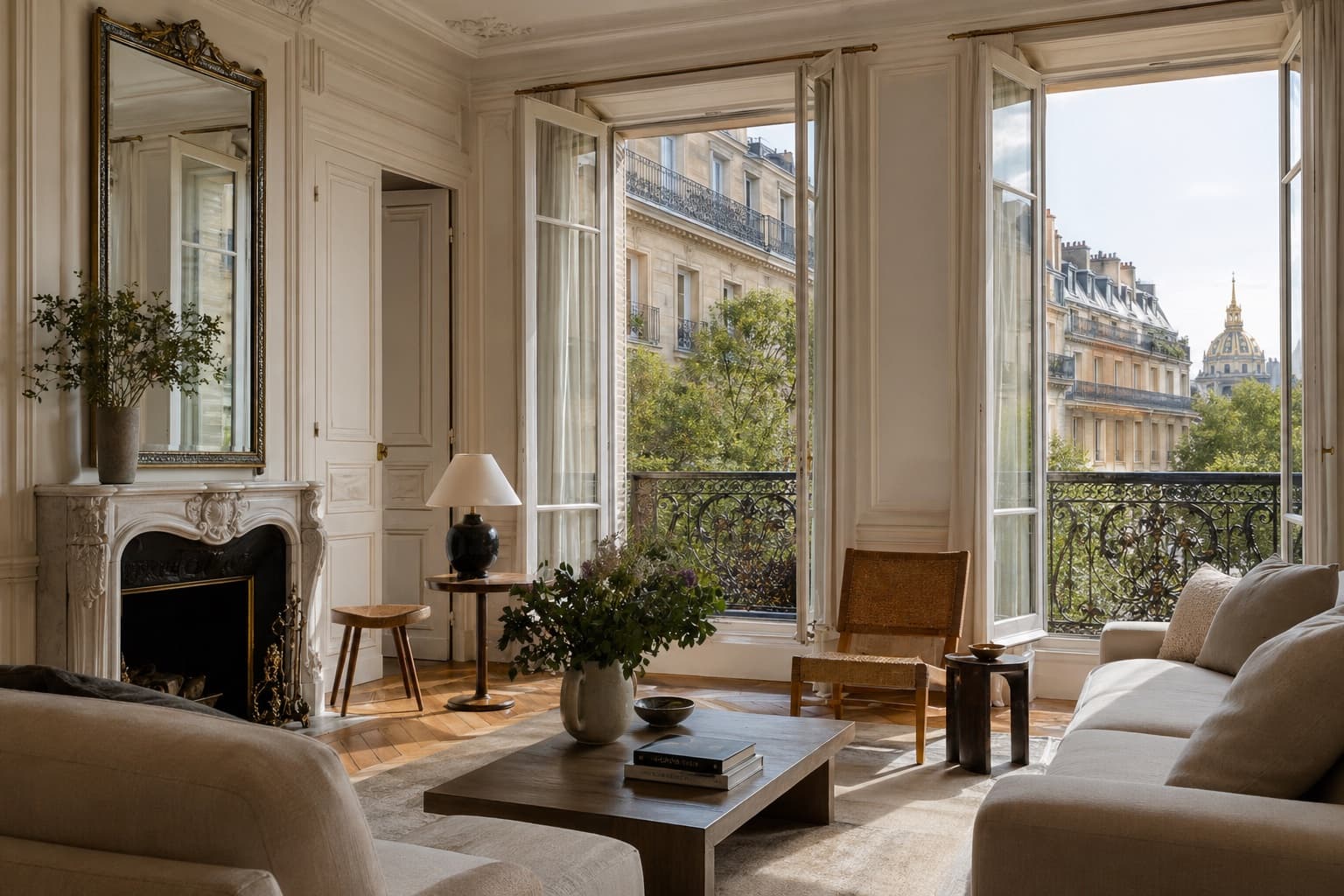
There is a particular kind of buyer who walks into a Paris estate agent on the Boulevard Saint-Germain in early 2026 and walks out twenty minutes later, quietly resigned. They have just been told that the two-bedroom apartment they came in to ask about — the one with the original parquet, the working fireplace, and the Haussmannian balcony overlooking a quiet courtyard — is on the market for €4.8 million. They have been told this is fair value. They have been told, more troublingly, that fair value in the 6th arrondissement is no longer drifting predictably upward in line with the broader Paris market. At the prime end — the apartments international luxury buyers actually want — it has been rising by closer to 5 to 7 per cent a year since 2023, even while the rest of central Paris has been correcting.
This is the new Paris property reality. The Left Bank — specifically the 6th and 7th arrondissements, which together form the most coveted residential geography in the capital — has become a market where the apartment a foreign luxury buyer actually wants is no longer reachable through ordinary purchase, even at €5 to €8 million. Banking lawyers, retired surgeons, and family-office principals from London and New York who used to assume Paris was simply a question of “we’ll buy when the time is right” are discovering that the time is no longer right. Or, more precisely, that the price of the time being right has moved beyond the line they drew in their own mental ledger.
Yet the exact apartments those same buyers want — third-floor Haussmann floors in the 6th, hôtel particulier conversions just behind the Esplanade des Invalides, top-floor pieds-à-terre with views toward the Eiffel Tower — are now available to them through a different door. The same buildings, the same neighbourhoods, the same key in the lock. The structural difference is that they are owning one-eighth of the property rather than the whole, alongside seven other vetted owners, with deeded ownership through a property-holding LLC and a professional management company taking care of everything between visits. In our current Paris inventory, that means apartments in the 6th and 7th arrondissements priced from around $525,000 per share — closer to €485,000 — for a 90-square-metre two-bedroom in the heart of Saint-Germain-des-Prés.
This is not a workaround. It is, increasingly, how serious foreign buyers are entering the Paris market in 2026. This piece walks through why the Left Bank specifically rewards co-ownership over almost any other entry route into Paris property, what the 6th and 7th arrondissements actually offer, what your share buys you in real square metres and addresses, and how the legal and tax structure works for non-French buyers. It is meant for the kind of buyer who has already decided that Paris matters to them, but has not yet decided how to get in.
Why the Left Bank, Not the Right
Paris is divided by the Seine into two halves that are, to anyone who has spent meaningful time in the city, almost entirely different places. The Right Bank — the 1st, 8th, 9th, 16th, 17th — is where the corporate Paris lives: the grand boulevards, the luxury retail of Avenue Montaigne, the embassies, the headquarters of CAC 40 companies, the polished Hôtel de Crillon and Plaza Athénée. It is where Paris transacts. The Left Bank — the 5th, 6th, 7th, 14th — is where Paris reads, eats, walks, and lives. Hemingway wrote on the Left Bank. Beauvoir and Sartre argued on the Left Bank. The Sorbonne is on the Left Bank. The bookshops, the small galleries, the tabacs that have not changed their façade since 1953 — all of that lives south of the river.
For a foreign luxury buyer, this distinction matters more than it might seem. A Right Bank apartment is closer to the airport, the financial district, and the major luxury hotels. A Left Bank apartment is closer to the version of Paris that buyer is actually paying to experience. The difference is between owning a base in the city and owning a presence in the culture of the city. Both are legitimate; the second is what most international buyers describe wanting when they articulate, honestly, what brings them to Paris in the first place.
Within the Left Bank, the 6th and 7th arrondissements are the unambiguous prize. The 5th is older and more student-heavy — beautiful, but rougher around the edges in places. The 14th is excellent but more residential and quieter than most international buyers want. The 6th is the literary and gastronomic heart of the Left Bank: Saint-Germain-des-Prés, the Luxembourg Gardens, the Latin Quarter spilling east, the Marché Saint-Germain, Café de Flore on the corner of Boulevard Saint-Germain and Rue Saint-Benoît. The 7th is the diplomatic and aristocratic heart: Invalides, the Esplanade, Musée d’Orsay, the Eiffel Tower at its eastern edge, the rue Cler market, the Faubourg Saint-Germain townhouses where the old French families have lived for three centuries. Between these two arrondissements lies the very specific Paris that is depicted in films, photographs, and the imagined geography most foreign buyers carry in their heads.
The data confirms what the gut suggests, but it has to be read carefully. The Notaires de France figures most often cited in the press are transacted prices — the prices at which deals actually closed, recorded at the Land Registry — not the asking prices that appear on the listings. Asking prices in central Paris typically run 3 to 6 per cent above sold, with that gap widening when sellers test the market and narrowing when motivated owners list to move quickly. With that distinction in mind: the median sold price per square metre in the 6th arrondissement stood at roughly €15,300 to €15,500 in late 2025 and early 2026. The 7th tracks slightly behind, with recent Notaires medians clustering around €14,200 to €14,500 per square metre.
Above those medians sits a distinct super-prime tier that international luxury buyers typically target and that does not appear neatly in the median data. Top-floor apartments with view, hôtel particulier conversions, river-facing Haussmann floors, and exceptional addresses on the most desirable streets in Saint-Germain or near the Tour Eiffel change hands at €22,000 to €30,000 per square metre, often off-market. A 100-square-metre apartment is therefore a €1.5 to €2.2 million proposition at median sold prices, but a €4 to €6 million proposition once you reach the super-prime end — which is precisely where the foreign luxury buyer’s shortlist tends to live.
The 6th and 7th have also been the most resilient of any Paris districts through the 2022 to 2024 correction, holding their value as broader central Paris softened by roughly 10 to 13 per cent. Over a 10-year horizon, capital appreciation in these two arrondissements has run on the order of 30 to 35 per cent, and inventory remains perpetually constrained by Paris’s strict heritage rules.
The 6th Arrondissement: Saint-Germain-des-Prés, the Latin Quarter, and the Luxembourg
To understand the 6th, walk it. Begin at the Place Saint-Sulpice in the late afternoon, with the fountain throwing its long shadow across the pavement. Cross to the Café de la Mairie where Beauvoir worked, then west along the rue Saint-Sulpice toward the rue Bonaparte. Drop south to the Saint-Germain church — the oldest in Paris, parts of it dating to the 6th century — and the cluster of cafés that surrounds it: Les Deux Magots, the Café de Flore, the Brasserie Lipp directly across the boulevard. East from there, the Marché Saint-Germain, then the Odéon and the rue de l’Odéon, where Sylvia Beach kept Shakespeare and Company in the 1920s and James Joyce wrote standing up. Further east, the Luxembourg Gardens — the most beautiful public garden in Europe, by most defensible measures — and the Sénat at its northern edge. South of the gardens, the rue d’Assas, the rue de Rennes, the smaller streets toward Montparnasse.
This is what the 6th arrondissement actually feels like. It is dense, walkable, and entirely defined by light and light-coloured stone. The buildings are predominantly Haussmannian — five to seven storeys, cream limestone façades, ornate iron balconies on the second and fifth floors, mansard zinc roofs in slate grey — but they are interrupted in places by older, narrower 17th- and 18th-century buildings, particularly in the streets behind the Saint-Germain church and along the rue Mazarine. The mix of periods is part of the 6th’s signature; an apartment from 1750 sits next to an apartment from 1865 sits next to an apartment from 1923, each with its own ceiling height and floor plan and pattern of light.
For a foreign buyer, the 6th is also defined by what is missing. There are very few high-rises. There are no shopping malls. There is no cluster of corporate office towers. The dominant retail is independent: bookshops, small galleries, ateliers, traditional tabacs, the great Poilâne bakery on the rue du Cherche-Midi, the chocolatier Patrick Roger on Boulevard Saint-Germain, the small wine merchants and cheese-mongers that have served the same neighbourhood for forty or fifty years. The arrondissement contains some of the finest restaurants in Paris — Allard, Le Comptoir du Relais, La Méditerranée — but its real character is the everyday infrastructure of small shops and markets that allow a resident, even an occasional one, to live a complete life on foot inside a square kilometre.
The current inventory in the 6th includes a 90-square-metre two-bedroom apartment with a working fireplace, listed from approximately $525,000 per share, and several larger two- and three-bedroom apartments in the same arrondissement at share prices through to $879,000. These are buildings within a five- or ten-minute walk of either the Place Saint-Sulpice or the Luxembourg Gardens, with the architectural quality and the floor plans that a buyer would recognise as authentically Parisian. The price per share buys deeded one-eighth ownership through an LLC — the same structure used across the broader portfolio — with annual usage rights that work out to approximately 44 days per year, plus the ability to swap or trade time with the other co-owners through the management platform.
The 7th Arrondissement: Tour Eiffel, Invalides, and the Faubourg
The 7th is the 6th’s older, quieter, more aristocratic neighbour. It is also, by most measures of property value, slightly more expensive at the top end, particularly within the corridor that runs from the Champs-de-Mars eastward through the Invalides to the Musée d’Orsay. This is the geography of state France: the National Assembly, the Hôtel des Invalides where Napoleon is buried, the École Militaire at the eastern end of the Champs-de-Mars, the embassies that line the rue de l’Université and the rue de Grenelle. The architecture is correspondingly grander. The streets are wider. The Haussmannian buildings are more uniformly stately. There are fewer corner cafés and more formal hôtels particuliers — large 18th-century townhouses, often built around interior courtyards, that have been subdivided into very large apartments and that change hands quietly, with little public marketing.
If the 6th is bohemian-aristocratic, the 7th is aristocratic-functional. It is the arrondissement where children of the older French families grew up, where they still go to school at Sainte-Clotilde and the Lycée Victor-Duruy, and where they keep their family apartments through generations. For a foreign buyer, this gives the 7th a character that the 6th does not quite share: a sense of continuity, of a residential infrastructure that has been working the same way for two centuries and that absorbs new arrivals without changing its rhythm.
The day-to-day life of the 7th centres on three poles. The first is the rue Cler, the pedestrian market street between Invalides and the École Militaire, which is the closest thing Paris has to a true daily neighbourhood market: butchers, fishmongers, two excellent cheese shops, a fromager at the corner, two or three good cafés, a Belgian chocolatier, a wine bar that does plates at lunch. The second is the Esplanade des Invalides itself, a vast green expanse running from the river to the dome of the Hôtel des Invalides, where families walk in the late afternoon and where the running paths fill at six on a weekday. The third is the Champs-de-Mars and the foot of the Eiffel Tower — at any hour, in any weather, the most photographed plot of grass in Europe, but for residents simply the place where the children kick a football on Saturday morning.
The current inventory in the 7th includes a 100-square-metre two-bedroom from $695,000 per share and a 130-square-metre two-bedroom from $600,000, both in buildings within five minutes’ walk of the rue Cler or the Champs-de-Mars. The largest is a 171-square-metre three-bedroom apartment listed from $818,000 per share — a property that, at full market value, would be priced in the €5.5 to €6.5 million range and would sit firmly outside the budget of most luxury buyers approaching Paris for the first time. As an eighth share, with everything from utilities to concierge handled centrally, it becomes a different kind of decision.
The Math: How One-Eighth of a Paris Apartment Works
The economics of co-ownership in Paris are not subtle, but they are easy to misunderstand if a buyer comes to them through the lens of timeshare or fractional vacation club, which are entirely different products. A co-ownership share in a Paris apartment is deeded property ownership. It is title to one-eighth of the underlying asset, held inside a property-holding LLC where each co-owner is a member with a fixed and tradeable share. The LLC owns the apartment. The co-owners own the LLC. The deed is registered at the French Land Registry. The share appears on the owner’s personal balance sheet. It is, in the precise legal sense, real-estate ownership — not a club membership, not a usage right, not a points system.
What makes the structure efficient is the cost split. Under the LLC, every operating expense is divided proportionate to ownership share. A one-eighth owner pays one-eighth of the property tax, one-eighth of the management fee, one-eighth of the building service charges and concierge fees, one-eighth of utilities, one-eighth of the maintenance reserve. For a Paris apartment, these annual costs are not trivial: a €5 million property might run €40,000 to €60,000 a year in total ownership costs, including taxe foncière, building charges, insurance, and management. As an eighth share, that becomes €5,000 to €7,500 per year — meaningful, but proportionate, and predictable.
The usage entitlement is structured around 44 days per year per share — roughly six weeks — with allocation handled by a smart-scheduling platform that distributes peak weeks (high summer, Christmas, fashion week, Roland-Garros) fairly across owners over rolling cycles. Most owners use 40 to 44 days; some use less and trade unused time with co-owners or with the wider network of properties through the platform’s swap functionality. For a Paris pied-à-terre, six weeks a year is, in practice, more than most full-property owners actually use their second home in the city. Industry estimates and the agencies that handle these properties put owner occupancy of central-Paris pieds-à-terre at roughly 30 to 50 days per year — a range familiar to anyone who has owned a city second home and tracked their own use honestly. Co-ownership simply matches the usage to the pricing rather than overpaying for time the owner will never use.
The exit mechanism matters. A co-ownership share is a transferable real-estate asset; it can be sold to another qualified buyer, listed on the partner platform’s resale marketplace, gifted to family, or held inside an estate plan. It is not a perpetual club membership. The market for resale shares in prime Paris addresses has been steadily liquid since 2023, with most listed shares clearing within roughly four to six months when priced realistically and at or near the original purchase level. Buyers should plan to hold for at least three years to absorb transaction costs, but the structure does not lock them in indefinitely.
Why Paris Demands Co-Ownership More Than Almost Any Other City
Of all the cities where co-ownership properties are listed, Paris is the one where the case is structurally the strongest. This is not a casual claim. There are three reasons, and they reinforce each other.
The first reason is occupancy. A Paris apartment is the archetypal “idle asset” — a property whose owner uses it for a small fraction of the year and whose value is therefore mostly tied up in time the owner will never spend there. The widely cited figure is that the median second-home apartment in central Paris is occupied for fewer than 50 days per year. This is not a marketing statistic; it appears in Notaires de France data and in research from the Institut Paris Région. Foreign luxury buyers are typically at the lower end of that range, often closer to 30 to 40 days, because Paris is rarely their primary holiday home. They visit for a long weekend in spring, a week around the openings of fashion week, perhaps a stretch in autumn for the gallery openings or the Salon du Chocolat, perhaps Christmas with family. The rest of the year, the apartment is empty. As a financial proposition, this is exactly the inverse of an efficient use of capital.
The second reason is operational complexity. A Paris apartment is more demanding to maintain at a distance than a coastal villa or even a country house. The building itself has a syndic — the French equivalent of a homeowners’ association — with its own meetings, decisions, and budget. The arrondissement has its own administrative quirks. There are mandatory inspections (boilers, gas, electrical). There are seasonal maintenance issues specific to Haussmann apartments: parquet movement, damp in old stone walls, the perennial question of which roof tile has slipped this winter. There are local service providers — the plumber, the electrician, the cleaner, the locksmith — who operate on relationships and language. For a non-French-speaking foreign owner, none of this is impossible, but it is steady, low-grade friction that compounds over years.
The third reason is the cost map. Paris has some of the highest combined holding costs of any major European city. Taxe foncière in the 6th and 7th now averages €22 to €28 per square metre per year. Building charges in a serviced Haussmann building with a guardien run €40 to €70 per square metre. Insurance on a high-value apartment is non-trivial. France’s Impôt sur la Fortune Immobilière (IFI), the wealth tax on real estate, becomes payable once a household’s net real-estate position crosses €1.3 million, with the rate scale then applying from €800,000 upward and rising progressively from 0.5 per cent through 1.5 per cent across the higher tranches. Non-residents are assessed only on French-located real estate, but the threshold and the rate scale otherwise apply the same way. Owning a €5 million Paris apartment outright, even as a non-resident, has a tax footprint that catches many foreign buyers off guard. Owning an eighth share materially reduces — though does not eliminate — that footprint, because each owner is taxed on their share, not on the gross asset.
Stack these three reasons together and Paris is, structurally, a city where co-ownership is not a compromise but a more sensible match between capital, usage, and obligation. The pied-à-terre lifestyle works better when seven other people are paying the boiler bill alongside you.
What You Actually Get for Your Share
The Paris inventory, as of this writing, includes six apartments across the 6th and 7th arrondissements, ranging from 90 to 171 square metres and from $525,000 to $879,000 per one-eighth share. The properties cluster around three price-and-size points, each suited to a different kind of buyer.
At the entry level — share prices from $525,000 to around $600,000, equivalent to roughly €485,000 to €555,000 — the inventory consists of compact two-bedroom apartments of 90 to 130 square metres in either the 6th or the 7th. These are pied-à-terre-scale properties: a generous main bedroom, a second bedroom suitable for guests or a study, an open kitchen-dining-living space of 25 to 40 square metres, and the original architectural features (parquet, mouldings, often a fireplace) that are the reason a buyer chooses Paris in the first place. The 90-square-metre 6th-arrondissement two-bedroom in this band sits within a few minutes’ walk of the Saint-Sulpice church and the Luxembourg Gardens; the 130-square-metre 7th-arrondissement two-bedroom is closer to the Champs-de-Mars and the rue Cler market.
At the mid-tier — share prices from approximately $695,000 to $759,000 — the apartments grow in scale and architectural quality. A 100-square-metre two-bedroom in the 7th in this band typically offers a more generous living-and-dining configuration, sometimes with two-aspect windows and a small balcony. The 6th-arrondissement two-bedroom at $759,000 is a higher-floor property in a building with lift access, in a particularly desirable corner of Saint-Germain-des-Prés. These are the apartments most often chosen by buyers who plan to use the property as a true cultural base — entertaining, hosting friends, and spending the full 44-day annual entitlement.
At the top of the current Paris inventory — share prices from $818,000 to $879,000 — the apartments cross into three-bedroom territory at 142 and 171 square metres. The 171-square-metre 7th-arrondissement three-bedroom is the largest property in the current Paris portfolio: a family-scale apartment with three bedrooms, three full bathrooms, a separate dining room, and the Haussmann floor plan that a 19th-century bourgeois family would recognise. The 142-square-metre 6th-arrondissement three-bedroom is its Left-Bank-bohemian counterpart — slightly more compact, slightly more characterful, and located in the heart of Saint-Germain-des-Prés. Both are properties that a buyer who plans to bring children, grandchildren, or extended family would specifically want.
In every case, the apartments come fully furnished — to a level designed by the partner platform’s interior team, generally drawing on French and Italian furniture houses — with all utilities, building charges, internet, and concierge service running through the management LLC. An owner arriving from London on a Friday evening picks up the keys, the apartment is clean, the linens are fresh, the wifi works, the fridge has been pre-stocked if requested. They leave on Sunday evening, drop the keys in the lockbox, and the management company resets the apartment for the next owner. This is not a small operational difference from owning the whole apartment outright. It is, for many buyers, the central reason for the structure.
The Foreign Buyer’s Reality: SCI, LLC, and the Tax Map
France’s property law makes foreign ownership relatively straightforward in practical terms but complicated in structural terms. A non-resident foreign buyer can purchase Paris property freely, but the structural choices — direct ownership, ownership through a Société Civile Immobilière (SCI), or ownership through a property-holding LLC — have meaningful tax and inheritance consequences.
The SCI is the historically dominant structure for French property ownership by foreigners and by family groups. It is a French civil-law company that holds the property; the buyers hold shares in the SCI. The advantages are significant for inheritance planning under French succession law (which would otherwise apply forced-heirship rules) and for tax structuring. The disadvantages are administrative: an SCI must keep accounts, file annual returns, and convene formal meetings of its shareholders. For a single property held by a single family, the SCI is a well-trodden path; for a property held by eight unrelated co-owners, it becomes administratively heavy.
The LLC structure used by the Paris properties on this platform is designed for the multi-owner case. Each property is held inside its own dedicated LLC; co-owners hold membership interests in that LLC; the LLC, not the individual co-owners, is the registered French property holder. This wrapping has three benefits for the foreign buyer. First, it cleanly separates the property from the personal balance sheet for liability purposes. Second, it allows the management company to handle administrative obligations centrally — French tax filings, annual accounts, mandatory inspections — without each co-owner needing to engage their own French lawyer. Third, it makes the co-ownership share itself a single, transferable instrument that can be sold, gifted, or inherited without re-registering the underlying property at the Land Registry each time.
That said, the foreign buyer does not escape French tax obligations entirely. Each co-owner is liable for their proportionate share of taxe foncière, which is the local property tax, and — if they meet the threshold — for IFI, the French wealth tax on real estate, calculated on their share. Rental income, if the property is ever rented (which is rare in this structure but possible in some LLC arrangements), is taxable in France first under the Franco-American or Franco-British double-tax treaties. Capital gains on the eventual sale of the share are taxable in France under the régime des plus-values immobilières, with reductions for holding period.
For most foreign buyers, the practical implication is that they should expect to file an annual declaration in France — typically handled by the management company’s accountant — and to factor approximately €1,500 to €3,000 per year in tax-administrative cost into their budget, on top of the share of property taxes. This is not a small consideration, but it is a fixed and predictable one. Buyers who want a fuller treatment of the legal structure for foreign property ownership in France, including the SCI vs LLC analysis in more depth, can refer to our detailed guide on the France SCI Property Structure for Foreign Buyers.
Use Cases: Who Buys Paris on the Left Bank
Across the Paris portfolio, four buyer profiles recur with enough consistency that they are worth describing directly. Each tends to choose a slightly different property and a slightly different arrondissement.
The first profile is the cultural pilgrim. This is the buyer for whom Paris is, specifically, an art and ideas city. They visit for the Louvre, the Musée d’Orsay, the Pinault Collection at the Bourse de Commerce, the Centre Pompidou (until it reopens after its 2025–2030 renovation), and the constant rotation of major exhibitions at the Grand Palais and the Jeu de Paume. They typically spend their 44 days in clusters of three or four days, attending vernissages, reading, eating well, and walking the city. This buyer almost always chooses the 6th, often the smaller 90-square-metre two-bedroom, and treats the apartment as a base for cultural intake rather than a venue for entertaining.
The second profile is the empty-nester couple. These are buyers in their late fifties or sixties whose children have left home, who have sold or are about to sell a primary residence in London, Frankfurt, or New York, and who are constructing a portfolio of European bases for the next phase of their lives. Paris is one of two or three cities they want; they may also have a property in Tuscany or on the Côte d’Azur. They tend to choose the 7th, often a mid-tier two- or three-bedroom, because they value the slightly more residential and family-oriented character of Invalides and the Champs-de-Mars. They are also more likely than other profiles to bring grandchildren, which puts a premium on a third bedroom or a sofa-bed configuration.
The third profile is the lifestyle-and-shopping buyer. This is, in a French context, often a buyer travelling alone or with a husband who is a frequent but secondary user. The pattern of use is short, frequent visits — long weekends, four or five days at a stretch — built around fashion-week appointments, Hermès waiting lists, the Bon Marché, and the small ateliers around the rue de Grenelle and rue du Bac. This buyer often prefers the 7th for proximity to the Bon Marché and to the Faubourg Saint-Germain, but the 6th is also common. Apartment size is less important than location and light.
The fourth profile is the remote-working principal. This is a category that has emerged sharply since 2022 — a senior professional, often a partner or principal in their firm, whose work has become genuinely portable and who wants a Paris base that they can use for two or three weeks at a time, working from the apartment in the morning and treating the afternoons as Paris. This buyer almost always wants a third bedroom that can serve as a study, a strong wifi setup, and a building configuration where the apartment is quiet during weekday daytime. This profile tends to gravitate toward the larger three-bedroom properties at the top of the inventory band.
These are not rigid types, and most actual buyers blend two or three of these patterns. But understanding which profile a buyer tilts toward materially affects which Paris property is the right one for them.
The Outlook for Paris Property in 2026 and Beyond
The forces shaping Paris property values over the next five to ten years pull in the same direction, which is upward. Three are particularly important.
The first is the structural supply constraint. Paris central — and particularly the Haussmann core of the 6th and 7th — is, by law, a finished product. New construction within the historic perimeter is essentially nil. The only new supply that comes onto the market is existing stock that is sold by current owners, and owner motivation to sell has been muted through the post-2022 inflation environment, which favours holding over transacting. The result is a tight market: total Paris transaction volume in 2024 hit a 10-year low at roughly 25,000 sales citywide, with the centre — and the 6th and 7th in particular — holding firm on prime pricing even as volume fell elsewhere. This is the classic profile of a market where supply scarcity is structurally locked in.
The second is the post-Olympic and infrastructure dividend. The 2024 Paris Olympics catalysed a wave of public-realm investment that has continued into 2025–2026 — the cleaning of the Seine, the repaving of the Quais, the rolling expansion of the Grand Paris Express transit network with its 200 kilometres of new track and 68 new Métro stations, the reopening of Notre-Dame in December 2024, and the broader pedestrianisation of central streets. These improvements, which would have been politically difficult in any other context, have raised the quality of the city as a place to live. They have also raised demand from international buyers who watched Paris on television in 2024 and added it to their shortlist. Most central-Paris agencies report noticeably stronger enquiry flow from US, UK, Swiss, and Gulf buyers through 2025 and into 2026, with the Notre-Dame reopening in particular drawing an unprecedented gathering of international wealth back to the city.
The third is the closing capital gap. Paris has been historically cheaper, on a per-square-metre basis, than London, Geneva, Zurich, Monaco, or Hong Kong at equivalent quality. That gap has been closing for the past decade and is now, by most reasonable measures, smaller than at any point since the 1990s. Prime Paris at €20,000 to €22,000 per square metre is still 20 to 30 per cent cheaper than prime Mayfair or prime Geneva, but the discount has been compressing at roughly 1 to 2 percentage points per year. Buyers who priced Paris against London five years ago and concluded “we’ll wait” have, in retrospect, been wrong every year since. There is no obvious reason — political, economic, or structural — to expect that pattern to reverse before 2030.
This does not mean Paris is uncomplicated. The French political environment remains turbulent. The IFI wealth tax is a permanent feature of French ownership at this asset level. The euro itself is subject to the same monetary uncertainties as any major reserve currency. None of these factors invalidate the structural case, but a foreign buyer should understand them and price them into their decision rather than assume they will not affect ownership cost.
What the structural case does suggest is that the Paris property entry decision is a question of when, not whether, for buyers whose budget and lifestyle aim them at the city. The window in which a 6th-arrondissement two-bedroom is reachable through co-ownership at a $525,000 share price is unlikely to remain open at that level past the next two years. The underlying property values, which set the share prices, are moving.
How to Move Forward
The honest framework is this. Paris is one of the very few global cities where a foreign luxury buyer can construct, through co-ownership, a property position that would be impractical or unaffordable through whole ownership, in neighbourhoods that would otherwise be reachable only at €4 to €8 million in cash. The 6th and 7th arrondissements are, within Paris, the specific neighbourhoods where this gap between desire and access is widest. The current inventory in those arrondissements as of early 2026 spans six apartments at share prices from $525,000 to $879,000. Each is fully managed, professionally maintained, governed by the LLC co-ownership agreement that we examined in detail in our recent piece on what the legal document actually says, and structured to deliver something close to the experience of owning a Paris pied-à-terre with none of the operational burden.
A buyer who is genuinely interested has three useful next steps. The first is to look at the full Paris inventory — slugs, photographs, floor plans, and the specific building locations within the 6th and 7th — and to identify the two or three properties that resonate most strongly with their pattern of use. The second is to read the co-ownership agreement and ask any specific questions about governance, exit rights, and tax treatment that are not addressed in our published material. The third, often most useful, is to schedule a Paris visit timed to overlap with a viewing window and to walk the actual apartment, the actual building, and the actual streets around it. Property is, in the end, a sensory decision as much as a financial one. The Left Bank rewards that visit more than almost anywhere else in Paris.
For everything else, our team is available to walk through the property selection, the legal structure, or the financing options. The properties are listed; the structure is explained; the only decision left is which apartment is yours.
See the homes behind this guide. Explore a current Paris co-ownership share, browse the wider French collection, or speak with our team about what is available now.
More from Co-Ownership Property


Kontakt aufnehmen
Sprechen Sie mit einem Experten
Sagen Sie uns, wonach Sie suchen, und einer unserer Miteigentums-Spezialisten meldet sich innerhalb von 24 Stunden bei Ihnen.