Marbella · Costa del Sol · Spain
Fractional Ownership & Co-Ownership in Marbella
From a contemporary villa above the Golden Mile with the Sierra Blanca rising behind to a gated cortijo in the wooded hills of El Madroñal — fractional ownership in Marbella means a real share of the single most established luxury second-home address on the Spanish Mediterranean, around six weeks of personal use a year, and a fully managed home in a town whose international resident community goes back to the 1950s. Whether you call it fractional ownership or co-ownership, you own a real share of the home.
No properties currently listed for this destination. Browse all properties or contact us for upcoming listings.
Spain's most internationally established sun-coast town, accessible through co-ownership.
Fully managed villas, apartments and penthouses across Sierra Blanca and the Golden Mile, Puerto Banús and Nueva Andalucía, La Zagaleta, El Madroñal and Las Brisas, Marbella East — Río Real, Bahía de Marbella, Cabopino and Elviria, and Marbella Old Town and San Pedro de Alcántara. Your 1/8 share of the home comes with around six weeks of personal use, a professional management team on call, and the long-term equity of the Costa del Sol's single most recognised address.
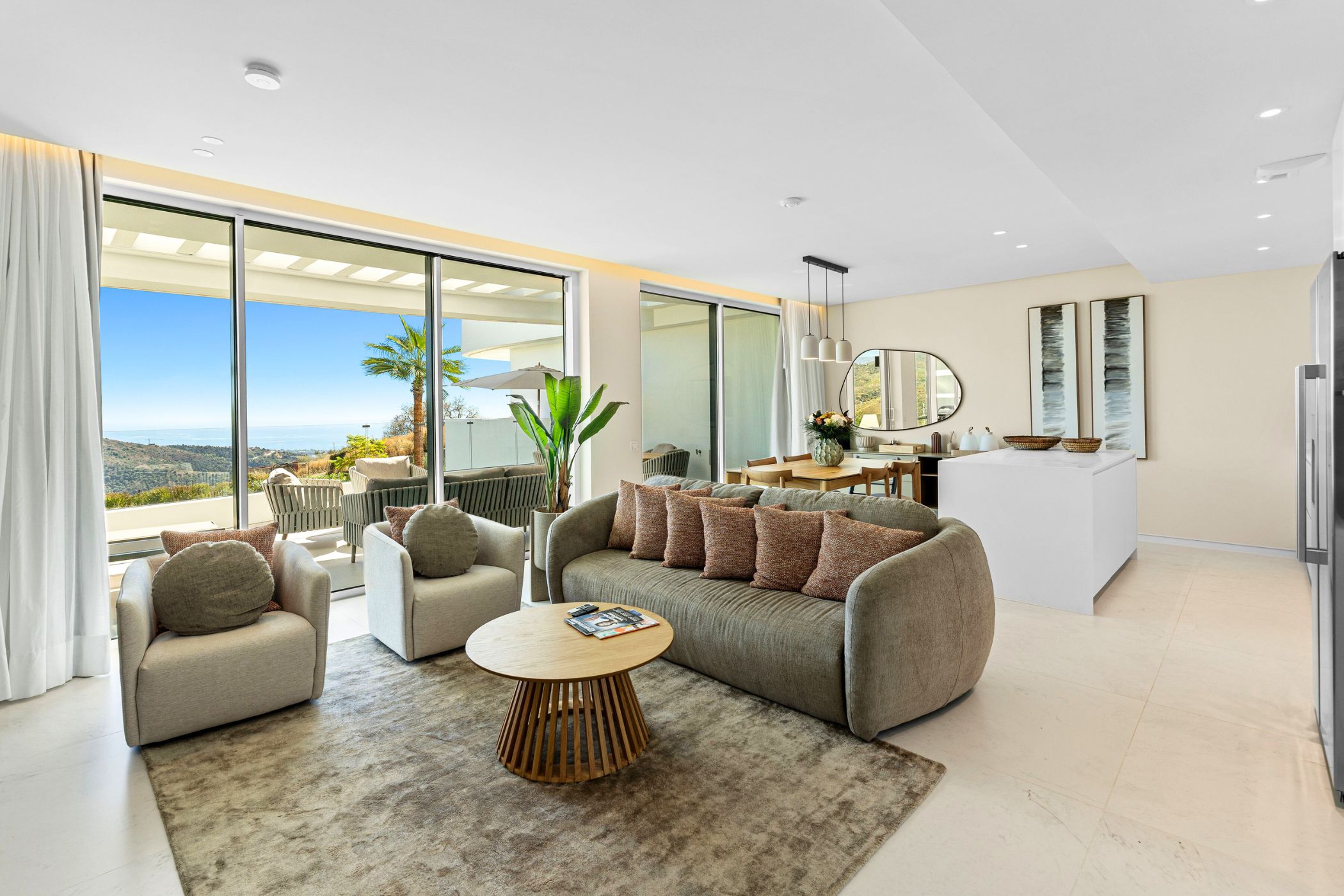
What is fractional ownership in Marbella?
Fractional ownership in Marbella means buying a real 1/8 share of a luxury second home, shared with up to seven other co-owners. Each owner receives personal use set by the partner that manages the home — a minimum of 44 or 45 nights a year with most of our partners, and no set cap with some others — through a fair-rotation calendar, with all property management, maintenance, taxes and operations handled by a professional team. You can sell it, pass it on to your heirs, and it grows in value with the home — it is not a timeshare, not a holiday club. The legal set-up is arranged by our partner for each home and walked through with you before you buy.
Why Marbella?
Marbella is, by every measurable metric that matters for a serious second-home buyer, the single most established international luxury residential town on the Spanish Mediterranean — and arguably the most internationally recognised sun-coast address in Europe. The town's history as a high-end residential destination begins with a specific moment: the opening of the Marbella Club Hotel in 1954 by Prince Alfonso of Hohenlohe-Langenburg, which over the following two decades brought European royalty, Hollywood actors, industrial heirs and the international press to a fishing village of barely 7,000 residents and turned it into the prototype European luxury sun-coast town. The Golden Mile — the four-kilometre stretch of coastline running west from the old town to Puerto Banús — was built out through the 1960s and 1970s by the same circle, and the result is the deepest stock of high-specification residential architecture on the Andalusian coast. Today the Marbella municipality holds a year-round population of around 156,000 — the second-largest in the province of Málaga after the capital itself — with a peak summer population that swells past 500,000 when the international owner-and-visitor community is in residence.
Your Marbella share is owned alongside up to seven other co-owners. You own a real share of the home — an eighth, a quarter — not a right to use it. You can sell it, pass it on to your heirs, and it grows in value with the home. Resale is handled through our partner's resale process, without you having to sell the whole house.
Marbella's particular advantage inside the Costa del Sol second-home market is the combination of climate, planning depth, infrastructure and international community that the broader 150-kilometre coastline cannot match in any single other town. The microclimate sits in the lee of the Sierra Blanca and the Sierra de las Nieves UNESCO Biosphere Reserve, which deflects the Atlantic cold fronts that occasionally cross western Andalucía and gives Marbella the highest annual mean temperature of any European coastline north of the Maghreb — around 19°C (mid-60s°F) annual average, with 320 days of sunshine per year recorded at the Spanish meteorological agency's Málaga–Marbella weather station. The planning depth on the prime addresses is the result of half a century of intensive residential building: the Golden Mile, Sierra Blanca, Las Brisas, La Zagaleta, El Madroñal, Río Real and Cabopino are all fully built-out residential districts with no remaining greenfield expansion capacity, which has the practical effect of capping new supply at the prime addresses and pushing demand into the existing villa stock at every market cycle. The international community infrastructure — international schools, multilingual professional services, a deep concierge and property-management ecosystem, direct charter-flight links from German, British and Nordic hubs through the season — is the deepest on the Spanish Mediterranean by a meaningful margin.
It is worth setting Marbella in its competitive context against the other established Mediterranean luxury sun-coast addresses. Sotogrande, thirty minutes west on the Costa del Sol's far western edge, offers comparable infrastructure with a quieter, more private rhythm and a polo-and-golf identity rather than the marina-and-restaurant identity of Marbella — and a smaller, more seasonal year-round community. Mijas Costa and Fuengirola, fifteen kilometres east, offer the same Costa del Sol microclimate at materially lower price points but without Marbella's depth of high-specification residential stock or the international community that anchors the prime addresses. Ibiza and Mallorca offer the Balearic-island lifestyle with a more seasonal, summer-led rhythm. The French Riviera — Cannes, Antibes, Saint-Tropez, Nice — offers comparable prestige with a different cultural register (more French, more art-and-design-led, more expensive at the prime tier) and a substantially shorter swimming season. Each has its admirers, and the comparisons help frame why the town remains, by some distance, the highest-volume international second-home market on the Spanish Mediterranean. The Andalusia regional tourism authority and the national tourist office both treat Marbella as the country's single most internationally established luxury residential town outside Madrid and Barcelona.
The third structural argument for Marbella is the diversity of usable lifestyles available inside a single town footprint. A Northern European family with a 1/8 share in Sierra Blanca is twenty minutes from a marina (Puerto Banús), thirty minutes from three of Europe's best-known golf courses (the Real Club Valderrama at Sotogrande, Real Club de Golf Las Brisas in Nueva Andalucía, the Real Club de Golf Sotogrande), forty minutes from a UNESCO-protected mountain range, sixty minutes from a major European city (Málaga at 578,000 residents), and ninety minutes from a Moorish-Andalusian heritage city (Granada with the Alhambra). The town packs a remarkable amount of difference into a thirty-kilometre east–west footprint — high-prestige villa districts, working Andalusian centres in the old town and San Pedro, marina-and-nightclub Puerto Banús, beach-front family-resort eastern flank, gated mountain estates in the foothills — and a Marbella share that combines proximity to several of these gives an owner a four-season base rather than a single-mode property. Few other European towns can match that range without significantly longer drive times.
For a co-ownership buyer thinking strategically rather than just emotionally, Marbella's combination of climate consistency, residential planning depth and international infrastructure matters more than the headline glamour. The villa you buy a share of in Sierra Blanca sits in a fully built-out gated district where the buildable land was capped in the 1980s and where the existing villa stock is fundamentally finite. The Nueva Andalucía apartment is in a district whose golf-valley footprint cannot expand because it is bounded by motorway, mountain and ridge. The Las Brisas townhouse is on a private gated estate whose internal road network and plot allocation has not changed in forty years. These are not assets that depend on a particular interest-rate cycle to hold their value; they depend on the unchanging facts that Marbella remains Marbella, that the Sierra Blanca lee climate cannot be replicated further east on the coast, and that the European appetite for established Andalusian sun-coast addresses is steady across generations. Add professionally managed co-ownership that makes a shared home transparent and resaleable, and the case for co-ownership in Marbella writes itself.
One under-discussed advantage that becomes obvious once you actually start using a Marbella second home is the depth of the town's professional services infrastructure for non-resident owners. Seven decades of British, German, Dutch, Belgian, Swedish, Norwegian, Danish, Finnish and (more recently) Middle-Eastern, American and Russian buyers have built up an ecosystem of multilingual lawyers, gestores (property administrators), property managers, notaries, tax advisers, boat-charter agencies, garden contractors and concierge services across the Marbella–San Pedro–Estepona corridor that no other Spanish coastal town can match. The local management companies in Sierra Blanca, the Golden Mile, Nueva Andalucía, Las Brisas, Río Real, Bahía de Marbella, Cabopino and Elviria operate in English, German, French, Dutch, Russian, Arabic and the Scandinavian languages as a matter of routine, with decades of operating history; the British and Scandinavian communities are large enough to run their own bilingual primary schools (the British School of Marbella, the Swedish School of Marbella, the Aloha College), English-language church services, and direct charter flights from Stockholm, Oslo, Copenhagen, Helsinki, Manchester, Edinburgh, Birmingham, Dublin, London Stansted, Düsseldorf and Munich through the long season. The Spanish notarial system gives ownership documentary clarity through the Registro de la Propiedad (the Spanish land registry, administered by the College of Property and Mercantile Registrars), and the cadastral records — held by the Dirección General del Catastro at the Spanish tax authority — are a long-running, reliable record-of-record system whose roots trace to the 1715 Catastro de Ensenada and the modern 1906 Mortgage Law. None of this is glamorous, but it is the kind of infrastructure that determines whether owning a sun-coast home from another country is a pleasure or a chore.
The fourth structural advantage worth naming is the transport infrastructure that makes a Marbella second home practically usable rather than just nominally owned. Málaga–Costa del Sol Airport (AGP) is the principal gateway, with direct year-round service from London (Heathrow, Gatwick, Stansted, Luton, City), Manchester, Edinburgh, Birmingham, Dublin, Amsterdam, Brussels, Paris (CDG and Orly), Frankfurt, Munich, Hamburg, Berlin, Düsseldorf, Zurich, Vienna, Copenhagen, Stockholm, Oslo, Helsinki, Reykjavik and dozens of further European cities, plus direct East-coast US service to New York JFK (year-round on JetBlue) and seasonal Newark, Boston and Washington Dulles. AGP handled over 25 million passengers in the most recent published full year, making it the third-busiest airport in mainland Spain after Madrid Barajas and Barcelona El Prat. The drive from AGP to Marbella is short: 40 minutes via the A-7 / AP-7 toll motorway to the Marbella exits, 50 minutes to Puerto Banús and Nueva Andalucía, 55 minutes to San Pedro de Alcántara, 30–35 minutes to Cabopino and Elviria on the eastern flank. Gibraltar Airport (GIB), an hour west, offers direct year-round London Heathrow, Gatwick and Manchester service and is the closer option for buyers heading to Sotogrande or western Estepona who happen to be coming via the UK. The Spanish high-speed rail network — Renfe AVE — connects Málaga María Zambrano station to Madrid Atocha in 2 hours 20 minutes and Madrid to Marbella by car in roughly 5 hours 30 minutes via the A-4 / A-45 / A-7. An owner can leave London on a Friday morning and be on the terrace in Sierra Blanca by Friday lunchtime.
Where to own in Marbella
Marbella's second-home market is best understood through five principal sub-zones running east–west along the thirty-kilometre town footprint, each with its own character, architecture, buyer mix and day-to-day rhythm. Each cluster has its own micro-zones — the gated estates inside Sierra Blanca, the urbanizaciones inside Nueva Andalucía, the beach-front districts of Marbella East — and we are happy to walk through any of them with buyers whose interests run that direction. But the supply story for fractional ownership in Marbella is concentrated in the five zones below: Sierra Blanca and the Golden Mile (the prestige flank between the old town and Puerto Banús), Puerto Banús and Nueva Andalucía (the marina district and the golf valley behind it), La Zagaleta, El Madroñal and Las Brisas (the inland gated estates in the Benahavís foothills above the town), Marbella East — Río Real, Bahía de Marbella, Cabopino and Elviria (the eastern beach-front family addresses running toward Calahonda), and Marbella Old Town and San Pedro de Alcántara (the working Andalusian centres at either end of the municipal footprint). Together they account for the overwhelming majority of international second-home demand in the Marbella name itself.
Sierra Blanca and the Golden Mile — the prestige flank
The Golden Mile — the four-kilometre stretch of beach-front road running west from the old town to Puerto Banús — is the foundational Marbella address. It was built out from 1954 onwards by the circle around Prince Alfonso of Hohenlohe-Langenburg's Marbella Club Hotel, which opened that year on a beach-front plot the prince's father had bought for the family, and was later joined on the same stretch by the Puente Romano Beach Resort (opened 1979, designed in low-rise Andalusian-village style around the Roman bridge from which it takes its name) and the Gran Meliá Don Pepe. The result is a hotel-and-villa corridor whose density and prestige has anchored the entire Costa del Sol market for seventy years. Sierra Blanca sits on the hill directly behind the Golden Mile, a gated residential urbanización built out from the late 1980s onwards with the Sierra Blanca mountain ridge rising directly behind and the Mediterranean opening south below — the single most prestigious residential address in the town, with a buyer mix that has historically run heavily Saudi, Kuwaiti, Russian and Northern European and a year-round community that operates with full security, private gardens and direct line-of-sight south to the coast.
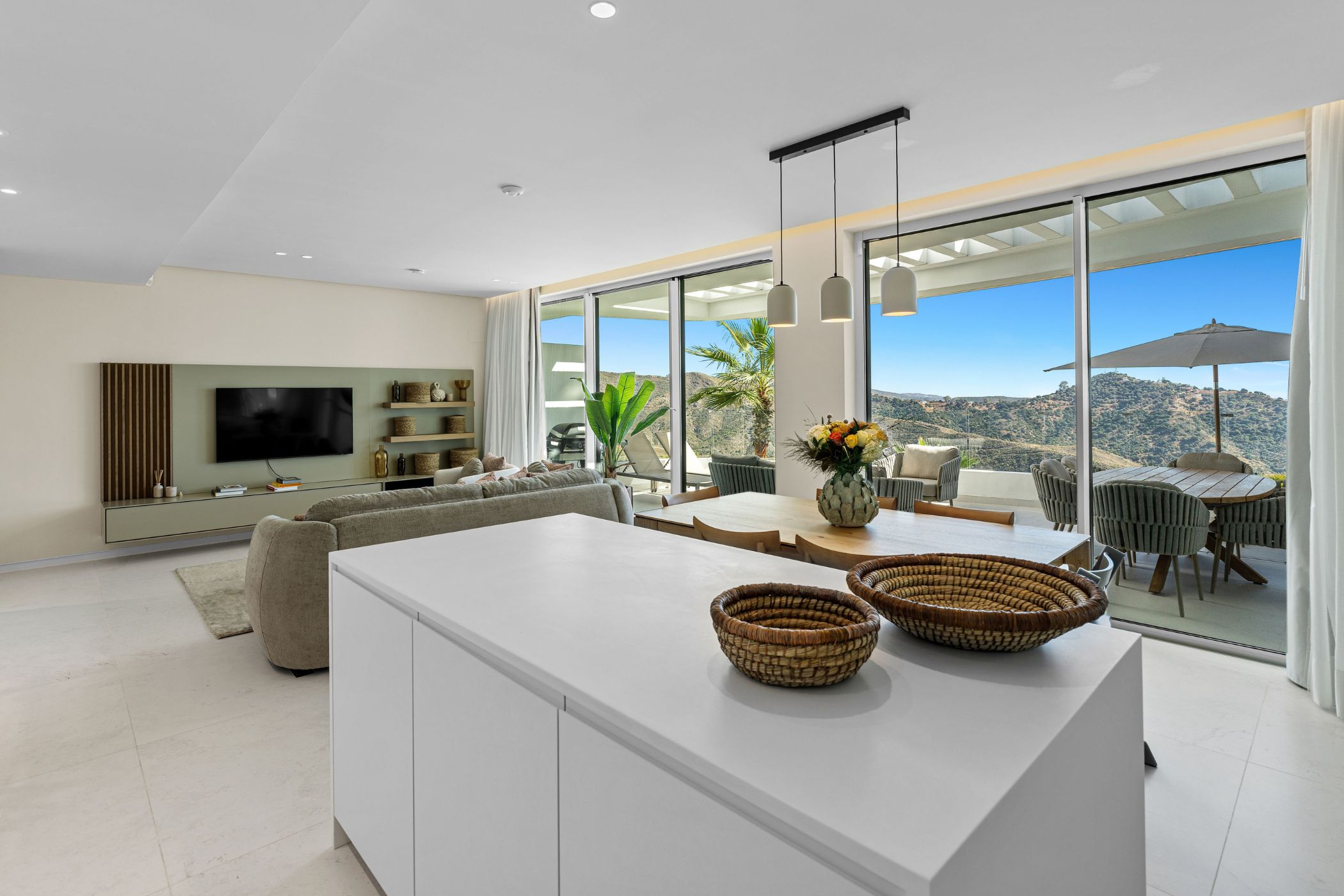
The Golden Mile's seafront architecture mixes the original 1950s-1970s low-rise Andalusian-village stock — white stucco, terracotta tile, wrought-iron balconies, internal courtyard patios with palms and fountains — with a layer of contemporary glass-and-steel villas built through the 2000s and 2010s in the gaps that opened up as older properties were rebuilt. The Marbella Club hotel itself, still owned and operated by the Hohenlohe-Langenburg family interests, anchors the western end of the strip with its beach-front bungalows and the long pine-shaded lawn between the main building and the sand; Puente Romano anchors the eastern end with its village-style internal streets and the Puente Romano Tennis Club, which has hosted the Senior Masters Cup. The beach-front Paseo Marítimo — the promenade running east-west along the entire Golden Mile and continuing through the old town to the Bahía de Marbella — is one of the longest continuous beach-front pedestrian routes on the Spanish Mediterranean at roughly 7 kilometres, and the long shaded run of palms and umbrella pines down its centre gives the strip its distinctive walking character.
Sierra Blanca itself sits on the slope rising from the AP-7 motorway up toward the Sierra Blanca peak at 1,275 metres. The urbanización is divided into several distinct gated sub-zones — Sierra Blanca Country Club, Cascada de Camoján at the higher altitude, La Carolina immediately above the Golden Mile — each with its own security and entrance gates, internal road network, and characteristic plot allocation (most villas sit on plots of 1,500–4,000 square metres with private pools, gardens and panoramic south-facing aspects). The microclimate up the slope is several degrees cooler than the beach-front in deep summer and several degrees warmer than the eastern beaches in the shoulder seasons — a meaningful practical difference for owners spending extended weeks through July and August. The view-line from the higher Sierra Blanca plots looks south across the Mediterranean to the Atlas Mountains of Morocco, visible on clear days as a long blue ridge along the southern horizon, with Gibraltar and the rock of Calpe visible to the west at the right time of day. The buyer mix on Sierra Blanca runs heavily Northern European, Middle-Eastern and Russian, with growing American and Latin American shares over the past decade. Climate at this elevation runs 10–17°C (high 40s°F to mid-60s°F) in mid-winter at the higher plots and 27–32°C (low 80s°F to high 80s°F) in high summer, with the lee-of-the-Sierra-Blanca shelter giving the slope a consistently calmer wind environment than the beach-front. Best for: buyers who treat the Golden Mile and Sierra Blanca name as part of the address itself, design-led couples drawn to the mix of original 1960s-1970s Andalusian-village architecture and contemporary glass-and-steel villa stock, multi-generational families valuing the security depth of the gated urbanización, and owners whose use pattern centres on the long shoulder seasons of April–May and September–October when the slope's microclimate is genuinely at its best.
Puerto Banús and Nueva Andalucía — the marina district and the golf valley
Puerto Banús, opened in May 1970 by José Banús with King Fahd of Saudi Arabia and Prince Rainier of Monaco among the founding guests, is the Costa del Sol's defining marina district. The harbour holds 915 berths for vessels up to 50 metres, and the four-storey ring of white-stuccoed apartment buildings around the water — laid out in low-rise Andalusian-village style by the architect Noldi Schreck — has been the visual shorthand for Marbella in the international press for more than fifty years. The marina's restaurants, cafés, retail concentration (Hermès, Louis Vuitton, Dolce & Gabbana, Chanel, Cartier, Bulgari) and the long evening cadence of the quayside walk define the town's most public face. Nueva Andalucía, immediately inland from Puerto Banús and stretching north up the valley toward the Las Brisas and Aloha golf courses, is the residential district behind the marina — laid out from the 1960s onwards as a planned urbanización with a dense network of villas, townhouses and low-rise apartment buildings centred on the five golf courses of what is locally called "Golf Valley".
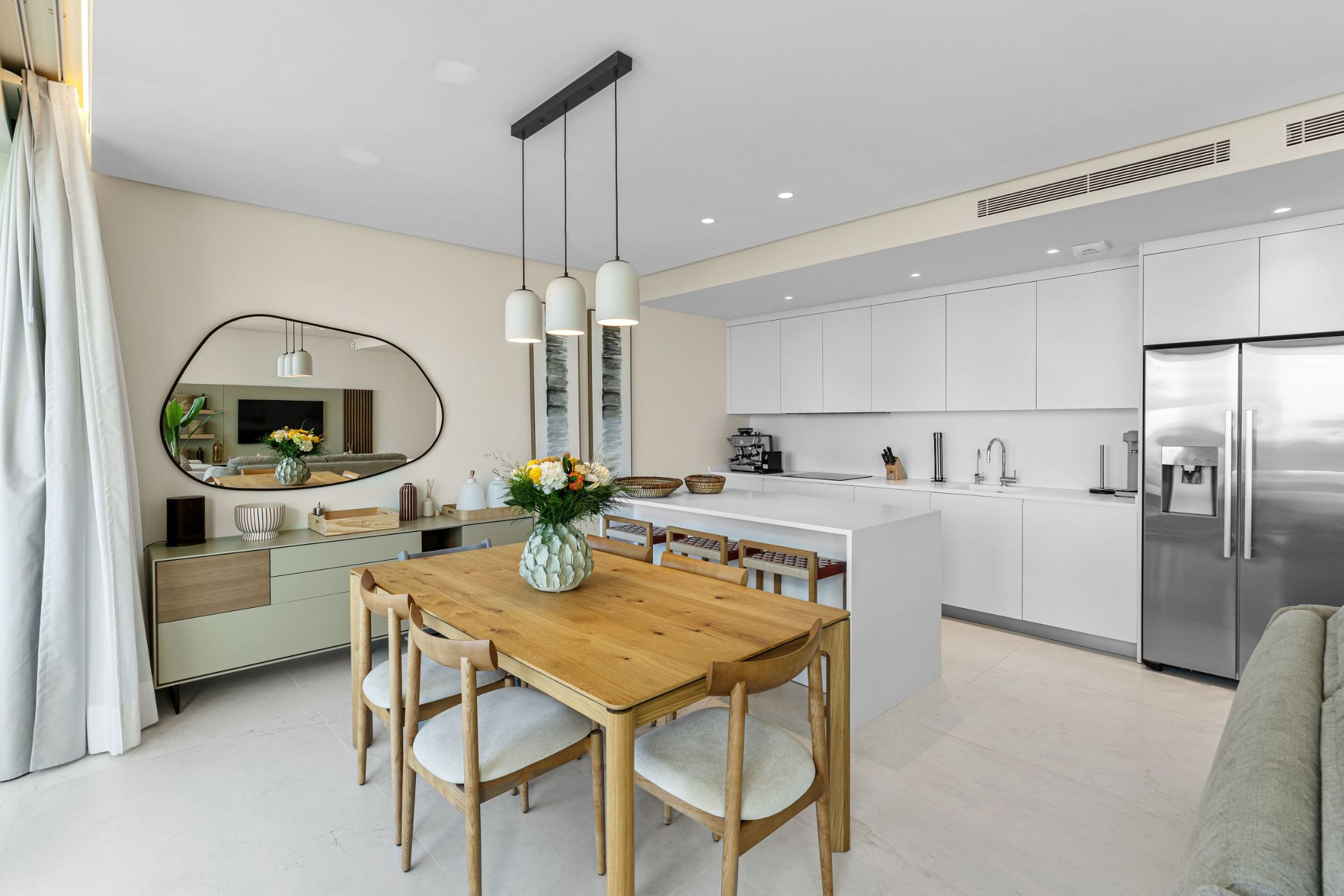
The five golf courses that anchor Nueva Andalucía are: Real Club de Golf Las Brisas (opened 1968, designed by Robert Trent Jones Senior, host of the 1973 World Cup and the 1989 Spanish Open); Aloha Golf Club (designed by Javier Arana, opened 1975); Los Naranjos (Robert Trent Jones Senior, 1977); Magna Marbella Golf; and La Quinta Golf. The concentration is one of the densest in continental Europe — five championship eighteens inside a single valley — and the urbanizaciones built around them through the 1970s and 1980s now form one of the most established middle-tier residential districts in the town. Nueva Andalucía works for a meaningfully wider buyer mix than the higher-prestige Sierra Blanca slope: the entry point is materially lower; the apartment-and-townhouse stock outweighs the villa stock at the southern end of the district; the proximity to Puerto Banús (a five-minute walk or two-minute drive) is uniquely close; and the day-to-day rhythm of the area runs through a working community of supermarkets, restaurants, dental clinics, gymnasiums and international schools that the higher-altitude gated estates cannot match. The famous Centro Plaza at the heart of Nueva Andalucía hosts the Saturday market each week — the largest weekly market on the Marbella–San Pedro stretch, with the same producer turnover for thirty years.
Drive times from Málaga airport are 50 minutes to Puerto Banús, 55 minutes to the central Nueva Andalucía urbanizaciones, 60 minutes to the upper Golf Valley. Climate runs 9–16°C (high 40s°F to low 60s°F) in mid-winter at sea level and 26–31°C (high 70s°F to high 80s°F) in high summer, with the marina's beach-front exposure giving slightly cooler summer evenings than the inland Sierra Blanca slope. Best for: buyers whose use pattern centres on the marina lifestyle and the proximity to the Puerto Banús restaurant and retail core, families with school-age children valuing the proximity to the international schools at Aloha and along the A-7, golfers wanting walking-distance access to five championship courses, and owners whose calendar leans heavily on the summer peak when the valley's air-conditioned villa-and-pool stock and the marina-side restaurant cadence reach their full operating capacity.
La Zagaleta, El Madroñal and Las Brisas — the inland gated estates
The gated residential estates in the foothills above Marbella — running from the prime La Zagaleta at the high western end through El Madroñal on the parallel ridge and Las Brisas at the lower urban edge — are the third defining cluster of the Marbella residential market and the deepest tier of privacy on the entire Costa del Sol. La Zagaleta itself, technically inside the Benahavís municipality immediately west of the Marbella town boundary, occupies 900 hectares of private mountainside above the AP-7 motorway with two private 18-hole golf courses, a private heliport, a private equestrian centre, and a single perimeter security gate controlling the only road in. The estate was developed from 1991 onwards by the Saudi arms dealer Adnan Khashoggi, who had originally assembled the land as a private hunting ground in the 1970s, and has held the position of the single most-private and highest-tier address on the Spanish Mediterranean since the late 1990s. The villa stock — typically on plots of 4,000–10,000 square metres with private pools, mature gardens and direct line-of-sight south to the coast and west to Gibraltar — is the prototype of the modern Andalusian luxury villa.

El Madroñal, on the parallel ridge to the east of La Zagaleta, is the next-tier gated estate — opened in the early 1990s with a similar privacy model (gated entry, internal security, plot sizes from 2,000–6,000 square metres, no commercial development inside the perimeter) but with a more naturally wooded character and a smaller overall footprint. The estate sits at 400 metres above sea level on a forested slope of pine, cork and madroño trees (the strawberry tree that gives the estate its name), with the villa architecture running heavily to the traditional Andalusian cortijo style — white-stucco walls, terracotta-tiled roofs, internal patios with citrus trees and fountains, wrought-iron details, beam-vaulted living rooms with double-height fireplaces. The cooler microclimate at altitude makes El Madroñal a meaningfully better deep-summer address than the beach-front, and the woodland setting gives an owner a privacy depth that the Sierra Blanca slope's open hillside cannot match. The Benahavís village two kilometres further inland, known locally as the "Dining Room of the Costa del Sol" for its concentration of restaurants per capita, anchors the small-town community around the estates.
Las Brisas sits at the lower urban edge above the AP-7 and the Nueva Andalucía valley — a gated estate built out from the 1970s around the Real Club de Golf Las Brisas course and adjacent to the Aloha and Las Brisas urbanizaciones. The estate is less private than La Zagaleta or El Madroñal (the perimeter is more permeable, the internal road network connects to the wider Nueva Andalucía street grid at several points), but the proximity to the golf course, the Puerto Banús marina (five-minute drive) and the international schools makes it the most usable of the three gated clusters for a buyer whose calendar runs heavily through the school terms. The villa stock is older and more architecturally varied than the newer La Zagaleta and El Madroñal — original 1970s and 1980s Andalusian-style villas mix with rebuilt contemporary glass-and-steel houses on the same street. Drive times from Málaga airport are 60 minutes to Las Brisas, 70 minutes to El Madroñal and 75 minutes to La Zagaleta. Climate at El Madroñal's altitude runs 8–15°C (high 40s°F to high 50s°F) in mid-winter and 24–29°C (mid-70s°F to mid-80s°F) in high summer — a meaningful five-to-seven-degree cooling on the beach-front in the deepest summer weeks. Best for: buyers whose dominant priority is privacy and security at the very top of the market, families spanning multiple generations who can fill a five- or six-bedroom villa on a 4,000-square-metre plot, owners drawn to the traditional Andalusian cortijo architecture rather than the contemporary glass-and-steel beach-front style, and four-season users who value the cooler altitude microclimate through the deepest summer weeks.
Marbella East — Río Real, Bahía de Marbella, Cabopino and Elviria
Marbella East — the corridor running east from the old town along the N-340 / A-7 for roughly fifteen kilometres to the Mijas Costa boundary at Calahonda — is the town's principal family beach-front cluster. The corridor moves through five distinct beach districts running west-to-east: Río Real (immediately east of the old town, around the mouth of the Río Real river and the Río Real Golf course); Bahía de Marbella (the beach-front strip running east from Río Real, with mature pine groves and the long sand beach of Playa El Pinillo); Los Monteros (the gated beach-front urbanización built around the historic Hotel Los Monteros, opened 1962); Cabopino (the marina-and-beach district around the small Puerto de Cabopino harbour); and Elviria (the largest of the eastern districts, a planned beach-front-and-foothills community built out from the late 1970s onwards). Together these zones form the town's most family-oriented residential band — beach-front, school-adjacent, restaurant-rich, and the most usable address for a family with children whose dominant priority is direct beach access and the safe-cycling and walking infrastructure of the eastern Paseo Marítimo extension.
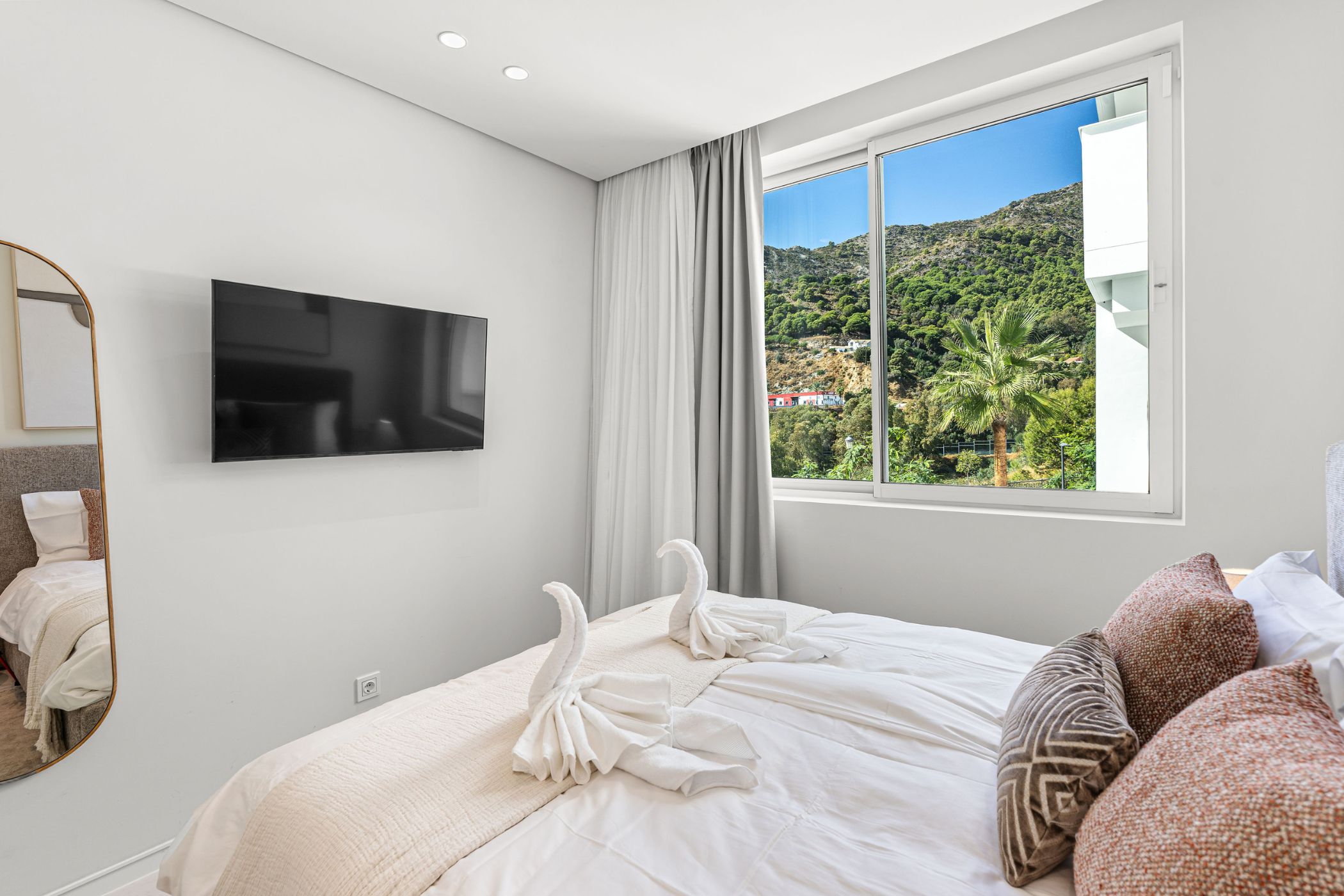
The eastern strip has its own distinct character relative to the Golden Mile and the inland estates. The beach-front exposure is direct — most of the residential addresses sit within 200 metres of the sand and the long Mediterranean view-line is unobstructed by the higher-density development of the Golden Mile. The swimming season on the eastern beaches runs from mid-May through mid-October at the conservative end, with the water reaching 22–24°C (low to mid-70s°F) through August and holding into late September. The international school infrastructure on this flank is particularly deep: the British School of Marbella in the lower Elviria area, the English International College on the foothills above Las Chapas, the Laude San Pedro International College further west — making the corridor the preferred address for international families with children in full-time Marbella schooling. The Cabopino dunes at the eastern end form a protected coastal area (Monumento Natural Dunas de Artola) with one of the only remaining intact dune systems on the western Mediterranean — a meaningfully different beach character from the developed sand strips further west.
Elviria itself has anchored the eastern corridor since the late 1970s development around the Hotel Don Carlos (now operating as part of the Don Pepe Collection) and the Santa María Golf course immediately inland. The district splits naturally into the beach-front Elviria Playa zone and the foothills-and-villa Elviria Hills zone above the A-7, with the residential mix running from beach-front low-rise apartment buildings through the gated urbanizaciones (Hacienda Las Chapas, La Mairena) up to detached villas on the upper slopes. The buyer mix on Marbella East runs most heavily British and Northern European, with strong Belgian, Dutch, German and Scandinavian shares, and a noticeably higher proportion of full-time-resident families than the more visitor-oriented Golden Mile. Drive times from Málaga airport are 30 minutes to Cabopino and Elviria, 35 minutes to Los Monteros and Bahía de Marbella, 40 minutes to Río Real — meaningfully shorter than the Golden Mile or Puerto Banús transfers because the corridor sits east of the town rather than west. Climate runs 10–17°C (high 40s°F to mid-60s°F) in mid-winter and 27–31°C (low 80s°F to high 80s°F) in high summer. Best for: families with school-age children whose dominant priority is beach-front access and the safe pedestrian-and-cycling infrastructure of the eastern Paseo Marítimo extension, international owners whose calendar runs on the Marbella school terms, beach-cycling and beach-walking enthusiasts drawn to the long uninterrupted run east from Río Real to Cabopino, and buyers who value the shorter airport-transfer time over the prestige weight of the western Golden Mile.
Marbella Old Town and San Pedro de Alcántara — the working Andalusian centres
The fifth Marbella cluster is the working Andalusian centres at either end of the town's east–west footprint: Marbella Old Town (the Casco Antiguo, the original medieval-and-Renaissance core around the Plaza de los Naranjos at the heart of the modern town) and San Pedro de Alcántara (the smaller historic town nine kilometres further west, technically a separate municipality administered as part of Marbella since 1885). Both are working year-round Spanish-speaking communities first and second-home destinations second — and the day-to-day rhythm of either is the closest a buyer comes to the underlying Andalusian character of the town. The Marbella Casco Antiguo is a tight grid of cobbled streets, white-stuccoed houses and orange-tree squares centred on the sixteenth-century Plaza de los Naranjos (the Square of the Orange Trees), with the Renaissance Town Hall, the Casa del Corregidor and the Ermita de Santiago all dating to the 1550s. The medieval Moorish quarter — the Barrio Alto, above the plaza — retains the irregular street plan of the pre-Reconquista town and the remnants of the tenth-century Moorish castle walls.
The Old Town's working life runs on the tapas-bar circuit through the central streets, the Tuesday-morning weekly market on the Avenida del Mercado, the year-round restaurant calendar that does not depend on the tourist season, and the long evening cadence of the orange-tree squares that fills with locals from the early evening onwards. San Pedro de Alcántara, the parallel working town nine kilometres west, has a similar but smaller-scale rhythm — a year-round population of around 30,000, a working agricultural-and-light-industrial history (the town was founded as a model agricultural colony in 1860 by the Marqués del Duero), a grid-planned old core around the Avenida Marqués del Duero, and a long sandy beach immediately to its south running east into Puerto Banús. The San Pedro Boulevard, opened in 2012 after the burying of the N-340 / A-7 underground through the town in a major civic-engineering project, is one of the longest pedestrian-and-cycling boulevards on the Costa del Sol at 1.7 kilometres, running parallel to the beach and providing the town with a continuous green spine that no other Marbella-coast town can match.
The buyer mix in both old towns is meaningfully different from the residential urbanizaciones further along the coast: more Spanish-resident, a higher proportion of older townhouses and apartment-blocks above ground-floor retail, smaller plot sizes, and a working community rhythm that the residential gated estates do not have. For a co-ownership buyer the old-town addresses suit a particular use pattern — the buyer who treats the working Andalusian town life as the primary attraction rather than the gated-villa privacy, who values the walking-everywhere proximity of the small medieval plan, and who uses the Marbella share for repeat shorter stays around the long shoulder-season and deep-winter weeks when the working town is genuinely at its best. Drive times from Málaga airport are 40 minutes to the Marbella Old Town and 50 minutes to San Pedro de Alcántara. Best for: design-led couples drawn to the working Andalusian centre and the preserved sixteenth-century Plaza de los Naranjos core, owners whose use pattern centres on the long shoulder seasons and the deep-winter weeks when the working town runs on its year-round rhythm rather than the tourist calendar, repeat-short-stay users who treat the Marbella share as a cultural address rather than a beach base, and buyers who prefer the walking-everywhere proximity of a medieval town plan over the drive-everywhere geography of the gated urbanizaciones.
A year in your Marbella co-ownership home
Spreading around six weeks of personal use across a Marbella calendar year is itself a skill — and one of the unsung benefits of the town specifically is that the microclimate at the lee of the Sierra Blanca gives an owner genuinely usable days across more of the year than almost any other European Mediterranean address. Below is a walk through the year with the particular weeks owners across the COP Marbella portfolio return to most often. The pattern is broadly the same across all eight co-owners of a given property, with the calendar mechanics ensuring every owner gets a fair allocation of peak weeks across a multi-year cycle. Owners who are flexible enough to use shoulder weeks — rather than competing for every week of August — consistently report a higher use-quality from their Marbella share than those who insist on peak.
Spring (March–May)
Spring is, for many seasoned Marbella owners, the defining season — and one of the strongest arguments in favour of fractional ownership over single-week ownership at any one address. The Marbella year properly opens in early March as the almond and orange blossom flush across the foothills behind the town, the first significant restaurant terraces reopen along the Golden Mile and the Puerto Banús quayside, and the daytime temperatures climb decisively into the 18–22°C (mid-60s°F to low 70s°F) range. The Spanish Semana Santa (Holy Week) calendar — moveable but typically late March or early April — anchors the first major season of the year: the Marbella Casco Antiguo runs a working procession calendar through the week with the Cofradías leading the religious floats through the old streets each evening, the Puerto Banús and Golden Mile restaurant booking windows tighten visibly, and the population of the town swells with the long Spanish-resident Easter influx from Madrid, Sevilla and Granada. The water temperature in the sea — around 16°C (around 60°F) in early April — is still too cool for most swimmers, but the pool-and-terrace weeks are fully open across the villa stock with private pools.
May is, on most measures, the connoisseur's month in Marbella — and the single most-requested shoulder month across the COP Marbella portfolio. The weather runs 20–26°C (high 60s°F to high 70s°F) through the day with cool but pleasant evenings, the bougainvillea climbs to its full flush across the Andalusian-village courtyards, the jasmine perfumes the Sierra Blanca slope through the warm late afternoons, the swimming pools have warmed to a comfortable 21–23°C (low to mid-70s°F), and the sea reaches 18–20°C (mid-60s°F to high 60s°F) in the southern beach-front exposure for the first comfortable open-water swimming weeks of the year. The Marbella San Bernabé fair (San Bernabé being the town's patron saint, the feast falling on the 11th of June) runs a long week through the end of May into the first week of June with the Casco Antiguo at its working-festival peak. The cycling and walking infrastructure of the Paseo Marítimo and the foothills behind the town runs through its best riding weeks of the year through May. Owners who plan their share-use around shoulder weeks consistently name April–May (and September–October, see below) as their favourite weeks of the entire year.
Summer (June–August)
Summer is the peak high season on the Marbella coast — and the months that anchor the value proposition of a Marbella second home. June brings the proper beach-bathing season: water temperatures climb from 20°C (high 60s°F) at the start of the month to 23°C (mid-70s°F) by the end, the beach-clubs along the eastern flank (the Nikki Beach at Elviria, Trocadero at Bahía de Marbella, the Marbella Club Beach Club on the Golden Mile) open their full-season schedules, and the Spanish school holidays begin in mid-June and run through mid-September which gives the coast a fourteen-week peak season that is meaningfully longer than the Italian Lakes' and the French Riviera's equivalents. July is the absolute peak — the Puerto Banús quayside operates at full capacity from the first weekend, the beach-front restaurants run at their tightest booking windows of the year (often four to six weeks ahead at the prime addresses), and the cultural calendars are at their fullest (the Starlite Marbella open-air concert series in the Cantera de Nagüeles quarry behind the Golden Mile runs from early July to late August with a programme that has hosted artists from Sting to Diana Ross to Lenny Kravitz).
August is the densest month — the Spanish Asunción public holiday on the 15th anchors the peak fortnight, with restaurant booking windows in the prime Marbella addresses stretching to four to six weeks ahead and Puerto Banús at its liveliest of the year. The sea water reaches its annual maximum of 23–25°C (mid- to high-70s°F) through the second and third weeks of August; daytime air temperatures across the beach-front reach into the 30–34°C (high 80s°F to mid-90s°F) range, with the lee-of-the-Sierra-Blanca shelter giving the Marbella coast a several-degree advantage over the more exposed eastern Mijas Costa stretch. Owners who time the calendar to land Asunción on the coast every two or three years (rather than every year) consistently find their use pattern more relaxed than those who try to anchor August every year. The cooler higher-altitude addresses — Sierra Blanca above the Golden Mile, El Madroñal at 400 metres, the upper plots of La Zagaleta at 500–700 metres — sit several degrees below the beach-front heat through August and are particularly favoured by Northern European owners whose summer-temperature tolerance runs lower.
Autumn (September–November)
For many seasoned Marbella owners, September is the favourite month of the entire year. The August crowds disperse from the first weekend of the month, the Spanish school year reopens through the second week, the Puerto Banús quayside restaurants take reservations again the same week you ask, and the sea remains comfortably warm (still 22–24°C / low to mid-70s°F) for swimming through the entire month and well into early October. The weather runs 23–28°C (mid-70s°F to low 80s°F) through the day with crisp early evenings; the beach-clubs continue running their full summer schedules into the second week of October; the cultural calendars carry their late-summer programmes (the Málaga Film Festival through early September, the Marbella International Polo Tournament running through the early autumn at the Santa María Polo Club at Sotogrande). The autumn light on the Costa del Sol — particularly through the second half of September — is the warm horizontal Andalusian light that has drawn painters and photographers to the coast for a century, the lower sun-angle flattering the white-stuccoed Andalusian-village architecture and the cypress-and-palm garden mix in a way the sharper summer light does not.
October is the autumn shoulder month and one of the most rewarding weeks on the coast for owners with calendar flexibility. The sea remains swimmable at 21–22°C (around 70°F) through the first three weeks, the foothills behind the town reach their best hiking weeks of the year, the almond harvest across the Sierra Bermeja foothills runs through the first half of the month, and the chestnut harvest in the higher Genal Valley above Estepona peaks through the same window. The Andalusian wine harvest in the Ronda hills thirty kilometres inland — the Serranía de Ronda DO wine region — runs through October with the bodega-visit weeks at their best. November begins the genuine off-season cadence: many of the seasonal beach-club restaurants close for the winter from the second week, the Puerto Banús quayside operates on a reduced winter schedule, but the year-round restaurant cores in the Old Town, San Pedro and the Golden Mile run through their full winter calendars. The Andalusian olive harvest in the Subbética foothills above the Costa del Sol runs through November and December — and several of the smaller Marbella restaurants run special tasting menus around the new-season Picual and Hojiblanca oils.
Winter (December–February)
Marbella has a genuine winter character that purpose-built summer resorts cannot replicate — and one that gives a Marbella owner usable weeks across the deep winter that an owner of a French Côte d'Azur villa or a Mallorcan finca simply cannot match. The microclimate at the lee of the Sierra Blanca keeps the December–February daytime range at 15–19°C (high 50s°F to high 60s°F) through the deepest winter weeks — meaningfully warmer than the equivalent latitudes on the Mediterranean north of the Strait of Gibraltar — and the long-running golf, padel and tennis calendars run through the entire winter as a matter of routine. December brings the town's most atmospheric short weeks: the Christmas markets across the Marbella Old Town's Plaza de los Naranjos, the long evening illumination of the central streets through to the 6 January Three Kings holiday, the Puerto Banús Christmas-tree lighting on the quayside, and the Spanish family-resident influx from Madrid and Sevilla over the school-holiday fortnight. The beach-front Paseo Marítimo runs through its quietest walking weeks of the year through December and January — long, mild, empty stretches of sand from Río Real to Cabopino that an August user would not recognise as the same coastline.
The Christmas-and-Three-Kings fortnight in Marbella is the season's single most atmospheric short window — the Casco Antiguo squares are floodlit through the long winter evenings, the orange trees in the Plaza de los Naranjos hang heavy with the new-season fruit, and the air temperature on a sunny December afternoon at sea level routinely runs in the 17–20°C (low to high 60s°F) range. The Spanish Cabalgata de los Reyes Magos (the Three Kings parade on the 5 January evening) is the year's most-watched single procession across both the Marbella Old Town and San Pedro. January is the connoisseur's month — the prime addresses run on the quietest schedule of the year, the year-round Old Town restaurants take same-day reservations, the golf courses at Las Brisas, Aloha, Los Naranjos and Río Real run at their best wind-and-temperature conditions of the entire year, and the surrounding ski areas (the Sierra Nevada ski resort above Granada at 2,100–3,300 metres) give a Marbella owner a 2-hour 30-minute drive to lift-served Spanish skiing through January and February — one of the only European addresses where a beach-front Mediterranean villa and a serious snow-covered ski resort sit inside a single morning's drive. February brings the Andalusian almond blossom and the start of the spring flush in the lower altitudes; the daytime range climbs back into the 17–22°C (mid-60s°F to low 70s°F) band through the second half of the month, and the long shoulder-season runs through to the spring proper.
Who buys in Marbella, and why
The international buyer mix in Marbella is the most varied of any single Spanish town — by a meaningful margin, and ahead even of Madrid and Barcelona for the depth of established expatriate community across the major Northern European, Middle-Eastern and Russian nationalities. British buyers have anchored the Marbella market since the 1960s — the British presence on the Golden Mile and the eastern flank dates to the original Hohenlohe-Langenburg circle and the Marbella Club opening of 1954, the British community in the eastern Cabopino and Elviria flank has built out steadily across the past four decades, and the long-established cultural references (Marbella in the Sunday Times property pages, the British-owned restaurants and beach-clubs from Elviria to Puerto Banús, the British-resident weekly newspapers) anchor the town's English-language profile. The Spanish census records around 10,500 British residents in the Marbella municipality alone, with substantial additional numbers across the wider Costa del Sol who use Marbella as their primary social-and-restaurant centre.
Scandinavian buyers — Norwegian, Swedish, Danish, Finnish — have built up the second-largest established Northern European community, with around 9,000 Norwegian residents alone across the Marbella–Mijas Costa corridor and large Swedish and Danish cohorts on the eastern Marbella flank. The Scandinavian presence anchors the international schools (the Swedish School of Marbella, the Norwegian School, the Danish school at Calahonda), several long-running Scandinavian-language churches, weekly Scandinavian-language newspapers, and direct charter flights from Stockholm Arlanda, Oslo Gardermoen, Copenhagen Kastrup and Helsinki Vantaa through the season. Belgian, Dutch and German buyers are a meaningful third cohort, concentrated on the gated estates of Sierra Blanca, El Madroñal and Las Brisas and on the beach-front Bahía de Marbella and Elviria flanks. French buyers have been a steady cohort since the 1960s, drawn to the Andalusian climate and the proximity-to-home of the Costa del Sol relative to the French Riviera; the French community on the western Marbella flank around San Pedro and the Nueva Andalucía golf valley is particularly long-established.
The Middle-Eastern buyer cohort on the prime Sierra Blanca and Golden Mile tier has been a meaningful share of the top end of the market since the 1970s, with the long-standing Saudi presence (King Fahd's Mar Mar Palace on the Golden Mile, built in 1979 as the largest single residential building in the town and still owned by the Saudi royal family) anchoring the international profile. Russian buyers have been a major share of the Sierra Blanca, Golden Mile and La Zagaleta market since the early 2000s; the geopolitical environment since 2022 has shifted the dynamics meaningfully but the established Russian-resident community remains a significant share of the year-round international population. American buyers, historically a minority outside the prime Sierra Blanca and La Zagaleta tier, have grown sharply over the past decade — drawn to the town by the climate and the residential-infrastructure depth, and by the relatively favourable euro–dollar dynamics through several recent cycles.
Spanish buyers themselves remain a meaningful share of the market — particularly Madrid-resident families using Marbella as their summer-and-Easter second home (the Madrid-on-Marbella pattern is the strongest single domestic flow, with many of the great Sierra Blanca and Bahía de Marbella villas being Madrid family addresses for two and three generations now), Sevillian families on the eastern Marbella flank, and Málaga residents using the western Marbella addresses as a weekend base inside an hour of the city.
The age-and-life-stage profile is in some respects more relevant than the nationality breakdown. The largest single buyer cohort across the COP Marbella portfolio is in the 45–60 age band — typically dual-income professional couples with school-age or university-age children whose Marbella calendars centre on the Easter, summer and Christmas school holidays, who value the operational simplicity of a fully managed villa, and for whom the long-term equity case of a Marbella second home is part of a broader portfolio rather than a single-asset bet. The second-largest cohort is the 55–75 age band — owners whose own primary income is established or who are recently retired, who often spend extended winter weeks (December through March) on the Costa del Sol to escape the Northern European winter, and whose long-run thinking on the Marbella property runs to the next 15–20 years of summer-and-winter use. The third cohort is the 35–50 age band — younger buyers earlier in their portfolio, often pairing a Marbella summer-and-winter share with a winter Alpine share, and using the Marbella property primarily through extended summer weeks plus selected May and September shoulder weeks plus the deep-winter escape weeks.
Within those nationalities, Marbella co-ownership tends to suit a small number of well-defined buyer profiles:
- Active families with school-age children — typically using a Marbella East or Nueva Andalucía share around the Easter, summer and Christmas school holidays plus shoulder-season weekends, with the children returning to the same villa year after year so it becomes their second home rather than a holiday rental. The fully managed model removes the friction of running an Andalusian villa remotely; the children return to familiar staff, familiar beach-clubs, familiar restaurants in the Old Town, the Paseo Marítimo and the Puerto Banús quayside.
- Empty-nesters and recent retirees from Northern Europe — particularly British, Scandinavian, Belgian, Dutch and German, who use their Marbella share in long winter blocks (December through February to escape the Northern European deep winter) plus shoulder-season blocks in April–May and September–October rather than competing for the August peak. The 55–75 cohort is the heart of this demographic, and Marbella's deep-winter usability is the single feature that no other Mediterranean address can match.
- Multi-generational groups — four-, five- and six-bedroom villas in Sierra Blanca, El Madroñal, La Zagaleta or the gated Elviria estates that sleep grandparents, parents, children and partners in the same week. The fractional model deals with extended-family calendar coordination better than a whole-ownership model, particularly when the family spans multiple countries with different school-holiday calendars.
- Design-led couples choosing the Marbella Old Town or San Pedro de Alcántara — owners who treat the working Andalusian-town life of the Casco Antiguo or the year-round San Pedro Boulevard rhythm as the primary destination, who book repeat shorter stays around the long shoulder seasons and the deep-winter weeks, and who value the walking-everywhere proximity of a medieval-and-Renaissance town plan as much as the swimming itself.
- Golf-and-padel-led owners choosing Nueva Andalucía or Las Brisas — a substantial cohort drawn specifically to the Golf Valley's five championship eighteens (Las Brisas, Aloha, Los Naranjos, Magna and La Quinta) plus the deeper network around it (Río Real, Santa María, Cabopino, Los Naranjos), with the buyer's calendar built around the long October-to-May golf season when the Costa del Sol's playing conditions are at their European best.
- Four-season Marbella enthusiasts — owners drawn to the town for the genuine winter and shoulder-season weeks (the Christmas market in the Plaza de los Naranjos, the Three Kings parade, the spring almond blossom, the autumn olive harvest, the long Andalusian autumn light) for whom the year-round calendar is as important as the summer peak. This cohort uses the share more evenly through the year than the August-only buyer.
A pattern worth highlighting is the multi-region buyer — Marbella owners who hold a second COP share elsewhere. The most common combination is Marbella plus Alpine (a Marbella summer-and-winter villa plus a French Alps or Swiss Alps winter chalet, with the alpine weeks taking the deepest snow weeks of January–March and the Marbella weeks taking the deeper-winter sun in December and early February). The second-most-common is Marbella plus a contrasting Mediterranean (Marbella plus an Italian Lakes shoulder-season villa, Marbella plus a Mallorca deep-summer finca, Marbella plus a French Côte d'Azur autumn apartment). Less common but increasingly observed is the Marbella plus city pattern (a Marbella sun-and-golf base plus a Madrid, Paris or London apartment for repeat short cultural stays through the year). The fractional model makes that portfolio strategy practical: two 1/8 shares cost less than a single whole property at either of the addresses individually, and the management relationship across the portfolio is unified, which removes the multi-jurisdiction friction.
What unites these otherwise quite different buyer profiles is the underlying calculation: the Marbella weeks each of them actually uses in a year are within the around six weeks a 1/8 share delivers, the operational overhead of running an Andalusian villa remotely is non-trivial in any of the prime addresses (and notably higher in the gated estates of Sierra Blanca, El Madroñal and La Zagaleta because of the staff coordination, the garden maintenance through the long irrigation season, the pool opening, the alarm-and-security infrastructure), and the resale liquidity of a fractional share inside a managed portfolio is — in our experience across the COP network — markedly higher than the resale liquidity of a whole property at the same address. Marbella is a market where the maths of fractional ownership lines up almost perfectly with the use pattern of the buyer.
Practicalities: getting there and what you own
Málaga, Gibraltar, Sevilla — and the resort transfers
Málaga–Costa del Sol Airport (AGP) is the principal gateway airport for Marbella and the wider Costa del Sol, and one of the most internationally connected airports in southern Europe. AGP sits 50 kilometres east of Marbella in the eastern Málaga municipal footprint, with year-round direct service from London (Heathrow, Gatwick, Stansted, Luton, City), Manchester, Edinburgh, Birmingham, Bristol, Dublin, Cork, Amsterdam, Brussels, Paris (CDG and Orly), Frankfurt, Munich, Hamburg, Berlin, Düsseldorf, Cologne, Zurich, Vienna, Copenhagen, Stockholm, Oslo, Helsinki, Reykjavik, Moscow, Istanbul, Tel Aviv and dozens of further European cities; year-round long-haul service from New York JFK on JetBlue and seasonal Newark, Boston, Washington Dulles, Toronto and Montréal. AGP is the third-busiest airport in mainland Spain after Madrid Barajas and Barcelona El Prat, handling more than 25 million passengers a year.
Drive times from Málaga airport to the major Marbella sub-zones are short. The eastern flank at Cabopino, Elviria, Bahía de Marbella and Los Monteros is 30–35 minutes; the central Marbella town and the Old Town are 40 minutes; the Golden Mile and Sierra Blanca are 45 minutes; Puerto Banús and Nueva Andalucía are 50 minutes; San Pedro de Alcántara and Las Brisas are 55 minutes; El Madroñal and La Zagaleta in the foothills are 65–75 minutes. The route runs the entire way on the A-7 / AP-7 toll motorway with the option of the slower coastal N-340 through the Mijas Costa villages for the eastern transfers. Most owners pre-arrange a private transfer through one of the established multilingual companies on the Marbella–San Pedro corridor that have been working the AGP transfer routes for decades. Gibraltar Airport (GIB), an hour west of Marbella, offers year-round direct London Heathrow, Gatwick and Manchester service through British Airways and easyJet, and is the closer option for buyers heading to the western Marbella flank, San Pedro or Sotogrande who happen to be travelling via the UK. The Spanish high-speed rail network (Renfe AVE) connects Málaga María Zambrano station to Madrid Atocha in 2 hours 20 minutes and to Barcelona Sants in 5 hours 50 minutes; the connecting coach from Málaga station to the Marbella–San Pedro corridor runs every 30 minutes through the day.
Whole-property vs 1/8 share: the comparison
The case for a fractional structure in Marbella is most clearly seen in the side-by-side comparison against both whole ownership and long-term rental — the three ways most international buyers actually consider holding a Marbella second home — and against a Marbella-specific comparison against the surrounding alternatives of Sotogrande, Mijas Costa, Ibiza and the French Riviera.
| Whole second home | COP 1/8 fractional share | Long-term rental | |
|---|---|---|---|
| Upfront commitment | Full property value | ~1/8 of the property value | First/last/deposit only |
| Equity in the asset | Full appreciation | ~1/8 of appreciation | None |
| Personal use | Up to 52 weeks (most use 4–8) | Around six weeks a year, fairly rotated | Defined by lease |
| Operations burden | Owner-managed or hired staff | Fully included | Landlord-managed |
The comparison most buyers find most telling is what you actually get for your capital. Owning a whole home outright ties up the full purchase price in a property most owners use for a few weeks a year, and leaves you to organise everything yourself. A 1/8 share gives you the same calibre of home, around six weeks a year, real equity and a professional team that takes care of everything in between.
It is also useful to set Marbella against the obvious peer alternatives. Sotogrande — thirty minutes west — offers a quieter, more private polo-and-golf identity at comparable price points and a quieter, more seasonal winter. Mijas Costa and Fuengirola — fifteen kilometres east — offer the same Costa del Sol microclimate at materially lower entry prices, but without Marbella's depth of high-specification residential stock, the international school infrastructure or the year-round community that anchors the prime addresses. Ibiza — a 90-minute flight or six-hour ferry — offers a Balearic-island lifestyle with a more seasonal, summer-led rhythm. The French Riviera — Cannes, Antibes, Nice — offers comparable prestige with a different cultural register (more French, more art-and-design-led, materially higher at the prime tier) and a substantially shorter swimming season. Marbella's particular strength is the combination of the Sierra Blanca microclimate, the seven-decade-deep international infrastructure and the deep-winter usability that none of these alternatives can match in a single address.
What you actually own — the legal share
The legal nature of a Marbella co-ownership share is simple. You own a real share of the home — an eighth, a quarter — not a right to use it. You can sell it, pass it on to your heirs, and it grows in value with the home.
The practical effect is that you hold real ownership — not a timeshare, not a points membership, not a usage right. You can sell through the established resale process or to a qualifying outside buyer, you can pass your share on to your heirs, and you participate proportionally in any appreciation in the underlying property's market value.
How fractional ownership works in Marbella
The mechanics of fractional ownership in Marbella are framed by two things that work together: the legal set-up our partner arranges for each home, and the Spanish property-tax regime that applies to all non-resident-owned second residences (including the IBI municipal property tax, the basura waste tax and the non-resident imputed-income tax). Together, they make for a clear, predictable ownership experience.
How co-ownership works for Marbella property
Big decisions — selling the home, major works — are decided together by the co-owners, and the calendar and the management arrangement are set out in the home's agreements.
Tax basics: IBI, basura, non-resident imputed income, capital gains
Spain operates a relatively straightforward property-tax framework for non-resident owners in Marbella. IBI (the Impuesto sobre Bienes Inmuebles, the municipal property tax) is the annual property tax paid by the owner of the property, calculated on the cadastral value (the valor catastral) as recorded at the Catastro, with the rate set by the Marbella ayuntamiento within the national framework (typical Marbella IBI rates on urban property run from roughly 0.40% to 0.65% of the cadastral value depending on the property type and location). IBI is handled by our partner. The basura (waste-collection) tax is the second municipal charge, applied at flat or property-size-based rates by the Marbella ayuntamiento. The non-resident imputed-income tax — a notional tax on the cadastral rental value of any Spanish property held by a non-Spanish-resident owner, paid annually to the Spanish national tax agency — applies where relevant. We recommend independent tax advice for your own circumstances.
Spanish capital-gains tax applies on resale. A direct sale of Spanish real estate by a non-resident generally faces Spanish capital-gains treatment at the non-resident rate (currently 19% for all non-residents, EU and non-EU alike, with the seller's home-jurisdiction treatment depending on the relevant bilateral tax treaty), with a 3% retention withheld at the notarial completion against the seller's final liability.
Inheritance and Spanish succession law (legítima)
Directly held Spanish real estate is subject to Spanish succession and gift tax, with rates structured around the relationship between the deceased and the heir and varying significantly between the seventeen autonomous communities — direct-line heirs (children, surviving spouse) in Andalucía benefit from substantial regional allowances (the Andalusian regional law allows for a 99% reduction on the standard succession-tax liability for direct-line heirs as of the most recent reform), with siblings and more distant relatives facing higher base rates. Spain's legítima regime is a defining feature of the national civil-code succession system: it reserves a fixed minimum share of the deceased's estate for direct-line heirs — typically two-thirds of the estate for the children (one-third strict legítima and one-third "mejora" reserved to the discretion of the testator among the children), with the surviving spouse always entitled to a usufruct interest. The legítima applies to Spanish real estate held directly by a Spanish-resident decedent and international buyers have a straightforward alternative.
The 2015 EU Succession Regulation (Brussels IV) gave EU residents the option to elect their home-country succession law for their estates; non-EU residents (US, UK post-Brexit, Canadian, Australian buyers) can also elect under the same regulation, with some limitations. Your adviser will confirm the best route for your own estate.
The professional management calendar and how scheduling works
Once the purchase completes, a professional management company takes over all operational responsibility for the Marbella property. Your personal weeks — around six weeks for a 1/8 share — are allocated through a fair-rotation calendar that mixes peak weeks (the Semana Santa week, the Asunción fortnight across mid-August, the long Indian-summer weeks of September on the southern beach-front, the Christmas-and-Three-Kings fortnight in the Old Town) with shoulder-season and quieter weeks across the year. Owners pre-book several months ahead; the unused weeks are either held for the owner pool or, where the property's structure allows, rented to the broader market with the income flowing back to the co-owners. Service-charge collection, building maintenance, insurance, IBI and basura payments, the linen-and-cleaning between stays, the pre-arrival garden and pool preparation, the welcome arrival, the on-call concierge — all sit with the management company. The deep multilingual operations ecosystem across the Marbella–San Pedro–Estepona corridor — seven decades old in the Golden Mile and Old Town, half a century deep on the eastern flank — means that the routine practical realities of owning a villa remotely on the Costa del Sol are handled by professionals who have been catering to non-resident owners for generations.
Resale: how to exit, typical timelines, the professional process
When you decide to exit your Marbella share, a professional resale process is in place: you sell your share — not the whole house — at the price you set, typically after an initial twelve months of ownership, with your co-owners offered the first chance to buy. Hundreds of shares in homes like these have already been resold — in just over three months on average, and nearly three in four for more than the owner paid. Whole-property resales typically take 12–24 months on Marbella's open market for the prime tier. For owners who want maximum control over the price and process, an open-market sale to any qualifying buyer remains an option — but most owners find the established process simpler.
The full mechanics of fractional ownership across all jurisdictions — usage calendars, exit procedures, rental income treatment, insurance, the transfer on death, the relationship with the management company — are covered in our co-ownership explained guide. For specific Marbella property availability, browse the listings in the property grid above, or join our list for new-property alerts as they come to market.
Your ownership at a glance
- Real ownership — you own a real 1/8 share of the home, not a right to use it: you can sell it, pass it on to your heirs, and it grows in value with the home. Not a timeshare, not a points membership.
- Professional management included throughout — year-round garden and pool maintenance, linen and cleaning between every stay, IBI and basura tax compliance, non-resident-imputed-income filings, building and contents insurance, alarm and perimeter security and the on-call concierge are all handled for you.
- Clear, supported resale through our partner's resale process — the existing audience of co-ownership buyers means your share has an organised market from day one, with our partner's resale process letting you sell your share without having to sell the whole house, rather than waiting the 12–24 months a comparable whole villa might sit on the Marbella prime-tier open market.
Still deciding which Marbella address?
Many readers arrive on this page already half-decided — they want Marbella, but not yet which Marbella. The choice between Sierra Blanca and the Golden Mile, Puerto Banús and Nueva Andalucía, the gated foothill estates of La Zagaleta and El Madroñal, the eastern beach-front corridor and the working Old Town and San Pedro is rarely about budget alone; the main sub-zones sit in overlapping price bands once you compare like-for-like quality at the prime tier. The decisive question is usage pattern. How will you actually spend your weeks across a calendar year — and how does that pattern map onto the microclimate, the airport transfer time, the buyer mix and the day-to-day rhythm of each Marbella sub-zone? Our team has spent years inside the Marbella second-home market and can walk you through the sub-zone differences — climate, calendar, owner mix, day-to-day rhythm — before you commit to an address. Below is the framework we walk through with buyers who reach the same fork — a simple starting point, since many owners end up loving elements of more than one.
Choose Sierra Blanca and the Golden Mile — the prestige flank between the Old Town and Puerto Banús — if your primary use pattern is built around the single most internationally recognised Marbella address, the seven-decade-deep concentration of high-specification residential architecture, and the prestige of the Marbella Club / Puente Romano hotel core itself. Sierra Blanca works hardest for owners who treat the gated-urbanización privacy and the cooler altitude microclimate as part of the address; the Golden Mile beach-front for buyers drawn to the original 1950s–1970s low-rise Andalusian-village architecture and the direct beach-and-Paseo-Marítimo access; the upper Sierra Blanca sub-zones (Cascada de Camoján, Sierra Blanca Country Club) for buyers whose summer-use tolerance runs lower and who value the five-to-seven-degree cooling at the higher plots. Unlike a traditional timeshare, a Marbella share gives you a real share of the underlying villa — not a fixed week in a fixed property year after year — which is precisely why the prestige-driven Sierra Blanca tier suits the fractional model so well.
Choose Puerto Banús and Nueva Andalucía — the marina district and the golf valley behind it — if your dominant priorities are the most varied lifestyle in a single Marbella sub-zone, the proximity to the marina-and-restaurant core, the depth of the Golf Valley's five championship eighteens (Las Brisas, Aloha, Los Naranjos, Magna, La Quinta), and the more usable middle-tier residential community than the high-prestige Sierra Blanca slope. Puerto Banús works hardest for owners whose calendar leans on the marina lifestyle and the late-evening quayside cadence; Nueva Andalucía's central urbanizaciones for families with school-age children valuing the proximity to the international schools and the day-to-day shopping infrastructure around Centro Plaza; the upper Nueva Andalucía addresses around the Aloha and Las Brisas courses for golfers whose week is built around walking-distance tee times.
Choose La Zagaleta, El Madroñal or Las Brisas — the inland gated estates — if you want the deepest privacy tier on the entire Spanish Mediterranean, the wooded pine-and-cork foothill setting at 400–700 metres of altitude, the cooler deep-summer microclimate, and the traditional Andalusian-cortijo architectural register rather than the contemporary glass-and-steel beach-front style. La Zagaleta works hardest for owners at the very top of the privacy-and-security spectrum who treat the 900-hectare gated perimeter as part of the value; El Madroñal for buyers drawn to the more wooded character and the smaller-estate scale; Las Brisas for owners who want the gated-estate format but value the closer urban-and-airport access. Unlike a traditional timeshare with its fixed week-and-property allocation, the fractional share lets your eight co-owners cover the year across the estate's distinct seasons — the cool altitude summer, the long October-to-May golf season, the December-to-February escape-the-Northern-European-winter weeks.
Choose Marbella East — Río Real, Bahía de Marbella, Cabopino or Elviria — if your dominant priority is the most family-oriented beach-front cluster in the town, with direct beach access, the long uninterrupted Paseo Marítimo run from the Old Town through to Cabopino, the deepest international school infrastructure on the eastern flank, and a meaningfully shorter Málaga-airport transfer (30–35 minutes vs the 45–55 minutes of the western Marbella addresses). Río Real works hardest for owners drawn to the proximity-to-Old-Town access and the Río Real Golf course; Bahía de Marbella and Los Monteros for buyers valuing the mature pine-and-palm beach-front setting and the historic Hotel Los Monteros anchor; Cabopino for the small-marina-and-dune district at the eastern edge; Elviria for the deepest international-school-and-villa concentration along the central eastern flank.
Choose Marbella Old Town or San Pedro de Alcántara — the working Andalusian centres — if your dominant priorities are the most authentic Marbella village rhythm, the year-round working community of the medieval-and-Renaissance core, the long shoulder-season and deep-winter usability when the working town runs on its own rhythm rather than the tourist calendar, and the walking-everywhere proximity of a sixteenth-century plan. The Marbella Casco Antiguo works hardest for design-led couples drawn to the Plaza de los Naranjos core and the Tuesday-morning market rhythm; San Pedro for buyers valuing the 1.7-kilometre San Pedro Boulevard and the working-town character with the beach immediately to the south.
The portfolio approach is worth at least mentioning. A meaningful proportion of Marbella co-ownership owners hold more than one share — either elsewhere on the Costa del Sol (a Sotogrande polo-and-golf villa for the quieter weeks, an Estepona apartment for the shoulder-season weeks, a Mijas Costa beach-front for the deep-summer family weeks) or further afield (a French Alps winter chalet, an Italian Lakes summer villa, a Mallorca summer finca, a Paris apartment for repeat short cultural stays). For owners building a multi-region portfolio with COP, you have one team across every destination — the same advisors, the same calendar mechanics, the same resale process across every property you own. Two 1/8 shares — a Marbella four-season villa plus a French Alps winter chalet, say — give an owner roughly 90 days of use across a calendar year, drawn from genuinely different lifestyle modes, at a combined annual carry that is still a fraction of what a single whole property at either address would cost.
Whichever way the decision goes, the deeper exploration starts on the cluster and parent pages:
- Explore the wider Costa del Sol →
- Explore Spain →
- Explore the Spanish Costas →
- Explore the Costa Blanca →
If you would like to talk through which Marbella sub-zone best fits your family's actual use pattern — rather than the brochure version of it — join our list and we will be in touch with relevant new-property alerts and an introduction to the team.
Questions & Answers
Marbella Fractional Ownership — Frequently Asked Questions
Fractional ownership in Marbella means buying a real 1/8 share of a luxury villa or apartment on the Costa del Sol — most often along the Golden Mile, in Sierra Blanca, around Puerto Banús and Nueva Andalucía, or in the gated valleys of La Zagaleta and the calmer Marbella East / Río Real corridor. The legal set-up is arranged by our partner for each home and walked through with you before you buy. Your 1/8 share is real property equity — your share appreciates proportionally if the property does, and it can be sold on the open market or passed on to your heirs. Each 1/8 share entitles you to around six weeks of use per year, at 1/8 the full purchase cost of one of southern Spain's most established prime addresses.
Marbella has been one of southern Europe's most resilient prime property markets for more than five decades. The combination of permanent supply constraints — the Sierra Blanca mountains to the north, the Mediterranean to the south, and tight municipal planning controls along the Golden Mile and through La Zagaleta — keeps new build-out limited in the most desirable zones. Year-round livability (mild winters, a long shoulder season, and reliable summer demand), continued international buyer flow from the UK, Northern Europe, the Gulf and increasingly North America, and the 40-minute proximity to Málaga airport all underpin long-term value. As a co-owner, you capture full proportional appreciation on your 1/8 share at 1/8 the capital outlay of full ownership.
Sierra Blanca sits on the hillside above the Golden Mile — gated, leafy, panoramic sea views, the most prestigious in-town address. Puerto Banús and adjacent Nueva Andalucía are the nightlife, restaurant and superyacht heart of the coast — high-energy, walkable, very international, with golf valleys (Las Brisas, Los Naranjos, Aloha) running inland. La Zagaleta, in Benahavís behind Marbella, is one of Europe's most exclusive gated estates — extremely large plots, two private golf courses, complete privacy, very low density. Marbella East / Río Real is quieter and more family-oriented, with long sandy beaches, golf courses and easier road access to the AP-7. Our team can walk you through which zone fits your use pattern before you commit.
Yes — many Marbella properties in the COP portfolio welcome short-term rental of unused weeks, and Marbella is one of the strongest year-round rental markets in southern Europe, driven by summer beach demand, spring and autumn golf tourism, and a loyal winter-sun audience from the UK and Northern Europe. Your unused weeks can be listed on short-term rental platforms, with income paid directly to you after the platform fee.
Each Marbella property listing shows whether short-term rental is available for that home, in line with its community's rules.
Since Brexit, UK passport holders can spend up to 90 days in any 180-day rolling period across the entire Schengen Area without a visa, and Spain is part of Schengen. A 1/8 share gives you around six weeks of annual use, so most owners sit comfortably below the limit on Marbella alone. Days spent in France, Italy, Portugal or any other Schengen country count towards the same 90-day total, so owners with homes in several countries simply plan their calendar. Spain closed its Golden Visa property route on 3 April 2025, so it is no longer an option for buyers looking for longer stays.
Selling is simple. When you decide to move on, your Marbella fractional share is marketed to buyers already looking for fractional co-ownership.
Our partner's resale process handles the sale for you, so you sell your share without the whole house having to be sold. After a typical first-12-months holding period you can sell whenever you choose, at the price you set — your co-owners get the first chance to buy. Hundreds of shares in homes like these have already been resold — in just over three months on average, and nearly three in four for more than the owner paid.
Browse COP's Marbella listings to see what's currently available across the Golden Mile, Sierra Blanca, Puerto Banús, Nueva Andalucía, La Zagaleta and Marbella East, and submit an enquiry on the property that interests you. If you would like to compare two or three different Marbella zones before deciding, our team can walk you through the trade-offs (privacy vs walkability, sea views vs golf valleys, summer beach use vs year-round occupancy) in a single conversation. The 40-minute drive from Málaga airport via the AP-7 toll road makes Marbella one of the most accessible prime second-home destinations in southern Europe.
Get in Touch
Speak to an expert
Tell us what you're looking for and we'll be in touch.