Market Insights
Climate and Insurance Costs for Mediterranean Homes
Climate risk has quietly inserted a third variable into the cost of owning a Mediterranean second home — and in 2026 it arrives as an insurance renewal letter, not a headline. Why the repricing is structural, and how a one-eighth share answers the question it poses.
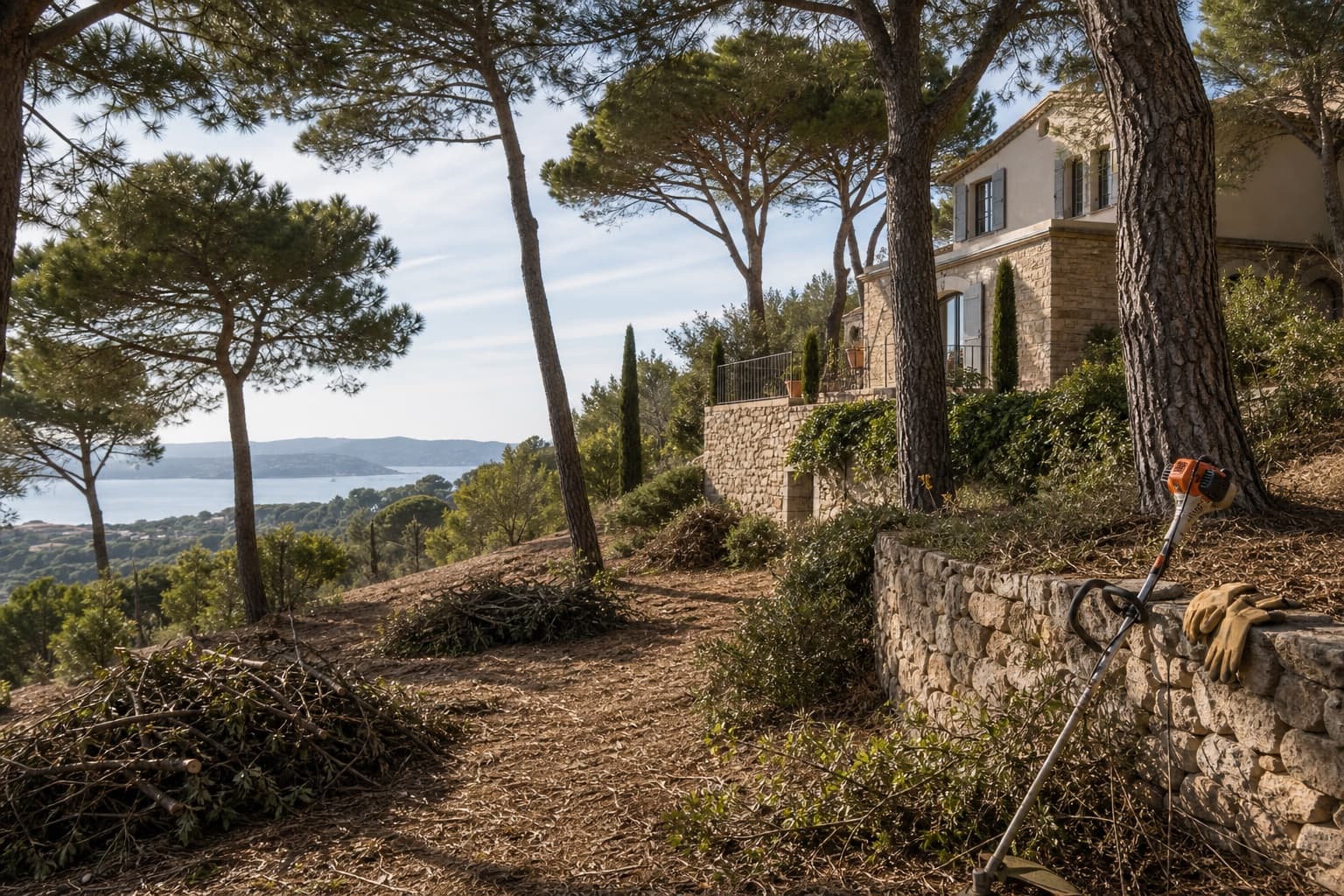
It is a little after seven on a morning in mid-May, and in the pine-wooded hills above the Gulf of Saint-Tropez a caretaker is walking the boundary of a property with a strimmer over his shoulder. The cicadas have not started yet. The air still holds the cool of the night, and the ground is already dry — dry in the way that the southern French hills are dry by May now, months before the old calendars said they should be. Around the house there is a band of cleared earth and pruned trees, the lower branches of the umbrella pines cut back, the scrub taken down to the soil. This used to be the gardener's least urgent task, something done in a leisurely way before the August heat. It is now the first job of the season, and it is carried out to a depth and a standard set not by the owners but by two parties they rarely think about: the préfecture, which enforces France's obligations légales de débroussaillement, and the insurer, who this year asked for dated photographs. The document that increasingly decides what a Mediterranean second home costs to own is no longer the estate agent's valuation — it is the insurance renewal letter.
This is the quietest of the structural shifts running through the European second-home market in 2026, and also one of the most consequential. For two decades the conversation around a Mediterranean property has been about price per square metre, rental yield and capital growth. Climate risk has now inserted a third variable into the arithmetic, and it arrives not as a headline but as a line item: a higher premium, a larger deductible, a fresh exclusion, a clause requiring brush clearance or storm shutters, and — in the most exposed pockets — a letter declining to renew at all. The European Insurance and Occupational Pensions Authority (EIOPA) has spent the past year documenting the scale of the problem; its April 2026 report, Insurance protection gaps in a changing climate, is unambiguous that households across Europe face higher premiums and a greater share of disaster costs falling on them directly. This post sets out what is driving the repricing, why the Mediterranean sits at the centre of it, and what it means for anyone weighing a second-home purchase this year.
The Protection Gap, in Numbers
The cleanest way to understand the 2026 picture is to start with how little of Europe's climate damage is actually insured. EIOPA's analysis finds that only around a quarter of natural-catastrophe losses in the European Union have been covered by insurance over recent decades — the rest absorbed by households, businesses and governments. The European Environment Agency has tracked weather- and climate-related economic losses across Europe running well into the hundreds of billions of euros since 1980, and the insured fraction has consistently sat near that one-quarter mark. On the demand side the figures are starker still: EIOPA's 2025 survey work found that only about 17 per cent of Europeans hold insurance covering property damage from natural catastrophes. This is the protection gap — the distance between what climate change is now costing and what is actually insured against — and it is the gap that insurers, regulators and, increasingly, buyers are all responding to at once.
A protection gap of that size does not stay stable as the underlying risk rises. It resolves in one of two directions: either coverage widens and premiums climb to reflect the true cost of the risk, or coverage narrows and the uninsured share grows. Across the Mediterranean in 2026, both are happening at once — premiums are rising for the property that remains straightforwardly insurable, the terms attached to those policies are tightening, and the worst-exposed addresses are quietly drifting toward being uninsurable on standard cover. For a second-home buyer, this is the single most important market development that does not yet show up anywhere in a price index.
Why the Mediterranean Sits at the Centre
The Mediterranean is not an average climate market. The basin is warming roughly 20 per cent faster than the global average, and the two hazards that the warming amplifies most directly — wildfire and sudden, violent rainfall — map almost exactly onto the landscapes that second-home buyers find most desirable. The pine-forested coastal hills, the scrubby headlands, the river valleys that drain steep ground to the sea: these are the postcard settings, and they are also the exposure. The evidence of the past two years is no longer abstract. In the summer of 2024, Greece recorded the hottest summer in its meteorological history, and wildfires on the fringe of Athens forced mass evacuations and destroyed homes. A month into the autumn, the DANA storm system over the Valencia region produced, in some areas, close to a year's rainfall in eight hours.
The Valencia event is the one that should concentrate a buyer's attention, because it shows what a single modern climate event now does to an insurance system. Economic losses ran beyond €20 billion. Insured losses passed €4 billion. Spain's Consorcio de Compensación de Seguros — the public compensation body that backs extraordinary risks — received more than 138,000 claims, of which over 43,000 were for residential dwellings, and absorbed an estimated 90 to 95 per cent of the regional bill. A preliminary scientific analysis concluded that the rainfall intensity had been made roughly twice as likely by the 1.3°C of warming the planet has already experienced. Storm Boris, a few weeks earlier, had already cost central European insurers an estimated €3 billion. None of this is a tail risk priced for some distant decade; it is the loss experience that 2026 premiums are being written against.
From Renewal Letters to Regulation
The repricing is arriving on two tracks at once. The first is the private market, and the clearest preview of where it leads is the United States, which sits two or three years ahead of Europe on the same curve. American home-insurance premiums rose by more than 40 per cent between 2020 and 2024, against cumulative inflation of roughly 22 per cent over the same period; in the most fire-exposed parts of California the insurer of last resort has sought a rate increase of 36 per cent; and one widely cited analysis estimates climate risk could erode $1.47 trillion of US real estate value over three decades. The European market is earlier in the same process, but the mechanism is identical — and it shows up first not in the headline premium but in the deductible, the exclusion, and the list of conditions an owner must satisfy to keep the policy alive.
The second track is regulation, and here the direction of travel is unmistakable. Spain already requires that extraordinary risks — floods, severe storms — be covered within every basic home-insurance policy, funded by a surcharge that flows to the Consorcio; it is the reason the Valencia response functioned at all. Italy has gone further for the commercial sector, making catastrophe cover compulsory for every business under its 2024 Budget Law and the 2025 implementing decree, with compliance deadlines that ran through to January 2026. Homeowners are not yet inside that Italian mandate — but few in the industry expect the residential carve-out to last indefinitely. At the European level, EIOPA proposed natural-catastrophe risk scores for individual buildings in December 2025, and in April 2026 set out, jointly with the European Stability Mechanism, a proposal for a Europe-wide risk-sharing mechanism to absorb the largest events. A buyer purchasing a Mediterranean property in 2026 is buying into a market whose insurance architecture is being actively rebuilt around them.
What It Means for the Second-Home Buyer
For anyone buying a whole Mediterranean property outright, the climate-insurance shift introduces three new exposures that the old price-per-square-metre conversation never captured. The first is premium volatility on the running line: insurance has moved from a small, predictable cost to one that can step up sharply at renewal and is no longer reliably forecastable five years out. The second is the resilience-management burden — the brush clearance, the drainage, the shutters, the dated photographs the insurer now wants, the claims process if the worst happens. That burden lands on an owner who, surveys of second-home use consistently show, spends fewer than thirty days a year at the property and is rarely on site when a contractor needs instructing. The third, and least discussed, is single-asset climate concentration: a full purchase places an entire second-home position on one hillside, in one micro-exposure, against one set of hazards. If that particular valley floods or that particular ridge burns, there is no diversification anywhere in the holding.
The Co-Ownership Answer
Co-ownership does not make climate risk disappear — no structure does — but it changes who carries the cost and the work, and it does so in a way that maps unusually well onto this particular problem. A COP property is held inside a limited liability company, with a buyer taking one-eighth of that company alongside seven other vetted co-owners and roughly 44 to 45 days of use each year. Insurance is simply one of the shared running costs of the property. For a quality Mediterranean villa whose full annual running costs — taxes, insurance, maintenance, management, pool and grounds — fall in the region of €18,000 to €32,000, each co-owner contributes only a small, equal share. Whatever the insurance line does at renewal, it is divided by eight rather than absorbed alone. Our how it works page sets out the structure, and the buying FAQs explain how shared costs are accounted for.
The management point matters as much as the cost point. The resilience work that insurers now demand — the seasonal brush clearance, the storm preparation, the documentation, the dialogue with the insurer, the claim itself if it comes — is precisely the off-season labour that the appointed management company already handles on a co-owned property. The owner does not field the renewal letter, does not chase the contractor, and does not stand in the cleared band of earth in May with a strimmer. And because a fractional position costs a fraction of a whole property, a buyer can hold shares across more than one market — a coast and a lake, a southern hillside and a northern valley — and so spread climate exposure in a way a single full purchase structurally cannot. Our analysis of the idle-asset problem develops the underutilisation argument, and our study of the 2026 prime-market divergence covers the wider supply picture these properties sit within.
The repricing of climate risk into Mediterranean property insurance is structural, not cyclical. It will not reverse, because the hazard it reflects is not reversing; EIOPA, the national regulators and the reinsurance market are all now planning around a permanently higher baseline. That does not make the Mediterranean a market to avoid — the basin remains one of the most desirable places on earth to own a second home, and the supply of genuinely good property in it remains tight. It makes it a market to enter with clear eyes. The buyers completing in 2026 are increasingly the ones who have read the insurance renewal letter as honestly as the valuation, and chosen to hold their Mediterranean property in a structure that divides the cost, delegates the work and spreads the exposure — rather than carrying all three alone.
For buyers weighing a Mediterranean purchase against this backdrop, COP carries live, professionally managed and fully insured inventory across the coasts and countryside of southern Europe. Browse the current selection on our our homes page, or speak with our team directly to understand how a specific property is insured, what its share price is in today's market, and how the running costs — climate line included — are structured and shared.
More from Co-Ownership Property
Get in Touch
Speak to an expert
Tell us what you're looking for and we'll be in touch.