Market Insights
Tuscany's Property Market Opens to Co-Ownership Buyers
For decades, owning in Tuscany meant committing millions to a property you would use for three weeks a year. A structural shift in how the market is priced — and how it is being bought — is changing that calculation for the first time.
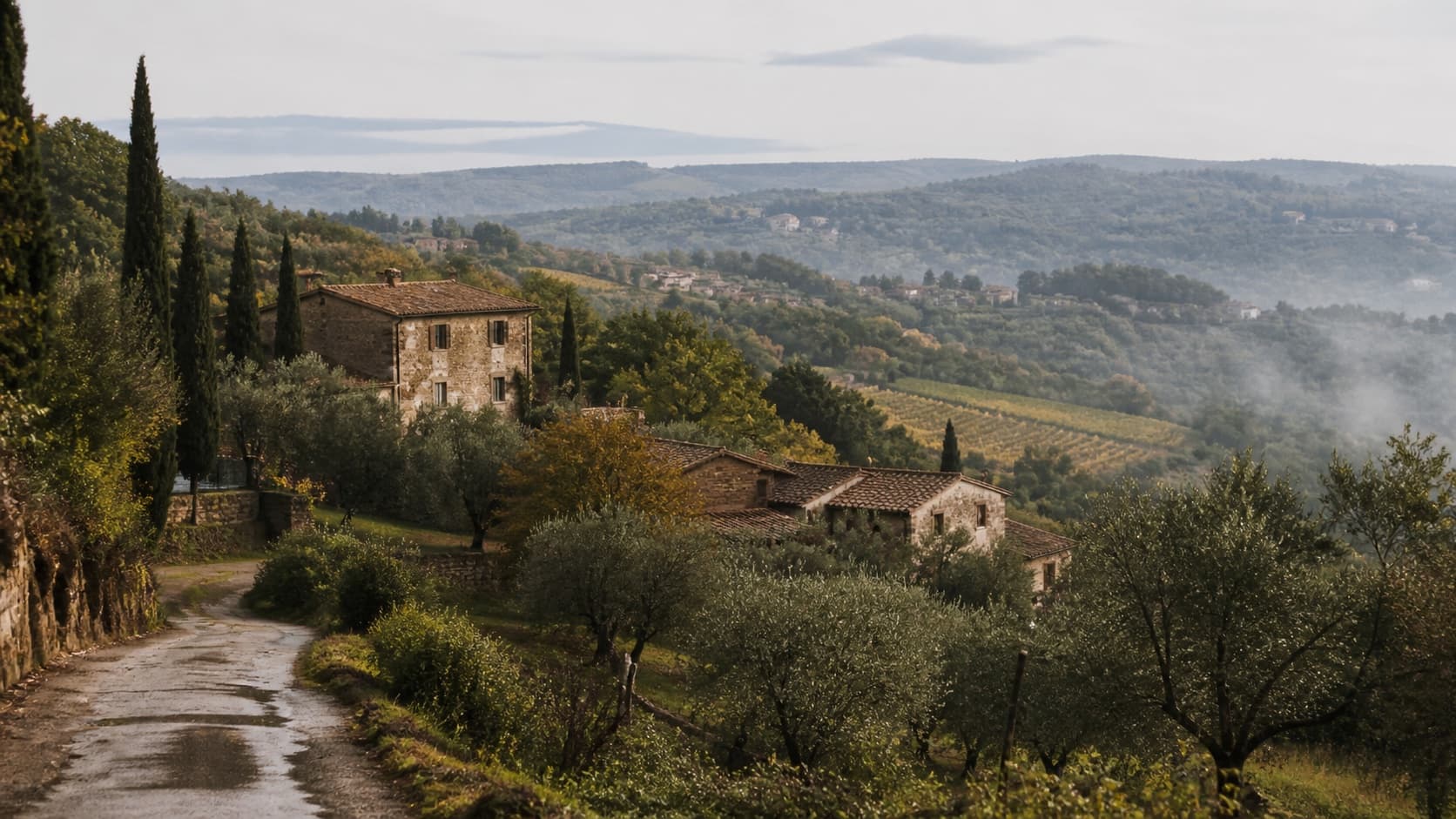
There is a particular conversation that happens regularly in the offices of Florentine estate agents. A couple arrives — British, American, occasionally German or Scandinavian — having spent two or three years thinking seriously about buying in Tuscany. They have done the research. They know the regions: the Chianti Classico corridor between Florence and Siena, the Val d'Orcia with its UNESCO-listed landscape, the Maremma coast, the Lucchesia hills. They understand what they want: a stone farmhouse or a converted villa, ideally with an olive grove, certainly with a view, within reasonable distance of a historic town. What stops them, in most cases, is not desire but arithmetic. The property they want costs €1.5 to €3.5 million. They will realistically use it for three to five weeks a year. The annual carrying costs — maintenance, property taxes, insurance, a caretaker — run €30,000 to €50,000 regardless of usage. The numbers, examined honestly, do not work for the lifestyle they actually want to live.
In 2026, that conversation is starting to end differently. The fractional co-ownership model — typically with eight co-owners, each owning a real one-eighth share of the home, and with the legal set-up explained in the property pack — is arriving in the Tuscan market at exactly the moment when the combination of high asset prices, rising carrying costs, and a generation of buyers who think in terms of usage rather than ownership for its own sake has made it a genuinely compelling alternative. This is not timeshare rebranded. It is real, legal, mortgageable property ownership — just shared intelligently among buyers who each want six weeks a year in a Tuscan property rather than fifty-two weeks of bills for three weeks of actual presence.
What the Tuscan Market Actually Looks Like in 2026
The Tuscan second-home market has been among the most consistently valued in Europe over the past two decades, with prices in the prime rural segments — Chianti Classico, Val d'Orcia, the Lucchesia — holding and growing through every cycle that has rattled more liquid markets. The structural reason is supply constraint: Italy's historic farmhouse and villa stock is finite, conversion rules are strict, and the combination of international buyer demand and Italian heritage preservation law has kept quality inventory scarce across all price points.
In the prime rural segments, a casale or podere of genuine quality — stone construction, conversion by a competent architect, three to five bedrooms, olive grove or vineyard, pool with a view — now enters the market at €900,000 at the absolute floor, with the sweet spot of supply concentrated between €1.5 and €4 million. The most exceptional properties — fully restored medieval farmhouses on elevated Chianti hillsides, or Val d'Orcia estates with multiple structures and working agricultural land — transact above €5 million and are increasingly sought by buyers from the Gulf, the United States, and Northern Europe for whom Tuscany represents a relatively accessible alternative to Provence or the Italian Lakes.
The millionaire migration data of 2025 and 2026 is relevant here. Italy has deliberately positioned itself as a destination for high-net-worth individuals through a series of tax incentives — the €300,000 flat tax for new residents transferring after 11 August 2024, the non-domicile regime, and the Beckham Law equivalent for returning Italians — that have attracted a significant new buyer class to the Italian property market. This has not reduced prices in Tuscany. If anything, it has introduced a new category of buyer — the relocated resident rather than the pure holiday buyer — who is willing to pay above the historical comfort zone for properties within commuting distance of Florence or Siena.
The Regions That Matter
Chianti Classico remains the benchmark. The zone between Florence and Siena — where the DOCG wine appellation overlaps with the most desirable rural property market in Italy — has the deepest international buyer pool and the most consistent transaction history. Properties here attract buyers who combine lifestyle motivations with long-term capital logic: the area is globally recognised, permanently liquid, and benefits from the sustained international interest in Tuscany that Florence-to-Siena tourist flows generate year-round.
Val d'Orcia is UNESCO World Heritage-listed and has a landscape — the cypress-lined roads, the hilltop villages, the rolling wheat and sunflower fields — that is among the most photographed in Europe. Properties here carry a prestige premium and tend to attract buyers for whom the landscape itself is the primary motivation. Supply is genuinely constrained by the heritage designation, which prevents most new development and keeps the existing stock highly valued. Prices in the Val d'Orcia's most sought-after communes — Pienza, Montepulciano, Montalcino — have risen consistently over the past decade and show no sign of correction.
The Maremma — coastal Tuscany south of Grosseto — is the relative value play. Less globally marketed than Chianti or the Val d'Orcia, less crowded in August, and with a coastline (the Argentario, Castiglione della Pescaia, the Laguna di Orbetello) that has no equivalent in the interior regions. Prices here remain below Chianti for comparable rural property, and the combination of coast access and Tuscan interior makes the Maremma increasingly attractive to buyers who have looked at the inland premium and concluded that the water justifies the compromise.
Why Fractional Ownership Makes Particular Sense in Tuscany
The usage reality of Tuscan holiday property ownership is stark. Italian property analysts consistently show that the average foreign buyer of a rural Tuscan property uses it for between three and six weeks per year. The remaining forty-six to forty-nine weeks, the property needs maintenance, security, garden care, pool management, and — if it is generating rental income — the management infrastructure of a professional letting business. The carrying cost of a €2 million Tuscan farmhouse, across all of these line items, is realistically €40,000 to €70,000 per year before any mortgage costs. That is the bill for being a Tuscan property owner. The bill for actually being in Tuscany — approximately four weeks per year — is something considerably less dramatic.
A one-eighth co-ownership share in the same €2 million property costs approximately €250,000 to €300,000, with all legal, notarial, and transfer fees included in the share price. The annual carrying cost — property taxes, insurance, maintenance, pool, garden, management — is split across eight owners: €5,000 to €8,750 per year per share. The annual usage allocation is approximately 44 to 45 days — more than the average full owner uses their property, at a fraction of the capital commitment and a fraction of the annual overhead. The management company handles every aspect of property maintenance. The co-owner arrives to a prepared property and leaves without a list of maintenance tasks.
For buyers who have wanted Tuscany for years but found the full ownership model difficult to justify — too much capital, too much overhead, too little actual usage — this arithmetic changes the conversation fundamentally. The question is no longer whether you can afford to own in Tuscany. It is whether you can get a share in the right property.
The Legal Structure and What It Means
With co-ownership in Italy, you own a real share of the home — an eighth, a quarter — not a right to use it. You can sell it, pass it on to your heirs, and it rises and falls in value with the house. The legal set-up is arranged by our partner for each home and walked through with you before you buy. It is not a rental agreement, a timeshare, or a right of occupation. It is ownership, structured to work for eight parties simultaneously.
The management company handles all scheduling, maintenance, and operational aspects. Co-owners receive their annual usage calendar, pay their proportional share of costs, and use the property according to the agreed schedule. Exit is straightforward: a co-owner wishing to sell their share can do so on the open market, after the other co-owners have had the first chance to buy at the seller's price. The resale market for co-ownership shares in desirable Tuscany properties is developing rapidly as the model gains recognition.
What a Season in Tuscany Actually Looks Like
The Tuscan calendar for a co-owner with 44 to 45 days per year divides naturally. A week in late April or early May — the truffle season in San Miniato, the wildflowers in the Val d'Orcia, the Florentine spring before the summer crowds — for a couple who want the cultural programme without August temperatures. Two weeks in June or early July for the vine flowering, the aperitivo evenings on the terrace, the long golden light that the region does better than anywhere in Europe. A further week or ten days in September and October — the harvest, the new wine, the chestnuts, the olive picking in November if the calendar permits. This is not an unusual or aspirational Tuscany; this is the Tuscany that the people who love it most actually seek out, and it is the pattern that co-ownership, with its flexible calendar agreed among eight compatible owners, is particularly well suited to support.
COP has current co-ownership inventory in Tuscany alongside properties across the wider Italian market including Lake Como, Sardinia, and the Italian portfolio. Browse the full current listings or speak with the team directly to understand which Tuscan properties are currently available and what a one-eighth share would cost in the current market.
More from Co-Ownership Property
Get in Touch
Speak to an expert
Tell us what you're looking for and we'll be in touch.