Co-Ownership Basics
How the Co-Ownership Calendar Works: Sharing a Year
How eight families actually share 365 days — the rotation, the peak weeks, the booking horizons, and the software that holds the whole system together.
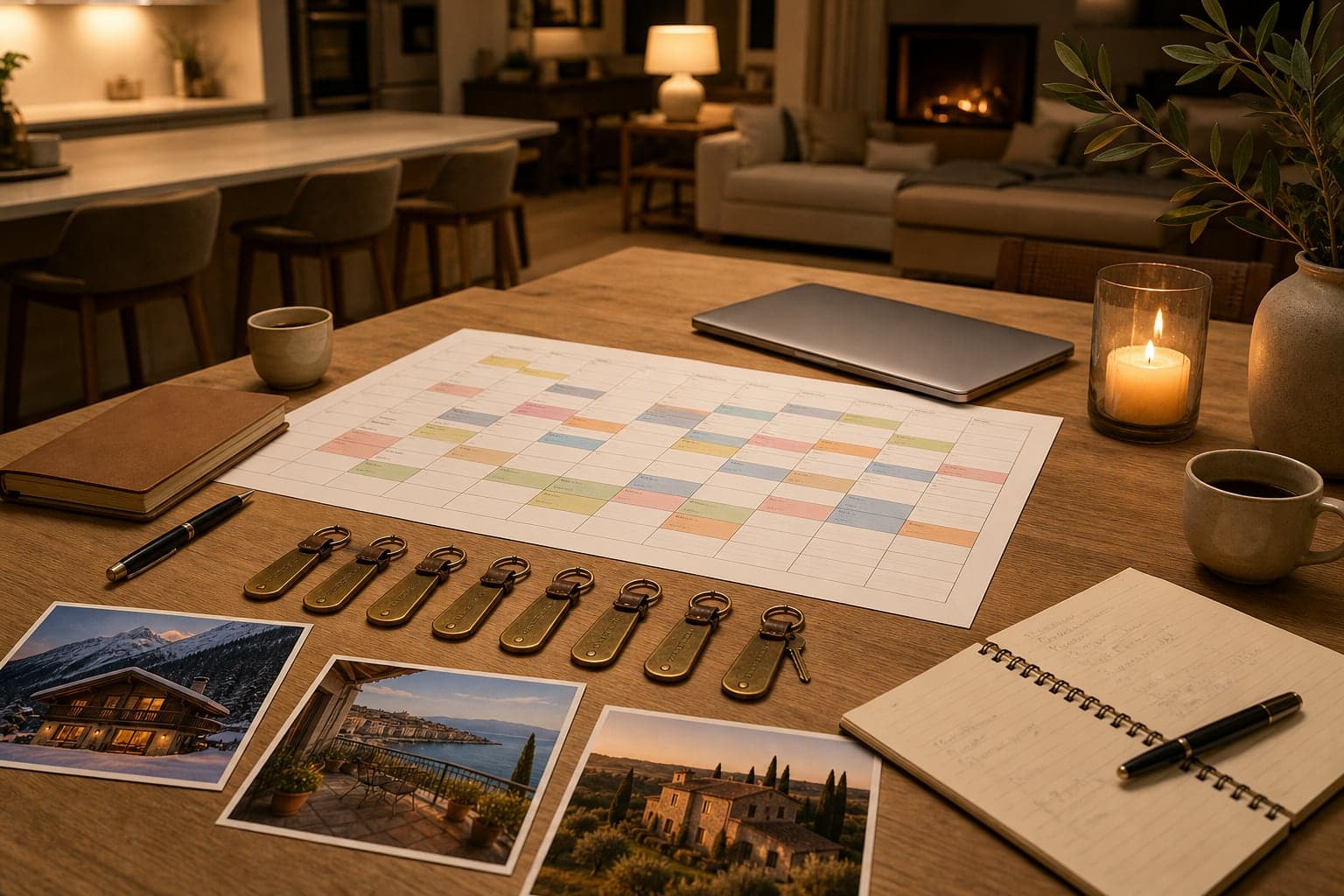
It is half past eight on a Sunday evening in January, and somewhere in the home counties a couple are sitting at the kitchen table with the calendar app open on a laptop. The husband has a notebook beside him with a list of dates: the school half-term in February, his mother's eightieth in May, the firm's quiet week in late August, the Friday in October when the truffle festival opens in San Miniato. The wife scrolls through the booking interface, picks the second week of February for the property in the French Alps, drops the late-August fortnight onto the apartment in Mallorca, and pencils in October half-term — which is exactly when the truffle festival runs — for the farmhouse in Chianti. Total time booked: about six weeks, across three properties. All of it secured eighteen months in advance. None of it overlapping with any of the other co-owners. This is what the co-ownership calendar actually does — and it is, for most prospective buyers, the most under-explained part of how the model works.
Most buyers come to co-ownership with a usage question rather than a financial one. They understand that one-eighth of a property is cheaper than the whole property, and that one-eighth of the running costs is cheaper than all of them. What they do not always understand, and what the brochure descriptions tend to gloss over, is the practical mechanics of how eight families actually share a single house across 365 days a year without anyone feeling shortchanged. The answer is more sophisticated than "first come, first served," and considerably more rigorous than the way most multi-family second homes are informally shared today. It is, in fact, one of the most carefully engineered parts of the product — the result of a quarter-century of trial and error in the luxury fractional and private residence club industry, refined into a software-driven booking system that gives every co-owner a fair share of the year, the peaks and the quiet weeks alike. Our how it works guide outlines the structure end-to-end; what follows is how the calendar specifically operates inside it.
The Basic Arithmetic: 44 Days, Divided Fairly
The headline number for an eighth-share is 44 to 45 days of annual usage per owner. That figure is not arbitrary. A 365-day year divided by eight is 45.6, with the remaining days held in reserve for changeover cleaning, owner maintenance windows, and the small operational gaps that any well-run property needs between guests. Each owner's annual entitlement is therefore roughly six weeks — but the design challenge is not the arithmetic, it is the seasonality. Forty-four days of August in Mallorca is a categorically different proposition from forty-four days of November in the Luberon, and a fair calendar has to account for the fact that some weeks are objectively more valuable than others.
The standard solution, used by every credible co-ownership company, is to split the year into three tiers. Peak weeks are the small handful of dates where demand is genuinely concentrated — Christmas and New Year, school summer holidays, half-terms in destinations close to school catchments, and the local high points that depend on the property: the festival fortnight on the Côte d'Azur, the white truffle weeks in Tuscany, the February ski peak in the Alps. Shoulder weeks are the soft periods on either side of those peaks, when the weather is excellent but the rental crowds have thinned — late September on a Mediterranean coast, the first week of November in the Luberon, the last warm weekend of October in Chianti. Off-peak weeks are the quieter months — late November, January outside the ski catchment, early March on a Mediterranean island. A well-designed eighth-share is allocated a structured mix of all three — typically something close to two peak weeks, two shoulder weeks, and two off-peak weeks as its starting point each year, with flexibility to swap, trade and reschedule after that.
Three Booking Systems — and Why the Hybrid Model Won
The luxury fractional industry has tested three distinct frameworks over the past three decades, each with characteristic strengths and weaknesses. Understanding which one a co-ownership company uses is one of the first questions a prospective buyer should ask, because the booking architecture more or less determines what the experience of ownership feels like in practice.
The first is fixed rotation. In a strict rotation system, eight owners are assigned every eighth week of the year on a permanent schedule — Owner A always takes weeks 1, 9, 17, 25 and so on; Owner B takes 2, 10, 18, 26; and the rotation shifts forward by one slot each year so that every owner cycles through every week of the calendar over an eight-year period. Fixed rotation has the virtue of total fairness in the abstract — given enough years, everyone gets every week — but the obvious vice of total inflexibility in practice. If your prime week happens to land on a school exam week, or on the wrong side of a work commitment, you simply do not get to use it that year.
The second is the pure reservation system. Every autumn, owners log into the platform to choose their weeks for the following year, with a rotating priority order so that whoever picked last this year picks first next year. This is more flexible than rotation but creates anxiety: peak weeks are claimed in the first hour the system opens, and an owner whose priority is low in a particular year may feel they have effectively lost out for twelve months.
The third is the hybrid model, which is what serious companies have converged on. A hybrid calendar guarantees each owner a small fixed allocation each year — typically the two peak weeks and one or two shoulder weeks — with the remaining weeks booked through a rolling reservation system. The fixed allocation rotates forward every year, so the owner who gets Christmas this year takes New Year next year and the family ski week the year after that. The flexible weeks are bookable in real time through a software platform, often with windows that open as much as 24 months in advance of the date. This combination — guaranteed peak fairness plus flexible booking for the rest of the year — has become the industry standard because it solves the two problems that all other models leave unresolved: it guarantees each owner gets a share of the prime weeks, and it lets families plan around school terms, work calendars and family events without having to wait their turn.
How Peak Weeks and Holidays Are Handled
The single most asked question by prospective co-owners is some version of "But what if everyone wants Christmas?" The answer is that nobody gets every Christmas, and everyone gets some Christmases — and the rotation that makes this work is one of the most carefully designed parts of the whole system.
A well-run co-ownership company treats high-demand holiday windows — Christmas and New Year, Easter, the August fortnight, the February school break — as rotating peak slots rather than first-come-first-served bookings. Each owner is guaranteed access to at least one major holiday window per year, and the holiday they get rotates on a published schedule. An owner who has Christmas this year takes Easter next year and the August fortnight the year after that. Over an eight-year cycle, every co-owner has had every major holiday at least once, in a fixed order known to everyone on day one. The rotation is set at the outset, written into the co-ownership agreement that governs the property, and visible to all owners on the booking platform — there is no horse-trading, no first-mover advantage, and no scope for the most assertive owner to capture the prime weeks year after year. Multi-generational planning around these slots is one of the most appreciated features of the model — see our piece on multi-generational holidays in co-ownership homes for how families typically build their year around the rotation.
Long Horizon, Short Horizon: The Two Booking Windows
Modern co-ownership platforms operate two simultaneous booking horizons. The long horizon opens 18 to 24 months in advance for the fixed peak and shoulder weeks — long enough to lock in a school holiday two years out, build it into your annual schedule and book flights at the cheapest end of the airline release window. This is when most owners do their major calendar planning, typically in a single sitting in early January for the year ahead, often in the same sitting in which they coordinate dates with extended family.
The short horizon is for the unplanned trips that turn out, in practice, to be one of the most valuable features of co-ownership. Most platforms allow owners to book any unclaimed dates on as little as two or three days' notice. A weekend in Mallorca on a Friday morning whim. A long weekend in Provence to escape London at the back end of October. A snap visit to the Alps because the snow is unexpectedly perfect in the second week of January. The unclaimed-week pattern is one of the under-recognised advantages of the structure: because no one owner can hoard the full year, there are almost always quiet midweek and shoulder-season windows that any co-owner can claim on a few days' notice without anyone else losing access. Our staying in my co-ownership property FAQs cover the booking mechanics in operational detail, including how check-in, key handover and concierge requests work in practice.
What Happens When There Is Genuine Contention
Real conflict over a single specific week is rarer than prospective buyers tend to assume, because the rotation already does most of the work. But it does occasionally happen, and the way a serious company handles it tells you most of what you need to know about the discipline of the platform.
The first mechanism is structural: the holiday rotation already guarantees that no two owners are ever simultaneously the top-priority claimant for the same peak week. The system is built so that contention for the most contested dates is allocated in advance, not negotiated in real time. The second mechanism is trade-based: most platforms allow owners to swap weeks with each other inside the calendar, and an owner who wants a particular date can offer one of their other weeks in exchange. In practice this works well because, as the established Mallorca and Tuscany ownership cohorts have shown, most groups of eight families discover that they naturally want different weeks — the family with school-age children weights toward summer, the retired couple toward October and the off-season, the city-based professional toward midweek work-from-anywhere stays. The third mechanism is the management override: in the rare case where two owners genuinely cannot resolve a conflict, the management company has authority under the co-ownership agreement to allocate the week to the higher-priority owner in that year's rotation and to compensate the displaced owner with a similar-quality week elsewhere on the calendar. Disputes of this kind are vanishingly rare in practice because the rotation is doing its job. The system is designed so that the management company almost never has to intervene.
The Software That Holds It All Together
A well-run co-ownership platform looks, from the owner's side, much like a domestic flight booking app. Owners log in to a personal dashboard that shows their fixed allocations for the next twelve and twenty-four months, the current rotation order, the unclaimed weeks available for short-notice bookings, and the trade requests other owners have posted. They can claim weeks, swap weeks, request property-management services for an upcoming stay — pre-stocked fridge, airport transfer, additional cleaning ahead of a family gathering — and review their share of the running cost statement, all from the same interface. The same software powers the management company's operational view, ensuring that no week is ever double-booked, that changeover cleans are scheduled into the gaps between owners, and that any maintenance windows are visible to everyone. The whole point of the platform is that the calendar runs itself. Owners do not negotiate with each other. They book.
This is, ultimately, what most distinguishes a properly structured co-ownership share from the informal multi-family second homes that have existed for generations. Holiday homes shared between extended families are a chronic source of low-grade resentment — who got the August fortnight, why your cousin always seems to have the Christmas week, the slow drift toward whoever is most assertive claiming the best dates. The co-ownership platform replaces all of that with software, a published rotation and a written co-ownership agreement that nobody can quietly bend. Every owner gets a fair share of every kind of week. Every owner can plan well ahead and still grab a quiet midweek at short notice. The result, after a year or two of use, is a calendar that feels less like a competing-claims problem and more like a piece of infrastructure — the operational scaffolding that makes the rest of the lifestyle possible.
The Case for Looking Carefully Before You Sign
The calendar is the part of the co-ownership product that most repays a careful look before signing. The right rotation discipline, the right software platform and the right management oversight are the difference between a co-ownership share that genuinely feels owned and a share that feels like a glorified booking lottery. The questions worth asking before committing capital are specific and answerable: Is the model fixed rotation, pure reservation, or hybrid? How are the major holiday windows allocated, and on what published rotation? How far in advance can an owner book, and how short-notice can they book? Are trades and swaps between owners permitted, and how are they recorded? What is the management company's authority to override in genuine contention, and how often is that authority used? Our due diligence checklist for co-ownership buyers walks through the specific calendar questions a prospective owner should ask, and our buying a co-ownership property FAQs cover the underlying agreement structure that makes the booking system enforceable rather than aspirational.
For anyone evaluating a co-ownership share — in the Alps, on a Mallorcan finca, in a Tuscan farmhouse, on a Provençal mas — the calendar is the daily reality of what ownership actually feels like. The properties matter, the destinations matter, the price per share matters. But the booking architecture is what determines, every week of every year, whether a one-eighth share is the relaxed and frictionless thing it is supposed to be or a slow-burn source of family negotiation. Done well, it is the quiet engineering that turns shared ownership into a second life. Browse our homes to see what is currently available across the destinations, or speak with our team directly to walk through how the calendar would work for a specific property and the way you would actually use it through the year.
More from Co-Ownership Property


Get in Touch
Speak to an expert
Tell us what you're looking for and we'll be in touch.