Properties & Destinations
Green Spain: Asturias and Cantabria for Co-Ownership
As the Mediterranean overheats and prices itself out of reach, Spain''s Atlantic north is quietly becoming the continent''s most intelligent second-home bet — and co-ownership is the most sensible way in.
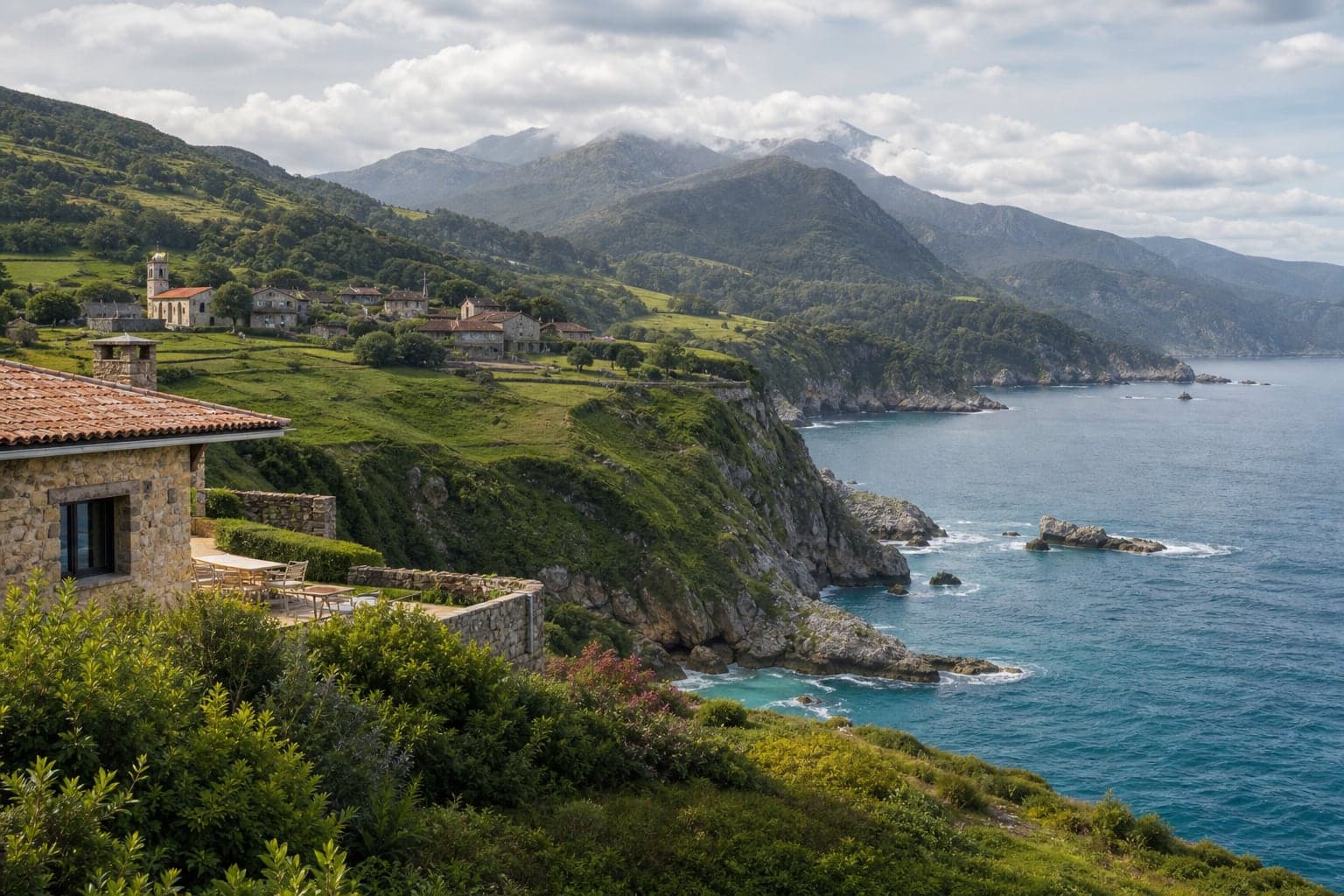
Begin with a contradiction. The most talked-about coastline in Spain this decade is not the one drawing the crowds. While the Costa del Sol and the Balearics absorb record visitor numbers, record temperatures and a rising tide of restrictions, a different Spain has been gathering quiet momentum two countries'' worth of coastline to the north. Along the Bay of Biscay, where the mountains fall almost into the sea and the hills stay green through August, the provinces of Asturias and Cantabria are doing something the Mediterranean increasingly cannot: offering space, cool air and unhurried authenticity at a fraction of the southern price. This is the Costa Verde — Spain''s Green Coast — and in 2026 it has become the country''s most compelling argument for owning a second home without owning all of it.
The term Green Spain is not a marketing invention of the last few summers. It was registered as a territorial brand in 1989 by Galicia, Asturias, Cantabria and the Basque Country, with the backing of the national tourist board, precisely to position the Cantabrian coast as an alternative to the sun-baked south. For three decades that alternative remained a domestic secret — beloved by Spaniards from Madrid and the Basque cities, largely unknown to the international buyer. What has changed is the rest of Europe. As heat, water stress and over-tourism reshape the calculus of the Mediterranean, the cool, wet, dramatic north has acquired a new logic. Co-ownership — owning one-eighth of a quality coastal home, alongside seven other vetted co-owners, with roughly 44 to 45 days of personal use a year — is the structure that turns that logic into something a buyer can actually act on. This is what the Green Coast offers, and why owning a share of it makes more sense than most people realise.
The Coolcation Coast: Why the North Is Now the Prize
The travel industry has given the trend an ugly word — the coolcation — but the underlying shift is real and durable. As southern Europe records summers that increasingly cross from pleasant into punishing, a growing share of travellers and second-home buyers are deliberately seeking cooler latitudes. The Cantabrian coast answers that brief almost perfectly. Summer temperatures along the northern shore typically sit between 20 and 25 degrees Celsius, tempered by an Atlantic breeze that never quite lets the air go still. The sea is bracing rather than balmy — around 20 to 21 degrees in July and August — but for a swimmer arriving from a heatwave further south, that is a feature, not a flaw.
The geography is the rarest part. Nowhere else in Spain do high mountains and open ocean sit so close together. The Picos de Europa — a compact, vertical limestone range shared between Asturias, Cantabria and León — rise to peaks above 2,600 metres just 20 kilometres from the coast. That proximity collapses the usual choice between a beach home and a mountain one. A co-owner can surf a river-mouth break in the morning and be walking a glacial gorge by early afternoon, then back at the house for dinner. It is also why the region stays green: the same Atlantic systems that keep the hills lush keep the crowds, and the heat, at bay. Where a Mediterranean owner increasingly plans around when it is too hot to be outside, an owner on the Costa Verde plans around the light. For buyers who want to understand how a shared calendar accommodates that kind of flexible, season-led use, our staying FAQs set out exactly how the year is divided.
What a Typical Week Looks Like
Consider a week in Llanes, the most beautiful of Asturias''s coastal towns. A medieval fishing port wrapped around a working harbour, it sits beneath the Sierra del Cuera with a string of small, cliff-backed coves — playas like Toró and Ballota — within a few minutes'' drive. The rhythm of a co-owner''s day here owes nothing to a resort. Mornings might begin at the indoor market for cabrales, the pungent blue cheese cured in mountain caves, and bread still warm from the bakery. The middle of the day belongs to the coast or the mountains. The evening belongs to cider. Asturias pours its famous sidra the traditional way — the bottle held high overhead, the stream aerated against the glass — in chigres that have served the same families for generations. A four-bedroom villa with a garden in Llanes places all of this within reach, and as co-owned property rather than a rental, it is yours to settle into rather than merely visit.
A little to the west, Ribadesella reads differently again — a town split by the estuary of the Sella, with a long crescent of town beach on one side and a colourful old quarter of indiano mansions on the other, built by Asturians who made fortunes in the Americas and came home to spend them. It is the finish line of the Descenso del Sella, the international canoe descent that fills the river with paddlers and the banks with cider every August. A week based at a four-bedroom house with a pool near Ribadesella can fold in the prehistoric painted caves at Tito Bustillo, a UNESCO World Heritage site, and a drive inland to the Picos without ever feeling rushed.
Cross into Cantabria and the coast softens slightly without losing its drama. San Vicente de la Barquera, a fishing town strung between two estuaries with the snow-streaked Picos as a backdrop, is among the most photographed views in northern Spain. The surfing here is some of the most consistent — and least crowded — in Europe; Asturias alone counts close to 30 surf spots, including the river-mouth wave at Rodiles that locals describe, only half in jest, as a smaller Mundaka. A four-bedroom house with a fireplace in San Vicente de la Barquera is built for exactly the kind of week the north does best: cool mornings, long walks, an open fire in the evening even in summer, and a table of grilled fish that came off a local boat that morning. This is not a holiday in the brochure sense. It is the slower, greener second life that the region quietly specialises in.
The Management Reality: What You Don''t Have to Think About
A house in a damp northern climate demands more attention than a Mediterranean apartment, not less. Gutters, garden growth, the wood-burner, the slow work that Atlantic weather does on stone and render — none of it stops because the owners are abroad for ten months of the year. This is precisely where co-ownership earns its keep. A professional management company handles the maintenance, the insurance, the local property tax (IBI), the utilities and the seasonal upkeep. Co-owners deal with none of it directly. They receive a single annual account, pay their proportional one-eighth share of running costs, and arrive to a house that has been aired, cleaned, heated and prepared before they walk through the door.
The arithmetic follows the same one-eighth logic as the use. Because you own a share of the property, you pay a share of everything it costs to run — never the whole. For most buyers that is the moment the idea shifts from appealing to obvious: the burden that makes a far-flung northern bolt-hole impractical for a sole owner is exactly the burden that a co-ownership structure is designed to dissolve. The full mechanics, from how shares are priced to how costs are apportioned, are laid out in our how it works guide, and the practical questions buyers ask most often are covered in the buying FAQs.
Green Spain''s Property Market in 2026: Value the South No Longer Offers
The market context is where the northern case becomes genuinely persuasive. Spanish housing has entered a sharp upcycle: the national index from the statistics office (INE) showed prices roughly 13 per cent higher year-on-year in early 2026, the valuation firm Tinsa recorded a 14.3 per cent annual rise in completed-home values, and the average asking price on idealista reached about €2,673 per square metre. BBVA''s research arm expects prices to climb a further 7 per cent across 2026. The steepest increases, however, are concentrated where they have been for years — Madrid, the Valencian Community, the islands and the southern costas.
Against that backdrop, the north still reads as value. The average house price in Asturias sits at roughly €1,500 per square metre — well under the national asking average and a long way below prime Balearic or Costa del Sol figures that now run into the multiples of thousands. The reason is not that the Costa Verde is unloved; it is that the region''s protected landscapes and strict building rules have kept mass development at bay, preserving the very scarcity that tends to defend long-term value. For a buyer, that combination — lower entry prices, constrained supply, rising national tide and a climate-driven shift in demand toward cooler coasts — is an unusually favourable alignment. A one-eighth share in COP''s northern-coast homes currently starts from around €135,000, a real ownership position on one of the few European coastlines that still feels early. The full range sits within the wider Spanish collection.
The Co-Ownership Case for the Costa Verde
What the Green Coast ultimately sells is not weather or price but a different relationship with time. The Mediterranean second home has become, for many owners, a thing to be managed — a calendar of heat, licences, contractors and crowds. The northern home asks for something gentler: presence across the seasons, walks regardless of the forecast, a fire in July, a table of cider and cheese, the same harbour growing familiar over years rather than a fortnight. Spread over five or six visits a year, that accumulates into a second life rather than a sequence of holidays — and it does so in a part of Europe that climate and demographics are pushing toward, not away from. Co-ownership is simply the most rational way to hold it: full use of the place that matters, none of the dead weight of sole ownership, and a real stake in a market that still has room to run.
See the homes behind this guide. Explore the live Cantabria co-ownership share in San Vicente de la Barquera and the Asturias villa in Llanes, browse the full current listings, or speak with our team about what a share on Spain''s Green Coast would cost in today''s market.
More from Co-Ownership Property
Get in Touch
Speak to an expert
Tell us what you're looking for and we'll be in touch.