Properties & Destinations
Palau, Sardinia: A Sea-View Three-Bed Facing La Maddalena
COP''s newest Italian listing is a brand-new, three-bedroom garden apartment in Palau, on Sardinia''s Gallura coast — a shared pool and a private terrace looking across to the turquoise national park of La Maddalena, the beach steps away and Porto Cervo half an hour east — offered as a real one-eighth share at €219,000, at the gateway to one of the Mediterranean''s most protected stretches of water.
The most famous coast in Sardinia is a marketing invention. The Costa Smeralda — Porto Cervo, the yachts, the €15,000-a-square-metre villas — was conjured out of empty Gallura scrubland in the 1960s by a consortium led by the Aga Khan, and it remains the island''s glittering shopfront. But drive twenty minutes west, past Cannigione and around the headland, and you reach the part of this coast that was already there: Palau, a working harbour town facing an archipelago that has been a national park since 1994. This is where the ferries go — not to a resort, but to seven protected islands of white sand and impossibly clear water. It is here, a few kilometres from the Costa Smeralda and a world away from its prices, that COP''s newest listing sits.
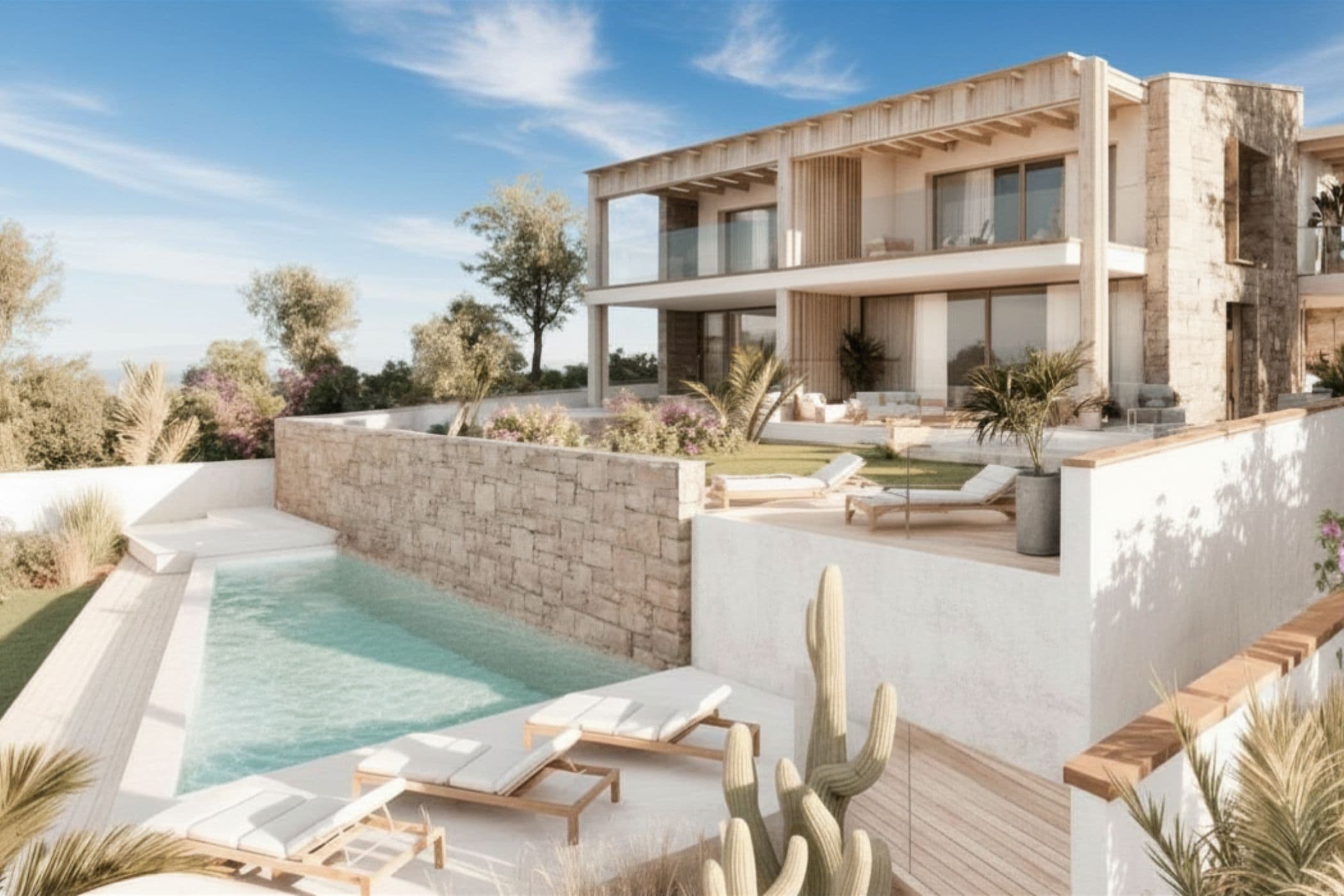
The property is a brand-new, three-bedroom garden apartment in a landscaped residential complex above Palau, its living space opening onto a private terrace and a sea view that reaches across to the La Maddalena Archipelago. It comes to market as a one-eighth co-ownership share at €219,000, a real share of the home owned alongside seven other vetted co-owners, with an annual usage entitlement of roughly 44 to 45 days a year. What distinguishes a home of this kind is less the footprint than the position: a shaded garden terrace for slow Sardinian mornings, a shared pool set into the surrounding nature, the beach a few steps from the complex, and the harbour — with its ferries to a marine park — within walking distance. The structure that makes a real share of an address like this accessible at this price is set out end-to-end in our how it works guide.
What the Property Actually Is
The apartment is a three-bedroom, two-bathroom new-build, delivered to current technical and energy standard in a beautifully landscaped complex — which on this coast is a meaningful distinction. Much of Gallura''s coastal stock is either dated 1970s and 1980s holiday development or ultra-prime villa product priced for a different buyer entirely; a genuinely new, well-built apartment in the middle ground is comparatively scarce. The layout is organised around the outdoors, in the way the Sardinian summer demands. A private garden terrace flows straight out from the living space — a shaded, green retreat rather than a balcony — and beyond it the shared pool looks out over the surrounding maquis toward the water.
The view is the asset that no floor plan captures. From the terrace the sea opens toward the La Maddalena Archipelago, the protected sweep of islands and lagoons that gives this stretch of coast its particular light. The apartment is delivered turnkey — furnished, equipped and ready — so a co-owner arrives with hand luggage rather than a fit-out project, and the feature that appears in no photograph is the one that matters most to anyone who has owned a seasonal home outright: between visits, someone else looks after it. The pool, the garden, the shutters closed against the winter salt air, the reset between one owner''s week and the next — all of it is handled. How each owner''s stays are scheduled, and how the apartment is cleaned and prepared between arrivals, is covered in our staying in your co-ownership property FAQs.
A Palau Address, at the Gateway to a National Park
Palau''s defining feature is what lies just offshore. From the town harbour, ferries cross to the island of La Maddalena in about twenty minutes, running up to thirty times a day in high season — the gateway to the Parco Nazionale dell''Arcipelago di La Maddalena, a protected marine and terrestrial park of seven main islands and dozens of smaller ones, established in 1994. Beyond La Maddalena town, a causeway leads to Caprera, the wooded island where Giuseppe Garibaldi spent his last years and is buried; further out lie Budelli, with its famous rose-tinted Spiaggia Rosa, and the anchorages that make this one of the Mediterranean''s great sailing grounds. Across the Strait of Bonifacio, the white cliffs of Corsica are visible on a clear day. This is a shoreline consumed by boat as much as by car, and Palau is its natural base.
Yet the address is not remote. Porto Cervo and the heart of the Costa Smeralda are about 30 kilometres east — some thirty minutes by car — close enough for a dinner or a day among the yachts, far enough that Palau keeps its own unhurried, year-round character rather than shuttering out of season. The town itself has the working infrastructure a resort lacks: shops, restaurants along the harbour, a market, the everyday rhythm of a place people actually live. Crucially for a home used in a few concentrated weeks a year, it is easy to reach: Olbia Costa Smeralda airport sits about 45 kilometres away, roughly a 45-minute drive, with direct seasonal flights across Europe. From the terrace of a garden apartment above Palau, the whole of it — the ferry, the beaches, the Costa Smeralda, the airport run — resolves to the easy scale a co-ownership calendar is built around.
Forty-Five Days a Year, and What That Looks Like
The one-eighth share entitles its holder to roughly 44 to 45 days a year, and a Sardinian coastal home is used differently from a city flat — in week-long blocks, the natural unit of a proper island stay. With eight families sharing, the scheduling question is rarely whether to take shoulder-season time but which weeks to claim. The brochures sell August, when the Costa Smeralda is at its most crowded and expensive; the people who own here use the edges of the season. June, when the sea has warmed but the archipelago''s beaches are still quiet and bookable. September, when the water is at its warmest of the year and the day-trippers have thinned. Late May and early October, when the maquis is in flower or the light goes long and gold and a boat can still be taken out in shirtsleeves. The calendar is agreed among the co-owners through the management company, and in practice most groups find their preferred weeks naturally diverge.
That figure — forty-five days — is worth holding against the alternative. Surveys of second-home use across the northern Mediterranean consistently find that the average foreign owner spends fewer than a month a year in a property held outright, while paying twelve months of standing costs, management and worry for the privilege. The one-eighth structure inverts the arithmetic: the co-owner pays for the days they will actually use, in a home that is professionally managed and ready on arrival, and leaves at the end of the week without a list of things to follow up. For a seasonal coastal apartment in particular — where salt, sun and an empty off-season are unusually hard on a building, and where a pool and garden do not pause — the managed model is not merely a convenience but a form of asset protection.
The Gallura Market, in Numbers
North-east Sardinia gives the share its underlying value, and the numbers describe a market pulling steadily upward from a broad island base. Sardinia as a whole averages around €2,700 per square metre, up a moderate 1.9 per cent over the past year, but the Gallura coast trades far above that island mean. The broader Arzachena municipality, which contains much of the Costa Smeralda, has averaged roughly €6,000 per square metre, while prime Porto Cervo runs from around €7,000 to €15,000 per square metre for the best villas — and considerably more for the exceptional. Palau sits in the value gap between that island average and those Costa Smeralda peaks: the same protected water, the same light, the same twenty-minute reach to the archipelago, at a fraction of the Porto Cervo tariff.
Demand is led from abroad. Agency tracking puts foreign buyers at more than 60 per cent of the Sardinian market, drawn from Northern Europe, the United States, the Middle East and beyond by the prestige of the Costa Smeralda brand and the scarcity of buildable coastal land under Sardinia''s strict planning regime. Analysts see a plausible 3 to 8 per cent upside for the island''s best-positioned coastal towns over the coming year, precisely where foreign appetite meets limited listings. The national backdrop is supportive too: Italy''s official house-price index rose 5.2 per cent year-on-year in the first quarter of 2026, according to ISTAT, an acceleration on the prior quarter and led by new-build stock — the category this apartment belongs to.
One regulatory note affects every Italian property buyer. Since 2024 Italy has required a national identifier — the CIN, or Codice Identificativo Nazionale — for any property let to tourists on platforms such as Airbnb or Booking, with full compliance mandatory from 2025. This has no bearing on co-owners who use their share personally, as the great majority do, but it tightens the supply of new short-let inventory and tends to support values for property already inside the framework. The annual IMU — Italy''s municipal tax on second homes — and the local waste charge apply as they would to any owner, and are handled, with everything else, through the share''s managed accounts rather than landing on the owner''s desk in untranslated Italian. Our buying a co-ownership property FAQs walk through how the costs are structured and billed.
The €219,000 Share, Examined
The headline number on the listing is €219,000 for a one-eighth share, and it is worth reading for what it actually buys. As with any properly structured co-ownership offering, the share price reflects more than a literal eighth of the bricks: it carries the full furnishing and turnkey fit-out, the legal set-up, the operating reserves the apartment needs to run smoothly through its first years of shared use, and the mobilisation of the management that keeps the home ready between owners. The right comparison is not the per-share figure against a bare appraisal; it is the cost of replicating what the share delivers — a new-build, sea-view, pool-and-garden apartment on one of the Mediterranean''s most protected coasts, fully run, with the entry taxes already settled inside the structure.
To assemble the equivalent outright — buy a comparable coastal apartment in Gallura, furnish it, hold it through a company and run it for a household that will use it perhaps four or five weeks a year — would commit well over a million euros of capital and a five-figure annual carry, alongside the steady administrative drip of a foreign-owned seaside home: the pool contract, the tax filings, the winter check after a storm, the turnovers. The one-eighth owner commits the share price plus a proportional eighth of a professionally managed, transparently billed running cost, in exchange for 44 to 45 days a year of use. Over a five- or seven-year hold the share moves with the underlying Gallura market, the appreciation accrues pro rata, and the capital concentration that makes a single-owner coastal home such a heavy asset simply never arises. It is, in the end, a utilisation argument: the buyer pays for the days they will use.
The Newest Listing, in Context
Co-ownership of a Palau apartment, like co-ownership of a Tuscan farmhouse or a villa above Lake Maggiore, is not first of all a financial argument — though the financial argument holds. It is a usage argument, and beneath that a relationship-with-a-place argument. This is the kind of home a buyer would want to know was looked after while they were away, would want to arrive at without a fit-out backlog, and would want to leave without a checklist. Co-ownership of a real share of the home, alongside seven other vetted families, is what makes owning a piece of this coast possible at €219,000. Over five or six visits a year — the June swim before the crowds, the September crossing to Budelli, the October evening on the terrace as the light goes gold over the archipelago — the small choreography accumulates into something that reads less like a holiday and more like a second life, at the gateway to one of the Mediterranean''s last genuinely protected seas.
For buyers weighing the wider country, the Palau apartment is one of several Italian opportunities currently on the books — from a new-build villa on Lake Maggiore to the sea-view terraces of the Riviera di Ponente. View the Palau listing in full, browse the wider Italian collection or the complete current inventory, or speak with our team directly to see the full gallery, the floor plan and the underwriting on this specific property — and to understand whether a garden apartment at the gateway to La Maddalena is the right match for the way you would actually want to use a Sardinian share.
More from Co-Ownership Property
Get in Touch
Speak to an expert
Tell us what you're looking for and we'll be in touch.