Properties & Destinations
Rincón de la Victoria: Málaga's Own Local Coast
On the coast east of Málaga — railway tunnels through the cliffs, fried anchovies on the seafront, a treasure cave in the rock above — a new-build two-bed with a wraparound sea-view terrace opens the city's own Costa del Sol at €119,000.

The prettiest walk east of Málaga goes straight through a cliff. In 1908, engineers cut a chain of tunnels through the limestone of El Cantal to carry a suburban railway along the shore towards Vélez-Málaga; the trains stopped decades ago, but the tunnels remain, and today they carry walkers and cyclists between La Cala del Moral and Rincón de la Victoria — cool galleries of bare rock that open every few hundred metres onto the glare of the Mediterranean. Infrastructure becomes character in a town like this. Rincón de la Victoria, roughly twenty-five minutes from Málaga and its airport, is the Costa del Sol the city kept for itself: a long sandy beach used twelve months a year, a seafront of chiringuitos serving the fried boquerones for which the town is known across the province, and remarkably little of the international polish that defines the coast west of the capital.
It is on this eastern shore that the newest listing on the COP platform stands: a new-build two-bedroom terrace apartment with panoramic sea views, a wraparound south-west-facing terrace and a shared saltwater pool, offered at €119,000 for a one-eighth share. On a coast where the conversation about property is usually a conversation about Marbella, the listing makes a quietly contrarian argument: that the most interesting value on the Costa del Sol in 2026 may lie not west of Málaga among the branded residences and beach clubs, but east of it — on the shore where the city's own families have always spent their summers.
The Coast Málaga Kept for Itself
Geography wrote two different histories on either side of the city. The western Costa del Sol was built for arrival: Torremolinos for the charter flights of the 1960s, Marbella for an international clientele that has never stopped coming, Puerto Banús for the boats. The eastern shore — the coastline of the comarca known as the Axarquía — developed instead as Málaga's weekend. Its villages became seaside neighbourhoods of the city rather than resorts, and Rincón de la Victoria, the first town along the shore, remains exactly that: a place whose summer population is drawn less from Manchester and Düsseldorf than from the streets around the Alameda, twenty minutes away. The result is a seafront economy calibrated to people who come back every week rather than once a year — and prices calibrated to them too.
The town also guards one of the strangest geological curiosities in Europe. In the rock above the El Cantal cliffs lies the Cueva del Tesoro, one of only three known sea-formed caves in the world accessible above sea level — and the only one of its kind in Europe — its chambers carved by the Mediterranean over millions of years before the land rose clear of the water. The name records a legend: the treasure of the Almoravid kings, said to have been hidden here in the twelfth century, pursued for decades by a local investigator who found six gold dinars for his trouble. The deeper history is stranger still — in 2025, researchers announced fossilised human footprints in the caves of this coast believed to be around 40,000 years old, among the oldest yet dated anywhere in the Mediterranean. Few suburbs of any European city carry this much time in their cliffs.
Day to day, the pleasures are simpler. The promenade runs for kilometres along the sand, past the old watchtowers that once warned the coast of corsairs, and through the railway tunnels that give the walk its drama. Behind the town, the hills of the Axarquía fold away towards Vélez-Málaga and, further east, the white villages and cliff-backed coves of Nerja. And in the other direction sits Málaga itself — its Picasso Museum, its rebuilt port, its restaurant scene now among the most talked-about in Spain — close enough that a dinner in the city ends with a fifteen-kilometre taxi ride home along the shore.
The Apartment: A Terrace Built for the Afternoon
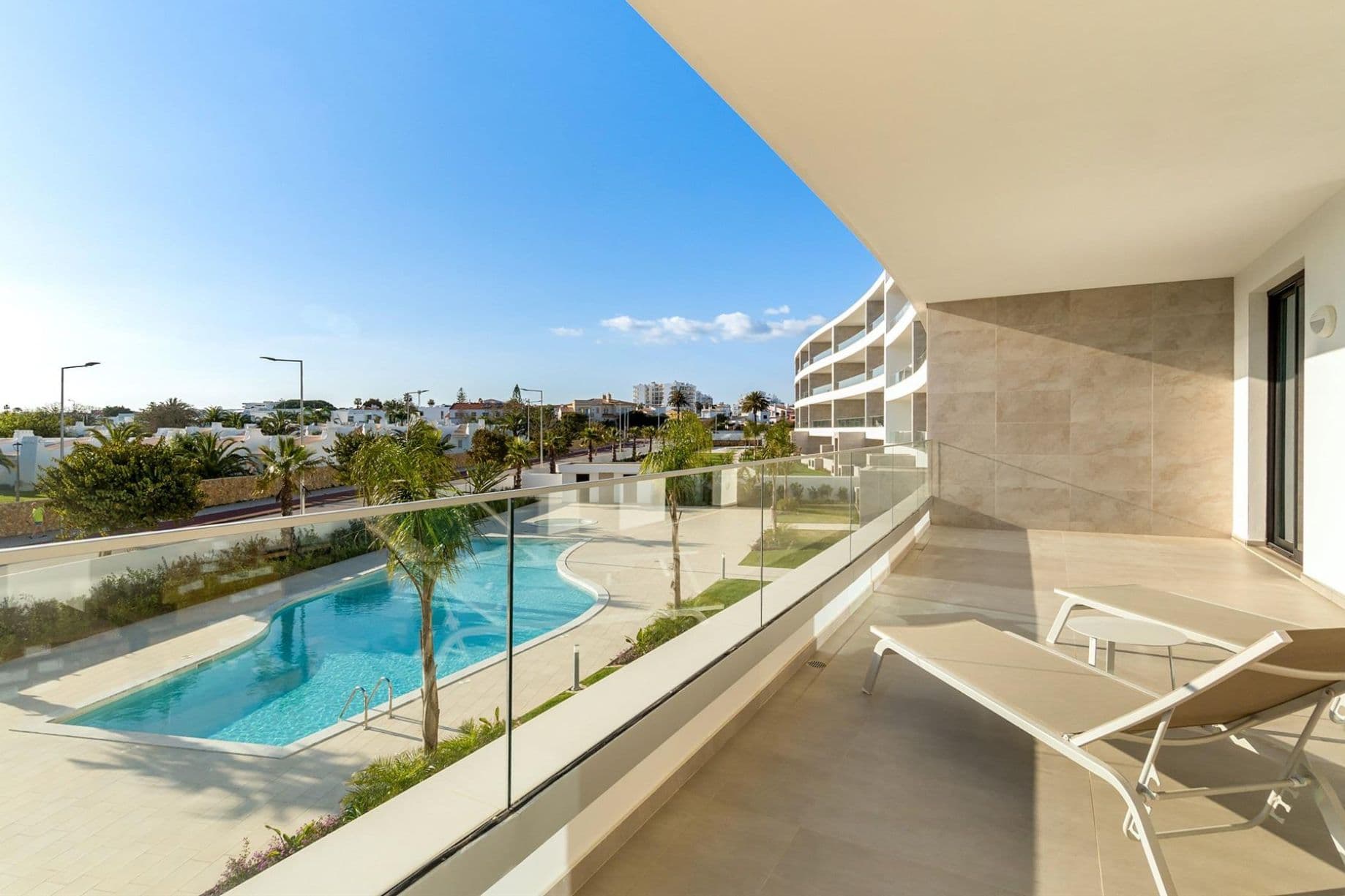
The home itself is a new-build two-bedroom, two-bathroom apartment whose defining feature is a wraparound south-west-facing terrace with panoramic views of the Mediterranean. Orientation is destiny on this coast, and south-west is the connoisseur's choice: morning coffee in early light, a long, shaded lunch, and then the main event — the sun dropping over the bay of Málaga while the sea turns to metal. An optional private hot tub extends the terrace's season deep into winter. Inside, the finish is contemporary and bright, arranged so that the living space and the terrace behave as a single room for most of the year.
The residence wraps the apartment in resort-grade amenities that the town's older housing stock cannot match: a shared saltwater pool lined with sun loungers, landscaped gardens, and a modern fitness area. The long sandy beach and the seafront restaurants are a ten-minute walk downhill; an 18-hole golf course sits minutes away on the edge of town; and the hills behind offer hiking and cycling in the cooler months. It is a rare combination on the eastern shore — new construction, sea views and pool — in a market dominated by apartments built for Spanish families decades ago.
The apartment comes fully furnished, equipped and professionally managed — the co-ownership standard in which the home is prepared before each stay and closed down after it. For the way a second home is actually used, the format is honest: a lock-up-and-leave base for a couple or a small family, scaled to walking distance from the water, with none of the maintenance anxiety that colonises the first morning of every stay in a wholly owned villa.
The Arithmetic of the Eastern Shore
The market context rewards attention. Málaga province ended 2025 at record levels — portal data put the provincial average around €4,000 per square metre, up more than fifteen per cent year on year — and forecasts for 2026 point to further growth of roughly seven to ten per cent, still comfortably above the Spanish national average. Within that market, the split between west and east is stark. Prime Marbella trades between €5,000 and €8,000 per square metre and beyond; Rincón de la Victoria, for all its proximity to the city and the airport, was listed this spring at around €3,400 per square metre. The eastern shore, in other words, still prices like what it has always been — Málaga's local coast — even as the city beside it becomes one of southern Europe's most desired addresses.
Connectivity underwrites the case. Málaga–Costa del Sol airport closed 2025 with a record 26.76 million passengers across 276 routes, with the United Kingdom alone accounting for more than six million passengers and Amsterdam, Paris, Brussels and Dublin among the best-connected hubs. From the terminal, Marbella is the better part of an hour west along the motorway; Rincón de la Victoria is roughly twenty-five minutes east. For an owner flying in for a long weekend six or eight times a year, that difference compounds into entire afternoons recovered.
Now run the share arithmetic. Eight shares at €119,000 imply a whole-home value of roughly €952,000 — a figure that, bought outright, would also bring Spanish transfer tax on the full amount, year-round utilities, insurance and the standing reproach of an apartment empty for ten months a year. The one-eighth structure buys the same terrace, the same saltwater pool and roughly forty-four days of annual use, with every running cost divided by eight. Within COP's Spanish collection, it stands among the lowest entry prices on the platform — for a new-build home twenty-five minutes from one of Europe's fastest-growing city markets.
How the Share Actually Works
The structure behind the listing is the standard one on the platform, explained in full on our how-it-works page. Each owner holds a one-eighth share of the home — a real share, not a right to use it, that can be sold or passed to heirs; the legal set-up is arranged by our partner and walked through with you before you buy. The other seven owners are vetted purchasers who bought into the same coast for the same reasons, and the home's governance — house rules, reserve fund, decision-making — is set out in an owners' agreement before anyone signs.
Day to day, a professional manager runs everything: cleaning, maintenance, utilities, insurance, the pool contract, the small repairs. Time is allocated through a booking calendar designed to rotate the premium weeks fairly across the eight owners, so that no one monopolises August and no one is exiled to November. The practical questions — what you can leave in the apartment, how bookings work, what happens between stays — are answered in our owners' FAQs, and the purchase process itself in the buying FAQs. Exit is deliberately unremarkable: a share can be listed and sold like any other property interest, at whatever the market then says a slice of this coast is worth — and the provincial price table suggests which direction that market has been moving.
A Year on Málaga's Local Coast
Forty-four days is not a holiday; it is a rhythm, and this coast — one of the few in Europe that genuinely does not close — rewards it in every season. The connoisseur's months are the shoulders: in May and June the sea has warmed, the promenade is at its liveliest without being crowded, and the chiringuitos grill without a waiting list; September and October may be better still, the water holding its summer heat for weeks while the light softens over the bay. High summer is the town as theatre — an early swim from the sand, the terrace shaded through the afternoon, dinner at the water's edge among malagueño families who have eaten at the same tables for generations.
Winter is where the eastern shore quietly outperforms almost everywhere else an hour from a European hub. Lunch outside is the rule rather than the exception, the tunnels and the promenade fill with walkers, and Málaga's museums and restaurants operate at full strength fifteen minutes away — the same year-round case we made for the western coast in our Costa del Sol guide, only closer to the airport and at a fraction of the entry price. Owners who spread their weeks across three or four seasons discover they own several different towns for the price of one: the packed August beach, the golden October sea, the bright, empty promenade of a January morning.
The Case for the Rincón
Every second home is a bet on repetition — the wager that a place will deepen rather than fade as you return to it. Rincón de la Victoria is a strong version of that bet precisely because it was never designed for visitors: what you are returning to is a working town on a warm sea, with forty millennia of human footprints in its cliffs and fried anchovies on its seafront, that happens to sit twenty-five minutes from a runway serving half of Europe. The coffee on the south-west terrace while the bay wakes up; the walk through the 1908 tunnels in four different lights; the waiter who stops asking. That is the second life this apartment contains — smaller than the first, slower, and anchored to a coast the city has trusted for a century.
The full details and photography are on the Rincón de la Victoria listing page, alongside the rest of our Spanish co-ownership collection. To ask about availability, the owners' agreement or a viewing, contact the COP team — the Costa del Sol that Málaga kept for itself is, for once, very easy to enter.
More from Co-Ownership Property
Get in Touch
Speak to an expert
Tell us what you're looking for and we'll be in touch.