Properties & Destinations
Port d'Andratx: What a Harbour-View Share Reveals
The priciest municipality on Mallorca is not Palma but a small, sheltered harbour on the island's south-west tip — and a one-eighth share of a modern two-bed above its marina has just opened it at €179,000.
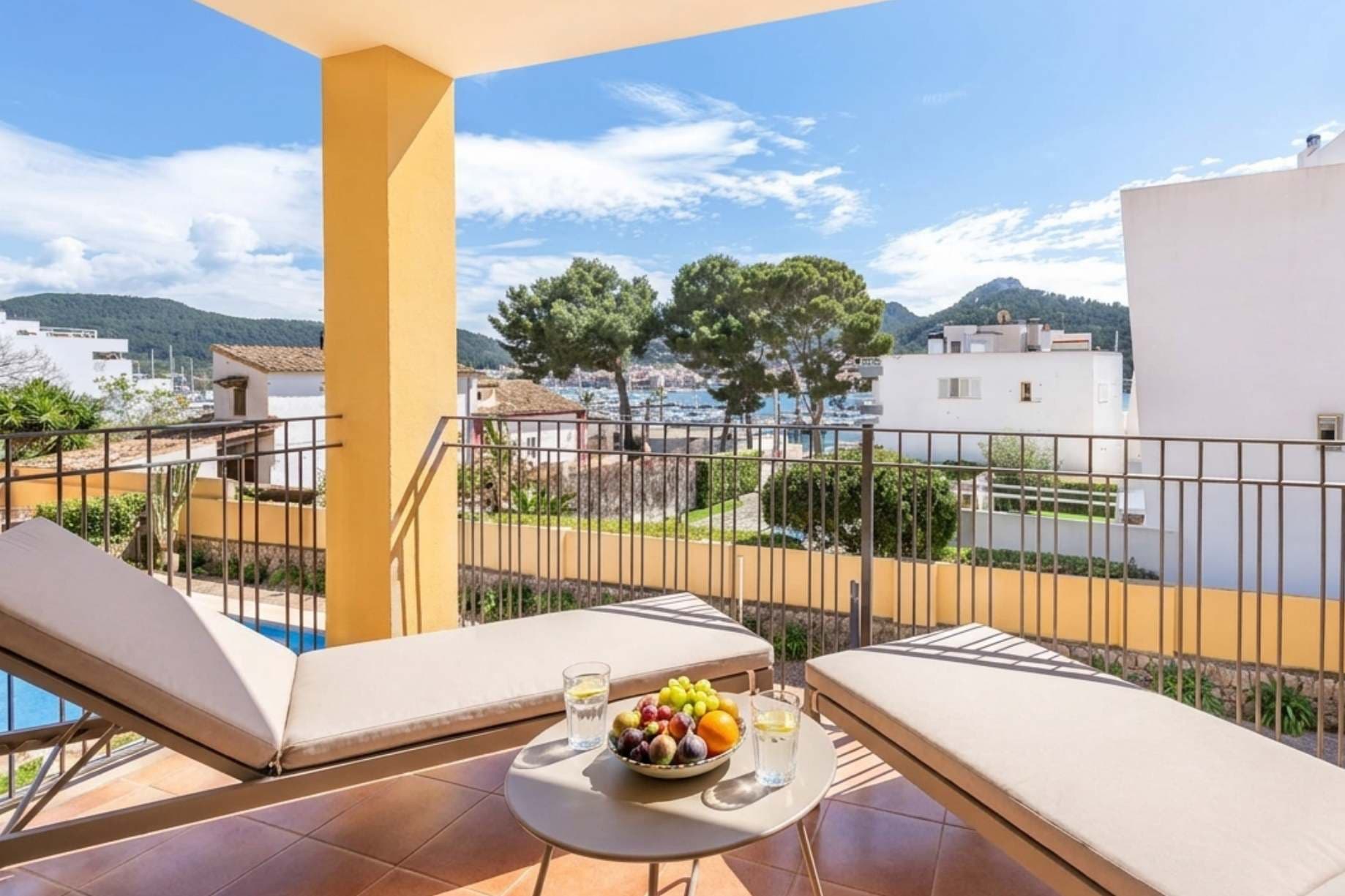
The most expensive address on Mallorca is not in Palma. For years the municipality of Andratx — anchored by a small, sheltered harbour on the island's south-western tip — has topped the island's price-per-square-metre table, ahead of the capital's Gothic old town and the storied villages of the Serra de Tramuntana. Prime homes around the port trade at €10,000 per square metre and considerably above, whole villas change hands for several million euros, and the yachts moored below them seem to grow a little longer every season. All of which makes the newest listing on the COP platform a quietly radical proposition: a modern two-bedroom apartment moments from the water, with the marina framed in its south-facing balcony, at €179,000 for a one-eighth share.
That number deserves a moment's scrutiny, because it collapses the distance between two markets that rarely touch. One is the market for whole homes in Mallorca's south-west, where scarcity, steep topography and two decades of international demand have produced some of the highest residential values in Spain. The other is the market for time — the six weeks or so a year that most second-home owners actually spend in their property, however much of it they nominally own. Co-ownership prices the second market rather than the first, and nowhere on the island does the difference between the two show more starkly than at the foot of these green hills.
A Harbour That Found Its Right Size
Port d'Andratx began as the maritime outlet of Andratx town, which — like most old Mallorcan settlements — was built prudently inland, out of sight of the corsairs who worked this coast for centuries. The port that grew at the water's edge kept the proportions of a fishing village even as its clientele changed: low buildings along the quay, a working fleet sharing the water with sailing yachts, restaurants that face the harbour rather than a promenade. It lacks the self-conscious gloss of Puerto Portals and the crowds of the bays nearer Palma. What it offers instead is the particular pleasure of a place that found the right size decades ago and stopped there, held in on three sides by hills too steep to build over.
The setting rewards slow exploration. Andratx town, five minutes inland, keeps its weekly market and its unhurried cafés; on the hillside between the two stands CCA Andratx, one of the largest contemporary art centres in the Balearics, an improbable and rather wonderful thing to find behind a fishing port. The coastal path that runs south-west from the harbour to the village of Sant Elm is among the island's finest walks, ending in views of Sa Dragonera, the uninhabited ridge of an island that guards Mallorca's western corner as a nature reserve. And the road north through Banyalbufar traces the western flank of the Serra de Tramuntana — a UNESCO World Heritage landscape — in a sequence of terraced vineyards and sea cliffs that no first-time driver forgets.
For all its seclusion, the port is not remote. Palma — its cathedral, its old town, its restaurants and its international airport — lies roughly forty-five minutes to the east, which places the harbour within a morning's reach of most European capitals. It is the combination that explains the price table: a settlement that cannot grow, on an island that much of Europe wants, less than an hour from a major airport.
The Apartment: A Front Row on the Marina
The home itself is a modern two-bedroom, two-bathroom apartment set close to the harbour, in one of the most sought-after pockets of the port. Its defining feature is a south-facing balcony that frames the marina directly: sailboats and motoryachts on their moorings, the morning light moving across the water, the evening procession of boats returning to berth. Harbour views are a different proposition from open-sea views — busier, more narrative, endlessly rearranged — and this one changes with the hour and the season without ever becoming ordinary.
Inside, the interiors are clean and contemporary, arranged so that the living space and the balcony work as one room for most of the year. A shared pool offers an alternative to the small pebble beach a few minutes' walk away, for those who prefer to swim somewhere quieter than the harbour itself. The apartment comes fully furnished, equipped and professionally managed — the co-ownership standard in which the house is made ready before each stay and closed down after it, so that ownership consists of arriving.
It is a home scaled to how the port is actually used: a base for a couple or a small family who want to walk to dinner on the quay, swim before breakfast, and lock a single door behind them when they leave. In a market where the local archetype is the multi-million-euro hillside villa, a two-bed apartment at the centre of the harbour's life is, arguably, the more honest instrument for six weeks a year.
The Arithmetic of Mallorca's Most Expensive Address
The market context is unambiguous. Andratx sits at the top of Mallorca's municipal price rankings, and the south-west corner it anchors is the most expensive region of an expensive island, with prime values around the €10,000-per-square-metre mark and well beyond on the water. The island as a whole has kept climbing: recent market studies put the Mallorca-wide average at roughly €7,400 per square metre, up close to ten per cent year on year, with the luxury segment expected to outpace the middle of the market again in 2026. Supply, meanwhile, is structurally constrained — the hills around this port are green precisely because they cannot be developed.
Demand shows no sign of retreating. Registry data for late 2025 put foreign buyers at close to a third of all Balearic home purchases, one of the highest shares in Spain, and government housing data indicate that around four in ten sales above €500,000 across the islands went to international purchasers. In the south-west, where German, Scandinavian and increasingly American money concentrates, the effective share at the prime end is higher still. This is the demand that has priced whole ownership in Port d'Andratx beyond most professional families — and it is exactly the demand that underwrites the value of owning any part of it.
Now run the share arithmetic. Eight shares at €179,000 imply a whole-home value of roughly €1.43 million — a figure that, bought outright, would also bring Spanish transfer tax on the full amount, year-round utilities, maintenance, insurance and the quiet reproach of an apartment standing empty for ten months a year. The one-eighth structure buys the same balcony, the same harbour and roughly forty-four days of annual use for the price of a modest suburban flat on the mainland — with every running cost divided by eight. Set against the rest of COP's Spanish collection, it is one of the lowest entry prices to one of the highest-value postcodes on the list.
How the Share Actually Works
The structure behind the listing is the standard one on the platform, explained in full on our how-it-works page. Each owner holds a real one-eighth share of the home — not a right to use it — that can be sold or passed to heirs, and that rises and falls in value with the apartment. The legal set-up is arranged by our partner and walked through with you before you buy. The other seven owners are vetted purchasers — people who bought into the same harbour for the same reasons — and the home's governance, from house rules to reserve fund, is set out in an owners' agreement before anyone signs.
Day to day, a professional manager runs everything: cleaning, maintenance, utilities, insurance, the pool contract, the small repairs that would otherwise colonise the first morning of every stay. Time is allocated through a booking calendar designed to rotate the premium weeks fairly across the eight owners, so that no one monopolises August and no one is exiled to November. The practical questions — what you can leave in the apartment, how bookings work, what happens between stays — are answered in our owners' FAQs, and the purchase process itself in the buying FAQs.
Exit is deliberately unremarkable. A share can be listed and sold like any other property interest, at whatever the market then says a slice of Port d'Andratx is worth — and the price table above suggests which direction that market has been moving. Co-ownership here is not a membership or a right to use someone else's asset; it is a small position in one of the most supply-constrained residential markets in the Mediterranean.
A Year in the Port
Forty-four days is not a holiday; it is a rhythm, and this harbour rewards it unusually well. The connoisseur's seasons are the shoulders. In May and June the sea has warmed, the coastal path to Sant Elm is at its green best, and the waterfront tables are still easy. September and October may be better still: the water holds its summer heat for weeks, the light softens, and the port returns to the locals and the owners while the flight schedules from northern Europe barely thin.
High summer is the harbour as theatre — swims before breakfast from the pebble cove, long afternoons at the pool, dinner on the quay while the yachts come in — and the balcony is the best seat in the house for all of it. Winter, meanwhile, is the island's quiet secret: mild enough for lunch outside more often than not, with the almond blossom arriving in the hills behind Andratx in late January and the Tramuntana at its best for walking. Owners who spread their weeks across three or four seasons discover they own several different ports for the price of one — a pattern our Mallorca ownership guide describes in detail, and one that works just as well here as it does for the platform's sister listing in Puerto de Pollensa on the island's north coast.
The Case for the Port
Every second home is a bet on repetition — the wager that a place will deepen rather than fade as you return to it. Port d'Andratx is an unusually safe version of that bet, because what you are returning to is not a resort that reinvents itself every season but a harbour that decided long ago what it wanted to be. The coffee on the south-facing balcony while the fleet goes out; the waiter who stops asking; the path to Sant Elm walked in four different lights; the last swim of October. That is the second life this apartment contains — smaller than the first, slower, and anchored to a view that the price table says half of Europe wants.
The full details, floor plan and photography are on the Port d'Andratx listing page, alongside the rest of our Spanish co-ownership collection. To ask about availability, the owners' agreement or a viewing, contact the COP team — Mallorca's most expensive address has rarely been this approachable.
More from Co-Ownership Property
Get in Touch
Speak to an expert
Tell us what you're looking for and we'll be in touch.