Properties & Destinations
Puerto de Pollensa: A Sea-View Penthouse in North Mallorca
Where the Tramuntana mountains fall into the sea, a top-floor penthouse with a private pool and a terrace facing the bay offers the quiet, cultured side of Mallorca — available now as a one-eighth share.
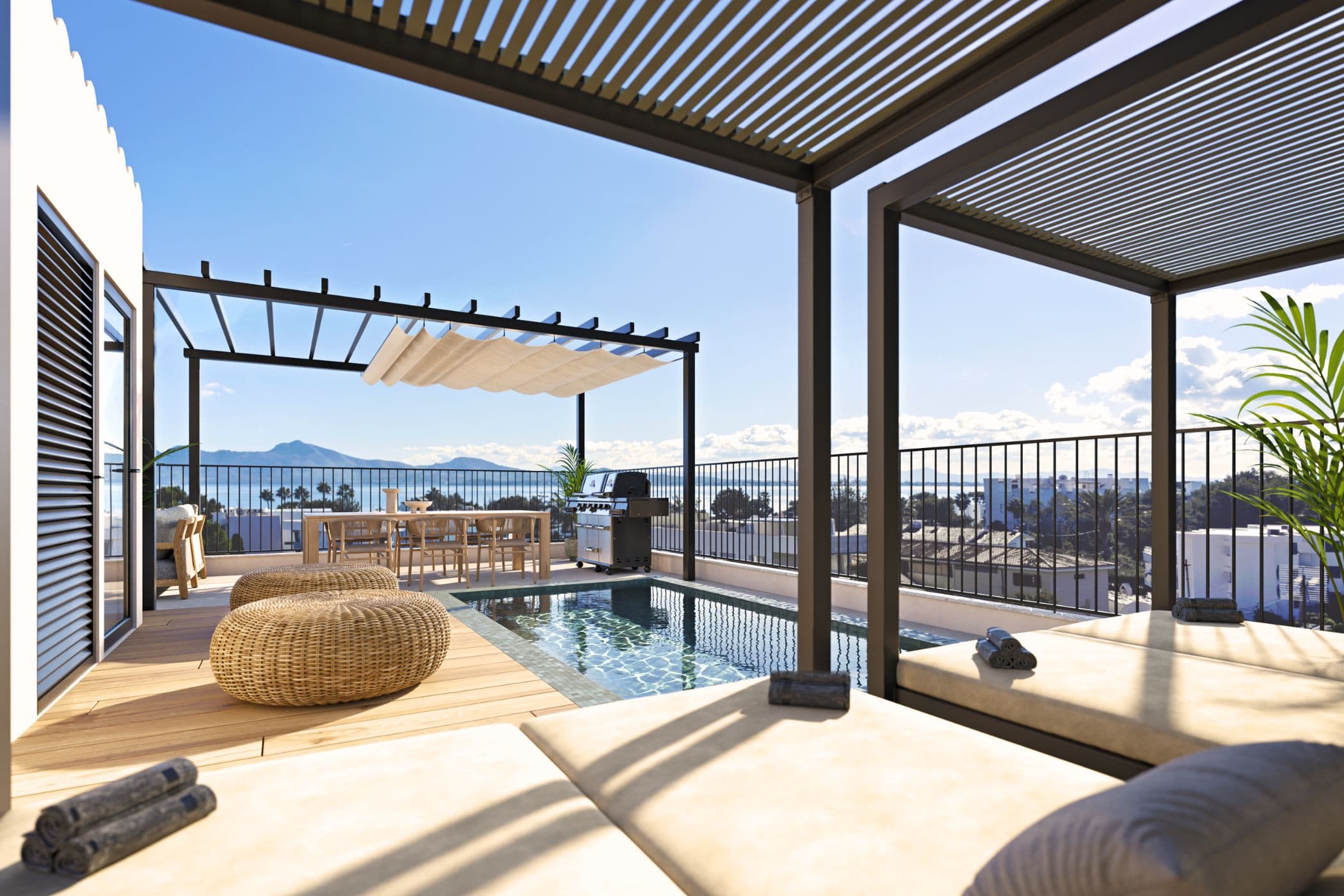
Most of Mallorca never reaches Pollensa. The package crowds turn off long before the north, drawn to the resorts of the bays nearer Palma, and the island they leave behind — pine-shaded, mountain-backed, slow — is the one the painters and the sailors kept for themselves. At the top of it sits Port de Pollensa, a town of low whitewashed houses curved around a calm bay, with the Serra de Tramuntana rising at its back and the Formentor peninsula reaching out to sea like the island holding its breath. It is here, on the top floor of a quiet residence a short walk from the water, that a two-bedroom penthouse with a private pool and a sea view has just opened as a co-ownership home.
The headline number is €299,000 — and the figure deserves a moment, because it is the price of a one-eighth share, not the whole apartment. Eight owners each own a real share of the penthouse, with roughly 44 to 45 days of use a year, the property professionally managed and maintained between visits. What that buys in northern Mallorca is not a studio in a crowded resort but a genuine penthouse, with its own pool and a terrace facing the bay, in one of the Mediterranean''s most quietly coveted corners. This is a look at the home and the place around it.
The Setting: The North That Mallorca Keeps for Itself
Port de Pollensa has been a refuge for people who could go anywhere for the better part of a century. The painter Hermen Anglada-Camarasa settled here and drew a colony of artists to the light; Agatha Christie set a collection of stories on its shore. Its most famous stretch is the Pine Walk, the Passeig Anglada Camarasa, a seafront promenade shaded by tamarisk and pine where old villas look out over moored sailing boats and the water stays flat and clear. There is no high-rise skyline, no strip of clubs. The town''s rhythm is set instead by the harbour, the weekly market, the long lunches and the mountains.
Behind it rises the Serra de Tramuntana, the mountain range that runs the length of Mallorca''s north-west coast and was inscribed as a UNESCO World Heritage landscape for its terraced hillsides and centuries of human cultivation. In front, the road to Cap de Formentor threads along cliff edges to the lighthouse at the island''s northern tip — one of the great drives in the Mediterranean. Inland, the old town of Pollensa proper, a few minutes away, climbs to the chapel atop the 365 steps of El Calvari and keeps the Sunday market, the squares and the restaurants that the port''s visitors drift inland to find. Between mountain and sea, this is a place that rewards staying rather than passing through — which is precisely what co-ownership is built for.
The Home Itself
The apartment is a two-bedroom penthouse on the top floor of its building — the position that, in a low-rise town like this, means light on every side and the bay laid out in front of you. Its defining feature is the outdoor space: a private pool and a generous terrace oriented to the sea view, the kind of space that turns a holiday flat into somewhere you actually live for the weeks you are there. Inside, two bedrooms make it a true family or two-couple home rather than a pied-à-terre — room for children or guests without compromise, and enough of it to settle in for a fortnight rather than a long weekend.
It is also walkable to everything that matters. The penthouse sits within easy reach of the seafront and the town, which means the car can stay parked for days at a time: the market, the restaurants along the front, the boats and the swimming are all on foot. For a holiday home, walkability is underrated and decisive — it is the difference between a base you drive to and from and a place you simply step out into.
A Year in the North
One of the quiet advantages of northern Mallorca is that its season is long. High summer brings the swimming and the long evenings, but the shoulder months are arguably the prize. Spring turns the Tramuntana green and fills Pollensa with cyclists — the climbs to Formentor and the famous switchbacks of the coast make this one of Europe''s great pre-season training grounds — while the almond and wild-flower hillsides draw walkers. Autumn holds its warmth into October, the sea still swimmable, the crowds gone. Even winter has its constituency: the air is clear, the walking is superb, and the town keeps its life year-round rather than shuttering after September.
This is what makes a share of 44 to 45 days a year feel generous rather than rationed. Spread across the seasons, it is a fortnight in high summer, a week of spring cycling or walking, a stretch of golden autumn and a winter escape — far more than the handful of weeks most outright owners of a Mallorcan second home actually manage to use. The calendar is shared fairly among the eight households through the booking system, so peak weeks rotate and no single owner monopolises August year after year. How that calendar works in practice, and what a typical week of ownership feels like, is something we explore in depth in our Mallorca ownership guide.
The Ownership, in Practice
You own a real share of the home — here a one-eighth share — not a right to use it. You can sell it, pass it on, and it rises and falls in value with the house. The legal set-up is arranged by our partner for each home and explained before you buy. Seven other vetted owners hold the remaining shares. A management company handles everything between visits — cleaning, maintenance, bills, the pool, the arrival and departure — and the shared running costs are met from a transparent annual budget, so the taxes and upkeep that make a sole-owned Spanish second home a part-time job are simply absorbed into the system. You arrive to a home that is ready, and you leave without a list of chores.
It is worth being clear-eyed about the economics, because they are the point. Outright ownership of a comparable sea-view penthouse with a pool in Port de Pollensa would run into seven figures, plus the full weight of Spanish purchase tax, annual IBI, and the standing cost of maintaining a property you use for a few weeks a year. A one-eighth share at €299,000 opens the same address, the same terrace and the same view for a fraction of the capital and a divided share of every running cost — while the days you actually use map closely to the days a typical second home sits occupied anyway. The detail of the Spanish tax position for co-owners is set out in our guide to Spain property tax, and the full mechanics on our how it works page.
The Case
There is a particular kind of buyer this home is made for: the one who has been to Mallorca, found the resorts wanting, and discovered the north — and who has done the arithmetic on a whole second home and balked, not at the price exactly, but at the waste of it. A villa or penthouse that sits empty forty-something weeks a year is a beautiful thing under-loved, with a tax bill and a maintenance burden that runs whether you are there or not. A one-eighth share answers that directly. It matches what you own to what you use, hands the burden to people whose job it is, and leaves you with the part that mattered all along: the terrace, the pool, the walk to the harbour, the light on the Tramuntana.
That is the quiet promise of co-ownership in a place like this — not a holiday let you happen to part-own, but a genuine second life in the north of Mallorca, sized correctly and ready when you are. The light that drew the painters to Pollensa a hundred years ago is still here. This is simply a sensible way to own a piece of it.
To see the penthouse in full — floor plan, photographs and the share details — visit the listing page. You can browse the wider Spain collection for other homes in Mallorca and beyond, and when you would like to discuss availability, the next share or a viewing, our team is ready on the contact page.
More from Co-Ownership Property
Get in Touch
Speak to an expert
Tell us what you're looking for and we'll be in touch.