Properties & Destinations
A Marais Two-Bed With a Private Terrace, Paris 4th
An 18th-century building on Rue Malher in the heart of Le Marais, a ten-square-metre private terrace, five minutes on foot to Place des Vosges — and a real one-twelfth share that turns the most coveted quartier in Paris into a usable second address.
The letters patent that created the Marais as we know it were sealed by Henri IV in 1605, on the site of the demolished Hôtel des Tournelles, to lay out what would become the Place des Vosges — Paris's first planned square and, four centuries on, still its most uncannily preserved. The square was inaugurated in 1612 to celebrate the betrothal of Louis XIII to Anne of Austria; the king who commissioned it had already been assassinated. The thirty-six identical brick-and-stone pavilions Henri specified — two storeys, dormered, arcaded at ground level, framing a 140-metre garden — set the architectural vocabulary that the surrounding quartier then took the rest of the seventeenth century to fill in. The Marais is, in the most literal possible sense, the city's first piece of master-planned urbanism, and the quartier's hôtels particuliers, narrow medieval streets and seventeenth-century courtyards remain, even now, an almost continuous open-air museum. Property in the heart of it does not behave like property in the rest of Paris. It behaves like an heirloom that occasionally changes hands.
COP's newest listing sits inside that heirloom. The property is a two-bedroom, two-bathroom, 72-square-metre apartment on Rue Malher, in the 4th arrondissement, set in an 18th-century building one block from Rue des Rosiers and a five-minute walk from the Place des Vosges. It comes to market as a one-twelfth co-ownership share at €237,000 — the full Rue Malher listing is here — carrying four weeks of personal use a year, or roughly 30 days: two fixed weeks (weeks 24 and 25, beginning 6 June) plus two floating weeks, with annual dues of about €5,000. What sets it apart from almost everything else trading in central Paris at this footprint is a single architectural feature: a ten-square-metre private terrace, an asset that, in the heart of the Marais, is rarer than the apartments themselves. The structure that makes a real share of an address like this accessible at this price point is set out end-to-end in our how it works guide.
What the Property Actually Is
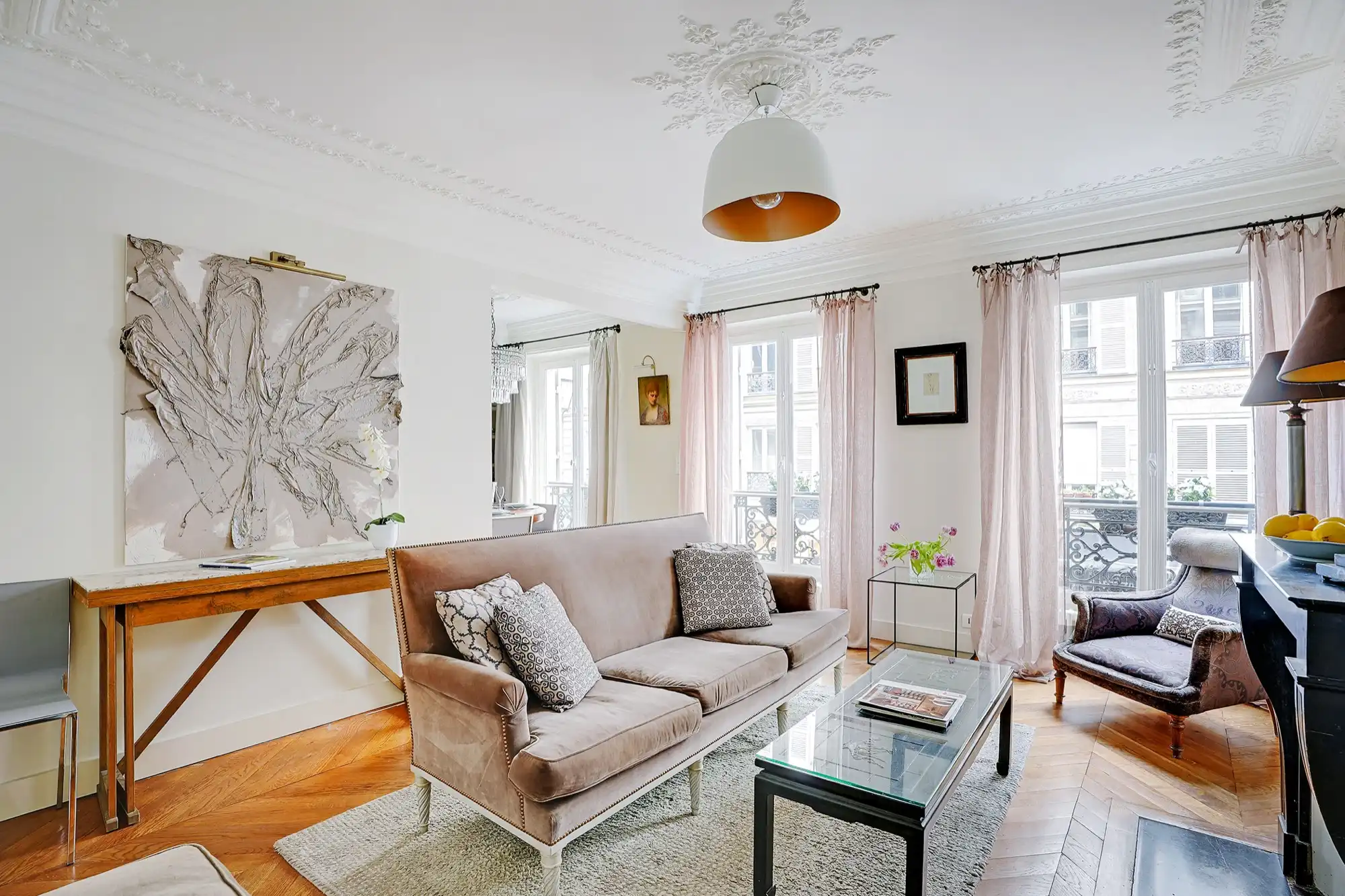
The apartment occupies a floor of a classic Marais building on the eastern flank of Rue Malher, the short north–south street that connects Rue de Rivoli to Rue des Rosiers. The internal layout has been thoughtfully reorganised so that the two bedrooms sit at opposite ends of the apartment, with the living and dining spaces — and the kitchen — between them. The practical consequence is unusual privacy for a 72-square-metre Parisian flat: two couples travelling together do not share a wall, and a family configuration places the children's room at one end and the parents' at the other. The guest bedroom itself is engineered for flexibility, with two daybeds with trundles that can be pre-configured before arrival as two queens, four singles, or any combination in between — a small but unromantic acknowledgement that a central-Paris pied-à-terre will, over twelve months, host very different sorts of visit.
The terrace is the headline feature. A private, ten-square-metre outdoor extension off the main living space, large enough to seat four for dinner and to absorb morning coffee for two, is something the Marais's eighteenth-century building stock was not designed to provide. In a quartier where most apartments open only onto narrow internal courtyards or directly onto the street, a private exterior space at this scale is unusual enough to operate as its own selling argument. The interior is delivered fully furnished and turnkey, with the specification a buyer would otherwise spend an eighteen-month renovation programme assembling — a level of finish that allows a co-owner to arrive with hand luggage rather than a builder. The detailed mechanics of how each owner's stays are scheduled, how the apartment is cleaned and reset between visits, and how the building's syndic dealings are handled are addressed in our staying in your co-ownership property FAQs.
A Marais Address, on Foot
The 4th arrondissement is the rare central-Paris address that rewards walking more than the métro. From the apartment's front door, the legendary Rue des Rosiers — the spine of the historic Jewish Marais, with Sacha Finkelsztajn's pastel-yellow patisserie, L'As du Fallafel's lunchtime queue, and a procession of seventeenth-century townhouses converted to bookshops, galleries and tea rooms — is a single block away. The Place des Vosges, in all weathers and at all hours one of the most photographed and least crowded of Paris's great squares, is five minutes on foot. The Musée Picasso, installed in the Hôtel Salé on Rue de Thorigny, is ten. The Centre Pompidou, the Musée Carnavalet, the Maison de Victor Hugo on the corner of the Place des Vosges, the medieval Saint-Paul–Saint-Louis church, the food halls of the Marché des Enfants Rouges in the 3rd, and the bouquinistes along the right bank of the Seine are all within a twenty-minute walking radius. Île Saint-Louis, with its quiet quays and the original Berthillon ice-cream window, is fifteen minutes south across the Pont Marie. The Louvre is twenty-five.
It is, in short, the kind of address that resolves the city to a pedestrian scale. The nearest métro stop, Saint-Paul on Line 1, is two minutes away — useful for the airports — but most of the apartment's actual usefulness is on foot. The Marais's Sunday opening — almost uniquely in Paris, the shops, cafés and galleries on Rue des Francs-Bourgeois and Rue Vieille-du-Temple trade through the weekend — is one of the reasons the quartier consistently outperforms the rest of central Paris on visitor footfall, and one of the reasons a long-weekend share is structurally easier to use here than in arrondissements that empty out on Saturday afternoon.
Thirty Days a Year, and What That Actually Looks Like
The one-twelfth share entitles the owner to roughly 30 days a year across the calendar — in this apartment, two fixed weeks (weeks 24 and 25, beginning 6 June) plus two floating weeks chosen around them, with annual dues of about €5,000, strikingly low for a luxury Paris fractional. That is the right unit of usage for a central-Paris apartment, and it is worth being explicit about why. A city pied-à-terre is not, in the way a country villa is, a vehicle for week-on-week summer holidays. It is a vehicle for three- and four-night stays distributed across the year: a long November weekend around an exhibition opening, a December stretch for the Christmas markets and the bracingly empty Tuileries, a March visit when the Marais's gardens come back to life, an early-September week before the rentrée crowds return, a half-term break between school terms, a birthday weekend, the periodic professional trip extended by two days at the front and one at the back. Thirty days a year, distributed in that pattern, is closer to seven or eight separate visits than to a single annual holiday — and the rhythm suits the architecture of the apartment, the operational economics of the building, and the way Paris is actually used by its international second-home owners.
The contrast with the longer-share format COP uses for country properties is deliberate. A Provençal villa or a Tuscan farmhouse is structured at one-eighth (~45 days) alongside seven other vetted families, on the reasoning that a country share is consumed in week-long blocks. A central-Paris share is structured at one-twelfth (~30 days) alongside eleven other vetted families, on the reasoning that a city share is consumed in shorter, more frequent visits, and that the calendar absorbs twelve families more comfortably than a country house absorbs eight. The vetting process and the day-to-day operating model are unchanged; the shape of the usage is what shifts. The mechanics of who books which weeks, how the booking ladder rotates, and how peak weeks (the Christmas market run, the late-September fashion-week stretch, the school half-terms) are allocated fairly across twelve households are set out in detail in our buying FAQs.
The Marais Market, in Numbers
The 4th arrondissement is one of the smallest in Paris by area and one of the most strongly priced by square metre. Current local-agency tracking puts the arrondissement average at around €13,600 per square metre, up modestly year-on-year, with the Marais's most coveted streets — Rue de Sévigné, Rue de Turenne, Rue des Francs-Bourgeois, the streets immediately around Place des Vosges — trading at €15,000 to €17,000 per square metre for renovated stock, and the genuinely exceptional properties (refurbished hôtels particuliers, top-floor terrace apartments, Île Saint-Louis quayside) reaching into the high teens and twenties of thousands per square metre. Whole two-bedroom Marais apartments with a private outdoor space, in turnkey condition, in the kind of eighteenth-century building Rue Malher offers, currently transact in a range that starts above €1.3 million and routinely runs higher. That is the underlying value the one-twelfth share gives a buyer a real stake in.
The market context matters as much as the headline number. Knight Frank's most recent Paris prime-market work points to a year of stabilisation in 2026, with a quiet return of buyer confidence in the historic central arrondissements and notaries' data suggesting that, while a sharp rebound is unlikely, progressive appreciation led by prime-central neighbourhoods is increasingly probable. The deepest international buyer pool — the United States, the United Kingdom, the Gulf, Northern Europe — has, after two years of caution, returned to the table for pied-à-terre stock in the 4th, 6th and 7th, with off-market and discreet sales accounting for a growing share of the activity. For the buyer of a real one-twelfth share, the implication is structurally favourable: the share entitles its holder to proportional appreciation in one of the most reliably appreciating residential micro-markets in Europe, while removing the capital concentration and the management drag that whole-ownership of a central-Paris flat imposes. A different angle on the same broader Paris market — focused on the Left Bank — is set out in our guide to co-owning on the 6th and 7th.
The €237,000 Share, Examined
The headline number on the listing is €237,000 for a one-twelfth share. As with any properly structured co-ownership offering, the share price reflects more than the proportional value of the underlying real estate: it includes the full furnishing and fit-out, the legal set-up, the building deposit, the management mobilisation and the operating reserves the apartment will need to run smoothly through its first few years of shared use. The right comparison is not the per-share arithmetic against the property's appraised value; it is the cost of replicating what a real share actually delivers. To buy a comparable Marais two-bed with a private terrace, fit it out turnkey, set up a holding company, and run it for a household that will use it perhaps three or four weeks a year would commit well over €1.3 million in capital, an annual carry running into five figures, and a steady stream of management work — the building's syndic meetings, the property-tax filings, the visitor turnovers — that any owner who has tried it will recognise as the real cost of central-Paris property.
The one-twelfth share inverts that calculation. A buyer commits the share price, plus annual dues of approximately €5,000 — professionally managed, transparently billed, and remarkably low for a luxury Paris fractional — in exchange for roughly 30 days a year of use of a turnkey Marais apartment with a private terrace. The carry on the share — utilities, the building's charges, the apartment's operating costs, the management fee — typically falls within a band that is meaningfully smaller than the running cost of even a modest London or New York pied-à-terre held outright, and dramatically smaller than the running cost of the equivalent Marais flat owned whole. Over the course of a five- or seven-year hold, the share's value moves with the underlying Marais market, the appreciation accrues to the holder pro rata, and the resale market for well-located co-ownership shares in prime-central European cities has, on COP's tracked transactions, been broadly stable to firm. The buying mechanics and the exit options are documented in the same buying FAQs linked above.
The Newest Listing, in Context
Co-ownership of a central-Paris apartment, like co-ownership of a Provençal villa or a Mallorcan finca, is not primarily a financial argument — though, on the arithmetic above, the financial argument holds. It is a usage argument and, more honestly, a relationship-with-a-city argument. The Rue Malher apartment is the kind of property a buyer would want to know was looked after when they were not there, would want to walk into without a renovation backlog, and would want to leave behind at the end of a long weekend without a list of follow-ups. Co-ownership of a real share of the home, alongside eleven other vetted households, is what makes that possible at the price point on the listing. Over six or seven visits a year, across different seasons, the apartment's small choreography — the morning bread at the boulangerie on the corner, the regular table at a particular café on Rue Saint-Antoine, the late-evening walk back through the Place des Vosges — accumulates into something that resembles less a holiday and more a second life inside the most fully realised quartier of Paris.
For buyers in the early stages of evaluating central Paris, the day-to-day mechanics — the calendar, the arrivals, the costs, the resale path — are set out in detail across the FAQ sections linked above. The Rue Malher listing is one of several central-European city shares currently on the books; view the Rue Malher listing in full, browse the full current inventory for the wider range, or speak with our team directly to see the full gallery, the floor plan and the underwriting on this specific apartment, and to understand whether a Marais two-bed with a private terrace is the right match for the way you would actually want to use a Paris share.
More from Co-Ownership Property
Get in Touch
Speak to an expert
Tell us what you're looking for and we'll be in touch.