Properties & Destinations
Valbonne: A Four-Bed Provençal Villa on the Côte d'Azur
COP's newest co-ownership opportunity is a turnkey four-bedroom villa in a private gated domain seven minutes from Valbonne village — a stake in one of the Riviera's most resilient micro-markets at an entry point the wider Côte d'Azur rarely permits.
In 1519, a bishop of Grasse called Augustin de Grimaldi commissioned a worker-monk named Don Taxil to lay out a new village on a grid pattern beside an old Cistercian abbey in the hills above Antibes. Five centuries later, the village he built is still there — a tight rectangle of cobbled streets organised around an arcaded central square, the Place des Arcades, where the Friday Provençal market sets out the produce of the surrounding plateau much as it has done since the founding charter was sealed. The grid plan, unusual for a Provençal hill village of that period, gives Valbonne its peculiar legibility. There is no labyrinth. You can walk every street in the historic core in under an hour. What has changed is everything around it. Beyond the medieval wall, the village now sits at the edge of Sophia Antipolis — Europe's first and largest science and technology park, founded in the late 1960s and today employing more than 38,000 people across some 2,500 companies, drawn from more than eighty nationalities. The combination is unique on the Côte d'Azur: a perfectly preserved sixteenth-century village inside a Provençal forest, with a global tech ecosystem on its doorstep, twenty minutes from the Mediterranean and forty from Nice airport. It is, in commercial-property language, an exceptionally resilient micro-market. And it is the setting of COP's newest co-ownership listing.
The property is a four-bedroom villa in Val d'Azur, a gated residential domain seven minutes by car from the historic centre of Valbonne. It comes to market as a one-eighth co-ownership share at €150,000 — a price point that, in conventional whole-property terms, no longer exists anywhere within driving distance of the Riviera coast. Whole Provençal bastides in the Valbonne and Mougins arrondissement now trade in a range that runs from roughly €1.2 million for a modest restored stone house to €6 million and beyond for a turnkey villa with land and a pool. Local agents put the average listed price for the village at well over €1.9 million, with active luxury inventory exceeding two hundred properties at any one time. A one-eighth share for €150,000 is, in that context, a structurally different proposition — the price of a modest apartment in a less fashionable arrondissement of Paris, exchanged for forty-five days a year of full ownership in a four-bedroom Provençal villa with a pool, tennis court and sea view, seven minutes from one of the most photographed villages on the Riviera. The structure that makes that possible is set out end-to-end in our how it works guide.
What the Property Actually Is
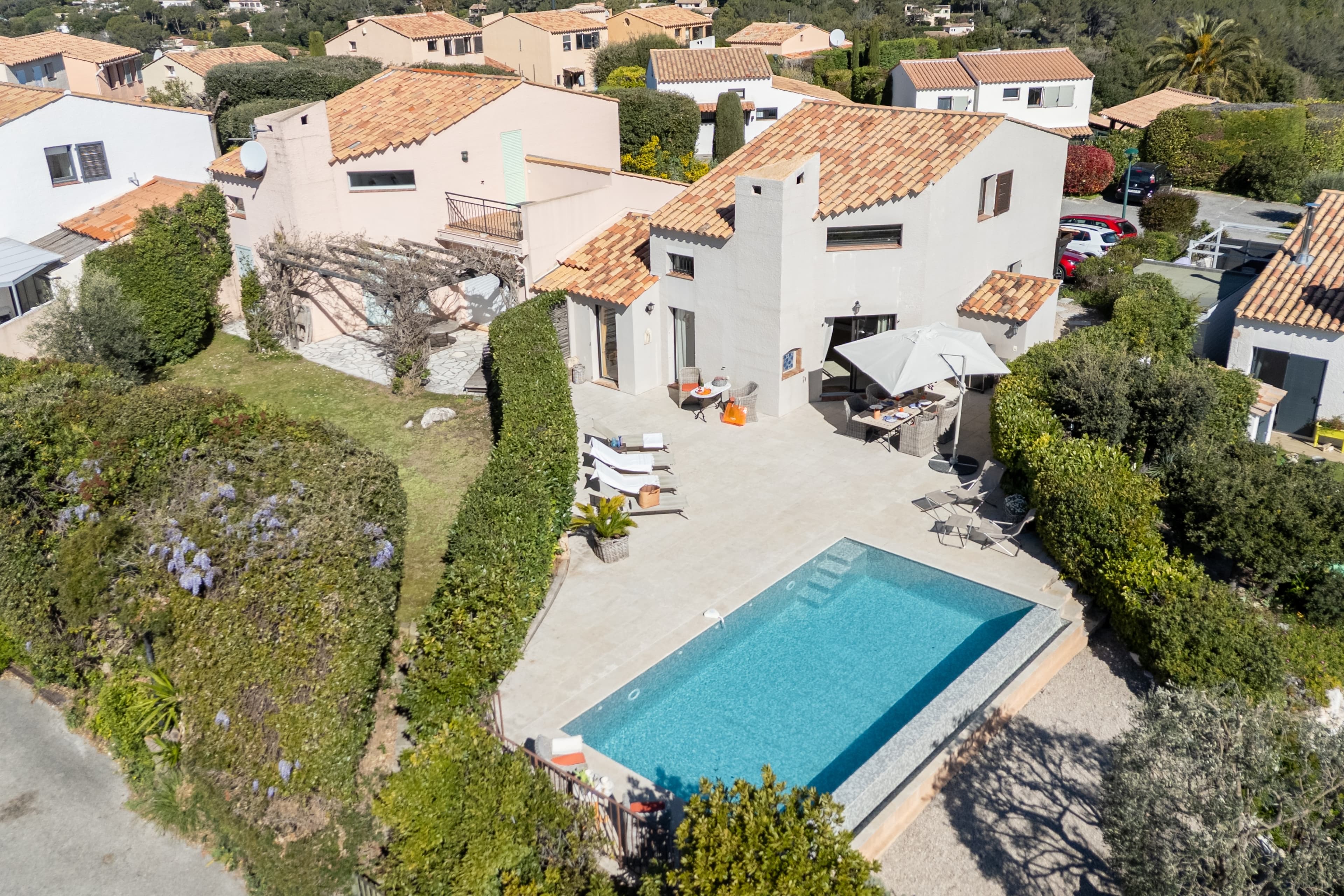
The villa is a 107-square-metre, four-bedroom, three-bathroom Provençal house arranged within a private gated domain known locally as Val d'Azur. The domain itself is the relevant part: a residential park with private tennis courts, a swimming pool, a beach volleyball area and substantial green and forested zones for the exclusive use of residents. The villa stands on its own plot inside that domain, with a fireplace, a covered terrace barbecue, an enclosed garden planted with mature olive trees, and a south-facing aspect that takes in the late-afternoon Mediterranean light. The interior is fully furnished and turnkey: air conditioning throughout, high-speed internet, a built-in home theatre, and the kind of specification that allows a co-owner to arrive with a suitcase rather than a renovation programme. The property is gated, pet-friendly and finished to a standard consistent with resale comparables in the wider Val d'Azur and Opio belt. For a buyer accustomed to the management overhead of a private villa, the most important feature is the one that does not appear in any photograph: the domain absorbs much of the upkeep — gardens, pool maintenance, perimeter security — that would otherwise fall on a private owner.
The annual usage entitlement under the one-eighth share is approximately 45 days per year — more than the average British, American or Northern European second-home owner in the Alpes-Maritimes region spends in their whole property in a typical year. The detailed mechanics of how the calendar is set among the eight co-owners, how arrivals and departures are managed, and how the management company handles the day-to-day are addressed in our staying in your co-ownership property FAQs. In practice, most co-ownership groups discover that their preferred weeks naturally diverge — one family wants the school summer, another the late September warmth, a third the Easter visit and a long November weekend — and the calendar tends to settle without friction.
A Week in Val d'Azur: How the Villa Lives
A Wednesday morning in late September in Val d'Azur runs at a particular pace. The plateau air is still cool at eight, the cicadas have not yet woken, and the domain is silent except for the lap of someone's earlier swim. A co-owner arriving for the week settles, within a visit or two, into the same small choreography: coffee on the terrace, a slow circuit of the garden, a check on the figs and olives, and then the eleven-minute drive into Valbonne for bread. The boulangerie on the Rue Eugène Giraud bakes twice a day. The Friday Provençal market in the Place des Arcades sells everything the Var hinterland produces — goat's cheese from the plateau, the rough country sausage that is sliced from the wedge at the asking, olive oil from a single grove twenty kilometres north, and the loose-leaf herbs the kitchens of every restaurant within a thirty-kilometre radius buy from the same three growers. The antique and bric-à-brac market on the first Sunday of every month draws collectors from across the Alpes-Maritimes and is one of the under-recognised pleasures of an autumn week in the village.
From the villa, the closest beach — the broad sweeping crescent at Antibes-Juan-les-Pins — is twenty-two minutes by car. Cannes is twenty-five. Nice airport is forty. The hill villages of Mougins, Biot and Tourrettes-sur-Loup are between five and twenty minutes away. The Verdon gorges are a long but easy day trip. The villa's calendar, in other words, can absorb a beach week, a culture week, a market-and-cellars week and a quiet read-by-the-pool week without leaving the same forty-kilometre radius. That density — of villages, beaches, restaurants, walking country and cultural venues within a short drive — is what the headline figure on the Côte d'Azur has always been buying. The Val d'Azur property delivers it without the bills, the security worries or the off-season management calls that follow private ownership of any villa in this part of France.
Why Valbonne Holds — and Why the Côte d'Azur Mid-Market Keeps Compounding
The structural reason Valbonne has held its value, and is likely to keep holding it, has less to do with the village and more to do with the technopole next to it. Sophia Antipolis is not a cyclical employer. It is the largest science and technology park in Europe, occupying some 2,400 hectares across five communes, with a continuous job-creation rate that has averaged over a thousand new positions per year in fields ranging from artificial intelligence and biotechnology to autonomous vehicles. The municipality's Sophia 2040 master plan commits to keeping the park competitive over the next fifteen years. The practical effect is a permanent, year-round, internationally diverse population of engineers, researchers and senior managers from more than eighty countries — and a corresponding floor under both the rental market and the resale market for quality residential property within a twenty-minute commute. That is the rare combination on the Côte d'Azur: a destination that is not seasonal, where the demand is not all foreign-buyer holiday demand, and where the underlying labour-market story is structurally tied to one of Europe's most resilient industries.
The broader market data underline the point. In the Provence-Alpes-Côte d'Azur region as a whole, house prices were modestly positive over the past year and up approximately 7 per cent over the past five — and within that regional figure, the Valbonne and Mougins belt has outperformed, with quality villa inventory rarely sitting on the market for long. Recent Côte d'Azur prime-market reporting suggests that off-market and discreet sales now account for a growing share of the Riviera's luxury transactions, with international buyers from the United States, the United Kingdom and Northern Europe continuing to dominate the upper end. For a co-ownership buyer, the implication is straightforward: the share entitles the holder to proportional appreciation in one of the more reliably appreciating micro-markets in the western Mediterranean, while removing the capital concentration and management exposure that full ownership would impose.
The €150,000 Entry Point, Examined
The headline number on the listing is €150,000 for a one-eighth share. It is worth setting that figure against three other numbers. The first is the implied whole-property price: a four-bedroom Provençal villa in a gated domain in Val d'Azur, turnkey and fully amenitised, would currently be expected to trade between €1.2 million and €1.6 million depending on plot size, condition and the strength of the domain's shared amenities. A one-eighth share at €150,000 is therefore structured at a level consistent with the rest of COP's inventory and reflects our partner's pricing rather than a discount to fair value.
The second is the running cost. A buyer of a one-eighth share pays one-eighth of the annual operating costs of the villa, which for a Côte d'Azur property of this specification with shared domain amenities typically runs between €18,000 and €24,000 per year for the full house — giving the share-holder an annual carry of roughly €2,250 to €3,000. The third is the usage: approximately 45 days a year, which is more than the average British, American or Northern European second-home owner in the region spends in their whole property in a typical year. The arithmetic at €150,000 is not a discount story; it is a utilisation story. The buyer is paying for the days they will actually use, in a property already structured to absorb the management overhead that makes full ownership of a Côte d'Azur villa so exhausting to those who have tried it. The full cost breakdown and buyer-side mechanics sit in our buying FAQs.
The Newest Listing, in Context
Co-ownership of a Provençal villa, like co-ownership of a Tuscan farmhouse or a Mallorcan finca, is not primarily a financial argument — though the financial argument is sound. It is a usage argument and, to be honest about it, a quality-of-life argument. The Val d'Azur villa is the kind of property a buyer would want to know was looked after when they were not there, would want to arrive at without a renovation backlog, and would want to leave behind at the end of a week without a checklist of things to follow up on. Co-ownership, alongside seven other vetted families, is what makes that possible at the price point on the listing. Over five or six visits a year, across different seasons, the relationship with the village, the domain and the surrounding landscape builds into something that feels less like a holiday and more like a second life — the slow late-autumn lunches under the pergola, the Friday-morning routine of bread and produce in the square, the year-after-year return to a property that belongs, in the fullest legal sense, to the buyer and seven other families.
For buyers in the early stages of evaluating the Côte d'Azur, the practical day-to-day mechanics — how the calendar is set, how arrivals are managed, how the costs are billed — are set out in detail across the FAQ sections linked above. The Val d'Azur listing is one of several Côte d'Azur and wider Mediterranean opportunities currently on the books; view the Val d'Azur listing in full, browse the full current inventory to see the range, or speak with our team directly to view the full gallery, the floor plans and the underwriting on this specific property, and to understand whether the Val d'Azur four-bed is the right match for the way you would actually want to use a Côte d'Azur villa.
More from Co-Ownership Property
Get in Touch
Speak to an expert
Tell us what you're looking for and we'll be in touch.