Co-Ownership Basics
Who Pays for the New Roof? The Reserve Fund Explained
The roof, the boiler, the pool plant — every house eventually sends a five-figure bill. Here is the quiet mechanism that decides whether it lands as a crisis or never lands at all.
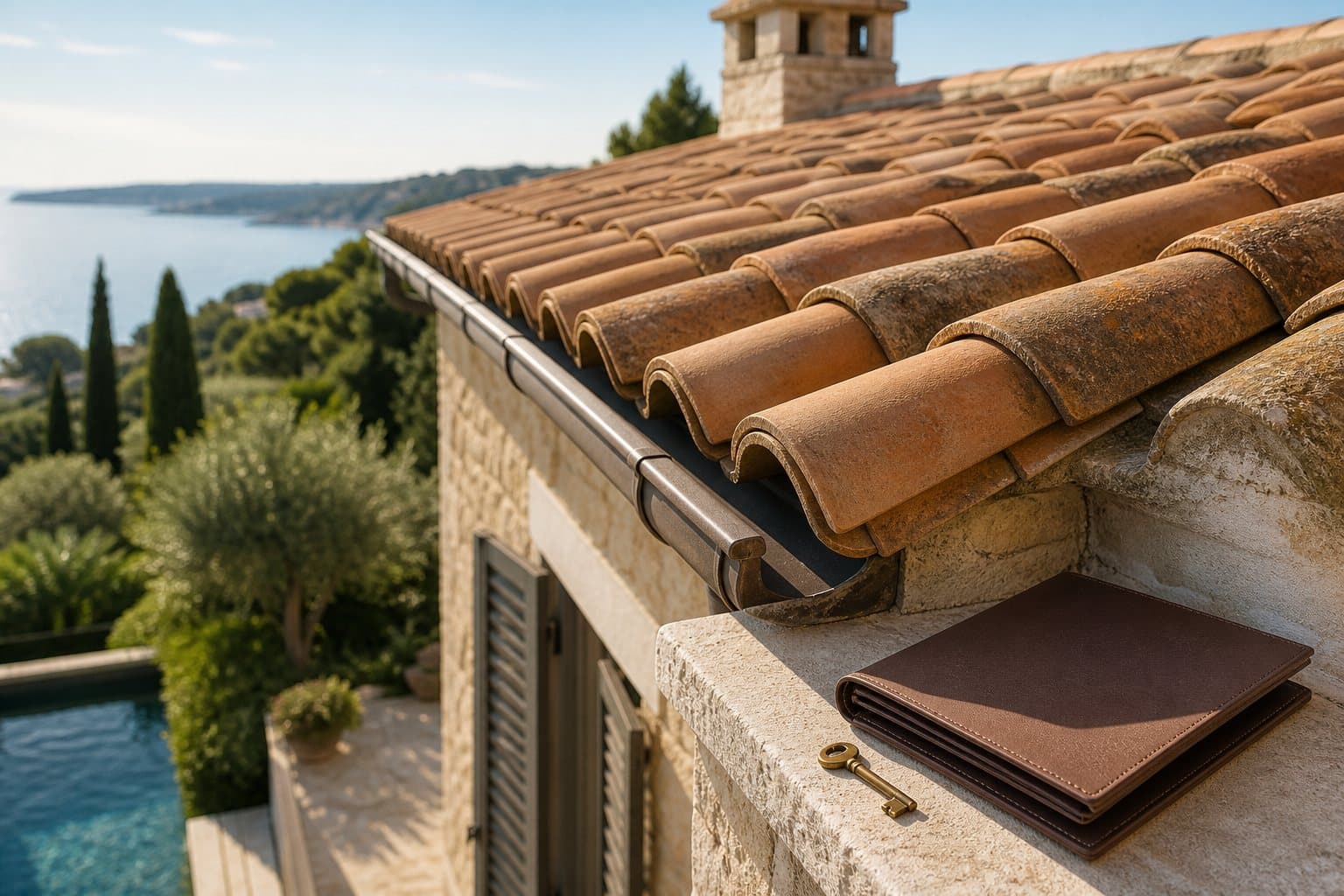
The letter most second-home owners dread does not announce itself. It arrives on an ordinary morning, from a roofer or a property manager, and it contains a single number with a great many zeros: the slate has reached the end of its life, the pool plant has failed, the boiler that limped through last winter will not survive the next. A roof replacement on a Mediterranean villa routinely runs into five figures, and a full heating-and-cooling system lands in a similar range. For the sole owner of a holiday home, that number is not a line in a budget. It is a phone call, a sleepless week, and a transfer that has to be made whether or not the property was used at all that year. The house that was supposed to be a pleasure has, for one season, become a creditor.
This is the part of second-home ownership that brochures never mention and buyers rarely price in. The headline figure — the purchase, the furniture, the first photographs by the pool — is the easy part. What separates a home that ages gracefully from one that becomes a source of quiet anxiety is something far less glamorous: a reserve fund, the pool of money set aside today for the large, infrequent repairs that are certain to come tomorrow. In a well-run co-ownership structure, that fund is not an afterthought left to one stressed owner's discipline. It is built into the model. Understanding how it works is, arguably, the single most useful thing a prospective buyer can learn — because it is the mechanism that turns a shared luxury home into something genuinely worry-free.
The Bill That Arrives Without Warning
Every building is, in slow motion, falling apart. Roofs have a lifespan. So do boilers, air-conditioning units, swimming-pool liners, terraces, shutters, water heaters and the dozens of other systems that make a house comfortable. The financial planning industry has a well-worn rule for this reality: a homeowner should expect to spend somewhere between one and four percent of a property's value every year on maintenance and eventual replacement, with older houses sitting at the higher end of that range. On a property worth a million euros, that is ten to forty thousand euros a year — not as a single bill, but as a long-run average, lumpy and unpredictable, that the wise owner smooths out over time rather than absorbing in the cruel year it all happens to land.
The problem for the individual second-home owner is that life rarely cooperates with averages. Boilers do not fail evenly across a decade; they fail in February, in the cold, often alongside something else. The owner who has not been quietly setting money aside discovers that the cost of ownership is not the smooth annual figure they budgeted for but a series of spikes — a calm few years lulling them into complacency, then a single season in which the roof, the pool and the heating all reach the end of their lives at once. It is precisely these capital expenditures — large, infrequent and non-negotiable — that wreck the economics of a holiday home far more often than the predictable running costs of insurance, cleaning and utilities ever do.
What a Reserve Fund Actually Is
A reserve fund — sometimes called a sinking fund — is the accounting answer to that problem. Rather than waiting for a repair to happen and then scrambling for the money, a small, regular contribution is collected and set aside specifically for major future works. It is a deliberately boring instrument, and its boredom is the point: it converts an unpredictable emergency into a predictable, manageable line item. When the roof eventually needs replacing, the money is already there. No emergency transfer, no awkward conversation, no scramble to find tens of thousands of euros in a hurry. The works are commissioned, the fund pays, and the owner's experience of the house never changes.
The crucial distinction — and one many buyers miss — is that a reserve fund is entirely separate from the everyday running costs of a property. The annual management fee covers the recurring, knowable expenses: the cleaning between stays, the gardener, the pool service, the local taxes, the insurance, the linen, the management itself. The reserve fund sits alongside it, doing a different job entirely — saving for the things that happen once a decade rather than once a week. A property that charges a low service fee but holds no reserve at all is not cheaper to own. It is simply deferring a reckoning, and the owner who buys in shortly before that reckoning arrives inherits the bill.
How Much Is Enough, and Who Decides
The discipline that governs reserve funds is borrowed from the world of professionally managed residential communities, where the question of how much to hold has been studied for decades. The benchmark professionals use is the percentage funded — the current reserve balance measured against the amount a property would ideally hold given the age and condition of all its components. A healthy reserve is generally considered to be one funded toward seventy to one hundred percent of that ideal. To arrive at the figure, well-run properties commission a reserve study: a methodical survey of every major component, its remaining life and its likely replacement cost, refreshed every three to five years so that contributions track reality rather than guesswork.
In a co-ownership home, that same logic is applied to a single high-quality property held through a dedicated company, and the contribution is shared. A portion of each owner's annual dues is directed into the reserve rather than spent, building the fund steadily year after year. Because the structure is transparent, owners can see what is held and what it is earmarked for — the roof in year eight, the pool plant in year twelve, the exterior repaint in year six. The forecasting is done in advance and the money accumulates quietly in the background, which is exactly how a reserve should behave. It is the financial equivalent of a well-maintained garden: invisible when it is working, conspicuous only when it has been neglected.
What happens when a reserve is allowed to run too thin is instructive, because it is the failure the whole system exists to prevent. In the managed-community world it takes the form of the special assessment — the sudden, mandatory top-up demanded of every owner when the fund cannot cover a repair that can no longer be postponed. It is the worst of both worlds: a large bill, arriving without warning, on top of the regular dues already paid. Reserve professionals treat the avoidance of special assessments as the entire purpose of the exercise, which is why they favour steady, slightly conservative contributions over the temptation to keep dues low and hope. A reserve that is forecast properly and funded patiently almost never produces a nasty surprise; a reserve that is starved to flatter the annual cost almost always does, usually at the least convenient possible moment.
Why One-Eighth Changes the Arithmetic
Here is where the co-ownership model does something genuinely useful rather than merely convenient. When eight households own a property together — each owning a real one-eighth share of the home, with roughly forty-five days of use a year — the cost of every major repair is divided eight ways before it ever reaches anyone's account. The roof that would land as a single intimidating bill on a sole owner becomes a long-anticipated, pre-funded item split across eight contributors who have each been putting a little aside for years. Exposure that felt existential to one owner becomes, to eight, an entirely ordinary fact of property life.
Consider a property like the four-bedroom villa with a pool in Valbonne, on the Côte d'Azur, offered at €150,000 for a one-eighth share. A villa of that kind has exactly the components a reserve fund is built to handle — the roof, the pool plant, the heating, the terraces, the garden irrigation. Owned outright, every one of those eventual repairs would fall on a single household. Owned in eight, each is anticipated by a reserve study, funded gradually through annual dues, and shared at the moment it occurs. The owner's relationship to the house is not one of liability but of arrival: the property is ready, the works are handled, and the unglamorous machinery of long-term upkeep runs without ever requiring their attention. You can see how this plays out across the wider portfolio of homes, each structured on the same principle.
Reading the Reserve Before You Buy
For a prospective buyer, the reserve fund is one of the most revealing things to examine, precisely because it is so often overlooked. A serious company will be able to tell you not only what the annual dues are, but how much of them flows into the reserve, what the fund currently holds, and what major works are forecast over the coming years. The questions worth asking are simple and diagnostic: Is there a reserve study, and how recent is it? What is the fund's current balance, and against what schedule of future works? Is the contribution adequate, or is it being kept artificially low to make the headline cost look attractive? A property that answers these questions clearly is a property being run by people who think in decades. One that cannot is a property whose true cost has simply not arrived yet.
This is also why the reserve fund matters at the moment of resale. A share in a home with a well-funded reserve and a clear maintenance forecast is a more attractive asset than an identical share in a home where the next owner can see a large, unfunded repair looming. The reserve is, in effect, a measure of how honestly a property has been run — and buyers, increasingly, know to look for it. For anyone weighing a purchase, the relevant detail sits in the buying process and its supporting documents, where the financial architecture of a share is laid out in full rather than implied.
The Quiet Discipline Behind a Carefree House
There is something quietly philosophical about a reserve fund. It is a structure designed entirely so that the future does not surprise the present — so that the pleasure of a house is never interrupted by the arithmetic of its upkeep. For the sole owner, that discipline depends on personal vigilance, and personal vigilance is exactly the thing a holiday home is supposed to let you set down. For the co-owner, it is institutional: built into the model, shared eight ways, forecast by professionals and funded a little at a time, so that the house can simply be a house. The reckoning that haunts the individual owner never comes, because it was paid for, calmly, years before it was due.
That is what a well-run reserve buys, in the end: not a number on a balance sheet, but a kind of peace — the freedom to enjoy a second home as a second life rather than a second job. If you would like to understand how the reserve, the dues and the long-term upkeep are structured across a specific property, speak with the team, who can walk you through the figures in detail. And if you are still weighing whether shared ownership is the right shape for the home you have in mind, the place to begin is simply to see the homes themselves — and to ask, of each one, the question most buyers never think to: who pays when the roof needs replacing, and is that money already there?
More from Co-Ownership Property


Get in Touch
Speak to an expert
Tell us what you're looking for and we'll be in touch.