Lifestyle & Ownership Experience
The Mallorca Ownership Experience: What a Week in Your Share Actually Feels Like
From the Tuesday morning market in Pollença to a Thursday afternoon at a private cove near Deià, co-ownership in Mallorca delivers the island's full lifestyle in six weeks a year — at one-eighth of the cost, with none of the management overhead that makes full ownership so exhausting.
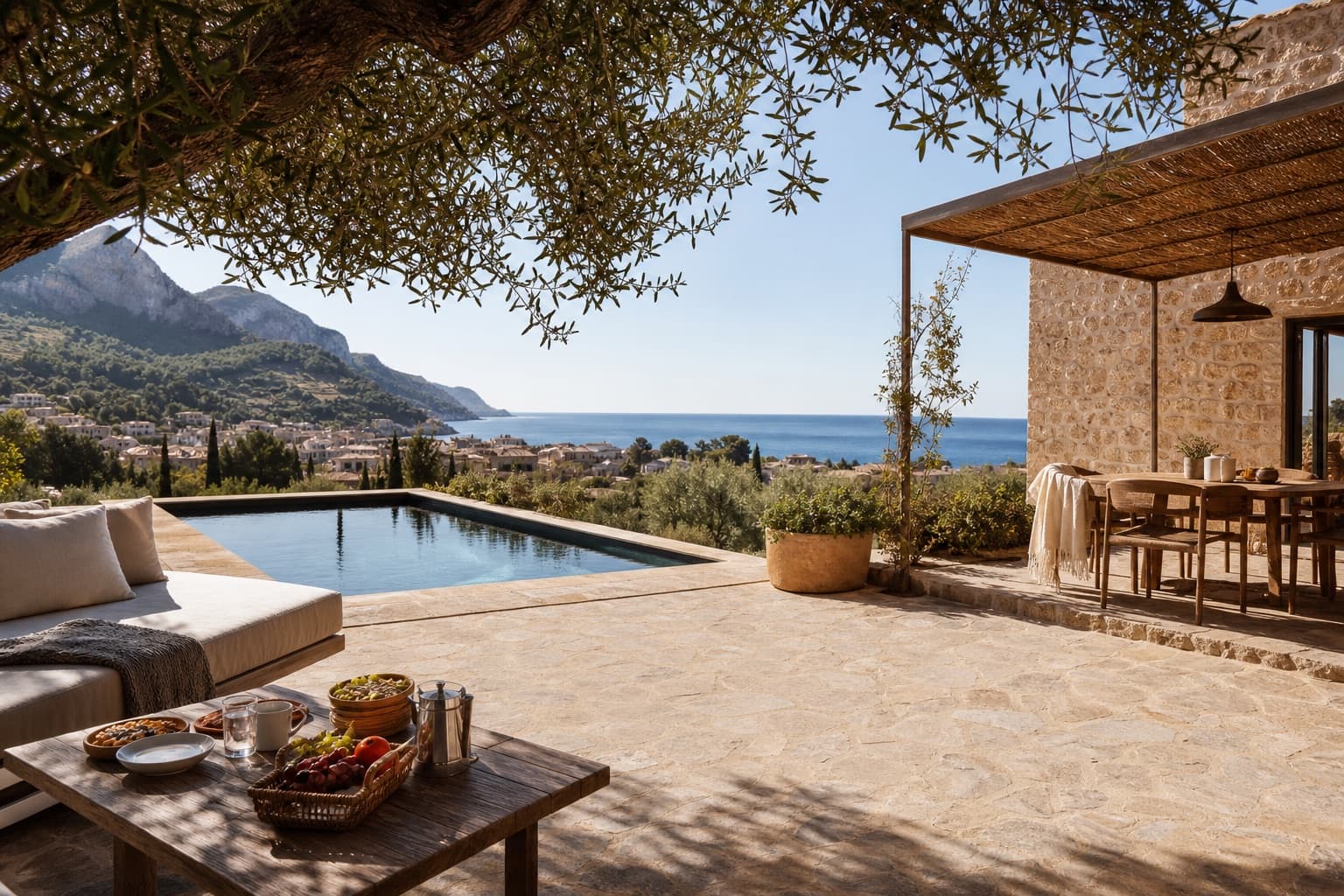
It is seven in the morning on a Tuesday in late September, and the market in Pollença's main square is setting up. The cheese stall goes first — wheels of Mahón from Menorca stacked alongside the local formatge that the woman behind the table makes herself, two villages over. Then the vegetable sellers, the olive oil man, the woman with the embroidered linen tablecloths that nobody ever buys but everyone touches. By eight o'clock the cafés around the perimeter have their first espressos on the go and the square smells of bread. This is not a tourist experience arranged for someone passing through. This is Tuesday in Pollença, the same as it has been every Tuesday for decades, and the family in the rental car photographing it on their phones will be gone by Thursday. The people sitting with their newspapers at the corner table, the ones who nod at the cheese woman and know the olive oil man's name, own property here. This is what ownership in Mallorca actually feels like — not the villa in the brochure, but the ordinary extraordinary rhythm of a place you return to.
For most second-home owners, that feeling is expensive to maintain and rarely experienced. The average British, American or Northern European owner of a Mallorcan property spends fewer than twenty-five days a year on the island, according to surveys of secondary-home usage in the Balearics. The pool is heated whether they are there or not. The property manager calls with questions they are not sure how to answer. The annual service charge arrives in January and is paid without much thought about what it covers. Co-ownership of a Mallorcan property — specifically, owning one-eighth of a quality villa or apartment through a properly structured LLC, alongside seven other vetted co-owners — changes the arithmetic entirely without changing the experience. You arrive. The property is ready. Someone else has managed it. You leave. The calendar resets for the next owner. This is what that week, and that month-and-a-half per year, actually looks like in practice.
Mallorca in the Shoulder Seasons: Why September and October Are the Real Prize
The travel brochures sell July and August. The people who actually own property in Mallorca use September and October. The sea temperature in late September sits around 24 to 25 degrees Celsius — warmer than the air temperature in London on a good August bank holiday — and the island has exhaled. The rental crowds have thinned. The restaurants take reservations again. The roads around the Tramuntana are driveable without convoy anxiety. It is the version of the island that residents describe when they explain why they never leave, and it is the version that a co-ownership calendar is particularly well-designed to capture.
With 44 to 45 days of annual usage per one-eighth share, the scheduling question for most co-owners is not whether to take shoulder-season time — it is which shoulder-season weeks to prioritise. A family with school-age children will weight their share toward the summer peak. A couple in their fifties with flexible schedules will take the last two weeks of September, the first week of November, and a long Easter visit. A buyer primarily interested in the island's cultural and culinary life — the Pollença music festival in August, the wine harvest in Binissalem in October, the almond blossom walks in February — can build an annual pattern that tracks those moments specifically. The calendar is genuinely flexible, agreed among co-owners through the management company, and in practice most co-ownership groups find they naturally want different weeks.
What a Typical Week Looks Like
The arrival experience for a co-owner is categorically different from a rental. You are not hunting for a key-safe combination on a doorframe. You are not reading a laminated instruction sheet about the WiFi and the bin collection days. The property management company has prepared the house before you arrive — fresh linens, the pool at temperature, the fridge stocked with the basics you requested in advance. The property is yours for the week. Not yours in the hedged sense of a hotel room, or the provisional sense of an Airbnb. Yours in the deeded, on-the-mortgage, your-name-is-on-the-company sense. That distinction is not abstract. It changes how you use the space from the first afternoon.
A Tuesday afternoon, say, in a co-ownership property near Deià. The village sits above the northwest coast at around 400 metres, with a descent to a rock-and-pebble cove that takes twenty minutes on foot. The cove — Cala de Deià — is small enough that in September it feels private. The restaurant at the top of the steps serves grilled llenguado (sole) and the house wine is the local cooperative's white, which is better than it has any right to be. A couple who own a one-eighth share in a restored finca above the village might spend the morning at the property — coffee, reading, a slow circuit of the garden — and the afternoon at the cove. This is not an unusual or aspirational description of how people use the island. It is the ordinary rhythm of ownership in one of Europe's most beautiful places.
By contrast, a week in the island's northeast — around Alcúdia or the Cap de Formentor — reads differently. The bay at Alcúdia is wide and shallow, the water extraordinarily clear, and the old walled town is compact enough to walk completely in an hour. The weekly market at Puerto Pollença draws serious olive oil buyers from across the island. The drive to Cap de Formentor and back before lunch, stopping at the viewpoint over the cliffs, is one of those journeys that takes about ninety minutes but occupies the memory for considerably longer. Property here — particularly apartments and small houses within walking distance of the bay — has appreciated meaningfully over the past five years, with asking prices for quality resale property now running between €400,000 and €1.2 million for two-to-four bedroom homes in good locations.
The Management Reality: What You Don't Have to Think About
The lifestyle argument for co-ownership in Mallorca is compelling on its own terms. The practical argument is equally so. Full ownership of a Mallorcan property above a certain value brings with it a management overhead that most buyers underestimate at the point of purchase and find exhausting within two years. The pool contractor, the gardener, the cleaner, the property manager, the insurance renewal, the IBI (local property tax), the community fees if the property is in a complex, the water bills that arrive quarterly in Spanish with a box of figures that don't immediately map to anything obvious. Co-owners deal with none of this directly. The management company — appointed by the LLC that holds the property — handles all of it. Owners receive a single annual account, pay their proportional share of costs, and use the property.
The cost structure is one of the most frequently misunderstood aspects of co-ownership. Because you own one-eighth of the property, you pay one-eighth of all running costs: property taxes, insurance, maintenance, management fees, pool and garden upkeep, and any agreed capital improvements. For a quality Mallorcan villa with a pool, running costs for the full property might run €18,000 to €28,000 per year depending on size, age, and specification. An eighth-share owner pays €2,250 to €3,500 annually — less than many people spend on two weeks in a rented villa. Understanding this is what changes the co-ownership conversation from "interesting idea" to "why haven't I done this already." For a detailed breakdown of how costs are structured and shared, see our how it works section.
Mallorca's Property Market in 2026: Context for Buyers
Understanding the Mallorcan market in 2026 matters because it shapes the entry price for co-ownership and the long-term capital position of co-owners. The island has been one of the most consistently appreciated property markets in Southern Europe over the past decade. Palma's prime residential market has seen prices rise by an estimated 40 to 55 per cent since 2014, with the southwest coast — particularly the so-called Golden Mile between Portals Nous and Puerto Andratx — sustaining values that place it among the most expensive coastal real estate in Europe. Prime villa prices in the southwest now start at €3 million and routinely exceed €15 million for exceptional properties.
The mid-market — the quality villas and apartments in the Tramuntana foothills, the northeast bay areas, and the historic inland villages — has moved less dramatically but consistently. Properties in this segment, which are the most relevant for co-ownership structures, now typically trade between €600,000 and €2.5 million for good-quality three-to-five bedroom homes with pools and land. A one-eighth share in a property at the mid-point of that range — say, a €1.2 million restored farmhouse near Pollença — would currently be priced at around €150,000 to €175,000 per share, depending on the operator's structure and any rental income offset. That entry point gives a co-owner deeded ownership in a market that has demonstrated consistent long-term appreciation, with none of the management exposure or capital concentration risk of full ownership. Browse the current Mallorca co-ownership listings on our site for live pricing.
One regulatory note that affects all Mallorcan property buyers: the Balearic Islands government has significantly restricted the issuance of tourist rental licences (ETV) for residential properties in many municipalities. New licences are effectively frozen in most of Palma and many coastal communes, meaning that many properties cannot legally be let on platforms like Airbnb. This has no effect on co-owners who intend to use their share personally — and the majority of co-ownership buyers do — but it is a structural factor that constrains supply of quality properties with rental income potential and tends to support capital values in the medium term. Co-ownership operators structure their properties either within the tourist rental framework where licences exist, or as personal-use-only arrangements. It is worth confirming which structure applies to any specific property before signing. Our buying FAQs address this in detail.
The Co-Ownership Case for Mallorca
The case for co-ownership in Mallorca is not primarily a financial argument, though the financial argument is sound. It is fundamentally a usage argument. The island rewards the kind of unhurried presence — the Tuesday markets, the September coves, the October wine harvest visits — that a few weeks of real ownership enables and that a holiday rental, with its check-in and check-out anxiety, rarely delivers. Co-owners arrive as owners. They know the property, have their routines in it, and engage with the island from a different starting point than a tourist. Over five or six visits a year, across different seasons, that builds into something that feels less like a holiday and more like a second life. That is, ultimately, what people are buying when they buy a share in a Mallorcan property — not the bricks, but the Tuesday in the square.
For buyers currently evaluating the island, COP has current inventory across Mallorca and the wider Balearics — including Ibiza and Menorca — spanning the price points and village characters described above. Browse the full current listings or speak with our team directly to understand which properties are available and what a specific share would cost in the current market.
See the homes behind this guide. Explore a current Mallorca co-ownership share, browse the wider Spanish collection, or speak with our team about what is available now.
More from Co-Ownership Property
Kontakt aufnehmen
Sprechen Sie mit einem Experten
Sagen Sie uns, wonach Sie suchen, und einer unserer Miteigentums-Spezialisten meldet sich innerhalb von 24 Stunden bei Ihnen.