French Alps · France · Europe
Fractional Ownership in the French Alps
From a slope-side chalet above Courchevel 1850 to a Chamonix duplex with the Aiguille du Midi filling the window — fractional ownership in the French Alps means a real share of the largest interconnected ski terrain on the planet, six to seven weeks of personal use a year, and a fully managed mountain home that is open the day the season opens.
2 properties · from €144,000
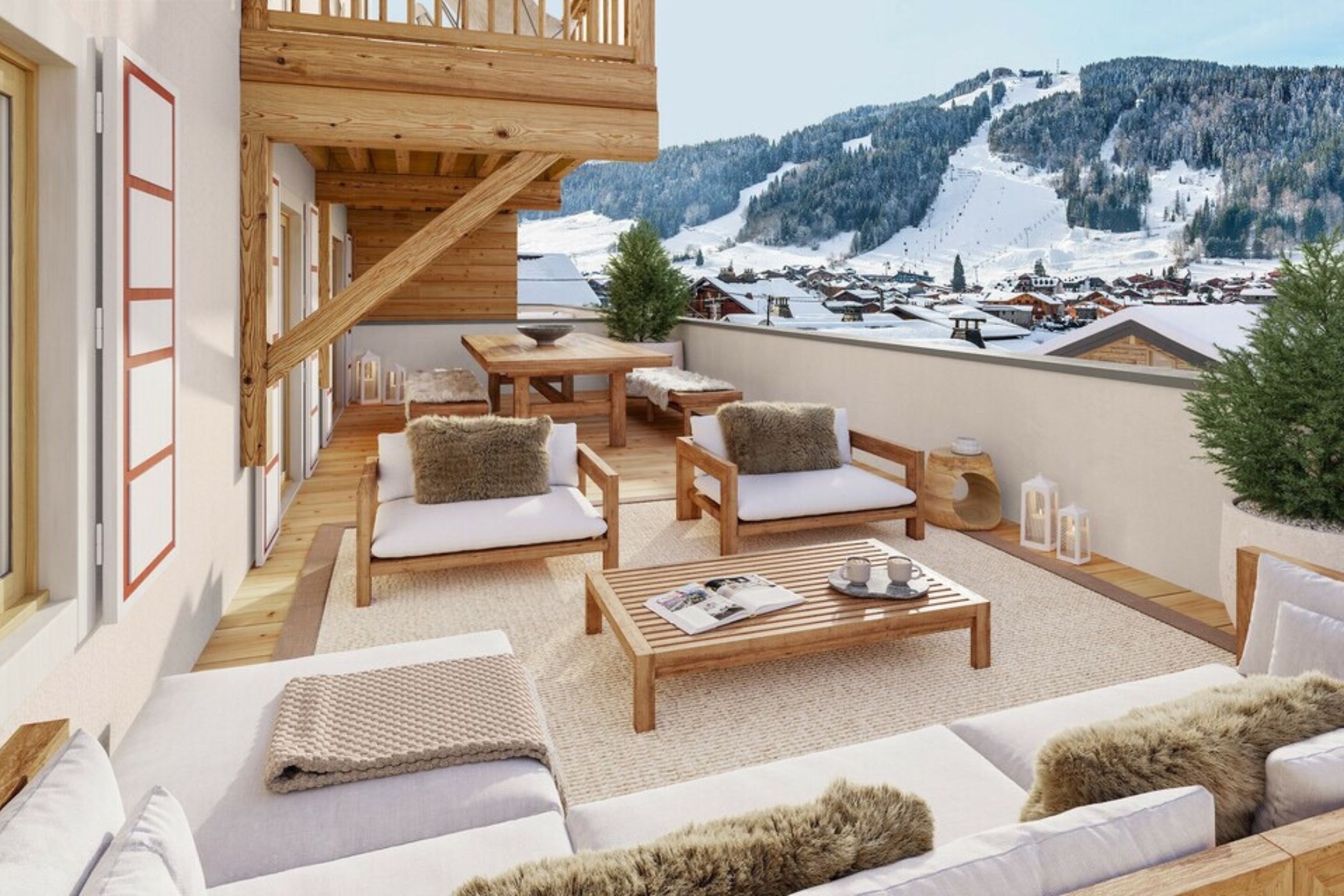
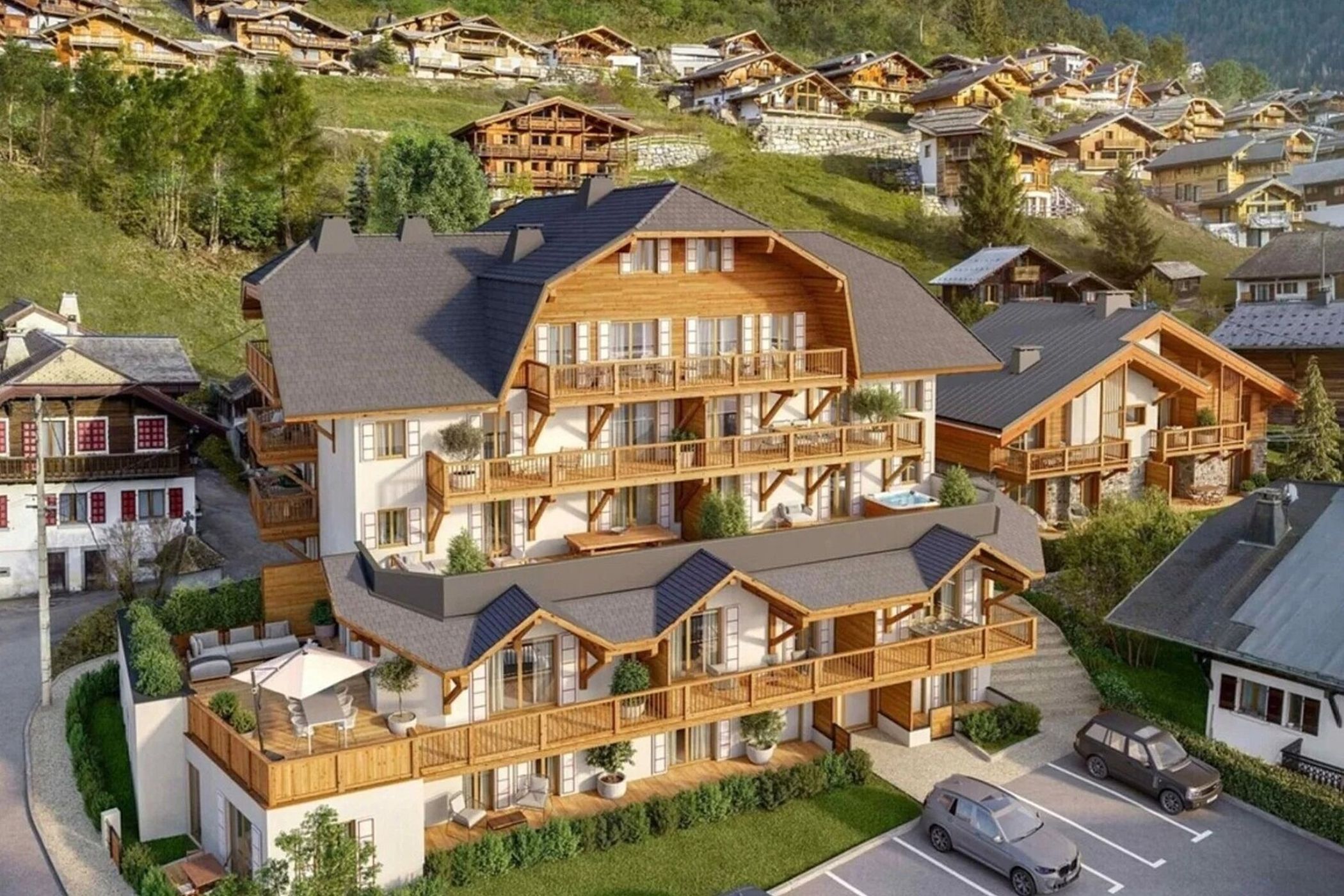
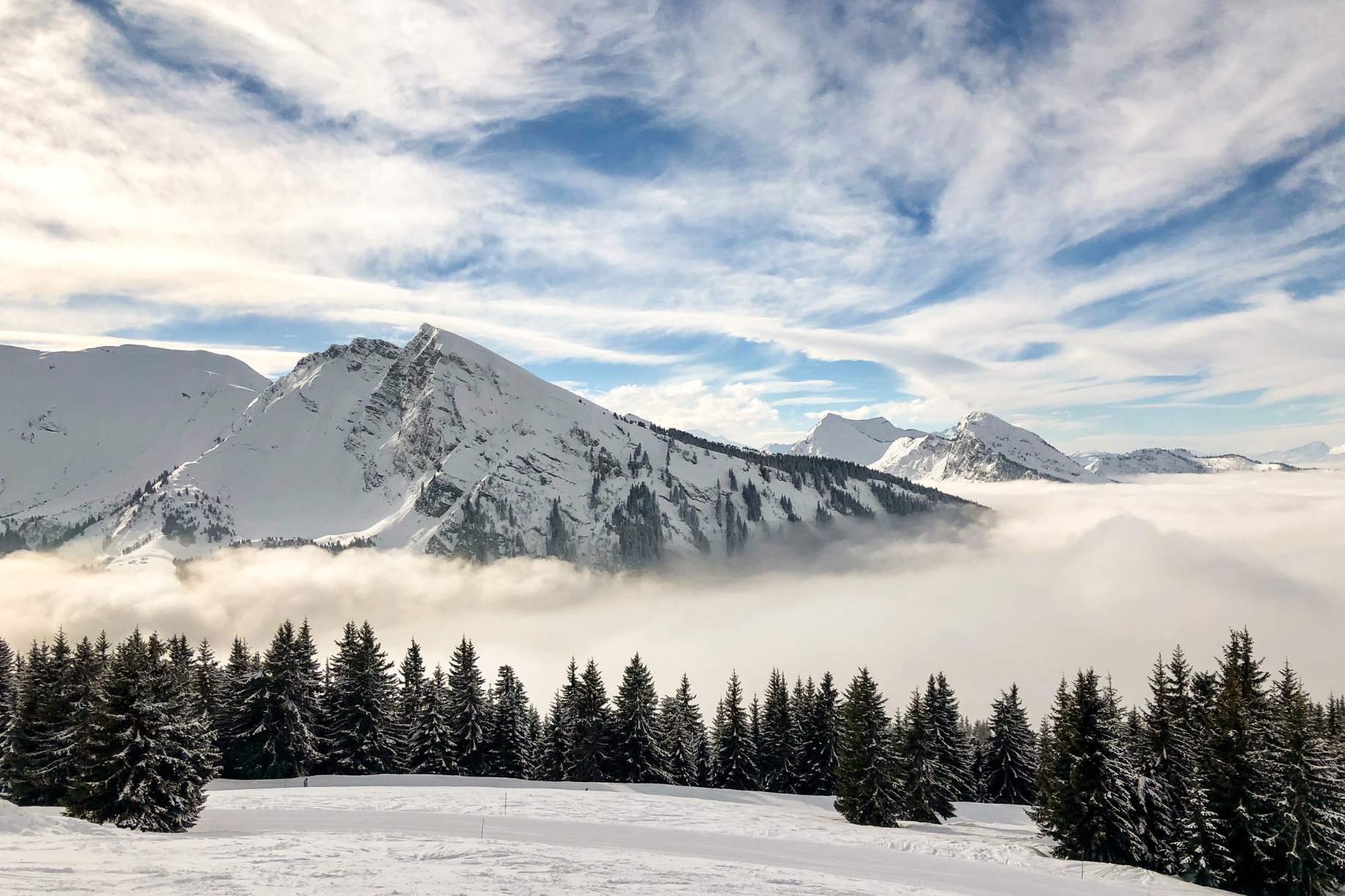
Morzine, Portes du Soleil, France — 2-Bed Apartment With Mountain Views
€144,000
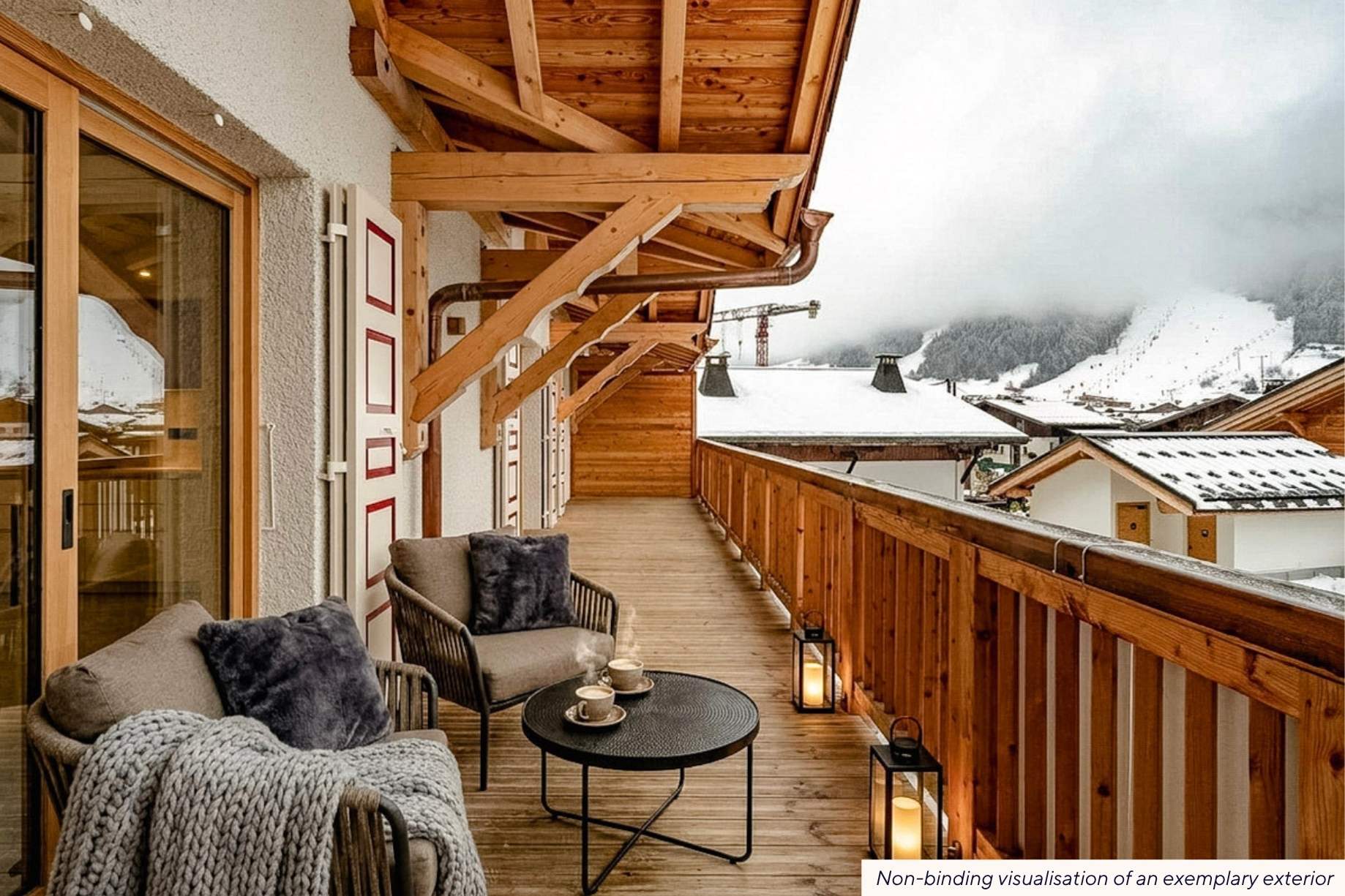
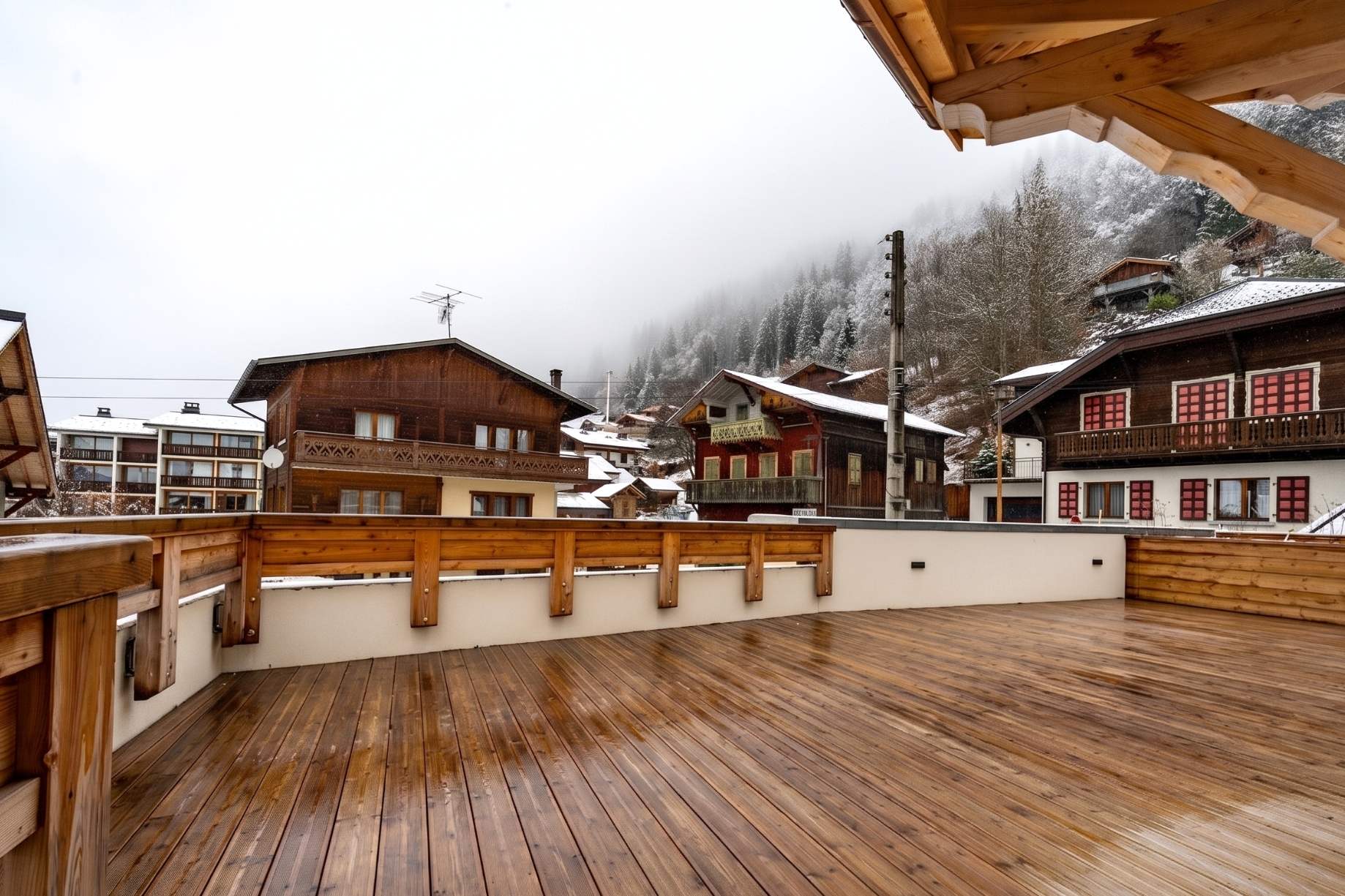
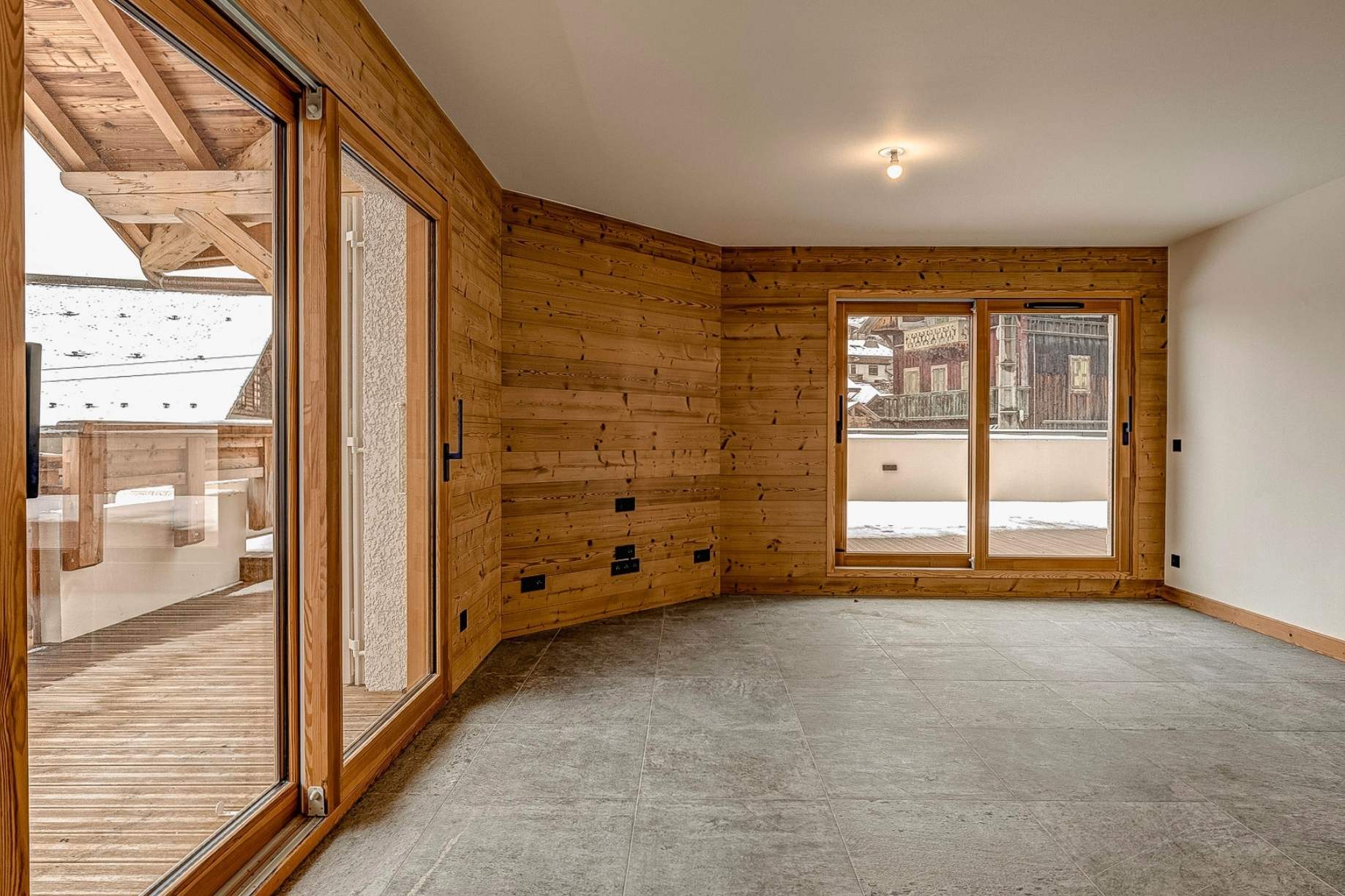
Morzine, Portes du Soleil, France — 3-Bed Terrace Apartment With Mountain Views
€249,000
The world's deepest ski domain, accessible through co-ownership.
Fully managed chalets, apartments and farmhouses across the Trois Vallées, the Espace Killy, Megève, Chamonix-Mont-Blanc and the Portes du Soleil. Your 1/8 share of the home comes with 6–7 weeks of personal use, a professional management team on call, and the long-term equity of Europe's most established alpine market.

What is fractional ownership in the French Alps?
Fractional ownership in the French Alps means buying a real 1/8 share of a luxury alpine second home, shared with up to seven other co-owners. Each owner receives personal use set by the partner that manages the home — a minimum of 44 or 45 nights a year with most of our partners, and no set cap with some others — through a fair-rotation calendar, with all property management, maintenance, taxes and operations handled by a professional team. It is real ownership of a share of the home — not a timeshare, not a holiday club.
Why the French Alps?
The French Alps are, by every measurable metric that matters for a serious second-home buyer, the single deepest ski-and-mountain market in the world. France contains more lift-served terrain than any other country, with the three largest connected ski domains on the planet — the Trois Vallées (600 km of pistes across Courchevel, Méribel and Val Thorens), Paradiski (425 km across Les Arcs, La Plagne and Peisey-Vallandry) and the Portes du Soleil (600 km across twelve resorts straddling the French–Swiss border) — all sitting within a two-hour drive of Geneva airport. The vertical drop in the major domains is European-best (the run from Val Thorens at 2,300 metres down to Saint-Martin-de-Belleville at 1,400 metres is a continuous 900-metre descent on snow); the lift infrastructure is the most modern in Europe after the recent waves of capital investment; and the off-season life across the major valleys — Megève and Chamonix in particular, where the year-round population is 10,000+ in each — gives an owner a four-season mountain base rather than a winter-only address. Few alpine regions in Europe, and arguably none outside the French Alps, combine that scale of skiable terrain with that depth of professional and residential infrastructure.
Your French Alps share is owned alongside up to seven other co-owners — a real share of the home, not a right to use it.
The French Alps' particular advantage inside European alpine markets is the combination of altitude, planning protection and lift-network scale that has kept the most desirable inventory genuinely scarce. The high-altitude purpose-built resorts of the Tarentaise valley — Val Thorens at 2,300 metres, Tignes at 2,100 metres, Val d'Isère at 1,850 metres, Courchevel 1850 at the elevation its name advertises — sit above the snow line that climate trends have raised in lower-altitude Alps, which is the reason buyers and tour operators alike have steadily migrated upslope over the past two decades. The traditional villages with protected building stock — Megève, Saint-Gervais, Argentière, the old core of Chamonix, Les Gets — operate under strict Plan Local d'Urbanisme rules that have kept new-build to a trickle and pushed restoration of existing chalets onto every available agricultural-conversion plot. The result is that the buildable stock of high-specification French Alps chalets is, in real terms, no longer growing at the rate of demand in the prime addresses — and the existing inventory is held tighter than at any point in the modern era.
It is worth setting the French Alps in their European competitive context. The Swiss Alps offer comparable altitude and lift networks at materially higher entry prices, with restrictive Lex Weber rules that cap second-home permits in many cantons and a notarial system that is heavier than the French equivalent for non-resident transactions. The Austrian Tyrol offers exceptional charm at lower altitude but smaller connected domains, and the off-season life in many Tyrolean villages is thinner than in the major French valleys. The Italian Dolomites are scenically extraordinary but the lift connections are fragmented across multiple consortia and the off-season infrastructure is concentrated in a smaller number of valleys. The Pyrenees offer real value but smaller domains and less internationalised resort towns. Together, these comparisons help frame why French alpine destinations remain, by some distance, the highest-volume international second-home market in the European ski tier. The broader regional tourism authority (Auvergne-Rhône-Alpes Tourism) and the French national tourism board both treat the alpine valleys as the country's single most valuable inbound tourism asset after Paris.
The third structural argument for the French Alps is the diversity of usable lifestyles available inside a single region. A Northern European family with a 1/8 share in Megève is forty minutes from the lift-served slopes above Mont d'Arbois and an hour from the Aiguille du Midi cable car at Chamonix; a Méribel buyer in the Trois Vallées is a single ski day from Courchevel and Val Thorens on the same lift pass; a Morzine buyer in the Portes du Soleil is a forty-minute drive from Geneva airport and a single chairlift ride from Avoriaz, Châtel and the Swiss side at Champéry and Les Crosets. The region packs a remarkable amount of difference into a 200-kilometre by 100-kilometre footprint — purpose-built high-altitude resorts, traditional Belle Époque villages, river-valley working towns, glacier-fed mountaineering centres, broad family-friendly bowls — and a French Alps share that combines proximity to several of these gives an owner a year-round mountain base rather than a single-season property. Few other alpine regions can match that range without significantly longer drive times.
For a co-ownership buyer thinking strategically rather than just emotionally, the French Alps' combination of scale, altitude security and infrastructure depth matters more than the headline glamour. The chalet you buy a share of above Méribel sits in a market where the buildable land along the village ridge is already capped by planning rules and where the existing chalet stock at slope-side addresses is fundamentally finite. The Val d'Isère apartment is in a resort whose central-village permits have not loosened in fifteen years. The Megève farmhouse is in a commune whose Plan Local d'Urbanisme protects the working agricultural valleys around Mont d'Arbois and Rochebrune. These are not assets that depend on a particular interest-rate cycle to hold their value; they depend on the unchanging facts that the Trois Vallées remain the Trois Vallées, that the Aiguille du Midi remains the Aiguille du Midi, and that climate trends keep favouring high-altitude alpine real estate. Add the professional management and resale infrastructure that makes shared ownership transparent and resaleable, and the case for co-ownership in the French Alps writes itself.
One under-discussed advantage that becomes obvious once you actually start using a French Alps second home is the depth of the region's professional services infrastructure for non-resident owners. Five decades of British, Belgian, Dutch, Scandinavian and (more recently) Russian and American buyers have built up an ecosystem of multilingual lawyers, property managers, notaires, tax advisers, ski-instructor agencies, chalet companies and concierge services across the major valleys that smaller alpine alternatives simply cannot match. The local management companies in Courchevel, Méribel, Val d'Isère, Megève, Chamonix and Morzine operate in English, German, Dutch, French and the Scandinavian languages as a matter of routine, with decades of operating history; the British community in the Trois Vallées is large enough to run its own ski schools, English-language church services and chartered-flight transfers through the season. The French notarial system gives ownership documentary clarity that traces back to the Napoleonic Code of 1804, and the cadastral records — held by the service de la publicité foncière — are a long-running, reliable record-of-record system. None of this is glamorous, but it is the kind of infrastructure that determines whether owning a mountain home from another country is a pleasure or a chore.
The fourth structural advantage worth naming is the transport infrastructure that makes a French Alps second home practically usable rather than just nominally owned. Geneva airport (GVA) is the gateway airport for the western French Alps — sitting on the French border, with direct year-round service from London, Manchester, Edinburgh, Dublin, Amsterdam, Brussels, Paris, Frankfurt, Munich, Hamburg, Berlin, Zurich, Vienna, Copenhagen, Stockholm and dozens of further European cities, plus East-coast US gateways through the winter. Lyon-Saint Exupéry (LYS) covers the southern Alps, and the smaller Chambéry (CMF) handles winter charter directly to the Tarentaise valley. Most Northern European hubs are under two hours' flight time to GVA; the drive from GVA to the major resorts is genuinely short (Morzine and Les Gets in 60 minutes, Megève in 75 minutes, Chamonix in 75 minutes, Courchevel and Méribel in 2 hours, Val d'Isère in 2.5 hours); and the TGV direct from Paris to Moûtiers and Bourg-Saint-Maurice gives the Tarentaise an additional rail backbone. An owner can leave London on a Friday morning and be on the Courchevel slopes by Saturday lunchtime. The professional ski instruction network through the École du Ski Français (ESF) — the national French ski-school federation, founded in 1945 — operates branches in every major resort and is the largest single ski-school organisation in the world.
Where to own in the French Alps
The French Alps' second-home market is best understood through five distinct sub-zones, each with its own altitude, architecture, season and buyer mix. There are, of course, French Alps addresses outside these five — the southern Alps around Serre Chevalier and Briançon, the Belledonne range above Grenoble, the smaller Maurienne resorts at Valloire and Valfréjus, the lower valleys around Annecy and Aix-les-Bains — and we are happy to discuss them with buyers whose interests run that direction. But the supply story for fractional ownership is concentrated in the five clusters below: the Trois Vallées (Courchevel, Méribel, Val Thorens), the Espace Killy (Val d'Isère, Tignes), Megève, the Chamonix-Mont-Blanc valley, and the Portes du Soleil (Avoriaz, Morzine, Les Gets). Together they account for the overwhelming majority of international second-home demand in the French Alps.
The Trois Vallées — Courchevel, Méribel, Val Thorens
The Trois Vallées is the largest connected ski domain in the world — 600 kilometres of lift-served pistes spread across three parallel valleys in the Tarentaise, with 183 lifts moving skiers between Courchevel, Méribel, Val Thorens, Les Menuires and Saint-Martin-de-Belleville on a single lift pass. Courchevel is the prestige anchor at the southern end of the domain — a six-village commune rising from Courchevel Village at 1,300 metres through Courchevel Moriond (1,650), Courchevel Village (1,550) and Courchevel 1850 at the top, where the slope-side residential addresses around the Jardin Alpin, Bellecôte and Plantrey have set European price records over the past two decades. Courchevel 1850 is the address that defined high-end alpine luxury in France and remains the most concentrated cluster of Michelin-starred restaurants in any ski resort worldwide. Méribel sits in the central valley — a deliberately low-rise chalet resort built around the wooden-balconied vernacular that British property developer Peter Lindsay imposed on the area in the 1930s, and one of the most architecturally coherent purpose-built resorts in the Alps. Méribel's twin altitude levels — Méribel-les-Allues at 1,450 metres and Mottaret at 1,750 metres — sit at the geographic centre of the domain and put every part of the Trois Vallées within a single ski day.
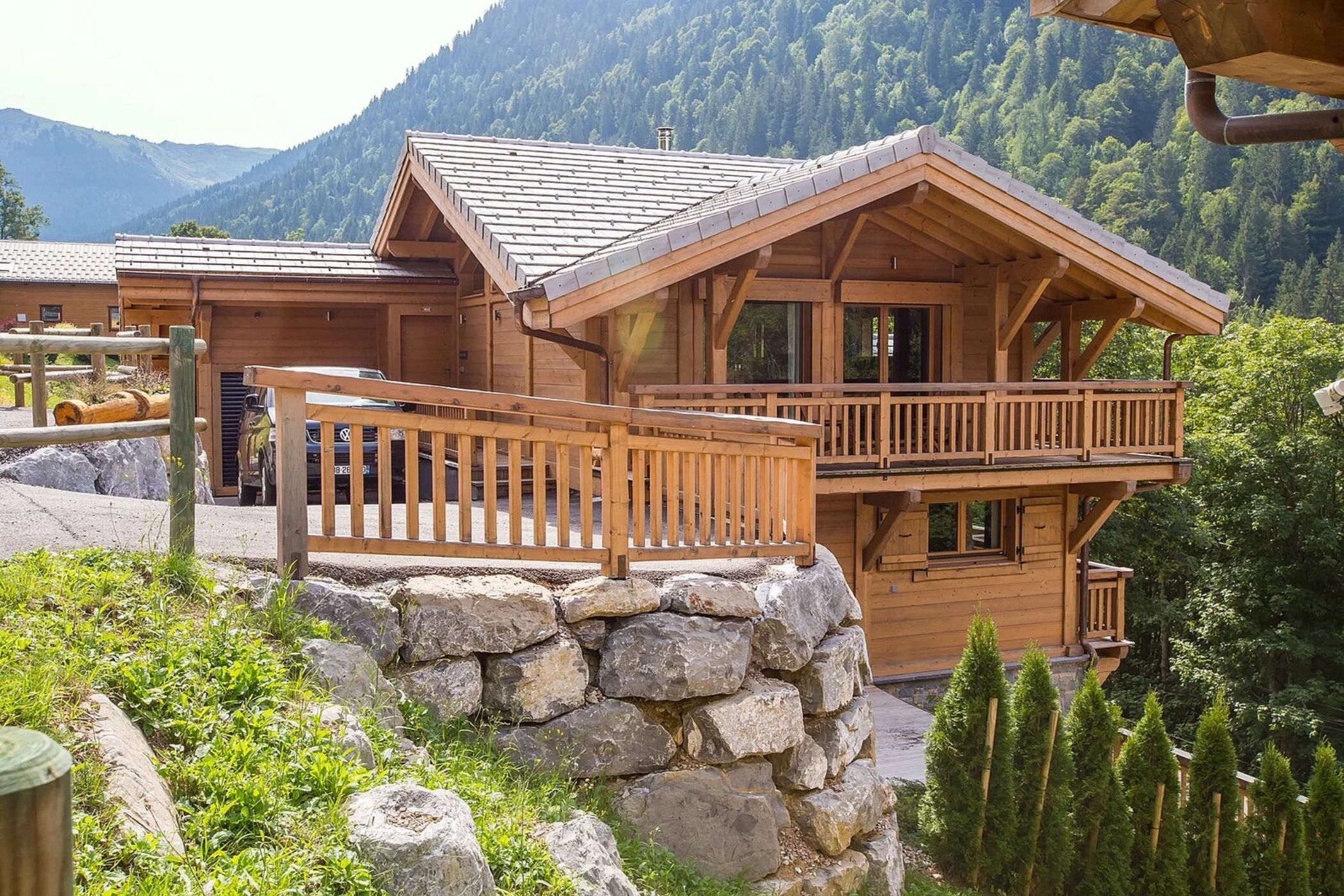
Val Thorens, at the head of the third valley, is the highest ski resort in Europe at 2,300 metres, with a building stock that is almost entirely high-altitude purpose-built and snow that runs from late November through early May in a typical year. Val Thorens has won the World Ski Award for "World's Best Ski Resort" multiple times in the past decade and is one of the most snow-sure addresses in the Alps. The international buyer mix across the Trois Vallées is heavily British and Belgian in Courchevel and Méribel, with a long-standing Dutch, Russian, Middle-Eastern and increasingly American presence in the prime Courchevel 1850 tier; Val Thorens sees a younger, more sports-oriented mix that crosses Northern European nationalities. The architectural inheritance divides cleanly between the high-altitude purpose-built apartments and small chalets of Val Thorens, the wooden-balconied chalet vernacular of Méribel, and the spread of contemporary slope-side chalets and apartment-residences around Courchevel 1850. Drive times from Geneva are 2 hours to Courchevel and Méribel and 2 hours 15 minutes to Val Thorens; from Lyon roughly 2 hours 15 minutes; from Chambéry a shorter 90 minutes. Climate runs −5 to 0°C (high 20s°F to low 30s°F) through the heart of the winter and 15–22°C (low 60s°F to low 70s°F) in high summer at resort altitude, with snow on the high pistes from late November through early May. The Trois Vallées sits inside the Vanoise National Park buffer zone, France's oldest national park (founded in 1963). Best for: serious skiers who want the deepest connected terrain in the world on a single lift pass, buyers who prioritise altitude-secured snow, and owners whose calendars centre on the December–April peak with shoulder-season summer use.
The Espace Killy — Val d'Isère and Tignes
The Espace Killy — 300 kilometres of pistes connecting Val d'Isère at 1,850 metres and Tignes at 2,100 metres — is the second of the major Tarentaise domains and the one that most defines the high-altitude expert-skier French alpine experience. Val d'Isère is the older village with the deeper traditional core — the late-medieval Saint-Bernard church, the long pedestrian Rue Principale, the original family-owned hotels around the central Place du Village — and has been a serious international ski destination since the 1955 World Championships. Tignes, at higher altitude, is the more purpose-built of the two — its four village levels (Le Lac, Val Claret, Le Lavachet, Tignes 1800) were rebuilt after the 1952 hydroelectric dam flooded the original village, which gives Tignes a more uniformly modern (and architecturally controversial) look than its older neighbour. The two villages share the Grande Motte glacier at 3,450 metres, which sustains lift-served skiing from late October through early May — among the longest seasons of any French resort and one of the few French addresses with reliable autumn skiing.

The international buyer mix in the Espace Killy is heavily British, Scandinavian and Dutch in Val d'Isère, with a younger and more sports-oriented mix across Tignes. The architectural inheritance in Val d'Isère is the traditional Tarentaise stone-and-wood village vernacular preserved through strict planning rules around the historic core, complemented by a tier of contemporary slope-side chalets that has emerged on the village fringes over the past two decades; Tignes is more uniformly modern. The Espace Killy is the natural choice for owners who prefer altitude-secured snow and serious expert terrain over the more compact convenience of the Trois Vallées; the off-piste skiing in the Vanoise National Park backcountry that the resorts back onto is among the best in Europe. Drive times from Geneva are 2 hours 30 minutes; from Lyon roughly 2 hours 30 minutes; from Chambéry 90 minutes; and the TGV reaches Bourg-Saint-Maurice, the rail terminus thirty minutes downvalley, from Paris and Lille direct. Climate is similar to the Trois Vallées at altitude — −6 to 0°C (low 20s°F to low 30s°F) mid-winter and 14–20°C (high 50s°F to high 60s°F) in high summer — but the high-altitude exposure makes Val d'Isère and Tignes both colder and more snow-secure than the slightly lower Méribel and Courchevel. Best for: committed skiers who prioritise terrain over village charm, families with strong-skier teenagers, and owners willing to trade convenience for the deepest snowpack and the longest season in the French Alps.
Megève
Megève sits in a different category from the Tarentaise high-altitude resorts. It is a Belle Époque traditional village founded as a resort by the Rothschild family in the 1920s — when Noémie de Rothschild, after a visit to Saint Moritz, decided that France needed its own equivalent and chose Megève for its broad sunny pasture, traditional Savoyard architecture and proximity to Mont Blanc. The result is the most architecturally complete traditional ski village in France: a working medieval centre around the seventeenth-century parish church and the pedestrian Place du Village, a residential ring of restored chalets on the slopes of Mont d'Arbois and Rochebrune, and a Belle Époque hotel tradition (the Four Seasons Hotel des Alpes, the historic Mont d'Arbois palace, the Lodge Park) that has anchored the village's identity for a century. The ski domain — 400 kilometres of pistes across the Mont d'Arbois, Rochebrune, Le Jaillet and Combloux sectors, with onward connection to the larger Évasion Mont-Blanc area — is mid-altitude (the highest lift tops out at 2,350 metres on the Cote 2000), which makes Megève less snow-secure than Val Thorens or Val d'Isère but materially more sun-blessed across the season.

The international buyer mix in Megève is the most Francophone of the major French alpine resorts — Paris families with second homes in Megève represent the single largest cohort, with a long-standing Belgian, Swiss, Brazilian and Lebanese presence and a smaller but growing Anglo-Saxon share. The architectural inheritance is the strict Savoyard chalet vernacular protected by the commune's planning rules — wooden balconies, stone bases, slate roofs, the pierre de Megève limestone trim — and the result is a village that looks like the platonic ideal of a French alpine resort. The off-season life in Megève is the deepest of the major French ski destinations: the village has a year-round population of around 4,000, the restaurants and shops open through May–June and September–October, and the summer calendar — golf at the Mont d'Arbois course, hiking the Aravis ridge, the late-July Megève Jazz Contest, the August Jumping International equestrian event — gives the village a genuine four-season identity that the higher-altitude resorts lack. Drive times from Geneva are 75 minutes; from Chamonix 30 minutes; from Lyon roughly 2 hours. Climate runs −2 to 4°C (high 20s°F to high 30s°F) mid-winter at village altitude (1,100 metres) and 18–24°C (mid-60s°F to mid-70s°F) in high summer, with the village's sunny exposure giving Megève noticeably more sunshine than the deep Tarentaise valleys. Best for: design-led families who value architectural pedigree and four-season usability over highest-altitude snow security, Paris-based owners who want a winter base inside three hours of the capital, and buyers who treat the village's restaurant and cultural calendar as part of the address.
The Chamonix-Mont-Blanc valley
Chamonix-Mont-Blanc, in the Arve valley at the foot of the Mont Blanc massif, is the oldest and most iconic French alpine resort — the site of the first Winter Olympics in 1924, the historical heart of European mountaineering, and the only major French ski address with a year-round full-service town life rather than a resort calendar. The town has a year-round population of around 9,000, three full-service hospitals, a daily market, the Musée Alpin, the historic Mont Blanc Hotel, and a working four-season life that the purpose-built ski resorts cannot match. The annual Cosmo Jazz Festival in late July sees jazz concerts staged on the high alpine pastures around the town. The Mont Blanc massif itself rises directly above the town to 4,809 metres — the highest peak in Western Europe — and the Aiguille du Midi cable car from the centre of Chamonix rises to 3,842 metres in twenty minutes, the highest vertical lift in Europe and the gateway to the legendary Vallée Blanche off-piste descent that drops 2,800 metres back to the town. The skiing in the valley is spread across multiple non-connected sectors — Grands Montets at Argentière, Le Tour at the head of the valley, Brévent and Flégère on the southern flank of the valley facing Mont Blanc, and the smaller Les Houches domain below the town — totalling 170 km of pistes served by a single Chamonix valley lift pass.
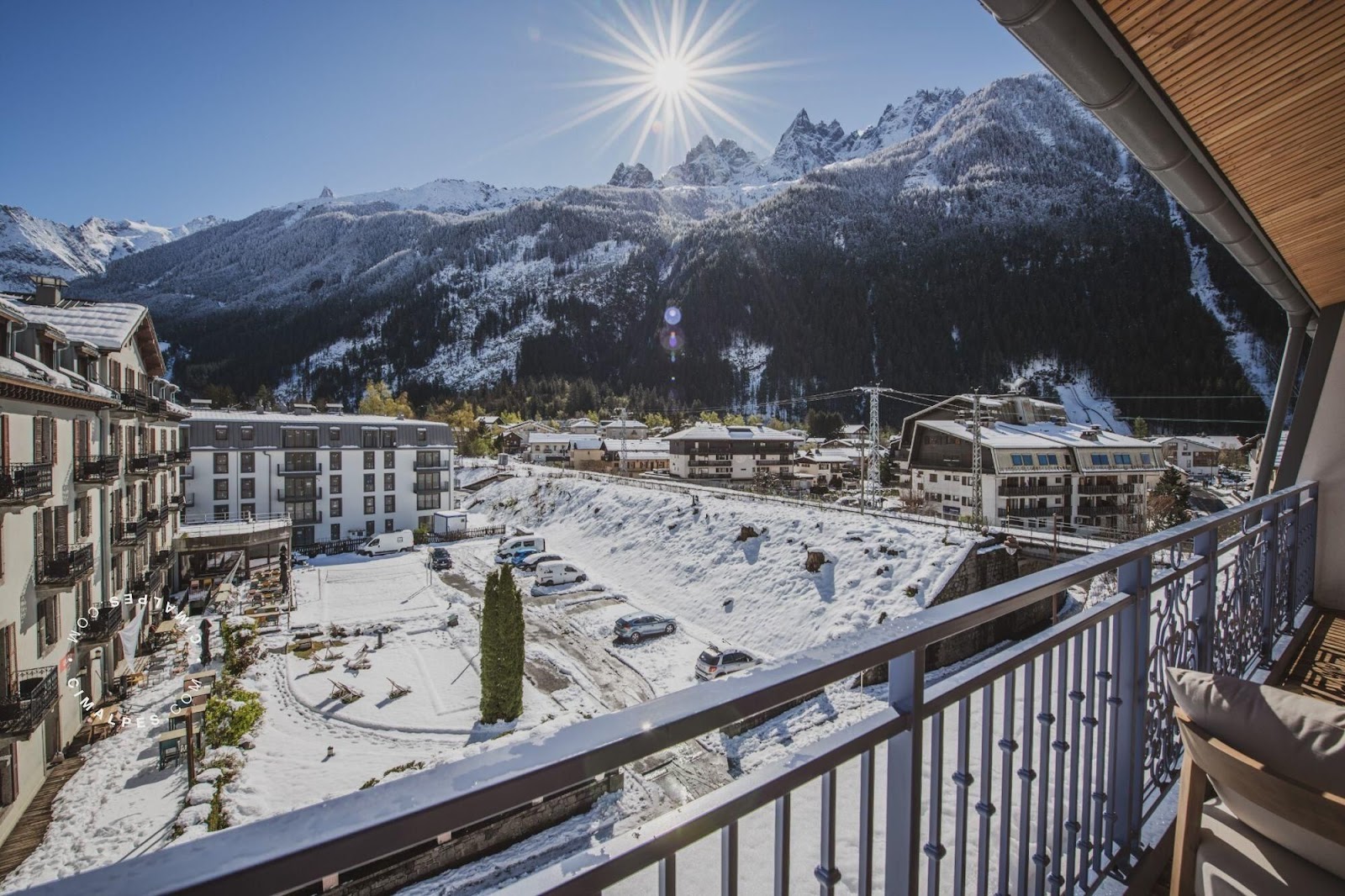
The international buyer mix in Chamonix is the most cosmopolitan in the French Alps — British, Scandinavian, Belgian, Dutch, German, Italian, American and a notable South American cohort, drawn as much to the mountaineering tradition as to the skiing. The architectural inheritance divides cleanly between the historic core around the Saint-Michel church and the Rue du Docteur Paccard (traditional Savoyard chalets and Belle Époque hotel architecture), the residential ring on the slopes above the town (a mix of restored farmhouses and contemporary chalets, particularly across the Argentière, Les Praz and Les Tines villages further up the valley), and a discrete stock of central apartments in the recently restored buildings around the Place Balmat. The historic Compagnie du Mont-Blanc operates the full network of valley cable cars and is the largest single lift operator in the Chamonix valley. The summer season in Chamonix is, on most measures, larger than the winter — the town's mountaineering tradition, the access to the Mer de Glace glacier via the historic Montenvers railway, the UTMB Mont-Blanc in late August, and the network of high-altitude hikes around the Tour du Mont-Blanc make Chamonix one of the few French alpine resorts where the summer schedule rivals or exceeds the winter calendar. Drive times from Geneva are 75 minutes on the A40 motorway; from Lyon roughly 2 hours 15 minutes; from Megève 30 minutes. Climate runs −4 to 2°C (mid-20s°F to mid-30s°F) mid-winter at the town's 1,035 metres and 15–24°C (high 50s°F to mid-70s°F) in high summer, with the deep valley exposure giving Chamonix shorter winter daylight than the higher-altitude resorts (the sun barely climbs above the Brévent ridge in December and January). Best for: owners who want a genuine four-season mountain town rather than a purely winter resort, mountaineering enthusiasts and serious off-piste skiers, and design-led couples who value the depth of historical and cultural identity that only a working full-service alpine town can provide.
Portes du Soleil — Avoriaz, Morzine, Les Gets
The Portes du Soleil is the cross-border ski area linking twelve resorts across the French and Swiss sides of the Chablais Alps — 600 kilometres of lift-served pistes spread across Morzine, Avoriaz, Les Gets, Châtel, Saint-Jean d'Aulps and Abondance on the French side and Champéry, Les Crosets, Champoussin, Morgins, Val-d'Illiez and Torgon on the Swiss side. The two anchor French addresses are very different in character. Morzine, at 1,000 metres at the bottom of the valley, is a traditional Savoyard market town that retains its working-village character — wooden balconies, slate roofs, a Sunday morning market on the Place de l'Église, a year-round population of around 3,000, and the deepest off-season life in the Portes du Soleil. Avoriaz, three kilometres uphill at 1,800 metres, is the opposite — a famously car-free architecturally extreme purpose-built resort designed in the late 1960s by Jacques Labro, with red-cedar-clad cliff-hanging buildings that have made it one of the most architecturally distinctive ski stations in the Alps. Les Gets, on the eastern flank of the valley, is the smaller traditional village that locals consistently rate as the most family-friendly cluster in the domain, with an active summer mountain-biking scene (Les Gets hosted the 2022 UCI Mountain Bike World Championships) that gives the village a genuine four-season identity.
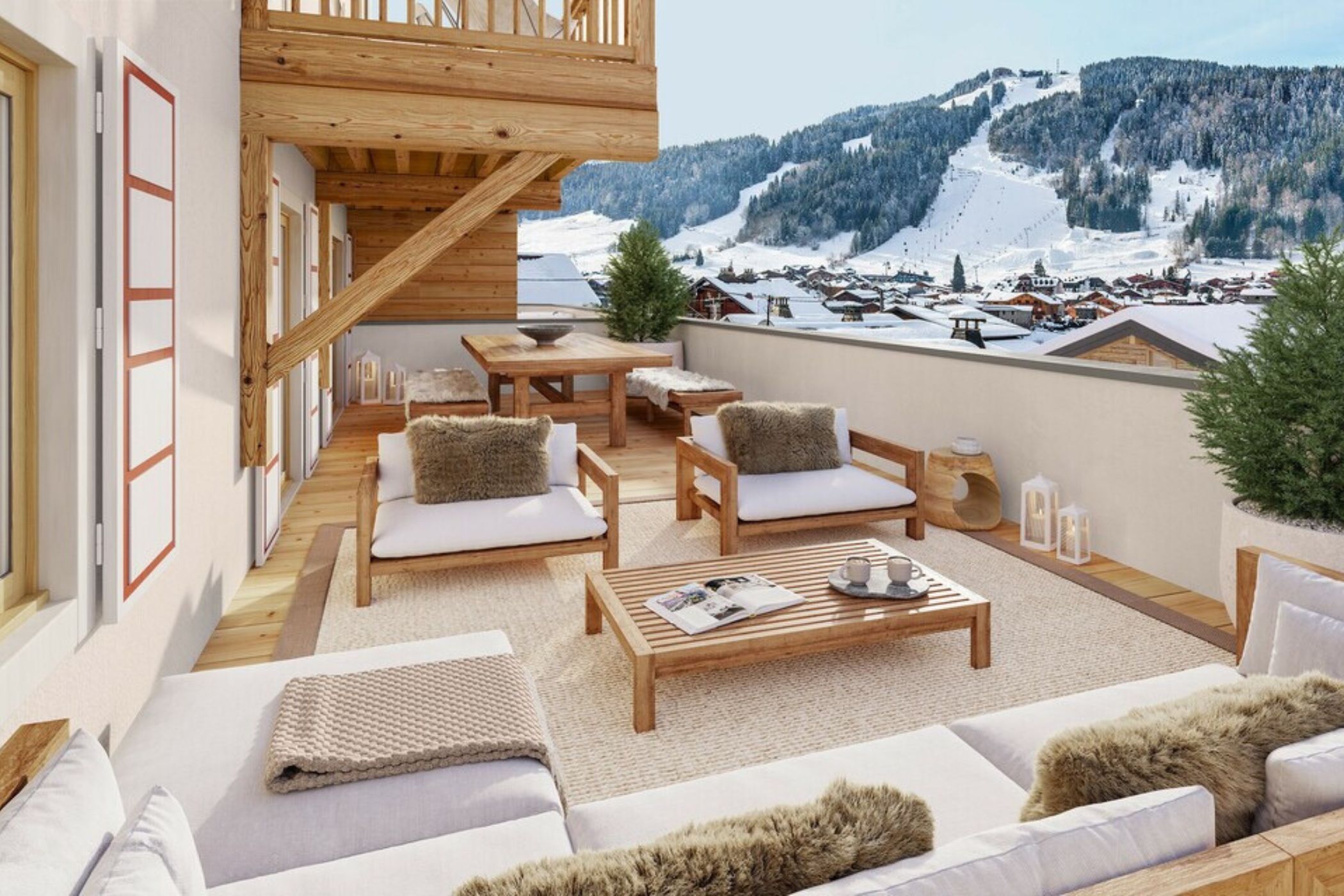
The international buyer mix in the Portes du Soleil is heavily British, Dutch, Belgian, Scandinavian and Swiss, with a long-standing British presence in Morzine that dates to the 1970s chalet boom and a growing Northern European share in Les Gets. The architectural inheritance is split between the traditional Savoyard chalet vernacular of Morzine and Les Gets (the slate roofs, the wooden balconies, the protected village cores) and the radical 1960s and 1970s purpose-built architecture of Avoriaz (the red-cedar cliff faces, the bell-tower roofline, the snow-flowing curved walls). The summer life in the valley is one of the strongest in the Alps — the UCI Mountain Bike World Cup regularly returns to Les Gets and Châtel, the long-distance hiking trails of the Chablais UNESCO Geopark are among the most usable in France, and the lake at Montriond gives the valley a true summer swimming venue. Drive times from Geneva are an industry-leading 60 minutes to Morzine and Les Gets and 75 minutes to Avoriaz — the shortest airport-to-front-door of any major French alpine address. Climate runs −2 to 4°C (high 20s°F to high 30s°F) mid-winter at Morzine's altitude and proportionally colder at Avoriaz, with summer ranges of 16–24°C (low 60s°F to mid-70s°F). Best for: families with school-age children — particularly British and Northern European — who value the shortest possible airport transfer, the Morzine village rhythm and the four-season mountain-biking life; and design-led buyers drawn to Avoriaz's architectural radicalism and altitude security.
A year in your French Alps co-ownership home
Spreading a minimum of 44 to 45 nights of personal use across a calendar year is itself a skill — and one of the unsung benefits of the French Alps specifically is that the region's combination of long ski seasons, dramatic summer hiking, gentle shoulder months and full-service town life in the major resorts gives an owner usable weeks across more of the year than almost any other European mountain destination. Below is a walk through the year with the particular weeks owners across the COP French Alps portfolio return to most often. The pattern is broadly the same across all eight co-owners of a given property, with the calendar mechanics ensuring every owner gets a fair allocation of peak weeks across a multi-year cycle. Owners who are flexible enough to use shoulder weeks — rather than competing for every week of February — consistently report a higher use-quality from their share than those who insist on peak.
Winter (December–April)
Winter is, unambiguously, the defining season of any French Alps share and the months on which the value proposition of an alpine home is built. The season opens in early December with the high-altitude resorts — Val Thorens, Tignes, Val d'Isère, Avoriaz, Courchevel 1850 — running lifts from the first weekend, with the lower-altitude addresses (Méribel, Megève, Morzine, Chamonix at town altitude) following through mid-December as the snowpack builds. The Christmas-and-New-Year fortnight is the single highest-demand window of the alpine year — the week between Christmas Day and 2 January is fully booked across every prime address in the Alps, with restaurant tables in Courchevel 1850 typically booked four to six weeks ahead and the village atmospheres at their most spectacular. Owners who time the calendar to land Christmas in the Alps every two or three years (rather than every year) consistently find their use pattern more relaxed than those who try to anchor Christmas every December.
January is, on most measures, the connoisseur's month — the lifts are quieter after the Christmas rush, the snow conditions are typically at their best (the cold-weather January powder is what serious skiers travel for), restaurant tables are easier to book, and the village atmospheres run at a more measured pace. February is the peak of the family-skiing calendar — the French school holiday rotation moves across three zones (Zone A, B and C) through the four weeks of the month, with overlapping British, Dutch, Belgian, German and Scandinavian half-terms pushing demand to its highest annual level. The third weekend of February is typically the single busiest piste-traffic week of the year across the major French domains. Restaurant booking windows in the prime resorts stretch to three to four weeks ahead, ski-school slots are pre-allocated, and the high-altitude pistes thicken noticeably. Owners who book ahead enjoy February in the French Alps at its liveliest.
March is the underrated month — the lift-served terrain is at its full opening, the snowpack is at its deepest of the year, the days are noticeably longer (sunset moves from 5:30 in mid-February to past 7:30 by the end of March), and the village calendars open up after the February peak. Easter week is the second-major holiday window of the season and the last reliable peak in the calendar; the high-altitude resorts (Val Thorens, Tignes, Val d'Isère, Avoriaz) carry full lift operations through Easter and into the third week of April, while the lower-altitude addresses typically wind down operations from mid-April onwards. The Trois Vallées domain typically runs lifts until the third week of April; Val Thorens to the first weekend of May; Tignes to a similar window depending on snow conditions; and the Grande Motte glacier above Tignes is one of the few addresses with year-round summer lift access. Climate-wise the winter runs −6 to 4°C (low 20s°F to high 30s°F) at resort altitudes, with the high-altitude resorts (Val Thorens, Tignes, Avoriaz) consistently colder than the lower-altitude (Megève, Chamonix town, Morzine) and noticeably more snow-secure across the season.
Spring (May–June)
The French Alps' spring is the most under-used of the four seasons by international buyers — and consequently one of the most rewarding for a fractional owner with calendar flexibility. May on the mountain is the season's quiet transition: the high-altitude resorts close from the second week, the villages briefly empty as the seasonal workforce departs, and the valleys turn from snowmelt to alpine spring through the second half of the month. Chamonix is the exception — the town's full-service population keeps the restaurants and cafés open through May, and the Tour du Mont-Blanc hiking circuit opens its lower sections from early May. Megève keeps a similar shoulder rhythm. The drive times shorten through the valleys as the alpine roads reopen — the Col de l'Iseran (the highest paved road in the Alps at 2,764 metres) opens in late May or early June, connecting the Tarentaise to the Maurienne in a way that the high-summer Alps routes never have.
June is when the alpine summer properly opens. The cable cars resume operation through the second weekend — the Aiguille du Midi in Chamonix, the Brévent-Flégère, the Saulire above Courchevel, the Mont d'Arbois above Megève — and the hiking calendar runs at its full opening. The wildflower meadows across the Beaufortain, the Aravis and the Vanoise National Park are at their photogenic peak through the second half of June; the alpine lakes (Lac de Roselend in the Beaufortain, Lac de Tignes-le-Lavachet, Lac Blanc above Chamonix) warm enough for cold-water swimming through the last week of June. The Tour du Mont-Blanc long-distance circuit fills with international hikers from mid-June onwards; the UTMB long-distance trail race in late August anchors the late-summer calendar but the broader hiking season runs from mid-June through mid-September. For owners who use their share in genuinely four-season mode — rather than just winter weeks — June is consistently named the favourite shoulder month in the French Alps.
Summer (July–August)
The French Alps' summer is a serious and well-defined second season — not the afterthought it can be in some alpine markets. July brings the alpine high season — Chamonix is at its busiest summer week in the run-up to the 14 July Bastille Day, with the village restaurants fully booked and the cable cars running at peak capacity. The Megève Jazz Contest in the third week of July is one of the village's defining summer events; the Festival du Mont-Blanc classical music programme runs across multiple venues from Saint-Gervais to Argentière. The Trois Vallées and Espace Killy resorts run lift operations through July and August — the Saulire cable car above Courchevel, the lifts to the Mont du Vallon above Méribel, the Funitel and the Cime Caron at Val Thorens, the Grande Motte glacier at Tignes — and a meaningful summer hiking and mountain-biking calendar runs across the high-altitude pistes.
August is the absolute peak — and the most expensive month — with the alpine valleys running at full capacity from the first weekend through the third week. The 15 August Assumption holiday is the single highest-density alpine weekend of the year, with restaurant booking windows stretching to four to six weeks ahead in the prime addresses. The Ultra-Trail du Mont-Blanc in the last week of August fills Chamonix and the surrounding villages with twenty thousand international runners and an even larger spectator crowd; the Megève Jumping International equestrian event in early August anchors the village's summer calendar. The Les Gets and Châtel mountain-biking circuits run at peak capacity through August; the cable cars at Brévent, Aiguille du Midi and Mont d'Arbois operate the full summer schedule. Climate-wise the valleys run 20–28°C (high 60s°F to low 80s°F) in the day in August at resort altitudes, with the high-altitude addresses (Val Thorens, Tignes, Avoriaz) several degrees cooler and the lower altitudes (Megève, Chamonix valley floor) similar to the lower hills. The alpine lakes reach swimming temperatures of 18–22°C (mid-60s°F to low 70s°F) across the season; the Mont Blanc snow line in August sits at around 3,200 metres, which means the high-altitude lift accessed terrain remains snow-covered all year round.
Autumn (September–November)
For many seasoned French Alps owners, September is the favourite month. The August crowds disperse from the first weekend of the month; the high-altitude lifts continue running through mid-September; the lower-valley restaurants take reservations again the same week you ask; and the hiking and mountain-biking conditions at altitude are arguably at their best of the year — the autumn larch needles in the Vanoise and Beaufortain massifs turn the alpine slopes a remarkable burnt-gold colour from mid-September through early October, and the weather windows for high-altitude routes are typically at their most stable. The Tour du Mont-Blanc circuit closes from late September as the high passes get their first snow; the lift operators wind down summer schedules through the third week of September. October is the genuine off-season — many of the seasonal village restaurants close, the cable cars run reduced schedules, the alpine hiking trails get their first snow on the high passes by mid-month, and the prime addresses run on a maintenance calendar before the November ski-season preparation begins.
November divides cleanly between the lower-valley addresses (Chamonix town, Megève centre, Morzine and Les Gets) — which keep a working off-season life through the month with most restaurants and shops open, the village markets running, and the local life largely uninterrupted — and the high-altitude purpose-built resorts (Val Thorens, Tignes, Avoriaz, Courchevel 1850), which run on a soft schedule as the resort prepares for winter. By late November the first lifts open at Val Thorens (typically the third weekend of November) and the season cycle begins again. Owners who use their share in genuinely four-season mode — three or four trips of seven to ten days across the calendar rather than two long holidays — increasingly name early September and the first week of December as their favourite weeks of the year. The high-altitude lakes, the autumn larches, the early-season piste openings before the Christmas rush — all available to the share-owner whose calendar can flex around the genuine peaks.
Who buys in the French Alps, and why
The international buyer mix in the French Alps is the most diverse of any European alpine region — by a meaningful margin. British buyers have anchored the French alpine market since the 1970s chalet boom and remain the largest non-French foreign cohort; the British community across Morzine, Méribel, Chamonix and Val d'Isère is large enough to run English-language schools, chartered Saturday flights, in-resort chalet operators and English-speaking ski-school provision through the season. Belgian and Dutch buyers are the second and third largest cohorts; the proximity from Brussels and Amsterdam (90 minutes by air, six hours by car) makes the French Alps the natural ski destination for both nationalities, and the established Belgian-Dutch presence in Courchevel, Méribel, Avoriaz and Les Gets dates to the 1980s. Scandinavian buyers — Swedes, Norwegians, Danes, Finns — concentrate in Val d'Isère, Tignes, Méribel and the Espace Killy, drawn to the deep terrain and the long season. German and Swiss buyers are well represented in Megève and Chamonix, where the Francophone-but-internationalised village life suits their taste better than the more purely British-anchored resorts. American buyers, historically a minority in the French Alps, have grown sharply over the past decade — drawn to Chamonix for the mountaineering tradition, Megève for the Belle Époque architectural pedigree, and Courchevel for the prestige factor and the directly-bookable East-coast flights through Geneva.
French buyers themselves remain a meaningful share of the international second-home market for these resorts — particularly in Megève (Paris families), Val d'Isère (Lyon and Paris families), and Chamonix (Paris and Lyon weekenders using the TGV). The cross-border Swiss demand from the Geneva and Lausanne metropolitan areas is significant in the resorts closest to the border — Megève, Chamonix, Morzine, Les Gets, Châtel — where Swiss families maintain weekend properties as a cheaper alternative to the Swiss-side equivalent.
The age-and-life-stage profile is in some respects more relevant than the nationality breakdown. The largest single buyer cohort across the COP French Alps portfolio is in the 40–55 age band — typically dual-income professional couples with school-age children whose ski calendars centre on the February, Easter and Christmas school holidays, who value the operational simplicity of a fully managed chalet, and for whom the long-term equity case of a mountain home is part of a broader portfolio rather than a single-asset bet. The second-largest cohort is the 55–70 age band — owners whose own primary income is established, whose children are at university or beyond (which gives them more calendar flexibility than the school-holiday-locked cohort), and whose long-run thinking on the mountain home runs to the next 15–20 years of skiing and summer-hiking use. The third cohort is the 35–45 age band — younger buyers earlier in their portfolio, often pairing a French Alps share with a Mediterranean summer share, and using the chalet primarily through long ski weekends and the February family-week.
Within those nationalities, French Alps co-ownership tends to suit a small number of well-defined buyer profiles:
- Active families with school-age children — typically using a Méribel, Morzine or Les Gets share around the Christmas, February and Easter ski holidays plus shoulder-season summer weeks, with the children coming back to the same chalet year after year so it becomes their second home rather than a holiday rental. The fully managed model removes the friction of running a chalet remotely; the children return to familiar staff, familiar ski-school, familiar restaurants.
- Empty-nesters and recent retirees from Northern Europe — particularly British, Dutch, Belgian and Scandinavian, who use their share in long shoulder-season blocks (January for the deep powder, March for the longer days, June and September for the summer hiking) rather than competing for the February peak. The 55–70 cohort is the heart of this demographic.
- Multi-generational groups — four- and five-bedroom chalets in Méribel, Megève, Val d'Isère or the Chamonix valley that sleep grandparents, parents, children and partners in the same week. The fractional model deals with extended-family calendar coordination better than a whole-ownership model, particularly when the family spans multiple countries with different school-holiday calendars.
- Design-led couples choosing Megève, Chamonix or Avoriaz — owners who treat the Belle Époque village pedigree of Megève, the mountaineering tradition of Chamonix or the architectural radicalism of Avoriaz as the primary destination, who book repeat shorter stays around the resort's quieter rhythms, and who value the proximity to the village restaurant calendar as much as the skiing itself.
- Serious skiers and mountaineers — a notable cohort who specifically choose Val d'Isère, Tignes, Chamonix or Val Thorens for the depth of expert terrain and off-piste access. This sub-cohort typically uses the property heavily in January (powder) and March (long-day spring conditions) rather than the February peak.
- Four-season mountain enthusiasts — owners drawn to Chamonix, Megève, Morzine and Les Gets for the genuine summer life (hiking, mountain-biking, classical music festivals, the alpine lakes) for whom the summer schedule is as important as the winter season. This cohort uses the share more evenly through the year than the winter-only buyer.
A pattern worth highlighting is the multi-region buyer — French Alps owners who hold a second COP share elsewhere. The most common combination is alpine plus Mediterranean (a French Alps chalet for the ski weeks at Christmas, February half-term and Easter, plus a Mallorca, Côte d'Azur or Italian Lakes share for the summer holidays). The second-most-common is alpine plus city (a Megève or Chamonix chalet for the ski calendar plus a Paris or London apartment for repeat short cultural stays through the year). Less common but increasingly observed is the alpine plus winter-sun pattern (a French Alps share for the ski calendar plus a Canary Islands or Algarve apartment for the deep-winter weeks of January and the spring half-term). The fractional model makes that portfolio strategy practical: two 1/8 shares cost less than a single whole property at either of the addresses individually, and the management relationship across the portfolio is unified, which removes the multi-jurisdiction friction.
What unites these otherwise quite different buyer profiles is the underlying calculation: the alpine weeks each of them actually uses in a year are within the 6–7 weeks a 1/8 share delivers, the operational overhead of running a chalet remotely is non-trivial in any of the major valleys (and notably higher in the high-altitude purpose-built resorts because of the seasonal staff turnover, the winter snow management and the off-season closures), and the resale liquidity of a fractional share inside a managed portfolio is — in our experience across the COP network — markedly higher than the resale liquidity of a whole property at the same address. The French Alps is a market where the maths of fractional ownership lines up almost perfectly with the use pattern of the buyer.
Practicalities: getting there, what it costs, what you own
Geneva, Lyon, Chambéry — and the resort transfers
Geneva airport (GVA) is the principal gateway airport for the western French Alps and one of the most internationally connected airports in Europe. GVA sits on the French border, with the Swiss and French sides of the terminal handled separately and a French sector that allows alpine-bound passengers to clear directly into France without a Swiss customs stop. Year-round direct service runs from London (Heathrow, Gatwick, City), Manchester, Edinburgh, Dublin, Birmingham, Amsterdam, Brussels, Paris (CDG and Orly), Frankfurt, Munich, Hamburg, Berlin, Düsseldorf, Zurich, Vienna, Copenhagen, Stockholm, Oslo and Helsinki; through the winter charter season the network expands to several dozen further European cities and direct East-coast US gateways including New York JFK and Newark, Washington Dulles and (seasonally) Boston, Chicago and Montreal. The Lyon-Saint Exupéry airport (LYS) handles the southern Alps and the Tarentaise resorts at roughly comparable drive times, with a stronger Lyon-based network of French domestic and southern-European flights. The smaller Chambéry-Savoie Mont Blanc airport (CMF) operates as a dedicated ski-season charter airport into the Tarentaise valley from December through early April, with direct service from London, Manchester, Edinburgh, Dublin, Birmingham, Amsterdam, Brussels and Copenhagen at Saturday peak frequency. An owner can reach a French Alps second home in under three hours door-to-door from any major Northern European hub through Geneva, which is the practical precondition for the high-frequency, short-stay use pattern that fractional ownership rewards.
Drive times from Geneva to the major sub-zones are short. Morzine and Les Gets are 60 minutes on the A40 motorway through the Vallée Verte; Avoriaz is 75 minutes with the village's underground car park five minutes' shuttle from the lifts; Megève is 75 minutes on the A40 to Sallanches; Chamonix is 75 minutes on the A40 to the eastern end of the valley; Courchevel and Méribel are 2 hours on the A41 to Albertville and then up the Tarentaise; Val Thorens is 2 hours 15 minutes; Val d'Isère and Tignes are 2 hours 30 minutes at the head of the Tarentaise. Most owners pre-arrange a private transfer rather than self-driving — particularly in the winter months when the alpine roads have snow restrictions and the resort approach roads are subject to chain control — through the established multilingual transfer operators that have been working the alpine routes for decades. The French Alps is also accessible by direct TGV from Paris and Lille to Moûtiers (the Trois Vallées rail terminus) and Bourg-Saint-Maurice (the Espace Killy rail terminus), with a popular weekend "ski train" running through the season. Eurostar runs the seasonal Eurostar Snow Train direct from London St Pancras to Bourg-Saint-Maurice and Moûtiers, putting the Trois Vallées and the Espace Killy within a single train journey of central London.
Whole-property vs 1/8 share: the comparison
The case for a fractional structure in the French Alps is most clearly seen in the side-by-side comparison against both whole ownership and long-term rental — the three ways most international buyers actually consider holding a French alpine second home.
| Whole second home | COP 1/8 fractional share | Long-term rental | |
|---|---|---|---|
| Upfront commitment | Full property value | ~1/8 of the property value | First/last/deposit only |
| Equity in the asset | Full appreciation | ~1/8 of appreciation | None |
| Annual carry | Full taxes, insurance, management, maintenance | ~1/8 of carry, fully managed | Full rent every year, indefinitely |
| Personal use | Up to 52 weeks (most use 6–10) | Set by the operator, professionally scheduled | Defined by lease |
| Operations burden | Owner-managed or hired staff | Fully included | Landlord-managed |
| Time to exit | 6–24 months on the open market | Sold through our partner's resale process | End of lease term |
The comparison most buyers find most telling is the annual-carry line. Owning a whole Courchevel or Méribel chalet outright means carrying full taxe foncière, full insurance, full property-management retainer, full snow-clearance and seasonal preparation, full reserve fund — every year, whether you spend two weeks on the mountain or twelve. A 1/8 fractional share carries proportionally less, fully managed, with the operational burden lifted entirely. Compared to renting a similar chalet long-term, you build real equity rather than burning rent — and the share is yours to sell, transfer, or pass on.
The other line worth examining is the time-to-sell. Whole-property resale in the French alpine prime tier — top Courchevel 1850 chalets, Val d'Isère central-village apartments, Megève slope-side farmhouses, Chamonix valley duplexes — is genuinely slow. The buyer pool at the top tier is small, well-informed and unhurried; a chalet in Megève going to market today might sit for 12–18 months before transacting, and the carrying costs of holding a whole French Alps chalet through a slow open-market sale can add up to a meaningful fraction of the sale price by the time it closes. A fractional share, by contrast, is sold through our partner's resale process, without you having to sell the whole house, to a buyer pool already aware of the property and the management framework. The carrying-cost differential between a quick professional exit and a slow open-market exit can easily exceed the headline transaction-fee difference between fractional and whole ownership.
What's included in the annual service charge — and what isn't
The annual carry on a 1/8 French Alps share is, by definition, roughly 1/8 of the carry on the equivalent whole property — which means it's a fraction of what an outright French alpine second-home owner pays in taxes, insurance, management and maintenance, and a fraction of what year-round long-term rental of an equivalent chalet would cost. It is best understood as a single all-in number that covers everything required to keep the property operating at full standard regardless of who is or isn't in residence. The included items typically run to: taxe foncière, the French municipal property tax; taxe d'habitation on second residences where applicable; non-resident income tax on the imputed-rental basis where applicable; building and contents insurance for the furniture and fittings; the full property-management retainer covering staff, scheduling and owner relationship; cleaning and linen between every stay; pre-arrival snow clearance, terrace preparation, fireplace stocking and seasonal opening; landscaping and pool maintenance where applicable; minor maintenance and repairs under a defined threshold; utility bills (electricity, water, internet, gas, alarm monitoring); the syndic-de-copropriété fees in apartment buildings; and a contribution to the reserve fund for major capital works (roof, heating, structural). What is typically not included: large capital improvements (kitchen replacement, major bathroom refurbishment) which are decided together by the co-owners and funded either from the reserve fund or from a one-off levy; personal staff costs (a private chef booked for an owner's stay, a private driver beyond the standard transfer, ski-instructor bookings); damage caused by an owner's own use; and unusually high-volume utility use during peak personal stays. The point is that the annual figure is not a "running cost" in the open-property sense but a comprehensive operating budget that covers the property in active condition all year — including the seasonal snow-clearance, the alpine-weather preparation, and the pre-arrival readiness that an owner of a French Alps chalet running the property remotely would otherwise have to organise themselves.
What you actually own — the legal share
The legal nature of a French Alps co-ownership share is one of the questions buyers should understand fully before purchase. You own a real share of the home — an eighth, a quarter — not a right to use it. You can sell it, pass it on to your heirs, and it grows in value with the house.
The practical effect is that you hold a real share of the home — not a timeshare, not a points membership, not a usage right. You can sell it through our partner's resale process or to a qualifying outside buyer; you can leave it to your children under your home jurisdiction's inheritance rules; and it grows in value with the house.
How fractional ownership works in the French Alps
The mechanics of fractional ownership in the French Alps are framed by three things that work together: the legal set-up arranged by our partner for each home, the French property-tax regime that applies to all secondary residences (including the taxe foncière municipal tax and the taxe d'habitation on second residences), and the well-developed service de la publicité foncière system that handles registration of the underlying property at the French land registry. That set-up is specific to each home; the French taxes are the standard local taxes that any non-resident second-home owner pays; and the publicité foncière is the long-running record-of-record system, with documentary precedent traceable to the Napoleonic Code of 1804, that gives the underlying real estate its documentary clarity. Together, these three pieces make for a clear, predictable ownership experience.
What you own: a real share of the French Alps home
You own a real share of the home — an eighth, a quarter — not a right to use it. You can sell it, pass it on to your heirs, and it grows in value with the house. Big decisions, such as selling the home or major works, are decided together by the co-owners.
Tax basics: taxe foncière, taxe d'habitation, capital gains
France operates a relatively straightforward property-tax framework for non-resident owners in the Alps, and almost all of the routine compliance is handled on the co-owners' behalf rather than by the individual owner. Taxe foncière is the annual municipal property tax paid by the owner of the property, calculated on the cadastral rental value as assessed by the local commune, with rates set by each town hall (Courchevel, Méribel, Val Thorens, Val d'Isère, Megève, Chamonix, Morzine and the other alpine communes each set their own rate within the national framework). Taxe foncière is paid from the annual service charge collected from co-owners, so individual owners never deal with the local tax office directly. Taxe d'habitation, the second municipal tax, has been progressively abolished for primary residences but remains applicable to second residences in many alpine communes — many of the major French ski resorts apply the maximum 60% surcharge permitted under the 2017 zone tendue legislation, which targets areas with strong second-home pressure. Both taxes are included in the annual service charge.
French capital-gains tax on resale is an area international buyers should understand. A direct sale of French real estate by a non-resident faces French capital-gains tax (administered through the French tax authority, impots.gouv.fr) at a base rate of 19% plus 17.2% social contributions (EU/EEA and UK residents covered by their own social security pay the 7.5% solidarity levy instead), with progressive abatements for length of ownership and a complete exemption typically reached after 30 years. Our partner sets out the tax position for your country before you buy. We recommend any international buyer review the specific position with their own tax counsel before purchase.
Inheritance and French succession law
Directly held French real estate is subject to French succession and gift tax, with rates structured around the relationship between the deceased and the heir — direct-line heirs (children, surviving spouse) benefit from substantial allowances and lower rates than collateral or unrelated heirs. France's réserve héréditaire regime is a defining feature of the French succession system: it reserves a fixed minimum share of the deceased's estate for direct-line heirs (typically half for one child, two-thirds for two children, three-quarters for three or more), with the remainder being the freely disposable quotité disponible. The réserve héréditaire applies to French real estate held directly by a French-resident decedent and has historically been one of the more complex aspects of holding French property for international buyers with home-jurisdiction succession arrangements that differ from the French model.
The 2015 EU Succession Regulation (Brussels IV) gave EU residents the option to elect their home-country succession law for their estates; non-EU residents (US, UK, Canadian, Australian buyers post-Brexit) can also elect under the same regulation, with some limitations. Your share passes to your heirs as part of your estate, and our partner sets out exactly how this works for your country before you buy.
The professional management calendar and how scheduling works
Once the purchase completes, a professional management company takes over all operational responsibility for the French Alps property. Your personal weeks — a minimum of 44 to 45 nights for a 1/8 share — are allocated through a fair-rotation calendar that mixes peak weeks (the Christmas/New Year fortnight, the February family weeks across the rotating French school zones, the Easter week on the high-altitude resorts, the August summer peak in Chamonix and Megève) with shoulder-season and quieter weeks across the year. Owners pre-book several months ahead; the unused weeks are either held for the owner pool or, where the property's structure allows, rented to the broader market with the income flowing back to the co-owners. Service-charge collection, building maintenance, insurance, taxe foncière and taxe d'habitation payments, the linen-and-cleaning between stays, the pre-arrival snow-clearance and seasonal preparation, the welcome arrival, the on-call concierge — all sit with the management company. The deep multilingual operations ecosystem across the major valleys — five decades old in Morzine, Courchevel, Méribel and Megève — means that the routine practical realities of owning a chalet remotely in the French Alps are handled by professionals who have been catering to non-resident owners for generations.
Resale: how to exit, typical timelines, the professional process
When you decide to exit your French Alps share, a professional resale process is in place, run by our partner, so you can sell your share without having to sell the whole house — whereas whole-property resales typically take 6–24 months on the French alpine open market. Shares sell: hundreds of shares in homes like these have already been resold—in just over three months on average, and nearly three in four for more than the owner paid. After a typical first-12-months holding period you set the price, and your co-owners usually get first refusal. The buyer pool is already aware of the property. For owners who want maximum control over the price and process, an open-market sale to any qualifying buyer remains an option — but most owners find the established process faster and cheaper.
The full mechanics of fractional ownership across all jurisdictions — usage calendars, exit procedures, rental income treatment, insurance, the transfer on death, the relationship with the management company — are covered in our co-ownership explained guide. For specific French Alps property availability, browse the listings in the property grid above, or join our list for new-property alerts as they come to market.
Your ownership at a glance
- Real ownership of the home — a real 1/8 share of the home: transferable, inheritable, and it grows in value with the house. Not a timeshare, not a points membership, not a usage right.
- Professional management included throughout — pre-arrival snow clearance, linen and cleaning between every stay, year-round maintenance, fireplace and heating servicing, taxes, insurance and the on-call concierge are all covered within your annual service charge, with no top-up bills for routine operating costs.
- Clear, supported resale through the COP owner network — the existing audience of co-ownership buyers means your share has an organised market from day one, with our partner's resale process letting you sell your share without selling the whole house, rather than facing the 12–18 months a comparable whole chalet might sit on the French alpine open market.
Still deciding which French Alps resort?
Many readers arrive on this page already half-decided — they want the French Alps, but not yet which French Alps. The choice between the Trois Vallées, the Espace Killy, Megève, the Chamonix valley and the Portes du Soleil is rarely about budget alone; the major sub-zones sit in similar price bands once you compare like-for-like quality. The decisive question is usage pattern. How will you actually spend your weeks across a calendar year — and how does that pattern map onto the altitude profile, the village character and the airport transfer time of each resort? The right answer for most buyers is one most have not previously articulated, because the question rarely arises until ownership becomes concrete. Our team has spent years inside the French alpine second-home market and can walk you through the regional differences — climate, calendar, owner mix, day-to-day rhythm — before you commit to a resort. Below is the framework we walk through with buyers who reach the same fork, with deliberate over-simplification — most owners actually end up combining elements from more than one — but useful as a starting point.
Choose the Trois Vallées — Courchevel, Méribel or Val Thorens — if your primary use pattern is built around the deepest connected ski terrain on the planet, the single largest lift-served domain in the world, and the prestige of the European alpine ski address that most defines high-end skiing in France. Courchevel works hardest for owners who treat the resort's restaurant calendar (the most concentrated cluster of Michelin stars in any ski resort) and its 1850-tier prestige as part of the address itself; Méribel for owners who value the architectural coherence of the wooden-balconied chalet vernacular and the central position inside the domain; Val Thorens for owners who prioritise altitude-secured snow above all other factors.
Choose the Espace Killy — Val d'Isère or Tignes — if you want the highest-altitude expert-skier French alpine experience, the deepest off-piste terrain backing onto the Vanoise National Park, and the longest reliable season anchored by the Grande Motte glacier above Tignes. Val d'Isère and Tignes are the natural choice for committed skiers who prioritise terrain over village charm, families with strong-skier teenagers, and owners willing to trade the convenience of a shorter airport transfer for the deepest snowpack and the longest season in the French Alps.
Choose Megève if you want the most architecturally complete traditional ski village in France, the Belle Époque pedigree of the Rothschild-era resort, and a four-season Paris-family-favoured rhythm that runs through the calendar rather than living and dying with the lifts. Megève works hardest for design-led families who value architectural pedigree and the depth of the village restaurant calendar over highest-altitude snow security, Paris-based owners who want a winter base inside three hours of the capital, and buyers who treat the village's cultural identity as part of the address.
Choose the Chamonix-Mont-Blanc valley if you want a genuine four-season mountain town rather than a purely winter resort, the mountaineering tradition that gave the Alps their identity as a destination, and the year-round full-service life that no purpose-built resort can match. Chamonix is the natural choice for owners who want a working alpine town life (the daily market, the year-round hospitals and schools, the summer cable-car schedule that arguably exceeds the winter calendar in volume), serious off-piste skiers and mountaineering enthusiasts, and design-led couples drawn to the depth of historical and cultural identity that only a working full-service alpine town can provide.
Choose the Portes du Soleil — Morzine, Avoriaz or Les Gets if your dominant priorities are the shortest possible Geneva-airport transfer (60 minutes to Morzine and Les Gets — industry-leading in the French Alps), the cross-border 600-kilometre ski domain that spans the French and Swiss Chablais Alps, and the Northern European family rhythm that anchors the valley. Morzine works hardest for families with school-age children — particularly British and Dutch — who value the traditional Savoyard village life and the four-season mountain-biking calendar; Avoriaz for design-led buyers drawn to the architectural radicalism of the car-free 1960s purpose-built resort; Les Gets for the smaller traditional village rhythm with the strongest summer mountain-biking identity. The Portes du Soleil is also — unlike a traditional timeshare, which locks you into one week in one property year after year — one of the easiest French Alps addresses to combine with a second share elsewhere, since the short Geneva transfer makes long-weekend use realistic from any Northern European hub.
The portfolio approach is worth at least mentioning. A meaningful proportion of French Alps co-ownership owners hold more than one share — either elsewhere in France (a Côte d'Azur villa for the summer, a Paris apartment for repeat short cultural stays) or further afield (a Mallorca finca for the long summer holidays, an Italian Lakes apartment for the spring shoulder season, a Canary Islands apartment for the deep winter). For owners building a multi-region portfolio with COP, you have one team across every destination — the same advisors, the same calendar mechanics, the same resale process across every property you own. Two 1/8 shares — a French Alps winter chalet plus a Mediterranean summer villa, say — give an owner roughly 90 days of use across a calendar year, drawn from genuinely different lifestyle modes, at a combined annual carry that is still a fraction of what a single whole property at either address would cost.
Whichever way the decision goes, the deeper exploration starts on the cluster and parent pages:
If you would like to talk through which French Alps resort best fits your family's actual use pattern — rather than the brochure version of it — join our list and we will be in touch with relevant new-property alerts and an introduction to the team.
Questions & Answers
French Alps Fractional Ownership — Frequently Asked Questions
Fractional co-ownership in the French Alps gives you a real 1/8 share of a luxury ski chalet or apartment in one of the world's premier Alpine resort areas — Courchevel, Méribel, Val d'Isère, Portes du Soleil, or the broader Les Trois Vallées network. The legal set-up is arranged by our partner for each home and walked through with you before you buy. Your 1/8 share is genuine property equity — around six weeks per year at 1/8 the full purchase cost of a genuine Alpine address.
The French Alps are home to the world's most extensive ski domain — the Trois Vallées (Courchevel, Méribel, Val Thorens) alone covers 600km of marked pistes. French planning authorities maintain strict controls on construction in Alpine communes, permanently limiting new supply of ski-in/ski-out chalets in the most desirable locations. Courchevel 1850 — the summit village — has fewer than 200 traditional chalets, and they very rarely come to market. This structural scarcity, combined with global demand from buyers across Europe, North America, Asia, and the Middle East, underpins stratospheric valuations: the highest per-square-metre values in the European Alps for the best Courchevel 1850 properties.
Your 1/8 share gives you around six weeks per year. French Alps properties have two distinct seasons: winter (December–April, ski season peak) and summer (June–September, hiking, cycling, and the Festival de Courchevel). A structured calendar manages peak ski-week allocations through a fair rotating priority system — ensuring no owner always has the same Christmas or February half-term weeks. Summer use of Alpine properties is increasingly popular and represents underutilised value in many fractional ownership schemes.
Yes — many of our French Alps properties welcome short-term rental of unused weeks, and it is an excellent way to offset your annual costs. Your unused weeks can be listed on short-term rental platforms, with income paid directly to you after the platform fee — particularly rewarding in high-demand locations.
Each French Alps property listing shows whether short-term rental is available for that home, in line with local rules.
Post-Brexit UK nationals face the 90-day per 180-day Schengen stay limit across all EU countries. With around six weeks of annual usage from a 1/8 share, planning is manageable. Note that your Schengen count includes time in any Schengen country — France, Spain, Italy — so UK owners with multiple European property interests simply keep an eye on their total Schengen days.
French ski resort property has one of the most compelling investment profiles of any European real estate: permanently constrained supply in the world's premier ski domains, global demand from buyers who can afford the world's best, and strong seasonal rental demand that can offset carrying costs on homes where letting is allowed. Fractional ownership in properties of this calibre — which would otherwise require a multi-million capital outlay for full purchase — is only feasible through the 1/8 model. You capture the same proportional appreciation as full ownership, at 1/8 the capital.
Selling is simple. When you decide to move on, your French Alps fractional share is marketed to buyers already looking for fractional co-ownership.
Our partner's resale process handles the sale for you, so you sell your share without the whole house having to be sold. After a typical first-12-months holding period you can sell whenever you choose, at the price you set — your co-owners usually get first refusal. Hundreds of shares in homes like these have already been resold — in just over three months on average, and nearly three in four for more than the owner paid.
Browse COP's French Alps listings, review the 1/8 share price and annual service charge for each property, and submit an enquiry. A COP specialist will contact you within 24 hours.
Also Explore
Get in Touch
Speak to an expert
Tell us what you're looking for and one of our co-ownership specialists will be in touch within 24 hours.