AI & Technology
AI Sensors and Predictive Maintenance in Co-Owned Homes
A pipe pressure shift at four in the morning. A pool pump drawing eleven per cent more amperage than it did last week. The luxury home no one is sleeping in is the hardest property in the world to manage — and AI sensor networks have quietly become the reason that argument has stopped being true.
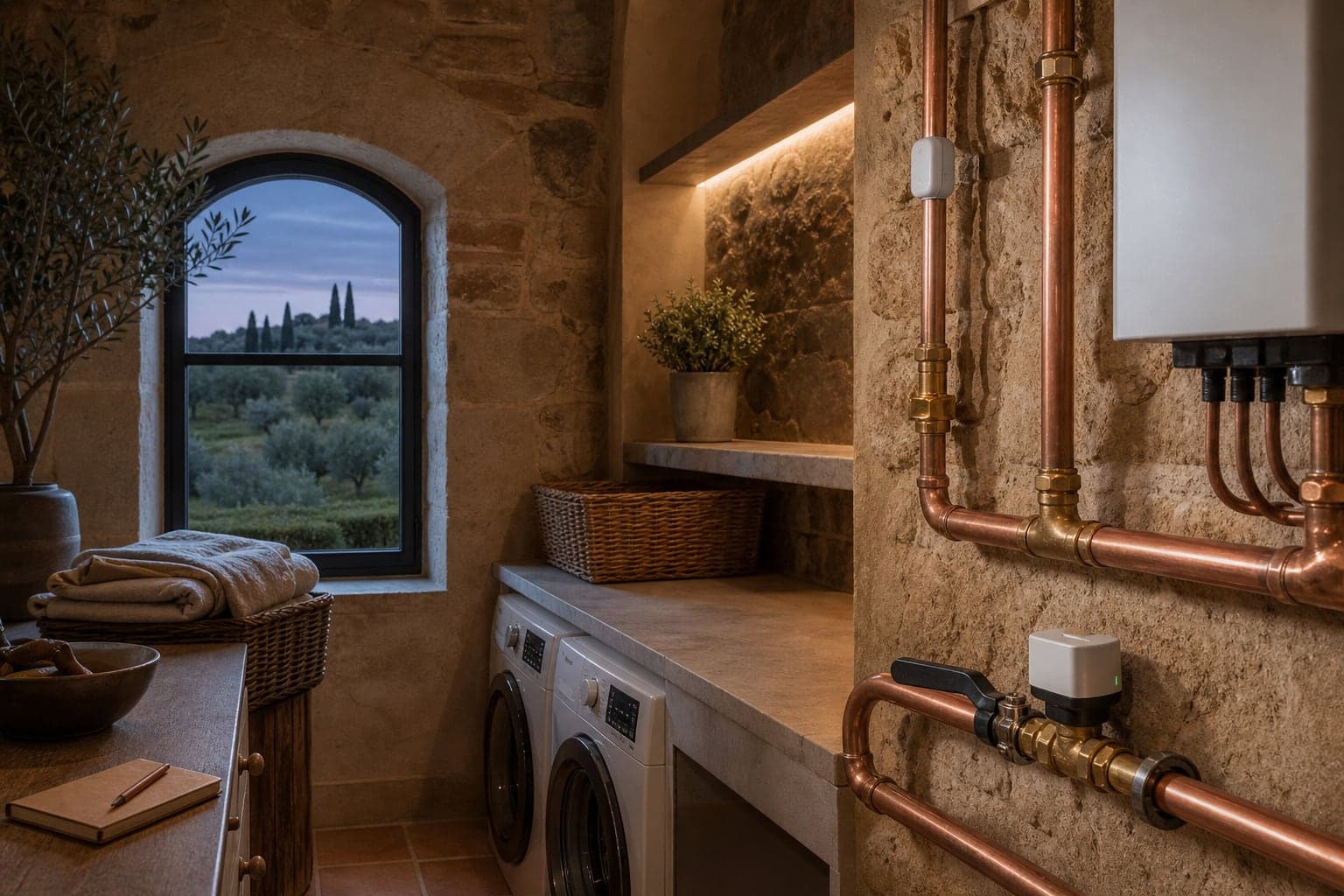
It is just before four in the morning on a Wednesday in early March, and the restored stone farmhouse above Castellina in Chianti is empty. The owners — a Belgian couple in their fifties who hold one of the eight shares — are asleep in Antwerp. The other seven co-owner households are scattered across London, Munich, Boston, Geneva and the Cotswolds. Nobody is in the building. The olive grove is quiet, the cypresses still, the kitchen tiles cold. And, in the laundry room behind the kitchen, a copper pipe joint that has been gradually loosening for eleven days is about to give. It will not give. At 03:48 a wireless acoustic sensor clipped to the pipe registers a high-frequency shift that does not match its baseline. Twelve seconds later the smart shut-off valve at the main has closed. Eleven minutes after that the on-call plumber in Castellina has been dispatched by the management company. The owners learn about it from the morning summary email at eight o'clock, after they have had their coffee. The house never floods. This is what 2026 property management actually looks like in a luxury co-ownership home — not a brochure photograph of a smart speaker on a marble counter, but a near-silent network of sensors, an AI model that has learned what this specific house sounds like at three in the morning, and a chain of human responses that begins before any human is awake.
For most luxury second-home owners, the empty house is the structural problem that no glossy lifestyle photograph wants to talk about. Insurance data has shown for years that water damage and freezing are among the most common and most costly home claims. The risk is not exotic. It is a slow leak under a sink while the owner is in another country, a pool pump that fails in August because nobody noticed it had been straining for three weeks, a heating system that stops in February in a stone house that takes four days to dry out. Co-ownership of a luxury property — owning a real one-eighth share of a quality home, alongside seven other vetted co-owners — already changes the arithmetic of these problems by professionalising the management layer. AI-driven sensor networks have changed it again, and more decisively, in the last eighteen months. Our how it works guide walks through the management structure end-to-end; this piece is about the technology layer that has quietly settled on top of it.
The Empty-Home Problem
Insurance underwriters have a phrase for the central anxiety of the second-home market: delayed-detection loss. The idea is straightforward. A burst pipe in a permanently occupied home is found within minutes — somebody hears the noise, sees the puddle, calls the plumber. The same burst in an empty house can run for hours, sometimes days, before anyone notices, and the cost curve is brutally non-linear. A leak caught in the first ten minutes is a tradesman's morning. The same leak caught after seventy-two hours is replastered ceilings, ruined floors, displaced electrics, and an insurance claim that may not be paid in full because the policy required the property to be checked at fixed intervals. Most luxury second-home insurance policies still carry an unoccupied-property clause that limits cover after a certain number of consecutive empty days, typically thirty to sixty depending on the carrier and the country.
Co-ownership reduces the raw exposure here, because eight owners using a property in rotation typically keeps the house occupied for a far higher share of the year than a single family using it three weekends and a fortnight in August. For the quieter spells in between — a cold-season gap, a few mid-week nights — an always-on sensor network turns those gaps into a non-event. Our overview of PropTech in co-ownership covers the management-software side of the same shift; what has changed in the last year is what is happening one layer down, in the building itself.
What Actually Sits in a 2026 Luxury Sensor Network
A serious 2026 installation in a Mediterranean farmhouse or alpine chalet is no longer a single connected smoke alarm. It is a layered system. At the plumbing level, acoustic and ultrasonic sensors clip onto the main inlet and key branches, listening for the specific frequency signatures of pinhole leaks, joint failures and partial blockages — patterns that a standard puck-style flood sensor will not catch until the water is already on the floor. A networked smart shut-off at the main can close the supply autonomously within seconds of an anomaly. At the climate level, distributed temperature and humidity sensors monitor each zone of the building independently, flagging the slow creep toward freezing in an unheated wing of a stone house long before it becomes a frozen-pipe risk.
Above that sit the predictive-maintenance sensors on the mechanical kit: vibration monitors and amperage-draw sensors on pool pumps, HVAC compressors, ventilation motors and well pumps. These are the components in a luxury home that are most expensive to fix when they fail unexpectedly and most predictable when they are properly instrumented. A failing blower motor draws progressively more current and runs at slightly higher vibration amplitude for weeks before it dies; a pool pump with a deteriorating bearing tells the same story. Pair this with smart energy meters at the consumer unit and you have a building that reports its own slow ageing into a dashboard. Add a layer of contact, motion and door sensors for security and presence detection, and the management company can answer the only question that ever really matters about an empty luxury house: is everything still as it should be, right now?
The AI Layer: Why 2026 Is Different From 2022
Sensors on their own have been available for the better part of a decade. What has changed is the layer above them. Until recently, an alert from a connected leak detector or a vibration sensor was a binary event — a buzzer for a property manager to investigate, often during business hours, often after enough false positives that the alerts were quietly muted. The current generation of predictive-maintenance AI works by building a per-property baseline. It learns what this specific farmhouse, this specific pool pump and this specific air-handling unit sound, draw and run like across an entire seasonal cycle. It then flags deviations against that baseline rather than against a generic threshold. A pump that always draws 7.2 amps in August and now draws 8.1 amps is not at a generic warning level — it is six per cent above its own running average, and that is enough to move it onto a watch-list before anything breaks.
The same approach applied to acoustic data is what allows the laundry-room scenario at the start of this piece to actually work. A trained model is no longer asking is there a flood? It is asking does this five-second clip of pipe noise match the seven-thousand previous five-second clips from this pipe? When the answer is no, the system has the confidence to act before the failure rather than after it. Our earlier piece on AI-powered property management covered the booking-and-operations side of this shift; the digital-twin piece covered the visualisation side. The sensor-and-prediction layer is the third leg of the same stool, and arguably the one that does the most work in the hours when the house is empty.
Why This Argument Is Particularly Strong for Co-Ownership
A serious sensor-and-AI installation in a luxury Mediterranean villa is not cheap. A comprehensive integrated package — the network, the smart shut-off, the predictive-maintenance layer, the security stack and the central dashboard — is a substantial upfront investment, with a recurring monitoring and software subscription on top. For a single full-ownership family, that is a meaningful number. For a co-ownership property, the cost is part of the property's setup budget and is shared eight ways, exactly like the kitchen renovation, the pool resurfacing and the heat-pump retrofit. An eighth-share owner contributes to a sensor system at a fraction of what they would pay if they were buying it solo, and they receive identical protection on the days they are using the house and the days they are not.
The structural advantage runs deeper than cost-sharing. A co-ownership property is already managed by a single professional entity on behalf of all eight owners; that entity is the natural recipient of every sensor alert, the holder of every emergency contact, and the party that has already retained on-call tradesmen in the local market. There is no question, when the acoustic sensor in Castellina pings at 03:48, of which of eight households is supposed to wake up and call a plumber in Italy in their second language. The management layer absorbs the alert and runs the response. Owners are informed; they are not on call. That is the version of how staying in your co-ownership property actually works in practice when the underlying infrastructure is right.
The 2026 Market Context: Why Adoption Has Accelerated
The European smart-home market has grown fast, and luxury and ultra-luxury automation is one of its quickest-growing slices. Two structural forces have pushed the technology specifically into the luxury second-home segment. The first is insurer pressure: a growing number of carriers in the United Kingdom, France, Italy and Spain now offer meaningful premium reductions for properties with active leak detection and automatic shut-off, and a smaller but growing number subsidise the hardware directly because the math on a few hundred euros of sensor versus a five-figure water claim is too obvious to ignore. The second is regulatory: tighter building-energy regulations across the Mediterranean are making it cheaper to retrofit an integrated system once than to revisit the same property three times for separate upgrades.
For full-ownership buyers, the practical question is whether to retrofit, when, and at what cost. For co-ownership buyers, the question is largely already answered. Properties brought to market in 2026 by serious companies are increasingly delivered with the sensor stack pre-installed and the predictive-maintenance subscription bundled into the annual running costs. Buyers reviewing inventory should treat its presence — and the quality of the data feed it produces back into the owner dashboard — as a meaningful indicator of operational seriousness. Our buying FAQs walk through what to ask any co-ownership company about technical infrastructure, monitoring and emergency-response service-level commitments before signing.
The Case: A Quieter Kind of Luxury
There is something faintly unromantic about discussing pipe-noise classifiers and amperage baselines in the context of a stone farmhouse in Chianti or a townhouse on the Left Bank. Luxury, in the brochures, is cypresses and morning light and the bread coming out of the village oven at eleven; not a wireless mesh of sensors quietly listening to a copper joint. But the people who have lived through the alternative — the 2 a.m. phone call from a neighbour who has noticed water coming under the front door, the insurer's letter querying whether the property had been checked weekly, the eight-month wait for re-plastering during which the house cannot be used — recognise immediately what is being bought when sensors and predictive AI are properly installed and properly run. It is the absence of that phone call. It is the freedom to leave the property for six weeks knowing that the building is being watched continuously by something that does not sleep, does not get distracted, and does not have to be reminded.
Co-ownership turns this from an expensive optional extra into a structural feature of the product. Eight owners, one professional management entity, one sensor network, one AI baseline per property, one chain of response. Costs shared, peace of mind not. The version of luxury second-home ownership that this enables is, in some ways, a quieter one — fewer surprises, fewer emergencies, more of the unhurried weeks the property was bought for in the first place. Our companion piece on the true cost of owning a luxury second home sets out the financial side of the same argument; this is the technological correlate. The two together are most of the case for owning a share rather than a whole house in 2026.
For buyers evaluating co-ownership today, the sensor specification, the monitoring and the speed of response are part of what makes a home exceptional. Browse current COP listings across our destinations or speak with our team directly to walk through how this technology layer is specified in any specific property — and what it changes about the experience of owning, and not having to constantly worry about, a luxury home in another country.
More from Co-Ownership Property

Get in Touch
Speak to an expert
Tell us what you're looking for and we'll be in touch.