Properties & Destinations
Gulf of Saint-Tropez: Co-Owning in Grimaud and the Var
Saint-Tropez itself now trades at sums that close it to all but the ultra-prime — yet the gulf around it, from the canals of Port Grimaud to the perched medieval village above, offers the same sea and the same Provençal light. A one-eighth share is the rational way to own a piece of it.
In 1962 a Mulhouse architect named François Spoerry bought a stretch of mosquito-ridden marshland at the mouth of the River Giscle, where it drains into the Gulf of Saint-Tropez, and was widely thought to have wasted his money. Four years later the first houses went up. What he built there over the following decades — Port Grimaud, a planned cité lacustre of pastel façades, arched bridges and private moorings, where many homes still open straight onto the water — is now among the most photographed places on the French Riviera, carries a French "Heritage of the 20th Century" label, and threads some 2,400 houses along seven kilometres of canals. Spoerry's insight was simple and unfashionable for its moment: that the gulf's real value lay not in the glamour of the single famous village across the bay, but in the quieter water and light all around it.
Sixty years later, that is still the smartest way to read this coast. The village across the bay is Saint-Tropez, and Saint-Tropez has become, in property terms, almost theoretical: the average residential price in the commune now sits at roughly €15,000 per square metre, and the rarest waterfront estates clear €45,000 per square metre and beyond. Those figures place whole-property ownership out of reach for all but a vanishingly small ultra-prime buyer. The gulf around it tells a more useful story. From the perched medieval village of Grimaud to the family beaches of Sainte-Maxime, the same sea, the same Provençal light and much of the same culture are available without the Saint-Tropez headline rate. And the most rational way to own a piece of that gulf — without committing several million euros or inheriting a second job's worth of maintenance — is to own one-eighth of a single excellent house, alongside seven other vetted co-owners, with roughly 44 to 45 days of use a year. This is what that looks like in practice.
Why Saint-Tropez Prices Out the Ordinary Buyer — and the Gulf Doesn't
The numbers explain the behaviour. Across the commune of Saint-Tropez the average residential price is around €15,118 per square metre, with the established luxury segment trading between €22,000 and €28,000 per square metre and the rarest waterfront properties — fine art with a roof — reaching €45,000 to €50,000 per square metre when the sea view, the address and the finish all align. Nor is this a peak that has rolled over. The wider gulf's average price per square metre has climbed by roughly 54 per cent over the past five years, underpinned by a near-total constraint on new coastal construction, strict environmental rules and simple land scarcity. At the very top of the market, around half of ultra-prime Riviera transactions are completed without any bank financing at all, which insulates values from interest-rate swings and means prices here rarely correct the way more leveraged markets do.
For the overwhelming majority of buyers who would love a foothold on this coast, those figures are not an entry point but a closed door. A whole villa of real quality on the gulf is a multi-million-euro commitment before furnishing, taxes and the standing army of contractors a Provençal property in a hot climate demands. Co-ownership reframes the equation entirely. COP's current Côte d'Azur inventory includes a three-bedroom, four-and-a-half-bathroom villa with a heated pool between Grimaud and Saint-Tropez, offered at €389,000 for a one-eighth share — a figure that reflects a whole-property value north of three million euros — alongside a sea-view villa at Les Issambres, on the gulf's northern shore, from €319,000. Each is a real share of a specific, already-finished house, not a timeshare or a points scheme. You can browse the live shares on our homes page, or filter straight to the French collection.
A Gulf, Not a Single Village
The mistake outsiders make is to treat Saint-Tropez and its gulf as the same thing. They are not. The Golfe de Saint-Tropez is a horseshoe of water ringed by a dozen distinct communes, and the village that lent its name to the whole is only one stop on it. Grimaud itself is two places in one. There is the perched medieval village — narrow stepped lanes, a Romanesque church, bougainvillaea against pale stone, and the ruins of a hilltop castle that looks out over the whole bay — and there is Port Grimaud below it, Spoerry's lakeside town of twelve islands linked by fourteen bridges, where the school run can be done by boat. Between them they offer the two things buyers most want from this coast: the old Provence of the hills and the water-level glamour of the shore, ten minutes apart.
Across the bay, Sainte-Maxime faces Saint-Tropez directly and is, for most families, the more liveable address — a long sweep of sandy beach, a working town that does not empty out in winter, and a market that supplies the whole gulf. The clever way to reach Saint-Tropez in August is not the single coast road, which seizes into a four-kilometre crawl by mid-morning, but the shuttle boat across the bay, twenty minutes deck-side with a coffee while the traffic bakes. Behind the coast rise the hilltop villages of Gassin and Ramatuelle — Gassin counted among France's officially "most beautiful villages" — and behind them again the Massif des Maures, a range of cork oak and sweet chestnut forest that keeps the gulf green and supplies the walking, cycling and cool evening air that the brochures never mention. A co-owner here is not buying a single village. They are buying a whole gulf to range across.
The Shoulder-Season Gulf: May, September and the Quiet After the Crowd
The travel pages sell July and August, when the port is a wall of superyachts and a table on the quay is a competitive sport. The people who actually own here use the shoulders of the season. May, when the Maures are green, the rosé is poured on terraces that are not yet full, and the sea is just warm enough for the brave. September, when the families have gone home, the water holds its summer heat well into October, and the gulf exhales. The single most beautiful week of the local year may be the late-September classic-yacht regatta that fills the Saint-Tropez harbour with gaff rig and varnished wood — best watched, like everything else here, from the right side of the bay. With 44 to 45 days of annual use per one-eighth share, the only real question for a co-owner is which of these weeks to claim, and in practice most co-ownership groups discover they naturally want different ones.
The gulf is also wine country, a fact the beach crowds tend to miss. The vineyards that climb the slopes behind Grimaud and La Garde-Freinet belong to the Côtes de Provence, the largest appellation in Provence, of which roughly 90 per cent of production is rosé; Provence as a whole accounts for around 45 per cent of all French AOP rosé. To be on the gulf for the vendange in September and early October — when the cellars open their doors and the first pressings appear on village tables — is to see the place as its residents do, rather than as its day-trippers do. A co-ownership calendar is unusually well suited to capturing these specific, moveable, deeply local weeks; our staying in your co-ownership property FAQs explain how the booking year is agreed among owners.
What a Co-Owner Actually Buys on the Gulf
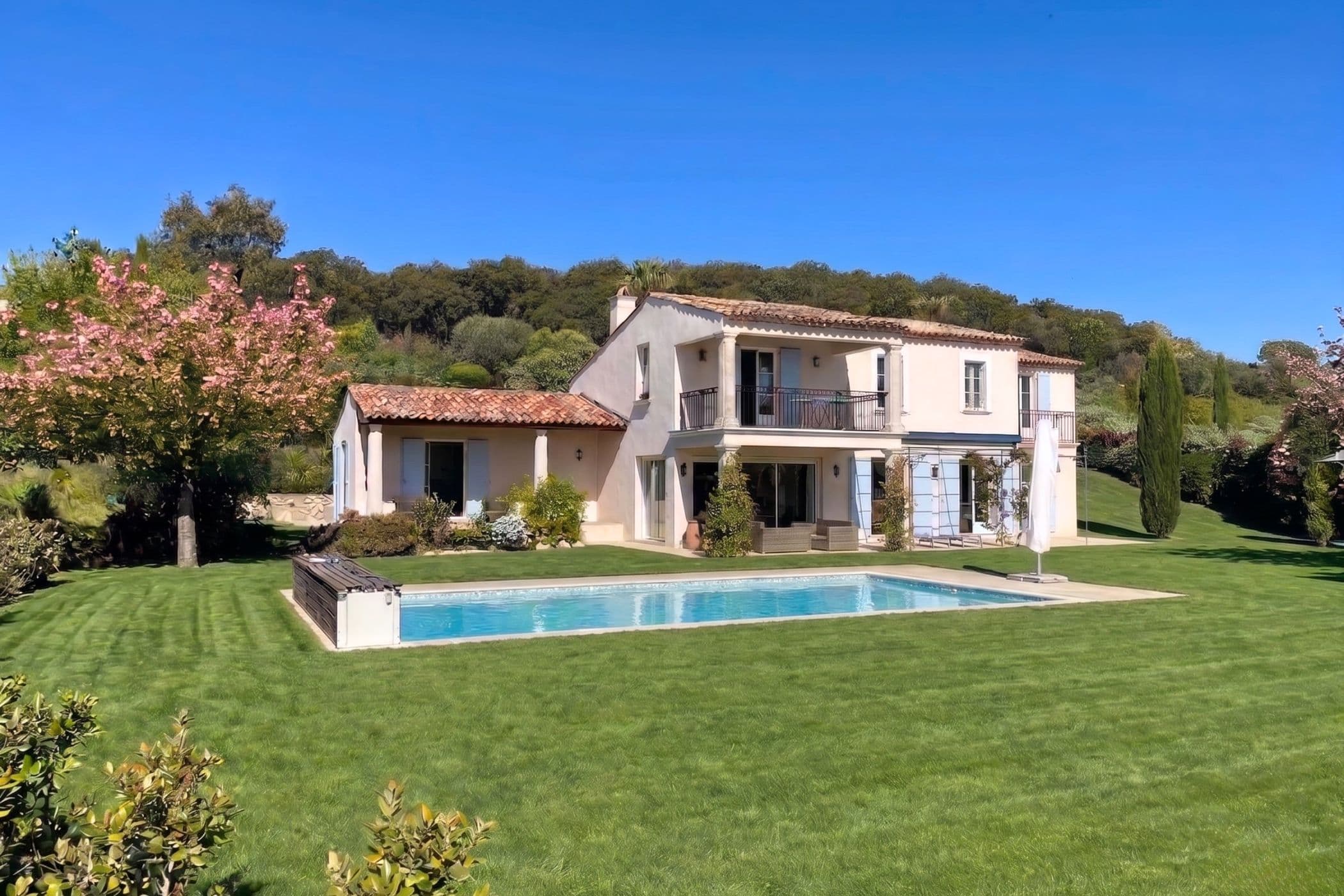
Consider the Grimaud villa concretely. It sits in the green countryside between the village and Saint-Tropez, built in the traditional Provençal manner — thick stone walls, high ceilings, interiors that feel solid and unhurried. The land is terraced and planted with lavender, olive and cypress; the south-east-facing terraces and the heated private pool look clear across the valley to the sea. Three bedrooms, four and a half bathrooms, room for a family and its guests without anyone tripping over anyone else. As a one-eighth co-owner you own a real share of that specific house, with your roughly 45 days a year booked through a shared calendar — not a hotel room, not an Airbnb, but a home you genuinely own a share of.
The practical argument is as strong as the lifestyle one. Full ownership of a villa on this coast brings a management overhead that most buyers under-estimate at purchase and find exhausting within two years: the pool contractor, the near-full-time summer gardener, the cleaner, the taxe foncière, the insurance renewals, the syndic fees if the property sits in a development, and the maintenance backlog that announces itself the one February nobody is in the country. Co-owners deal with none of this directly. The management company handles all of it; owners pay their one-eighth of running costs through a single annual account and simply use the house. You arrive to fresh linen, the pool at temperature and the fridge stocked to a list you sent ahead. The full mechanics are set out in our how it works guide, and the cost structure in our buying FAQs.
The 2026 Market and Regulatory Picture
Two things matter for a buyer reading the gulf in 2026. The first is that the prime French Riviera has proved structurally resilient: constrained supply, an internationally wealthy and largely cash-funded buyer pool, and tightening environmental limits on new coastal building have kept values firm even as higher-rate markets elsewhere softened. The second is regulatory. France's Loi Le Meur, enacted in November 2024, is the most significant overhaul of short-term-rental rules in fifteen years. It requires every meublé de tourisme to carry a thirteen-digit national registration number by 20 May 2026, bars the worst energy-rated homes (a DPE grade of G) from new tourist lets with stricter thresholds to follow, lets town halls cap rental quotas neighbourhood by neighbourhood, and — significantly for any shared building — allows a co-ownership to forbid short-term letting on a two-thirds majority rather than the unanimity once required.
For the buyer whose interest is personal use — which is the great majority of co-owners — the practical effect of all this is small. You are not running a rental business; you are using your own house for six weeks a year. But the new framework tightens the supply of legally lettable short-stay property and tends, if anything, to support values for compliant, already-finished, well-rated homes of exactly the kind a co-ownership structure holds. It is always worth confirming whether a specific property is structured for personal use only or sits within the rental framework before signing, and our partner will tell you plainly which applies.
The Co-Ownership Case for the Gulf of Saint-Tropez
The case for co-ownership here is not, in the end, primarily financial — though the financial logic is sound. It is a usage argument. This gulf rewards the returning, unhurried presence that a few weeks of genuine ownership make possible and that a hotel or a holiday let, with its check-in anxiety and its always-slightly-different keys, never quite delivers: the May terrace before the season fills, the September swim after the crowd has gone, the boat across the bay you no longer think of as a novelty, the vineyard you have learned to time your visit around. Over five or six stays a year, across different seasons, that accrues into something that feels less like a holiday and more like a second life — and you have paid for one-eighth of the house, and thought about none of the upkeep, to have it.
If the gulf appeals but you are weighing it against the Provençal interior, the Luberon ownership experience and the hills above Cannes make the same one-eighth argument with a different landscape. For the gulf specifically, COP carries live shares across the French collection, including the Grimaud and Les Issambres villas described here. Browse the current homes or speak with our team to understand exactly what a specific share would cost and how a week on the gulf would work.
More from Co-Ownership Property
Get in Touch
Speak to an expert
Tell us what you're looking for and we'll be in touch.