Lifestyle & Ownership Experience
Ibiza's Wild South-West Coast: A Week Facing Es Vedrà
An island that earned its reputation by night looks entirely different from the limestone cliffs above Cala Codolar — where Es Vedrà rises 413 metres from the sea, tourist licences are frozen and the real Ibiza belongs to those who own it.
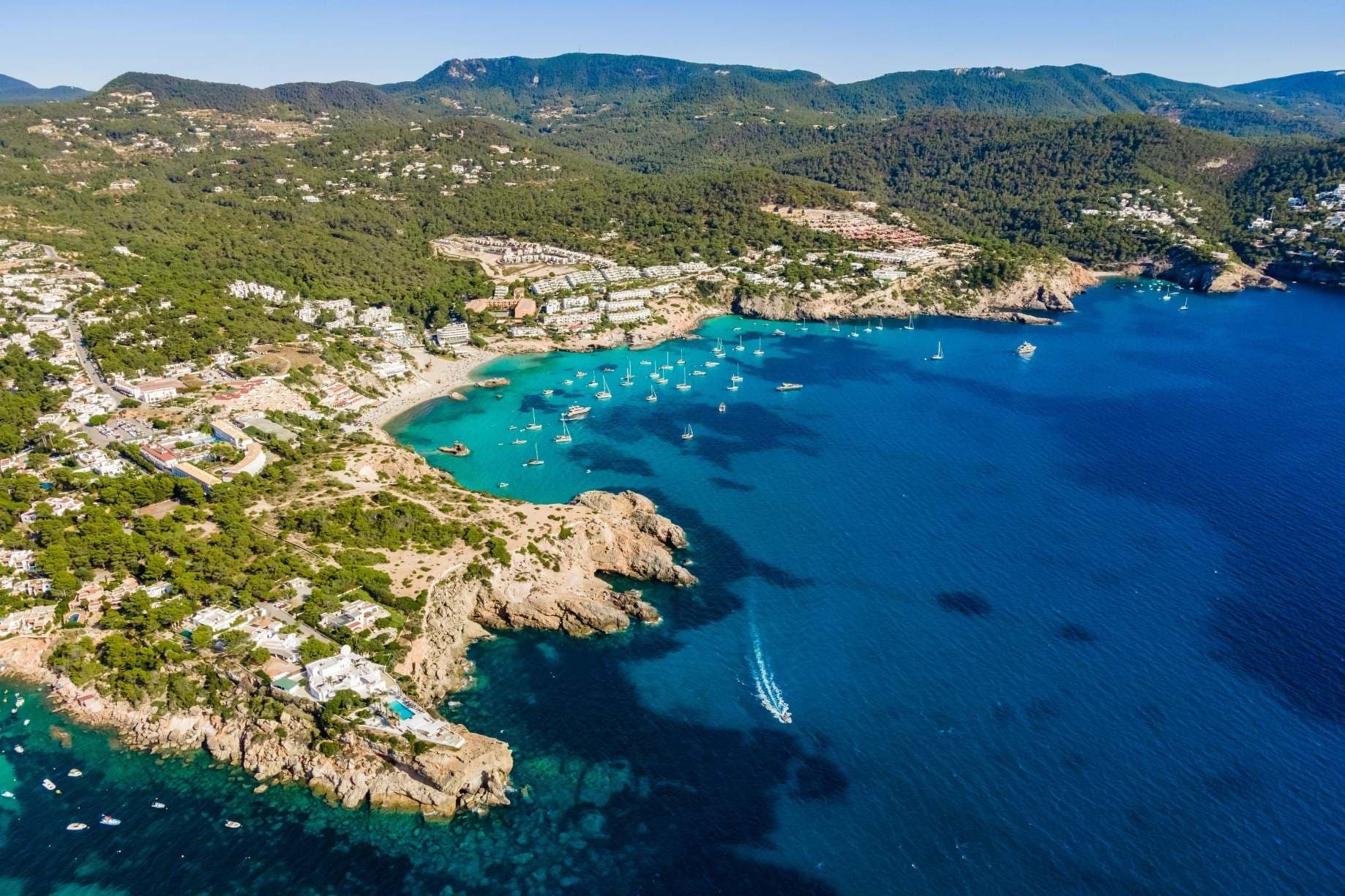
In the summer of 1855, a Carmelite friar named Francis Palau y Quer was lowered by a small boat onto the rocky island that rises like a spire from the sea, a mile and a half off the south-west coast of Ibiza, and stayed. He had been exiled from Catalonia, had no address, and survived on rainwater collected from cave drips in the limestone. The island is Es Vedrà. It stands 413 metres above the surface of the Mediterranean, composed of Mesozoic limestone pressed over hundreds of millions of years from the shells and corals of ancient seas — and it is the view of that rock, rising from the water at dusk like a cathedral spire backlit in copper and amber, that has been drawing people to this corner of Ibiza ever since.
The island's global reputation was built on something else entirely. Ibiza became a byword for a specific kind of summer — high-season, high-volume, a cultural export that has nothing to do with the south-west coast and its particular silence. The people who know the island well — not the ones who passed through in August, but the ones who own property here and have been returning for twenty years — tend to be protective of that distinction. They have been here in late April when the maquis scrub is in flower along the road to Sant Josep. They have eaten grilled sea bream at a table above the water at Cala d'Hort with no yacht visible on the horizon. They have watched Es Vedrà disappear into October mist and reappear in afternoon light more clearly than it had been all summer. Owning property on the south-west coast of Ibiza — specifically, owning a real one-eighth share of a quality villa, alongside seven other vetted co-owners — means having access to that version of the island rather than the other one.
The South-West and the Natural Park
The Ses Salines Natural Park runs from the salt flats at the island's southern tip up through the coastal corridor of the south-west, and within its boundaries, development has been strictly controlled for decades. The coastline around Cala d'Hort, Cala Codolar and Es Cubells is consequently some of the least built-upon in the Balearics — a sequence of limestone cliff, aromatic scrub, and cove that has changed very little in character. The municipality of Sant Josep de sa Talaia, which governs most of the south-west, is simultaneously Ibiza's quietest rural commune and its most expensive address. Es Cubells, the tiny hilltop village perched on a cliff edge some twenty minutes from Ibiza Town, remained effectively unknown to mass tourism until fairly recently and still functions as an ordinary Ibizan village, with a church, a handful of restaurants, and a view that real estate agents describe in superlatives but that requires no adjectives at all.
Cala d'Hort is the beach that anchors the south-west coast in most people's imagination. It sits within the natural park, accessible by road from Sant Josep but reachable by no ferry service — an absence that has kept it, more than any planning rule, as close to its original character as any beach in the Balearics. The restaurants above the waterline serve grilled fish and local wine. The water faces west and the light in the late afternoon arrives at an angle that makes the sea's colour impossible to describe precisely — somewhere between cobalt and something paler that has no name. Cala Codolar, a few kilometres north, is smaller and quieter still: a cove of pebbles and golden sand reached by a dirt track that deters casual visitors, with a single beach kiosk and the same unobstructed views of Es Vedrà that the friar was facing. This is one of the few corners of Ibiza where the coastline and the sea remain genuinely unchanged from one decade to the next.
The Owner's Calendar: When to Be Here
The travel industry sells Ibiza in July and August. The people who actually own property on the south-west coast tend to arrive in the periods between — late April for the spring light and uncrowded beaches, mid-September for the sea temperature and the exhaled quiet that follows the closing of the summer clubs, and late October when the island belongs almost entirely to residents and the limestone cliffs catch the lower autumn sun at an angle that high summer's bleaching heat never allows. Sea temperatures in September on the south-west coast sit around 24 to 25 degrees Celsius — warmer than the air temperature in many Northern European cities on a good August bank holiday — and October follows close behind at around 22 degrees, genuinely swimmable rather than merely dippable. Air temperatures in October average 23 to 24 degrees by day, with evenings cooling to around 16 degrees: warm enough for a terrace dinner, cool enough to want one.
With 44 to 45 days of annual usage per one-eighth share, the scheduling question for a south-west Ibiza co-owner is one of genuine abundance. A couple with flexible schedules might take the last two weeks of September, an October visit, and a long week in late April. A family with school-age children will weight their allocation toward the summer peak. Over several seasons, most co-owners develop their own rotation — specific weeks in specific months that align with the island's different moods rather than simply with its temperature peak. The co-ownership calendar is agreed among co-owners through the management company, and in practice most groups find that their preferred periods fall naturally in different parts of the year.
What a Week on the South-West Coast Actually Looks Like
The arrival experience in a co-ownership property is different in kind, not just degree, from a rental. There is no key-safe combination on a doorframe and no laminated instruction sheet about bin collection days. The management company has prepared the house before you arrive — fresh linens, the pool at temperature, the kitchen stocked with the basics you requested in advance. The property is yours for the week in the sense of real ownership — a share of the home, not a right to use it — and that distinction changes how you use the space from the first afternoon. You are not a guest in your own home. You are at home.
On the south-west coast, a week organises itself around the light. Mornings at the property tend to involve the terrace and the pool and the view of Es Vedrà shifting colour with the moving sun. Mid-morning is the time for Cala d'Hort or Cala Codolar, both reachable in ten minutes, before the beach fills toward noon. Lunch is often at Es Cubells village — at the family-run restaurant perched with its terrace above the sea, or at Ses Boques in the cove below the cliff, where the speciality is seafood and the view is worth arriving early for. The tradition is one that long predates the island's summer reputation: grilled dorada (gilthead bream), olive oil, local bread, the house white. The afternoon returns to the property and the pool and the particular slowness that the south-west coast imposes on everyone who settles into it. This is not a constructed or aspirational description. It is simply what a week here looks like when the person living it owns the place.
The defining daily moment on this stretch of coast is the sunset. Ibiza's west-facing coastline produces sunsets that have been photographed in their millions and remain, in person, something no photograph accurately conveys. The combination of open sea, the silhouette of Es Vedrà and its smaller companion island Es Vedranell, and the particular quality of Mediterranean light at the close of a long day produces something that feels genuinely theatrical — not manufactured or arranged, but the actual physics of the planet at the right latitude and time of year. Watching it from an infinity pool above Cala Codolar, or from the cliff edge at Es Cubells, is the kind of experience that justifies the flight and the property share and is, for a co-owner in September, entirely ordinary in the best possible sense.
Evenings, for those who want them, do not need to stay local. Ibiza Town's Dalt Vila — the UNESCO World Heritage-listed walled city on its promontory above the harbour — is twenty-five minutes from the south-west coast and is, by any measure, one of the most accomplished historic city centres in the Western Mediterranean. Its cathedral, its Phoenician-era ramparts, the restaurant terraces cut into the fortifications, the evening light on pale limestone: this is the Ibiza that predates the clubs by several centuries and will outlast them by the same margin. The distinction between the island's cultural depth and its summer reputation is most visible from a dinner table in Dalt Vila when you are arriving from your own property rather than a hotel room in San Antonio.
The Management Reality: What Co-Owners Don't Have to Think About
Full villa ownership on the south-west coast of Ibiza brings a management overhead that most buyers underestimate at the point of purchase and find exhausting within two or three years. The pool contractor, the gardener, the cleaner, the property manager, the insurance renewal, the IBI bill from the Sant Josep municipality, the community fees, the plumbing call that arrives via WhatsApp on a Thursday morning when you are in a meeting in another country. Co-owners deal with none of this directly. The management company handles the entire operational layer. Owners receive a single annual statement, pay their proportional share of running costs, and use the property. The difference between owning a fraction of something properly managed and owning it alone is largely the difference between enjoyment and administration. A full explanation of how this structure works in practice is on our how it works page.
The cost structure is one of the most clarifying aspects of co-ownership for buyers working through the numbers. As a one-eighth co-owner, the upkeep of the house, its pool and its garden is shared with the other owners and handled by our partner, so the home is ready when you arrive.
Ibiza's Property Market in 2026: What Buyers Need to Know
Ibiza's property market has been one of the most consistently appreciated residential markets in southern Europe for more than a decade. Island-wide average asking prices reached approximately €8,800 per square metre by mid-2026, up roughly 74 per cent since 2017, when the island average stood at just over €4,000 per square metre. In the premium zones of the south-west — Sant Josep, Es Cubells, Cala Conta, Cala Jondal — prices for quality villas with sea views have moved more sharply. Prime properties in these locations now trade at €10,000 to €20,000 per square metre, with exceptional frontline properties exceeding €25,000 per square metre. A typical four-to-six bedroom villa with an infinity pool in the Es Cubells microzone lists between €3 million and €10 million. Knight Frank's 2025 Wealth Report ranked Ibiza among the top five global resort markets for price growth, alongside Aspen, St. Moritz, and the Algarve — a reflection of the island's structural supply constraints as much as its demand profile.
Several structural factors limit the probability of that trajectory reversing. Ibiza is a small island — roughly 45 kilometres at its widest point — and planning controls have been progressively tightened over the past decade. The Balearic Islands government's moratorium on new tourist accommodation licences (ETV) for residential properties is effectively frozen across most municipalities, constraining the supply of legally leasable holiday homes precisely as international demand continues to grow. Development on undeveloped land within the Ses Salines Natural Park and surrounding protected zones is prohibited entirely. New residential supply has been minimal for years. The result is a market in which the supply of quality villas with sea views on the south-west coast is genuinely finite — and co-ownership structures that grant real partial ownership of existing properties are one of the few practical entry points below the single-ownership threshold for this part of the island.
The Co-Ownership Case for Ibiza's South-West Coast
The argument for co-ownership in this corner of Ibiza is not primarily a financial one, though the financial logic is sound. It is a quality-of-usage argument. The south-west coast rewards the kind of slow, repeated presence — the same cove across different days, the same restaurant through different seasons, the particular quality of October light on the limestone that is worth flying for specifically and is entirely unlike July — that ownership enables and that a rental, with its check-in anxiety and check-out finality, never quite delivers. Co-owners arrive with ownership's ease. The property, in the informal sense that matters, knows them — the terrace angle, the pool temperature, the kitchen they have stocked before. Over several visits a year, across the different seasons that the south-west coast offers each of them, that builds into something that is genuinely less like a holiday and more like a life. That is what a share in a south-west Ibiza property actually is, at its core — not one week, but all the different weeks that the island becomes across a year, accumulated and repeated and used.
Ibiza has earned most of its legends from the summer. The better ones belong to the off-season and the places the boats don't go — the limestone cliffs above Cala Codolar in October, the village terrace at Es Cubells on a weekday afternoon in April, the silhouette of Es Vedrà at the moment the copper light is exactly right. The friar on his rock knew something that took the rest of the world considerably longer to work out: this part of the island is not a backdrop. It is a place. And the difference between visiting it once and owning a piece of it — in the sense of real ownership, with a share of the home and a calendar slot in September — is the difference between a memory and a second life.
See the homes behind this guide. Browse the current Cala Codolar villa with its Es Vedrà infinity-pool views, explore the wider Spanish co-ownership collection, or see all current listings. To speak with someone about what is available and what a specific share would cost in the current market, our team is here.
More from Co-Ownership Property
Get in Touch
Speak to an expert
Tell us what you're looking for and we'll be in touch.