Lifestyle & Ownership Experience
Tenerife's South-West Coast: A Midwinter Week as an Owner
Eighteen degrees in January, the Atlantic still swimmable, and a fishing-village coast that never closes — Tenerife inverts the second-home calendar. A guide to what a week of ownership feels like when the rest of Europe is cold.
Eighteen degrees. That is the average daytime temperature in Costa Adeje in January — not a freak warm spell but the ordinary midwinter mean on the south-west coast of Tenerife, where the afternoons climb toward twenty-one degrees and the Atlantic holds near twenty degrees well into the new year. Hold that number against the logic that governs the rest of this series. Every ownership experience COP has written about — Mallorca, Tuscany, the Côte d'Azur, Lake Como — turns on the shoulder seasons: the September coves, the October harvests, the few warm months wrung out before the place exhales and empties for winter. Tenerife inverts that calendar entirely. There is no off-season here. The island's prize weeks are precisely the ones when the rest of Europe is cold, and that single fact changes what a share in it is actually for.
For most owners of a Canary Islands second home, that year-round potential goes largely unused. The apartment sits warm and empty for the bulk of the year while its owner visits for a couple of weeks, pays the community fees, and fields the occasional call from a property manager about a leaking terrace or a pump that has tripped. Co-ownership rewrites the arithmetic without touching the experience. Owning a real one-eighth share of a quality property, alongside seven other vetted co-owners, gives roughly 44 to 45 days of personal use a year — and on an island with no real off-season, those days can be spread across midwinter sun, a spring week on the water and a stretch of the long, dry autumn, rather than crammed into a single overheated fortnight. You arrive; the home is ready; someone else has managed it; you leave; the calendar resets for the next owner. This is what that pattern actually looks like on the south-west coast.
The Island With No Off-Season: Why Winter Is the Real Prize
The numbers that matter in Tenerife are the winter ones. Costa Adeje averages roughly nine hours of sunshine a day in January, with daytime highs around twenty-one degrees, nights that rarely drop below sixteen, and a sea temperature near twenty degrees that stays swimmable when every other property in this series has its pool covered and drained. Rain, when it comes, is brief — a handful of days across the month. For a buyer in London, Munich or Amsterdam, the proposition is not a warmer version of a Mediterranean summer; it is a different asset class of week, the kind that turns the dead part of the northern year into the part you look forward to. The co-ownership calendar is well suited to capturing exactly this, because the weeks most owners want here are the ones the brochures never bother to sell.
It explains who tends to buy. A retired couple from the north of England who once endured the January gloom now spend six weeks of it on a terrace above the sea. A remote-working family takes the February half-term and a fortnight at Easter, the children in the pool while colleagues at home scrape ice off windscreens. A pair in their fifties build an annual rhythm of three winter visits and one in the gentler autumn, when the island is at its quietest. Because a one-eighth share carries genuine flexibility — weeks are agreed among co-owners through the management company — the scheduling question on Tenerife is rarely whether to take off-peak time. It is which of the bright, empty winter weeks to claim first.
What a Typical Week Looks Like
The arrival is categorically different from a rental. There is no hunt for a key-safe combination, no laminated sheet about the WiFi and the bin days, no deposit hanging over the week. The management company has prepared the home before you reach it — fresh linen, the pool at temperature, the fridge stocked with the basics you asked for in advance. The home is yours for the week: not in the hedged sense of a hotel room or the provisional sense of an Airbnb, but in the sense of real ownership — a share of the home, not a right to use it. That distinction is not abstract. It changes how you use the space from the first afternoon, and it is the difference between visiting Tenerife and belonging to it.
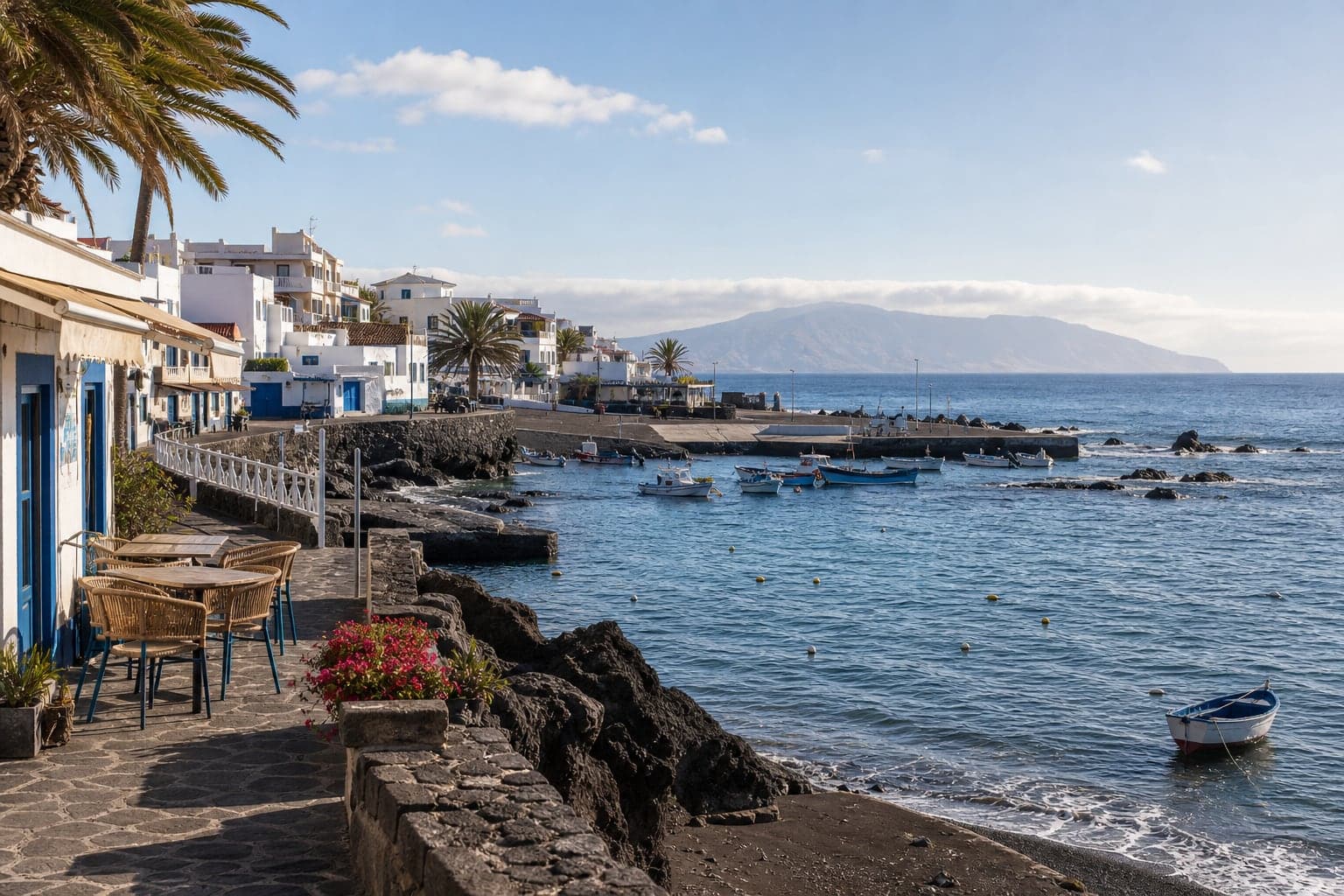
The south-west coast is the part of the island built for this. It is a string of low-rise, sea-facing communities running from Costa Adeje down through Callao Salvaje to Playa San Juan, a working fishing village in Guía de Isora set between the resort coast and the great cliffs of Los Gigantes. This is not the high-rise Tenerife of postcard cliché; it is black-sand coves, a seafront promenade where the fishing boats still come in, and a clutch of seafood restaurants at La Caleta that locals drive across the island to reach. A two-bedroom apartment with sea views in Playa San Juan puts you inside that village rhythm rather than beside it — the morning catch, the children's swimming pool by the harbour, the long lunch that bleeds into the afternoon.
A typical day asks very little of you. A slow morning at the home — coffee on the terrace, a swim in the infinity pool above Callao Salvaje, the Atlantic flat and silver below. Lunch of grilled vieja or cherne at La Caleta, the local white from the volcanic vineyards inland. An afternoon drive north toward Los Gigantes, where the cliffs fall six hundred metres straight into the sea and the whale-watching boats leave from the harbour, or simply a second swim and a book. There is no itinerary anxiety because there is nothing to miss; the week is not a holiday to be optimised but a place to be inhabited. Owners describe the shift after the second or third visit, when the supermarket, the fish stall and the café owner stop being discoveries and become routine.
Beyond the Coast: Teide, the Laurel Forests and the Two Tenerifes
What keeps owners returning rather than tiring of the island is that the coast is only one Tenerife. At its centre stands Mount Teide, at 3,715 metres the highest peak in Spain and the heart of a national park inscribed by UNESCO as a World Heritage Site. In winter it does the thing that no other destination in this series can offer: it wears snow on its summit while you swim at sea level an hour's drive below — a contrast that never quite stops being startling. The drive up through the pine forest into the caldera, a lunar expanse of ochre rock and lava fields, is one of the great European day-trips, and it sits entirely within a morning of the south-west coast.
North of the volcano lies the other island — green, cooler, older. The Anaga massif holds an ancient laurel forest, the laurisilva, a relic of the woodland that once covered the Mediterranean basin millions of years ago. The old town of San Cristóbal de La Laguna, the island's former capital, is itself a UNESCO World Heritage Site, its grid of palacios and patios the template for colonial cities across the Americas. And threading through the hills above Tacoronte and the Orotava valley are the volcanic vineyards that produce wines found almost nowhere else, grown in black soil that never knew phylloxera. An owner who treats Tenerife as a winter sun-trap and nothing more is using a fraction of it. The island rewards the slow accumulation of these places across many visits — which is precisely what a few weeks of ownership a year, returned to season after season, is built to provide.
The Management Reality: What You Don't Have to Think About
The lifestyle argument is compelling on its own; the practical one is just as strong. Full ownership of a south-coast property brings a management overhead that buyers reliably underestimate and find wearing within two years — the pool contractor, the gardener, the cleaner, the comunidad fees, the IBI property tax, the insurance renewal, the utility bills that arrive in Spanish with a box of figures that map to nothing obvious. Co-owners deal with none of this directly. The management company handles maintenance, cleaning, the pool and garden, insurance and the annual accounts. Owners receive a single statement and pay their proportional share.
That proportion is the part most newcomers misread. Because you own one-eighth of the property, you carry one-eighth of every running cost: taxes, insurance, maintenance, management, pool and garden upkeep, and any agreed improvements. The annual outlay for a quality south-coast apartment with a shared pool is modest set against a full villa, and divided eight ways it becomes a small fraction of the whole — while delivering several weeks on the island every year and an actual stake in the asset. The mechanics of how those costs are set and shared are laid out in full in our how it works section.
Tenerife's Property Market in 2026: Context for Buyers
The market context matters because it shapes both the entry price for a share and the long-term position of co-owners. The south of the island is its strongest segment, and Adeje is the most expensive municipality in the province: asking prices in the area run at roughly €4,600 to €5,000 per square metre in early 2026, with prime stretches of Costa Adeje reaching €6,500 per square metre and quality villas and resort apartments commonly priced between €850,000 and €1.8 million. Demand remains brisk: well-priced homes in the best south-coast locations sell quickly. Against that backdrop, a one-eighth share in COP's south-west inventory — sea-view apartments and infinity-pool homes around Callao Salvaje and Playa San Juan — opens the same coast from around €189,000 per share, real ownership in a market with strong, steady demand, with none of the management exposure or capital concentration of buying outright.
One regulatory shift is reshaping every Canary Islands purchase and is worth understanding before you buy. Under the regional holiday-let law that took effect from the end of 2025, the Canaries have imposed a five-year freeze on new tourist-rental (vivienda vacacional) licences, restricted short-term letting in designated tourist zones, and enshrined a housing-first principle that caps tourism use and lets a building's comunidad de propietarios prohibit holiday rentals outright. For a buyer chasing rental yield, this has made legal tourist-use status the single most important question about any property. For co-owners who use their share personally — as the great majority do — it changes very little. The permitted use of each home is set out before you buy, and our buying FAQs cover the detail.
The Co-Ownership Case for Tenerife
The case for a Tenerife share is not, at root, a financial one, though the financial logic holds. It is a usage argument, and a seasonal one. The island's distinct gift is the winter week — the eighteen-degree January, the swimmable Atlantic, the snow on Teide above a coast that never closes — and that gift is wasted on a property used for a fortnight a year and ignored for the rest. Co-ownership matches the asset to the way the island actually pays out: several visits across the bright half of the northern year, returned to season after season, until the south-west coast stops being a destination and becomes a second life with the heating turned off. That, in the end, is what people buy when they buy a share here — not the bricks, but the January that the rest of Europe doesn't get. It is the same instinct that draws buyers to a quieter Balearic share, translated to an island where summer never quite ends.
See the homes behind this guide. Explore a current Tenerife co-ownership share above Callao Salvaje, browse the wider Spanish collection or the full set of current listings, and speak with our team about what a specific share on the south-west coast would cost in today's market.
More from Co-Ownership Property
Get in Touch
Speak to an expert
Tell us what you're looking for and we'll be in touch.