Lifestyle & Ownership Experience
Austria's Alps in Summer: A July Week in a Shared Chalet
While the Mediterranean bakes, Austria's valleys stay green and its cable cars keep running — and one-eighth of a chalet turns the Alps' record-breaking second season into something you own.
Ask a room of second-home buyers when an alpine chalet earns its keep, and nearly everyone will answer with a week in February. The numbers no longer agree. Austria closed 2025 with a record 157.3 million overnight stays, and May 2026 — before a single summer cable car had properly opened — set another record: 9.6 million overnight stays, up 12 per cent year on year and the strongest May since the country's electronic tourism records began in the 1973/74 season. The Alps' warm half is no longer the consolation season, the quiet stretch when the lifts stand still and the chalet waits for snow. It is the growth story — and almost nobody who buys in the mountains is positioned to use it.
The reason is arithmetic, and it is brutal. The classic alpine second home is bought for ski weeks and used for little else: a fortnight in high winter, perhaps a half-term, and then ten months of paying a mountain property to stand empty through hay-cutting June, swimming-lake August and golden September. Co-ownership rewrites both halves of the equation at once. Owning one-eighth of a fully managed Austrian chalet or apartment — a real share of the home, alongside seven other vetted co-owners — brings roughly 44 to 45 days of use per year, which is precisely what makes the second season real: a ski week in February, a summer fortnight, a September walking week, and the house earning its keep for someone in the group the rest of the time. The structure is set out step by step in our how it works guide, and the homes themselves in our Austrian collection. This is what the warm half of that calendar actually feels like.
The Second Season: What the Alps Do Between the Thaw and the First Snow
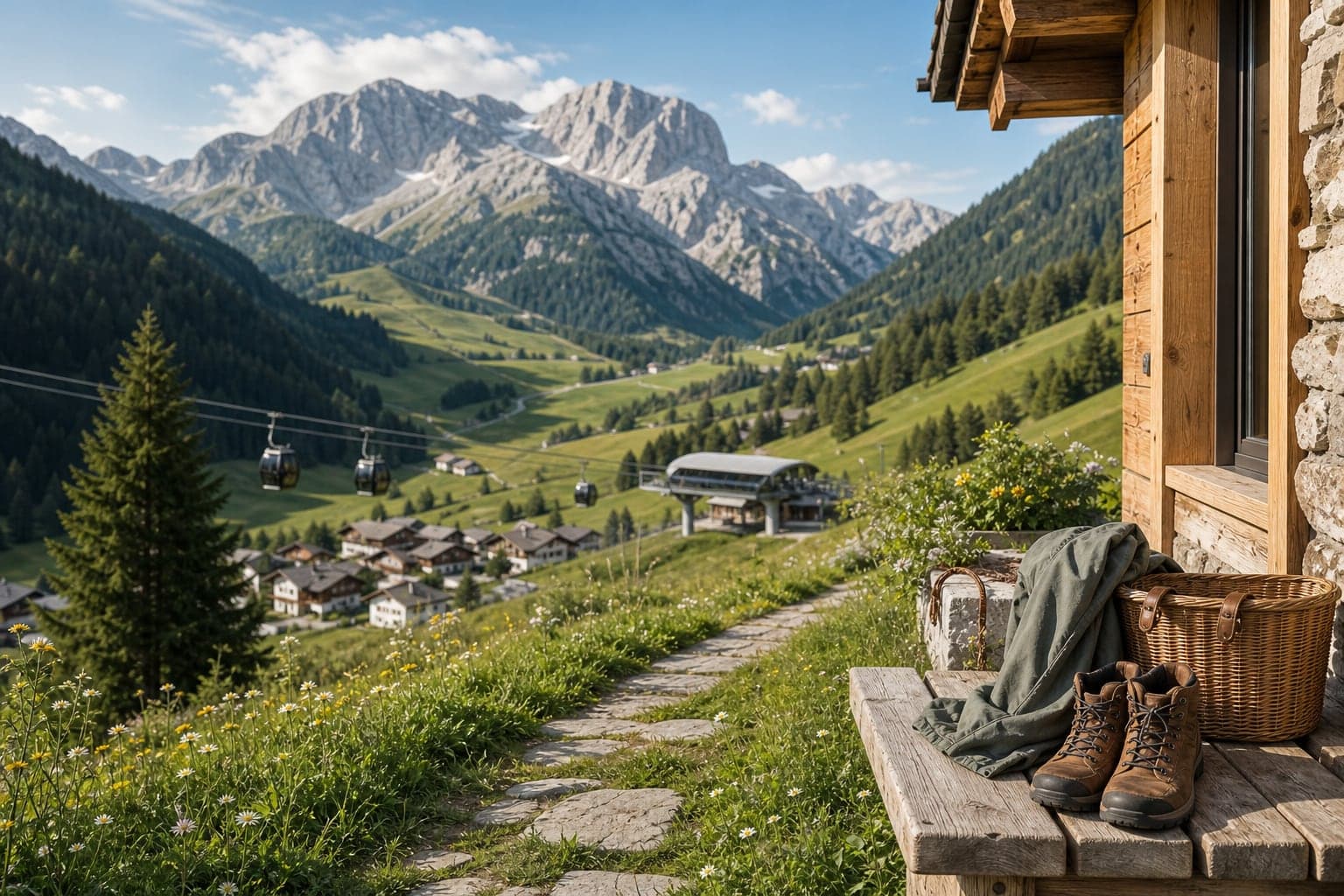
From late May the valleys change character entirely. The cattle go up to the high pastures and the meadows below are cut for hay, filling whole valleys with the smell of it. The cable cars that hauled skiers in January reopen for walkers and bikers. Village swimming lakes warm through July; mountain huts serve lunch at two thousand metres; and in September the Almabtrieb brings the herds back down garlanded in flowers, through villages that turn the descent into a festival. The tourist offices call all this the second season. On the ground it no longer feels like the second anything: Tyrol alone recorded 23.2 million overnight stays and 6.7 million arrivals in summer 2025, its strongest summer on record — a season that would flatter many countries' entire year.
Part of what is driving that growth is temperature. While Mediterranean coastlines have spent recent summers issuing heat warnings, an Austrian valley at eight hundred or a thousand metres holds its afternoons in the comfortable twenties and asks for a sweater by dinner. Buyers who once defaulted south are increasingly splitting the difference — sea in June, mountains in August — and the co-ownership calendar is built for exactly that pattern. A family claims the school-holiday fortnight in July; a retired couple takes the empty gold of mid-September; the group's skiers concentrate on February. In practice, co-owner groups discover their preferences interlock far more neatly than newcomers expect, a dynamic explained in our staying FAQs.
What a Summer Week Actually Looks Like
Begin with the arrival, because it is where co-ownership stops being a concept. There is no key-safe on a fence post, no laminated sheet about the boiler, no first hour spent working out which cupboard holds the pans. The management company has opened the house, aired it, made the beds and stocked the fridge with what you asked for; the boots you left in the spring are in the boot room where you left them, and the trail maps on the shelf are annotated in your own hand. You are not checking in to the mountains. You are coming back to them — and that difference shapes every day that follows.
Take a Tuesday in the Paznaun. The village of See sits at the mouth of the valley, a little over an hour from Innsbruck, where the Trisanna river runs glacier-pale under the road that climbs toward Ischgl and the Silvretta peaks. Ischgl in summer is unrecognisable to anyone who knows only its winter reputation: the après-ski crowd is gone and the valley belongs to hikers, road cyclists and families riding the lifts to ridge trails. A co-owner's morning here is coffee on the balcony while the valley is still in shadow, a cable car up into the light, four or five hours on the high paths, and a slow return for a late-afternoon sauna. COP's listing in the village — a two-bedroom apartment with mountain views at €169,000 for a one-eighth share — is the least expensive doorway into the Tyrolean Alps currently on our books.
A week under the Wilder Kaiser reads differently. Going am Wilden Kaiser, roughly ninety minutes from Munich, sits directly beneath the great limestone wall that gives the region its name, and the mountain performs twice daily — pale and austere at noon, glowing rose at sunset in the phenomenon locals simply call the glow. Days here are gentler than in the high Silvretta: a swim in a mountain lake along the valley, an easy meadow walk to a hut for Kaiserschmarrn, the village bakery before eight. The three-bedroom chalet with sauna COP lists in the village — €379,000 per one-eighth share — is built for exactly this rhythm, with the Kitzbühel Alps on the doorstep for anyone who wants a harder walk.
West and South: Vorarlberg's High Plateau and the National Park
Vorarlberg, Austria's westernmost province, is the quiet overachiever of this market — roughly two hours from Zurich and correspondingly popular with Swiss and German buyers who want alpine summers without alpine circus. Bürserberg occupies a sunny shelf above the Brandnertal, with the Tschengla plateau's walking country directly above the village and the turquoise Lünersee at the head of the valley. COP currently carries three homes in the village, led by a three-bedroom penthouse at €439,000 per one-eighth share, with two-bedroom apartments from €229,000. Further up the Arlberg road, Stuben — a hamlet of a few dozen houses on the old pass — offers a two-bedroom apartment at €289,000 for buyers who want the smallest, quietest version of the Alps that exists.
South-east of these, in the Salzburger Land, Neukirchen am Großvenediger sits on the rim of the Hohe Tauern — Austria's largest national park — with the Wildkogel above the village and the Krimml waterfalls, the country's highest, a short drive along the valley. This is the Alps at their most elemental: glacier views, marmots above the treeline, and a village that still organises its year around the mountain rather than the market. COP lists a three-bedroom chalet here at €239,000 per one-eighth share, alongside a two-bedroom apartment at €169,000 and, one valley along in the Pinzgau, a three-bedroom chalet with hot tub in Hollersbach at €439,000.
The Management Reality: Two Seasons, None of the Work
Mountain houses are demanding in ways coastal ones are not. Snow load and meltwater test roofs and drainage every single year; chimneys must be swept on a legal schedule; gardens at altitude grow a metre in June; and the shoulder months — the muddy weeks of November and April when no owner wants to be there — are precisely when an alpine property needs the most attention. In a co-ownership structure, none of this lands on the owner. The management company winterises and summerises the house, contracts the sweep and the roofer, prepares the property before each stay and closes it after, and presents the owners with a single annual account. Each co-owner pays one-eighth of the running costs — typically a fraction of what two peak-season rental weeks in the same valley would cost — and simply arrives. The cost mechanics are set out in our buying FAQs.
The Austrian Market in 2026: A Mild Recovery and an Eight Per Cent Wall
The market context favours the patient buyer. After a two-year correction, Austrian residential prices returned to nominal growth through 2025, with the national residential property price index up around 2.1 per cent year on year in the final quarter — a gentle recovery rather than a boom, underpinned by falling rates and rising real incomes. The alpine premium, however, never really corrected. Condominium prices in Tyrol average close to €5,800 per square metre, well above the national average, and the Kitzbühel district — where houses changed hands at an average of around €2.7 million in 2024 and apartments exceed €8,000 per square metre — remains the most expensive address in the country. Whole ownership of a quality chalet in a name-brand Tyrolean valley is now a seven-figure commitment before running costs.
Then there is the wall that has nothing to do with price. Tyrol's spatial planning law caps leisure residences — Freizeitwohnsitze — at 8 per cent of the dwellings in any municipality, and most desirable resort communes sit at or above that line, meaning new leisure-residence designations are effectively unobtainable. The province counts only around 16,000 legal leisure residences, enforcement has tightened sharply, and the penalties for using an ordinary home as an undeclared holiday house now run from fines to forced sale. For a foreign buyer, this is the strongest practical argument for the co-ownership route: a properly structured, already-compliant property removes the single largest legal risk in the Austrian market. We covered the rulebook in detail in our guide to buying ski property in Austria, and the tax side in our Germany and Austria property tax guide.
The Case for an Alpine Summer Share
The financial case for Austrian co-ownership is sound — a hard-capped supply of legal leisure homes, a recovering market, an entry price from €169,000 rather than €1.7 million. But the deeper case is what happens to the weeks themselves. Over two or three years they acquire ritual: the same first-morning trail while the family sleeps, the hut lunch that has become yours, the Almabtrieb weekend booked a year ahead, the late-September evening when the air first smells of coming snow and you are, for once, still there for it. That is not a holiday pattern. It is a second life running quietly in parallel to the first — in a landscape that works, unusually among Europe's great second-home destinations, twelve months a year.
See the homes behind this guide. Explore the two-bed in See, browse the full Austrian collection and the rest of our homes, or speak with our team about what a share in the Alps' second season would cost this summer.
More from Co-Ownership Property
Get in Touch
Speak to an expert
Tell us what you're looking for and we'll be in touch.