Properties & Destinations
Lake Maggiore Co-Ownership: Italy's Quieter Great Lake
Italy's second-largest lake trades at roughly half the per-square-metre price of Como, sits an hour from Milan by direct train, and has just become 2026's most underestimated co-ownership address.
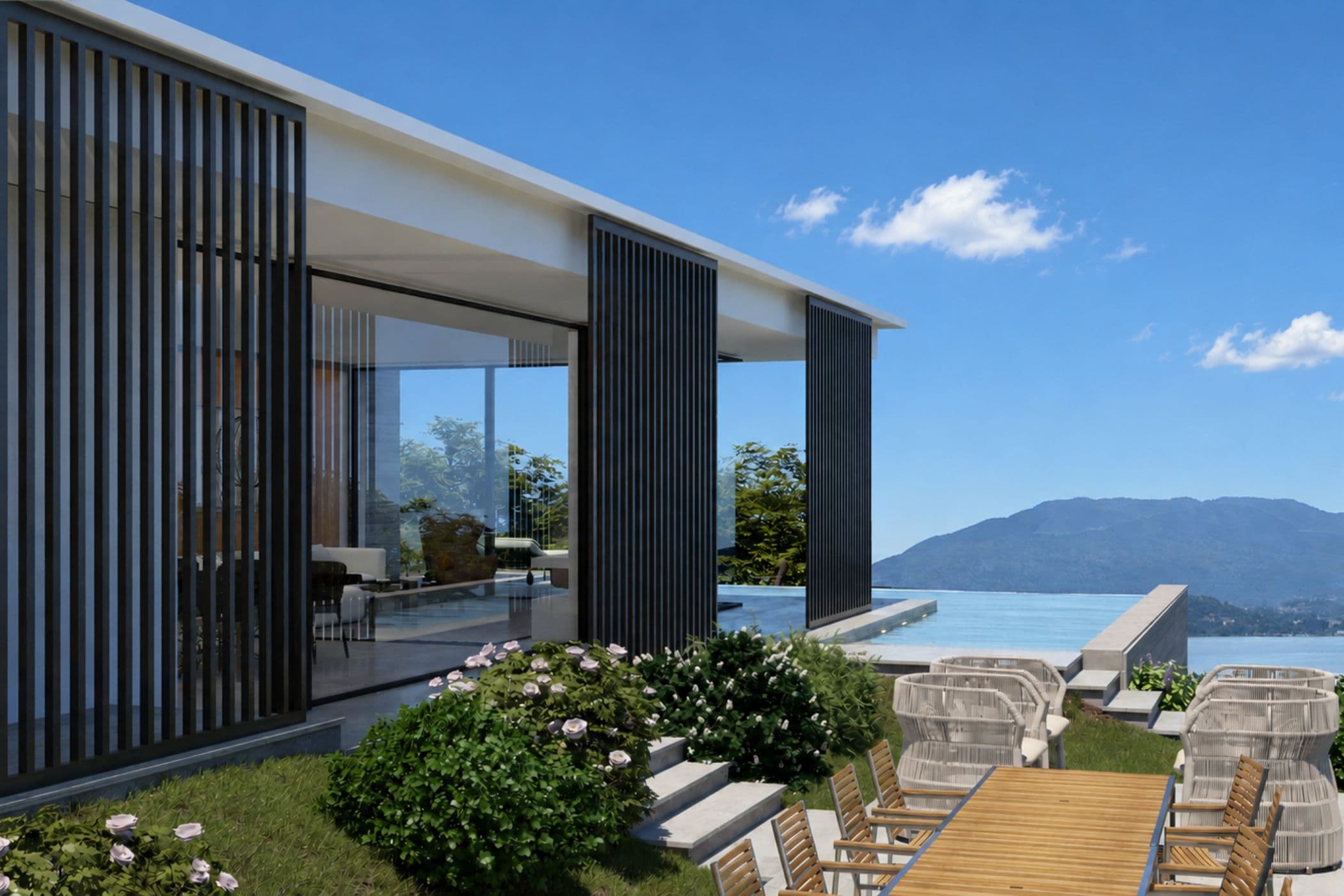
In a country where the great lakes have become a luxury sport, one of them has been hiding in plain sight. Lake Maggiore is the second-largest in Italy, longer than Como, the only one to straddle the Swiss border, and the only place at Alpine latitude where camellias flower outdoors in February and palms grow without protection. It is also, in 2026, trading at roughly half the per-square-metre price of its more famous neighbour to the east. Top-end quotations on Maggiore sit at around €8,000–8,500 per square metre, while equivalent lakefront properties on Como now cross €15,000. The lake's quietness is not accidental — Maggiore has never bid for celebrity in the way Como has, and the Borromeo family has been running its prettiest islands since the fifteenth century without ever feeling the need to publicise them. But the result, for a co-ownership buyer reading the 2026 market carefully, is a paradox: the most beautiful undervalued lake in Italy, just as Milan's Olympic year pulls international attention north.
For most second-home owners on the Italian lakes, the romance fades the moment the wire transfer clears. The average British, American or Northern European owner of a lake-district villa spends fewer than thirty days a year on the property. The grass is cut whether they are there or not. The IMU — Italy's annual municipal property tax for second homes — arrives every June. Co-ownership of a Lake Maggiore villa — specifically, owning one-eighth of a quality property, alongside seven other vetted co-owners — changes the arithmetic without changing the experience. You arrive. The house is ready. Someone else has managed the off-season. You leave. The calendar resets for the next owner. Roughly 44–45 days of use per year, a fraction of the capital outlay, and none of the management overhead. Our how it works guide walks through the structure end-to-end.
A Microclimate the Brochures Don't Quite Believe
Lake Maggiore sits at the same latitude as Lyon and Geneva, but on its western shore something improbable happens. The lake is deep — almost 370 metres at its lowest point — and it functions as an enormous thermal radiator, releasing in winter the heat it has absorbed in summer. The surrounding mountains shield the basin from northern winds. The result is a microclimate that feels Mediterranean while the snow stays on the peaks above. Citrus, olives, palms, agaves and the twenty thousand plant species in the Villa Taranto botanical garden at Verbania all thrive on shores that, on a latitude map, ought to be cold. Camellias open in late February. Azaleas and rhododendrons crowd the slopes in April. The lake itself swims comfortably from mid-June through to early October, with surface temperatures of 21–22 degrees Celsius into mid-September.
For a co-owner, this microclimate stretches the usable year well beyond the conventional July–August template that drives second-home buyers further south. The lake's real prize is the shoulder season: April and May, when Villa Taranto reaches peak bloom and Stresa fills with garden-festival visitors; September and early October, when the alpine air sharpens, the light turns brassy, and the tourist crowds collapse to nothing. A one-eighth co-ownership calendar — built around four to six visits a year of roughly a week each — maps almost perfectly onto these months. You stop chasing peak heat and start chasing the lake at its quietest and most photogenic.
Stresa, Verbania and the Borromean Spine
The western, Piemontese shore of Maggiore runs north from Arona at the foot of the lake through Belgirate, Lesa, Meina and Stresa to Verbania, Cannobio and the Swiss border. Stresa is the lake's traditional capital of leisure: Belle Époque hotels strung along a lakefront promenade, a cable car climbing 1,492 metres to Mottarone for the panoramic view across to Monte Rosa, and a five-minute ferry to Isola Bella, the Borromeo family's baroque palace island that Flaubert once called "the prettiest place in the world." Verbania, a few headlands north, is the quieter half: Villa Taranto's botanical gardens, a daily food market in Intra, and a generous waterfront that has lately become Lake Maggiore's gravitational centre for serious foreign buyers.
Between the two, the smaller villages — Belgirate, Meina and Lesa — combine authenticity with the most attractive price arithmetic on the lake. Local agents and Italian luxury-market trackers identify these three as the strongest appreciation candidates for 2026, with margins that allow targeted renovation of historic Liberty-style houses at competitive entry points. In Stresa proper, homes in good condition sit in the €3,300–5,600 per square metre band; in Belgirate and Meina, the comparable lakefront stock is meaningfully below that, with restoration upside that the established Stresa addresses no longer offer.
A typical week of co-ownership on this shore takes its shape from the lake itself rather than a programme. The hop-on, hop-off ferry circuit of the Borromean Islands becomes an instinctive ritual: a morning at Isola Bella's baroque gardens, lunch at Isola dei Pescatori where the fishermen's families still cook the day's catch, an afternoon under the cedar of Lebanon on Isola Madre. The Mottarone cable car runs every twenty minutes and ends, in spring and summer, in alpine meadows that look down on six lakes at once. Cannobio's Sunday market — among the largest in Northern Italy — fills the lake's northernmost Italian town with cheese, linen and farm produce from across Piemonte. By midweek the rhythm settles: an early swim from a private mooring, a long lunch in Intra, a late dinner on a Stresa terrace, and the slow ferry pull back across water the colour of slate.
The 2026 Market: Milan, the Olympics and the Quiet Foreign Tilt
What has shifted about Lake Maggiore in 2026 is less the place than the demand around it. Milan, an hour by direct train from Stresa, has become Northern Italy's reluctant headline city: financial capital of the country, co-host of the Milano-Cortina Winter Olympics, and the centre of a 12 per cent annual rise in real-estate enquiries reported across Italian agencies during the run-up to the Games. That demand is spilling outward. Maggiore is the closest of the great lakes to Milan's Malpensa airport — roughly twenty minutes by car — and accommodation in the lake basin is recording the kind of forward-booking pressure that typically precedes a price step. Italy is projected to receive 66 million international visitors in 2026, up from 60 million in 2023, and accommodation alone will account for roughly two-thirds of the Games' €5.3 billion economic footprint.
The buyer profile is tilting in parallel. Italy Sotheby's International Realty opened a dedicated Lake Maggiore office in response to demand it could no longer service from Milan, joining established local specialists in Stresa and Verbania. According to agency surveys of the lake, foreign buyers now make up around 65 per cent of the Maggiore market: Germans first (about 25 per cent), then Swiss (12), British (10) and a further 18 per cent drawn from France, Belgium and the Netherlands. American and Middle-Eastern enquiries cluster at the ultra-luxury end. The average buyer is over 45 — established, family-led, often planning across two generations. In Italian-lake terms, that demographic signals durable rather than speculative interest, the kind of cohort that holds property through cycles rather than flipping at the first uptick.
What separates Maggiore from Como in 2026, however, is value rather than appeal. Como remains the louder market — the celebrity addresses, the Bellagio premium, the price points that have moved sharply over recent cycles — and our Lake Como village guide sets out that micro-market in detail. Maggiore is the rational alternative: the same Italian-lake life, the same Belle Époque architecture, the same proximity to Milan, with quotations roughly 40 to 45 per cent below Como for comparable lakefront. For a co-ownership buyer, that differential is structural rather than cosmetic. A one-eighth share of a Maggiore villa now buys a slice of lake-frontage that on Como would require a different conversation altogether.
What an Eighth of Lake Maggiore Actually Costs
In practical terms, a fully restored three-bedroom villa with lake view and infinity pool in the Meina–Stresa–Verbania corridor sits comfortably in the most sought-after Maggiore range of €500,000 to €1.5 million for historic apartments and lake-view homes, with the rarer trophy villas climbing past €5 million. A one-eighth share through COP typically lands in the €200,000–400,000 band, with conveyance costs, the legal set-up and the first year of management included. That share carries roughly 44–45 days a year of guaranteed use, allocated through a rotating calendar that gives every co-owner equitable access to peak weeks across a five-year cycle.
The legal set-up is arranged by our partner for each home and walked through with you before you buy, and the Italian property taxes (IMU, TARI, and the small annual lake-shore concession where applicable) are split eight ways. Our guide to Italian property tax for co-owners in 2026 walks through exactly what each share carries. Crucially, no individual owner is exposed to unbounded repair surprises: the property carries a reserve fund, the management agreement caps annual contributions, and the Italian compliance overhead — accounts, tax filings — is handled centrally rather than landing in eight personal inboxes.
The Management Reality on an Alpine Lake
Most of what frustrates whole owners on the Italian lakes happens between November and April. The garden goes dormant; the boat-shed needs winterising; a March storm strips tiles; a contractor calls in Italian with a question about a heating circuit at seven in the evening. A co-ownership structure absorbs all of this through a single managing entity. A local property manager — accountable to the co-owners as a group, not to any individual owner — handles seasonal opening and closing, garden and pool maintenance, the lake-specific quirks of dock and shoreline upkeep, and the inevitable Italian paperwork around condominio meetings, utilities and municipal levies. Each owner pays a single transparent annual management fee, capped against an agreed schedule, and the property is delivered on arrival in a state that no individually managed second home reliably achieves.
The point of co-ownership on Maggiore, in other words, is not principally about sharing — it is about outsourcing the parts of ownership that erode the pleasure. For the right buyer, that trade is exactly the one that converts a romantic idea of a lake house into a working second life. For more detail on how that calendar mechanics looks across the year — and what shoulder-season buyers tend to choose first — our staying-in-your-co-ownership-property FAQs covers the practical side end-to-end.
A Second Life on Italy's Western Lake
Hemingway closed the central act of A Farewell to Arms by rowing across Lake Maggiore in a storm at four in the morning, his small wooden boat pitching toward the Swiss shore. The lake has not changed materially in the century since. The Borromeo family still owns the islands. The Mottarone cable car still climbs to its high meadow. The camellias still open in February, and the ferries still trace the same shapes on the water. What has changed is the way an outsider can hold a piece of it. Until very recently, ownership on the Italian lakes meant either a full villa with all the burdens of an empty house, or no ownership at all. One-eighth of a Maggiore villa, with 44–45 days of guaranteed use, professionally managed and resellable through our partner’s resale process, is something different — it is the lake as a second life rather than a second house.
Used well, that share gives a family back the rhythm of a place to return to: a Tuesday morning at the Intra market, a September swim from the property's own mooring, the gardens of Villa Taranto in full mid-May bloom, and the long slow ferry pull back from Isola dei Pescatori at the end of a Saturday. To see the homes Co-Ownership Property currently has on Lake Maggiore and across the wider Italian lake district — including the Meina villa with infinity pool and lake view now coming to share — browse the live inventory. If you'd like to talk through the numbers, the calendar mechanics, or the right village for your family, our team is a short message away, and our how-it-works walk-through sets out how ownership works, the management framework, and the standard COP buying timeline in full.
See the homes behind this guide. Explore a current Lago Maggiore co-ownership share, browse the wider Italian collection, or speak with our team about what is available now.
More from Co-Ownership Property
Get in Touch
Speak to an expert
Tell us what you're looking for and we'll be in touch.