Properties & Destinations
See, Tyrol: A Two-Bed Between St. Anton and Ischgl
A new-build apartment with a southwest balcony and the Silvretta range in full view — and a rare, legitimate route into one of the few corners of the Alps that keeps foreign second-home buyers firmly on the other side of the door.
Tyrol is, on paper, one of the hardest places in Europe for a foreigner to buy a holiday home. The province caps leisure residences — Freizeitwohnsitze — at eight per cent of a municipality''s housing stock, and because almost every desirable resort village already sits above that line, the register of permitted second homes is effectively frozen: no new chalet or apartment can be added to it. Buyers from outside the EU face a separate Grundverkehr approval at the district authority that is regularly refused for exactly this purpose. The result is a paradox that catches out a great many would-be Alpine owners — some of the most coveted mountains in Europe, in a region whose buildable land is squeezed to almost nothing between the peaks, and a front door that is, for most outsiders, bolted. And yet a new co-ownership listing in the Paznaun Valley, the famous gorge that climbs toward Ischgl, opens precisely that door.
COP''s newest listing is a two-bedroom apartment in the village of See, a high-quality new-build set on a hillside in the lower Paznaun, between the legendary ski towns of St. Anton and Ischgl. It comes to market as a one-eighth co-ownership share at €169,000, shared with seven other vetted co-owners, with an annual usage entitlement of roughly 44 to 45 days a year. What it offers is unusual on two counts: the address itself, in a valley most international buyers have never been told they could own, and the structure that makes it reachable at all. The mechanics of how a share of an Alpine home like this is assembled and governed are set out end-to-end in our how it works guide.
What the Property Actually Is
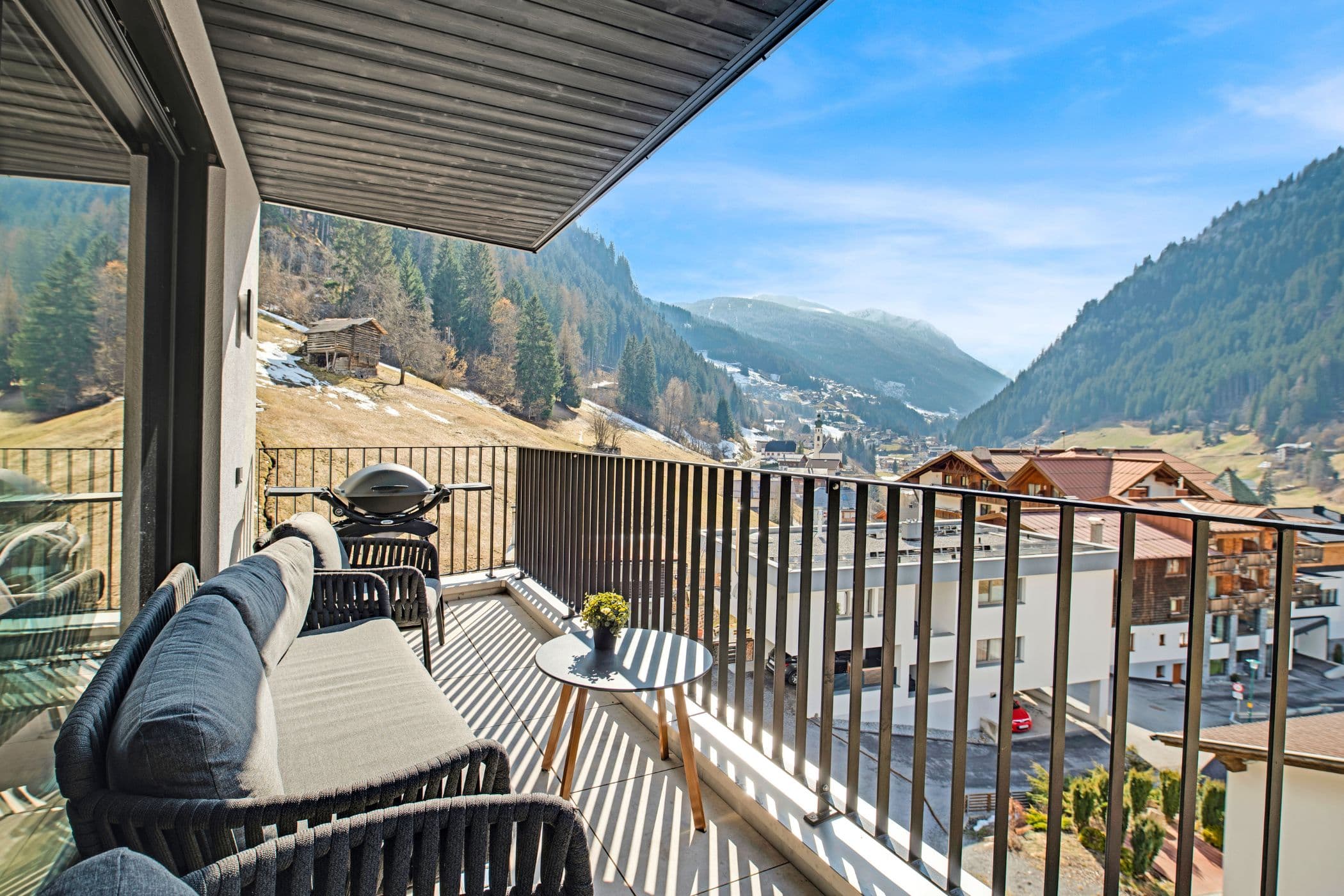
The apartment is a two-bedroom, one-and-a-half-bathroom new-build finished in what the Tyroleans call alpine-chic — pale timber, clean lines, the warmth of the mountains without the chalet-kitsch. Its defining feature is the light. Floor-to-ceiling sliding doors run the length of the open-plan living and dining area and fold back onto a southwest-facing balcony, a sun-trap oriented to hold the afternoon and evening sun and to frame the Silvretta range in full panorama. From the bedrooms and the living room alike, the mountains are not a glimpse between buildings but the entire view — the majestic, glaciated wall that gives the Paznaun its grandeur. A fireplace anchors the living space, the detail that separates a true four-season mountain home from a summer-only one: the reason to come in February as much as in July.
Because it is a new construction, the apartment arrives without the renovation overhang that shadows so much resale Alpine property — no dated wiring, no tired bathrooms, no fit-out project waiting on the far side of completion. It is delivered to a standard a private buyer would otherwise assemble slowly and expensively, and it is professionally managed, which is the feature that appears in none of the photographs and matters most to anyone who has owned a mountain property outright. Between stays, someone else looks after it — the snow-clearing, the maintenance, the readiness on arrival. How that choreography works in practice, from booking your weeks to finding the home cleaned and warm when you walk in, is addressed in our staying in your co-ownership property FAQs.
The Licence That Opens the Door
Return to the paradox in the opening, because resolving it is the whole point of this listing. The reason a foreigner cannot simply buy a flat in See and use it as a holiday home is the Freizeitwohnsitz regime: Tyrol''s zoning law treats a leisure residence as a scarce, quota-limited category, and in the popular valleys the quota is full. What this apartment carries instead is a tourist licence — a touristic dedication that permits the home to be let to alternating guests under professional management rather than registered as a private second home. That single legal distinction is what makes the property available to an international co-owner at all. It is not a workaround; it is the established, lawful channel through which managed Alpine apartments are owned and used in Tyrol, and it is precisely the structure the co-ownership model is built around.
The practical effect for a buyer is liberating rather than limiting. You own a real one-eighth share of the home; you take your 44 to 45 days across the year through the shared calendar; the management company handles the licensing, the lettings framework and the day-to-day, and folds it all into transparent annual accounts. You acquire the use of a Tyrolean mountain home without personally navigating a Grundverkehr file or gambling on a quota that does not exist. For buyers who want to understand how Austria''s ski-property rules actually bite — and why a structured share is so often the cleaner route through them — our guide to buying a ski property in Austria walks through the legal terrain in detail.
Skiing From the Door, and the Silvretta Twenty Minutes Up the Valley
See is the smallest village in the Paznaun, and it keeps its own ski mountain quietly to itself. The See ski area lift is a two-minute drive from the apartment, opening onto roughly 42 kilometres of groomed pistes that locals prize precisely because they are uncrowded — the family mountain, the place you ski on the days you do not feel like queuing. The headline act, though, is twenty minutes up the valley. Ischgl''s Silvretta Arena is one of the great ski circuses of the Alps: 239 kilometres of slopes spanning the border into the duty-free Swiss resort of Samnaun, served by 46 modern lifts and rising to 2,872 metres at the Greitspitz. With ninety per cent of its runs above 2,000 metres and some 1,150 snow machines, the Arena holds a season that runs reliably from late November to early May — a snow guarantee that the lower, sunnier resorts of Europe increasingly cannot match.
Twenty minutes the other way lies St. Anton am Arlberg, the spiritual home of Alpine skiing and the anchor of one of the largest linked ski regions in Austria. To sit between the two — the legendary Arlberg on one side, the snow-sure Silvretta on the other, your own quiet home mountain at the door — is a position very few addresses in the Alps can claim. And after the lifts close, Ischgl supplies the other half of its reputation: the restaurants, the bars and the famously theatrical après-ski are a short drive from a village that itself stays calm, so an owner can choose the evening they want rather than the one the location forces on them.
The Other Half of the Year
The mistake outsiders make about the Paznaun is to read it as a winter address with a dormant summer. The owners who use these valleys know the opposite. When the snow retreats, the Paznaun becomes a landscape of wildflower meadows, glacial streams and high mountain trails, and the Silvretta — its glaciers, its turquoise reservoir lakes, the great Silvretta-Hochalpenstrasse pass that threads the range — turns into one of the most spectacular hiking and cycling theatres in Austria. The southwest balcony that catches the winter sun catches the long northern summer evenings just as well; the fireplace that warms a February night is unlit but the mountains beyond the glass are, if anything, more beautiful in green. This is the practical meaning of a genuine four-season home: not a property you visit once and shutter, but one whose calendar gives back something different in every quarter.
That is also what makes the forty-five-day arithmetic so well suited to a share rather than a whole. With eight families holding the property, the scheduling question is rarely whether to take time outside the school-holiday peaks but which edges of the year to claim: the deep powder weeks of January, a sunlit March when the days lengthen and the pistes soften by afternoon, a week of July walking when the meadows are in flower. The calendar is agreed among the co-owners through the management company, and in practice the preferences of eight households naturally diverge — the skiers gravitating to the cold months, the walkers to the warm, the few who want both quietly assembling a year that touches each. The average owner of a whole second home, by contrast, uses it fewer than a month a year while paying twelve months of standing costs, snow-clearing and worry for the privilege.
The Tyrol Market, in Numbers
Tyrol is Austria''s most expensive region for residential property, with average values running roughly seventy per cent above the national figure and a 2026 median home price of around €520,000 — a number that hides an enormous gap between workaday districts and the luxury resort belt, where Kitzbühel routinely clears €2 million. The engine beneath those prices is geological as much as economic: buildable land is hemmed between the mountains and bound by strict zoning, so supply stays structurally tight no matter how demand moves. In the resort areas specifically, prime chalets and second homes in the orbit of Ischgl, St. Anton and Seefeld have been priced around €2.5 million through 2026 and have seen annual growth of five to eight per cent, driven overwhelmingly by international buyers competing for a fixed, quota-frozen pool of stock.
The transaction framework is worth knowing before any purchase here. Austria levies a real-estate transfer tax (Grunderwerbsteuer) of 3.5 per cent of the purchase price on a standard arm''s-length sale, with a land-registry entry fee of 1.1 per cent on top — one-off costs rather than annual ones, and in a co-ownership structure carried within the share rather than landing on the buyer as an untranslated surprise. The ongoing items — the municipal charges, the buildings insurance, the management and the upkeep that a snow-loaded Alpine roof genuinely needs — are likewise pooled and billed transparently. For a co-owner, the implication is straightforward: a one-eighth share carries proportional exposure to one of Europe''s most supply-constrained mountain markets, without the capital concentration or the administrative drag of owning the whole.
The €169,000 Share, Examined
The headline figure is €169,000 for a one-eighth share. Multiply it out and the implied whole-property value sits a little under €1.35 million — a coherent number for a new-build, two-bedroom apartment with a Silvretta panorama in the lower Paznaun, comfortably below the Kitzbühel and Ischgl-core extremes yet squarely inside Tyrol''s premium band. As with any properly structured co-ownership offering, the share price reflects more than a literal eighth of the bricks: it carries the furnishing and fit-out of a turnkey home, the legal set-up, the touristic licensing that makes the address usable at all, and the operating reserve a managed Alpine building needs to run smoothly through its shared life. The right comparison is not the per-share figure against an appraisal; it is the cost of replicating what the share actually delivers.
To do that outright — to buy a comparable new-build in the valley, fit it out, secure the licence, and run it for a household that will use it perhaps four or five weeks a year — would commit well over a million euros of capital and a five-figure annual carry, before a single day on the snow. The one-eighth owner commits the share price plus a proportional eighth of a professionally managed, transparently billed running cost, in exchange for 44 to 45 days a year of use of a finished, four-season home. Over a five- or seven-year hold the share moves with the underlying Tyrolean market, the appreciation accrues pro rata, and the resale market for well-located shares has, on our partner''s tracked transactions, been broadly stable to firm. It is, in the end, a utilisation argument: the buyer pays for the days they will use, in a place that otherwise turns most foreign buyers away at the valley mouth.
The Newest Listing, in Context
Co-ownership of a Paznaun apartment, like co-ownership of a Ligurian terrace or a Baltic penthouse, is not first of all a financial argument — though the financial argument holds. It is a usage argument, and beneath that a relationship-with-a-place argument. This is the kind of home a buyer would want to know was looked after while they were away, would want to arrive at without a backlog of snow and paperwork, and would want to leave without a checklist. Co-ownership alongside seven other vetted families, is what makes that possible at €169,000 — in a valley that, bought any other way, would most likely not be possible at all. Across a January powder week, a March of long afternoons and a July of flowering meadows, the small choreography accumulates into something that reads less like a holiday and more like a second life, lived between two of the most storied ski mountains in the Alps.
For buyers weighing the Tyrolean Alps, the See apartment is one of several mountain and wider opportunities currently on the books. View the See by Ischgl listing in full, browse the wider Austrian collection to see the range, or speak with our team directly to see the full gallery, the floor plan and the underwriting on this specific property — and to understand whether a share in the Paznaun is the right match for the way you would actually want to use an Alpine home.
More from Co-Ownership Property
Get in Touch
Speak to an expert
Tell us what you're looking for and we'll be in touch.