Properties & Destinations
Stuben: Where Modern Skiing Found Its Feet
A small Arlberg village with an outsized ski legacy — and a live €369,000 penthouse share designed for repeat winter weeks.
In Stuben, the history of skiing is not sealed behind museum glass. It is there in the shape of the village, in the slopes rising immediately behind the roofs and in the bronze figure of Hannes Schneider, the local boy whose teaching helped turn a difficult mode of winter travel into a modern sport.
That legacy gives Stuben something many ski resorts cannot manufacture: a reason to look beyond the piste map. The village is small enough to learn, connected enough to make each return feel expansive, and serious enough about snow that a home here can become part of a family’s winter rhythm rather than an address visited once.
A current co-ownership opportunity makes the idea tangible. COP is introducing a two-bedroom penthouse with a €369,000 asking price for a 1/8 share and a stated minimum of 44 nights a year. The proposition is not simply fewer weeks in an Alpine property. It is a repeated place in one of skiing’s defining landscapes, without buying eight-eighths of a home that may stand empty for much of the year.
The warming room that became a ski village
Long before skiing, Stuben was about crossing the mountains safely. The village’s official history traces its role as a last rest stop before the Arlberg Pass to the 13th century. Its name probably came from a warming room that offered travellers, muleteers and carters protection on the route. In 1218, the Knights of St John established accommodation providing what the local account translates as “fire, water and shelter”.
The arrival of the Arlberg Railway in 1884 reduced the village’s importance to road traffic. Yet the snow that had made the pass difficult created a new future. Early visitors used Stuben as a mountaineering base; winter sport followed. It is a neat reversal: the place that once protected people from the mountain became a place from which to enjoy it.
Hannes Schneider and the art of making turns
Hannes Schneider was born in Stuben in 1890. According to the Stuben tourism office’s account, he became the Arlberg’s first ski instructor at 17 and helped develop the Arlberg style. His method made skiing a sequence that could be taught: control, turn, rhythm and progression, rather than an improvised descent reserved for the unusually brave.
Schneider founded Austria’s first ski school on the Arlberg in 1920. Films carried the technique much further than a lesson on one slope could, while Schneider later taught in Japan and eventually established a ski resort in North Conway in the United States. Stuben’s claim is therefore precise and unusually interesting: it was the birthplace of a teacher whose ideas helped people elsewhere learn how to ski.
For a returning owner, this history changes the texture of the place. A familiar piste is not only a route down the mountain. It belongs to a longer story of technique, access and confidence. Children improving over successive visits are participating in exactly the kind of gradual learning that made Schneider influential.
Small village, 300 kilometres of choice
History would be a thin reason to buy if the skiing were limited. It is not. The official Ski Arlberg summary records 85 cable cars and lifts, more than 300 kilometres of marked ski runs and a further 200 kilometres of deep-snow runs. The Flexenbahn connects towards Lech and Zürs; the Valfagehrbahn provides the route towards St Anton.
That scale makes repeat ownership more convincing. A one-week visitor may feel pressure to chase the famous circuits. An owner can let conditions decide: familiar snow above Stuben on one day, a longer excursion across the interconnected area on another, and a quiet morning at home when visibility closes in. Returning removes the need to complete the mountain.
The numbers also require good judgement. Deep snow is not a promise of safety, and off-piste terrain demands suitable ability, equipment, local advice and attention to avalanche information. A large domain is valuable because it gives owners options, not because every kilometre belongs on every itinerary.
A penthouse organised around the return from snow
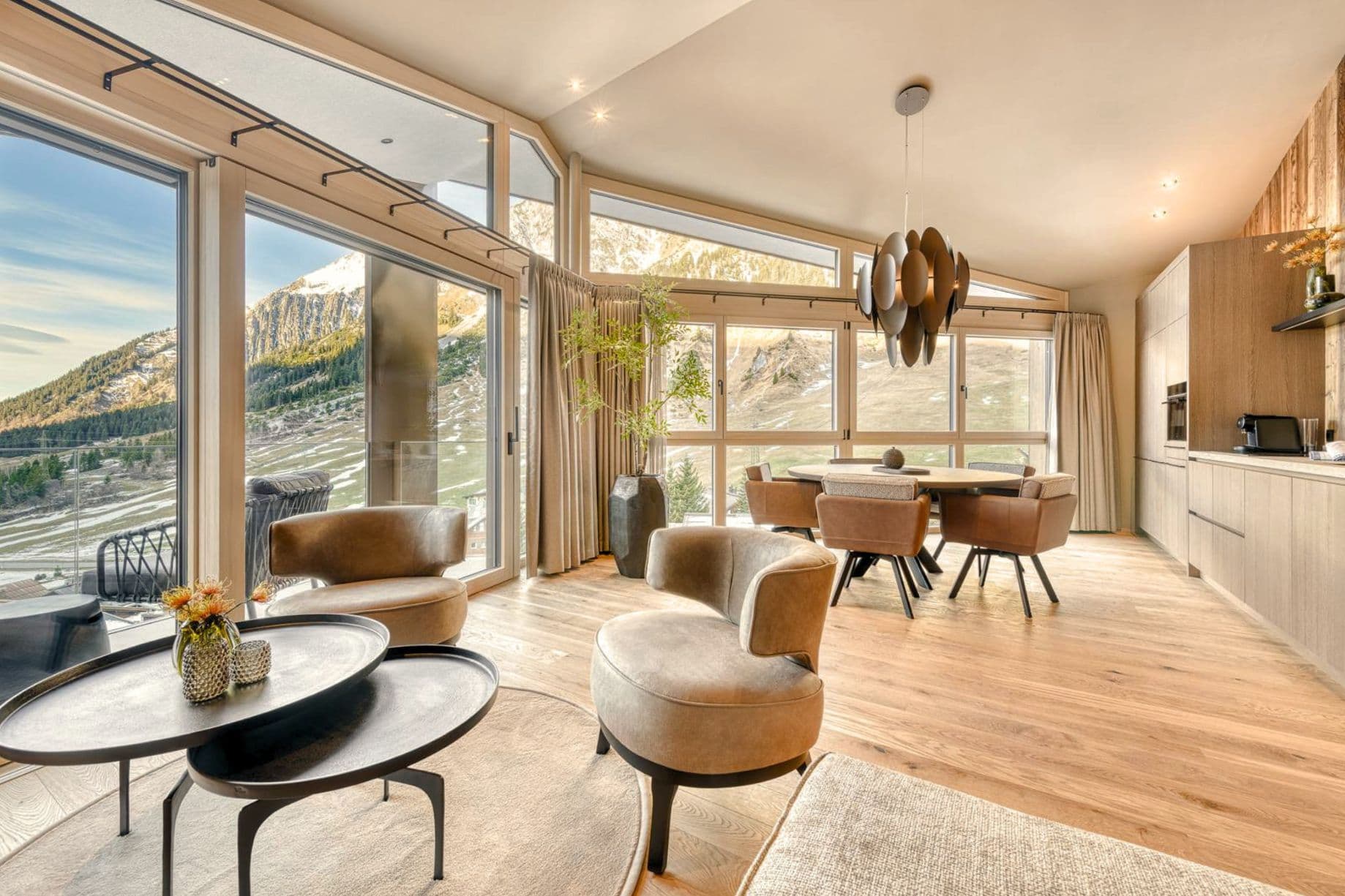
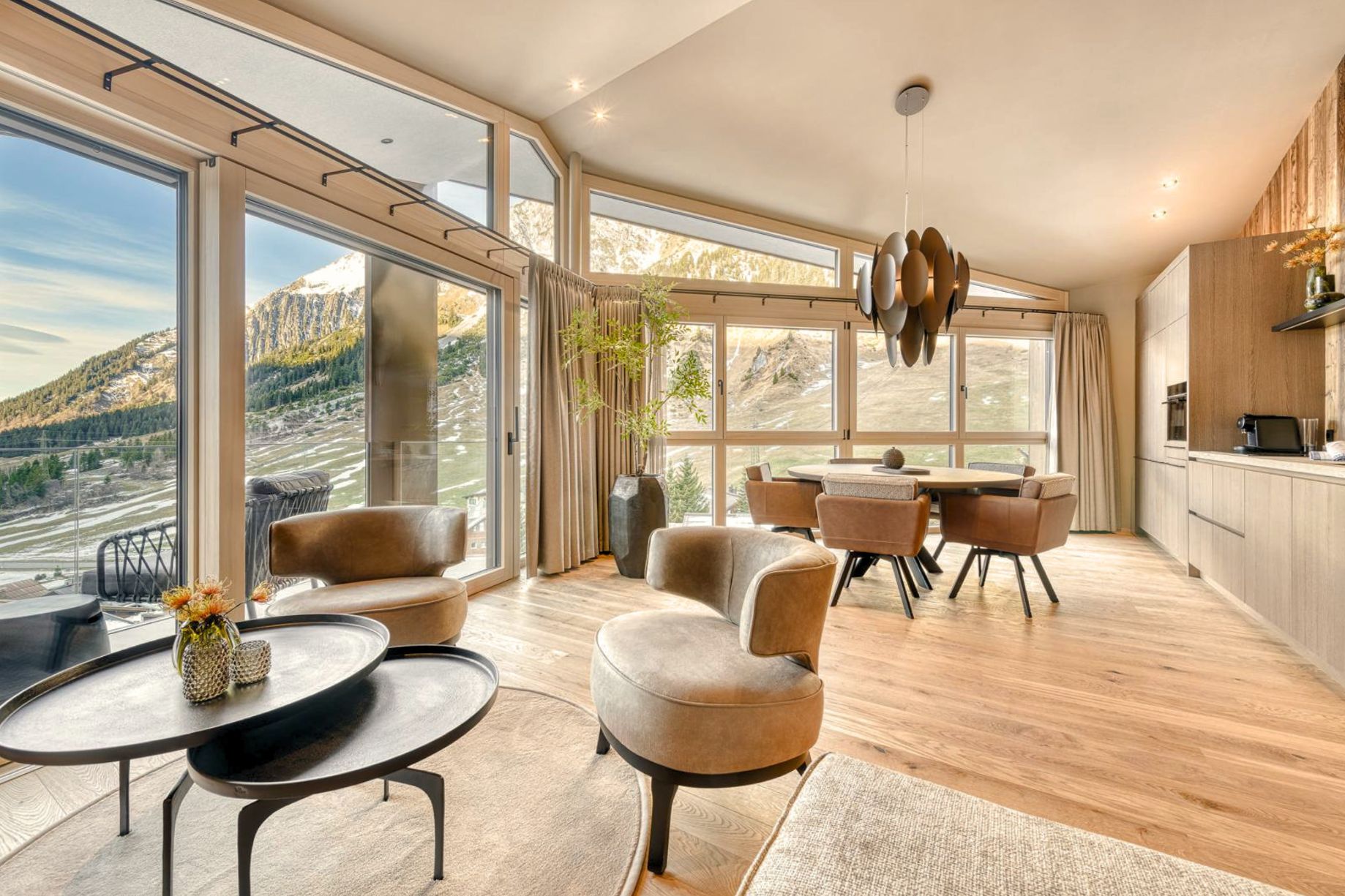
The live Stuben penthouse listing is an asking-price opportunity, not a recorded sale: €369,000 for a 1/8 share. It has 87 m² of living space, two bedrooms, two and a half bathrooms and a south-west-facing balcony. Floor-to-ceiling windows pull the mountain view into an open living and dining room, while an open fireplace and private sauna address the other half of a ski day: coming home.
Two bedrooms keep the footprint focused. This is a home for a couple, a small family or a compact group of friends, rather than a chalet designed around a revolving house party. That can be an advantage in co-ownership: less space to heat, maintain and furnish, with the principal rooms given to daylight and the view. Buyers who regularly travel with several guests should test the sleeping plan honestly rather than treating the living room as an extra bedroom by default.
The public listing describes ski-in/ski-out proximity, not an unconditional doorstep-to-piste guarantee. Snow, route conditions and the exact access point matter. It is worth walking the connection during a viewing and asking how it works early and late in the season, with children, and while carrying equipment.
What the 1/8 share actually says
The property page states a minimum of 44 nights a year and describes the interest as real, deeded property ownership rather than points or a timeshare. It also says running costs are divided between the eight owners and that maintenance, cleaning and scheduling are managed. These are important headline terms, but they are not a substitute for the legal and operating documents.
Before committing, confirm exactly what is registered and what entity, if any, owns the property; how votes work; which costs sit inside the annual budget; and whether a reserve fund covers larger future works. Ask for the historic or forecast running budget in euros, not only the statement that costs are shared. A 1/8 obligation is still an obligation.
The calendar deserves equal attention. Forty-four nights is a meaningful minimum, but it does not by itself explain Christmas, New Year, February school holidays or how longer stays compete with shorter ones. Buyers should review the actual booking rules, advance windows, rotation or priority system, cancellation policy and any allowance for guests or rental. The same applies to resale: the listing says an owner may sell, but the procedure, costs, rights of first refusal and timing should be read in the agreement.
Practical continuity matters too. If skis, boots and winter clothing can remain securely between stays, a short break becomes easier. The availability, dimensions and rules for owner storage should be verified for this home; COP’s guide to what stays between visits provides a useful checklist.
The season after the season
A ski home becomes more resilient as a lifestyle choice when the non-ski weeks have their own appeal. Stuben’s official visitor site points to hiking and biking routes from the village, while the Arlberg summer programme links the five villages of Lech, Zürs, Stuben, St Christoph and St Anton through the Arlberg Trail. The current official page describes a challenging multi-stage route, not a casual promenade; individual sections and lift opening periods should be checked for the dates of a stay.
For co-owners, the quieter calendar can be the hidden value. A south-west balcony, mountain-facing glass and a sauna do not stop making sense when the skis are stored. Walking, reading, cooking and watching weather cross the valley are credible reasons to use nights outside the most contested winter weeks. That flexibility also takes pressure off the booking system.
The ownership test for Stuben
Stuben suits buyers who value access over spectacle in the village itself, and who like the idea of recognising a place over time. Its scale may feel restful to one household and too quiet to another. The two-bedroom plan rewards a clear view of who will actually travel. The 44-night minimum is attractive only if the rules can produce the weeks you are likely to use.
The best viewing therefore has two parts. Inspect the property in daylight: windows, balcony, storage, access and the route to snow. Then read the ownership documents with equal attention: title structure, calendar, annual budget, management, repairs and exit. Co-ownership works when the home and the system both fit.
If they do, this is a compelling combination. Stuben offers the intimacy of a small mountain village, the reach of Austria’s largest interconnected ski area and a history that rewards curiosity. A share makes that story available in repeat chapters rather than a single, hurried week.
Frequently asked questions
What does €369,000 buy?
It is the current asking price for a 1/8 interest in the two-bedroom Stuben penthouse, not the advertised value of the entire property and not evidence of a completed transaction. Buyers should confirm acquisition costs, ongoing charges and the precise legal structure before purchase.
How much annual use comes with the share?
The live listing states a minimum of 44 nights a year. Exact dates, peak-season access, booking windows, guest use, cancellations and any rental rights depend on the property’s calendar rules and ownership agreement.
Is this a timeshare?
The public property page describes real, deeded ownership of a 1/8 interest, rather than points or a contractual right to occupy. The exact title or owning-entity arrangement should be verified in the transaction documents for this home.
Can you ski directly from the building?
The listing says “ski-in/ski-out proximity”. Treat that as a prompt to verify the precise route, walking distance and dependence on snow conditions. Access can feel very different with children or equipment.
Is Stuben useful outside winter?
Yes. Official local sources describe hiking and biking from the village, and Stuben lies on the multi-stage Arlberg Trail. Lift dates, trail conditions and difficulty vary, so plan against current information rather than assuming winter infrastructure operates year-round.
Sources and data notes
Property price, share, annual nights, dimensions and amenities were checked on the live COP listing on 27 September 2026. Destination facts come from the official Stuben tourism office pages on village history, Hannes Schneider and Ski Arlberg, plus the official Ski Arlberg summer page. Piste, lift and trail information can change with season and conditions.
Could Stuben become your place in the Arlberg?
Explore the live penthouse share, browse co-ownership homes in Austria, or read how co-ownership works. COP can introduce the opportunity and help you identify the questions to put to the seller and operator.
Plus de Co-Ownership Property

Nous contacter
Parlez à un expert
Dites-nous ce que vous recherchez et un de nos spécialistes en copropriété vous contactera sous 24 heures.