Baqueira · Val d'Aran · Spain
Fractional Ownership & Co-Ownership in Baqueira
From a ski-in apartment at the foot of the Baqueira-Beret gondola to a stone duplex in Bagergue, one of the highest villages in Spain — co-ownership in Val d'Aran means a share of a fully managed ski home, around six weeks a year, from €120,000.
12 properties · from €120,000
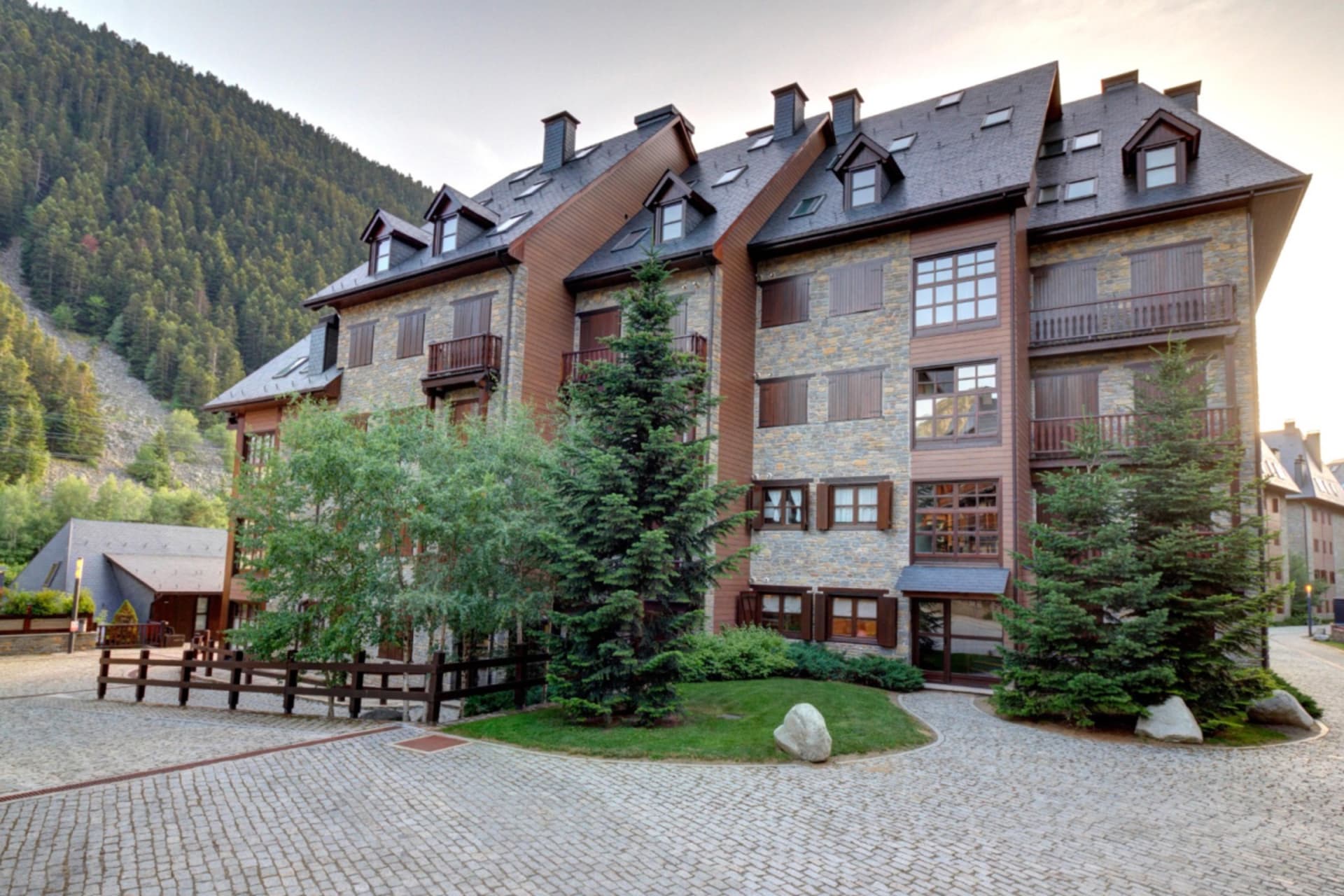
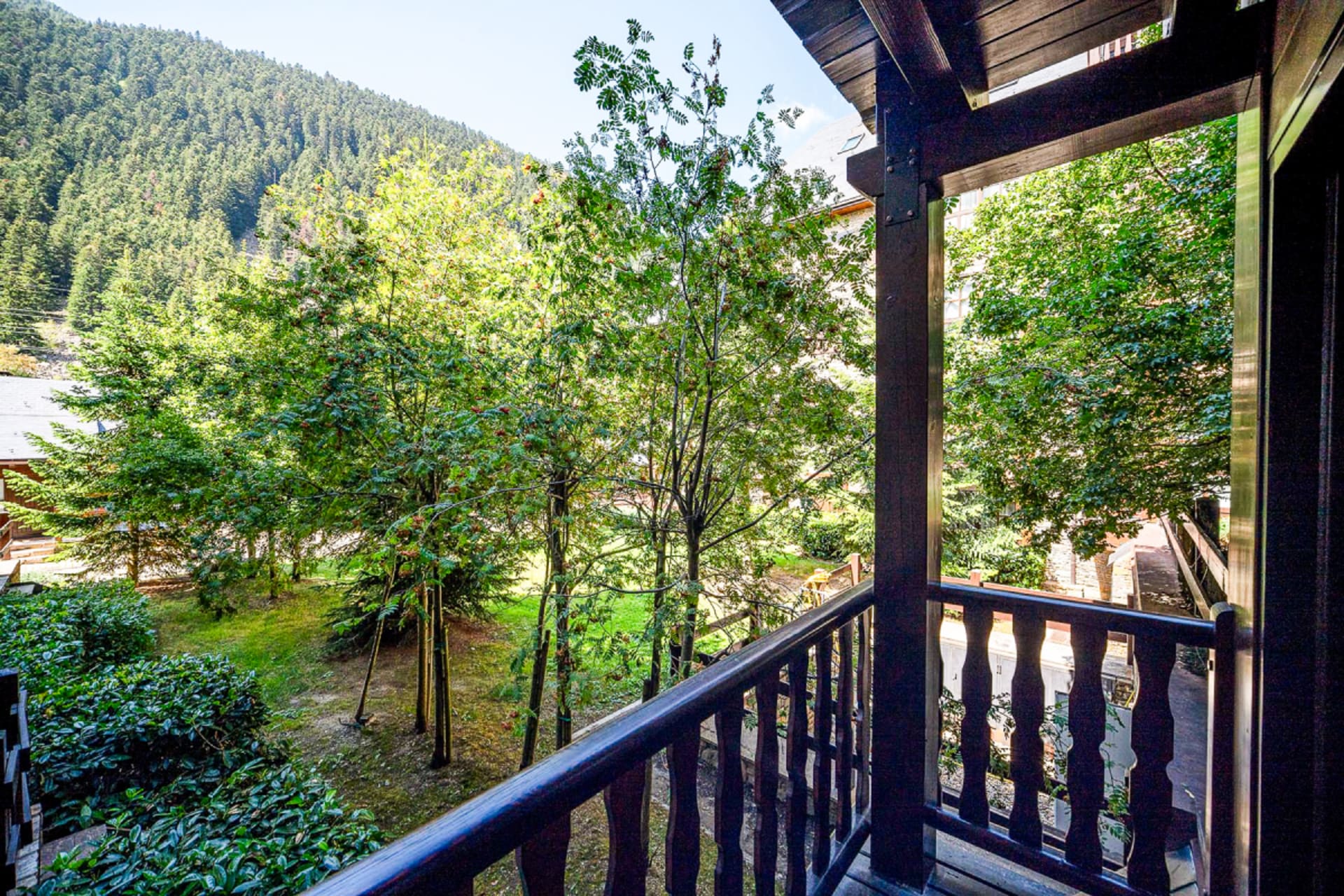
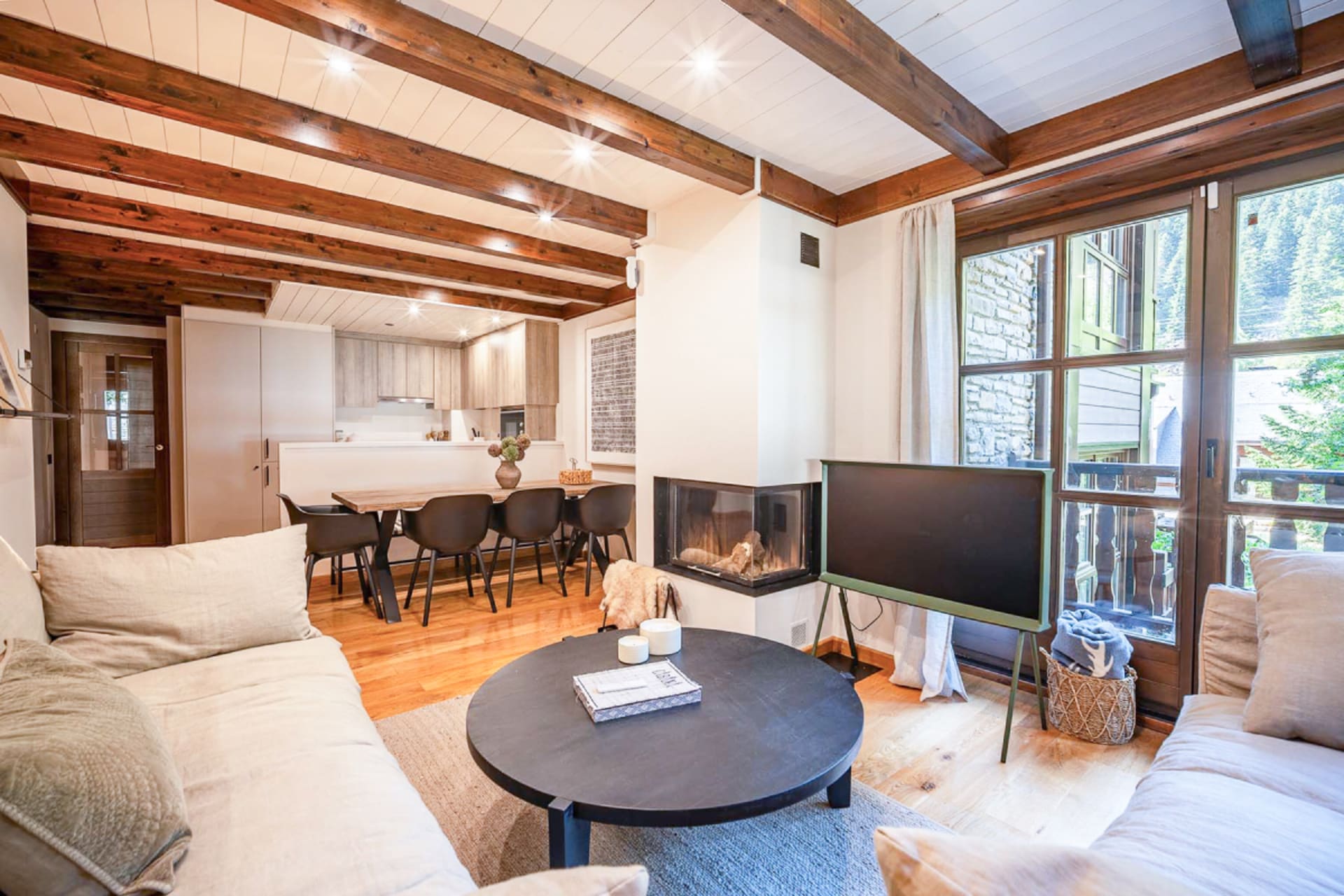
Baqueira, Val d'Aran, Spain — 3-Bed Apartment Steps From Baqueira-Beret With Covered Parking
€185,000
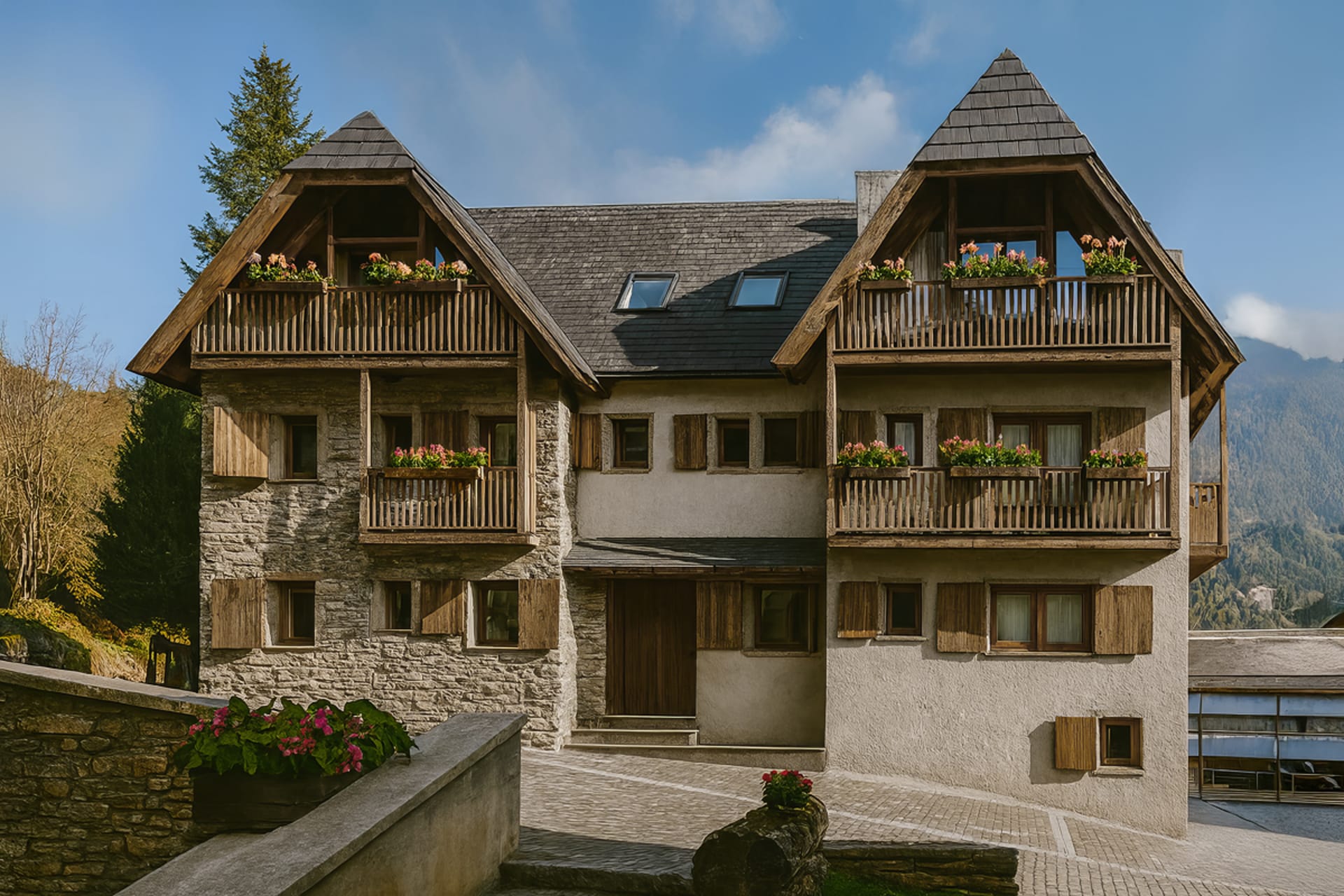
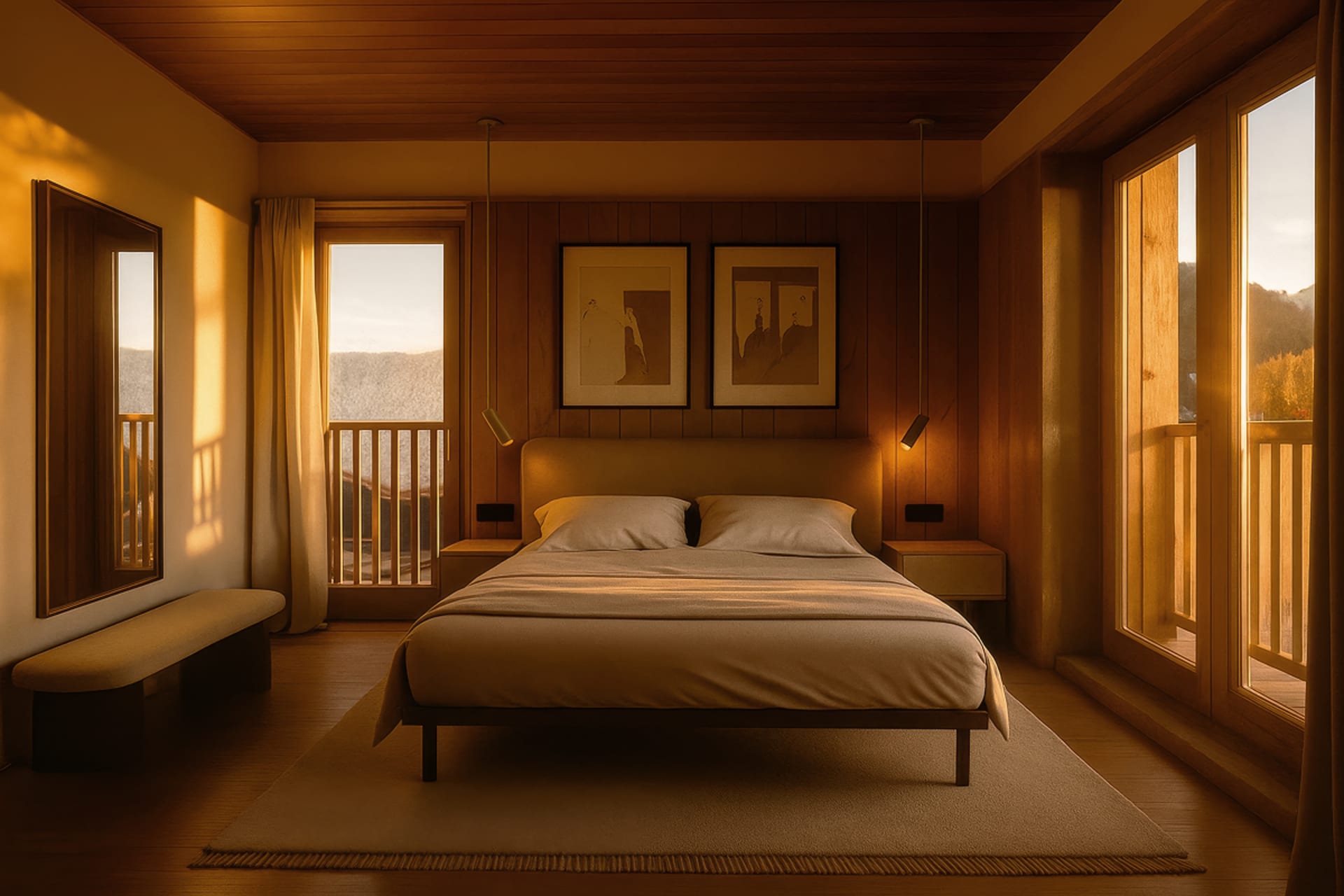
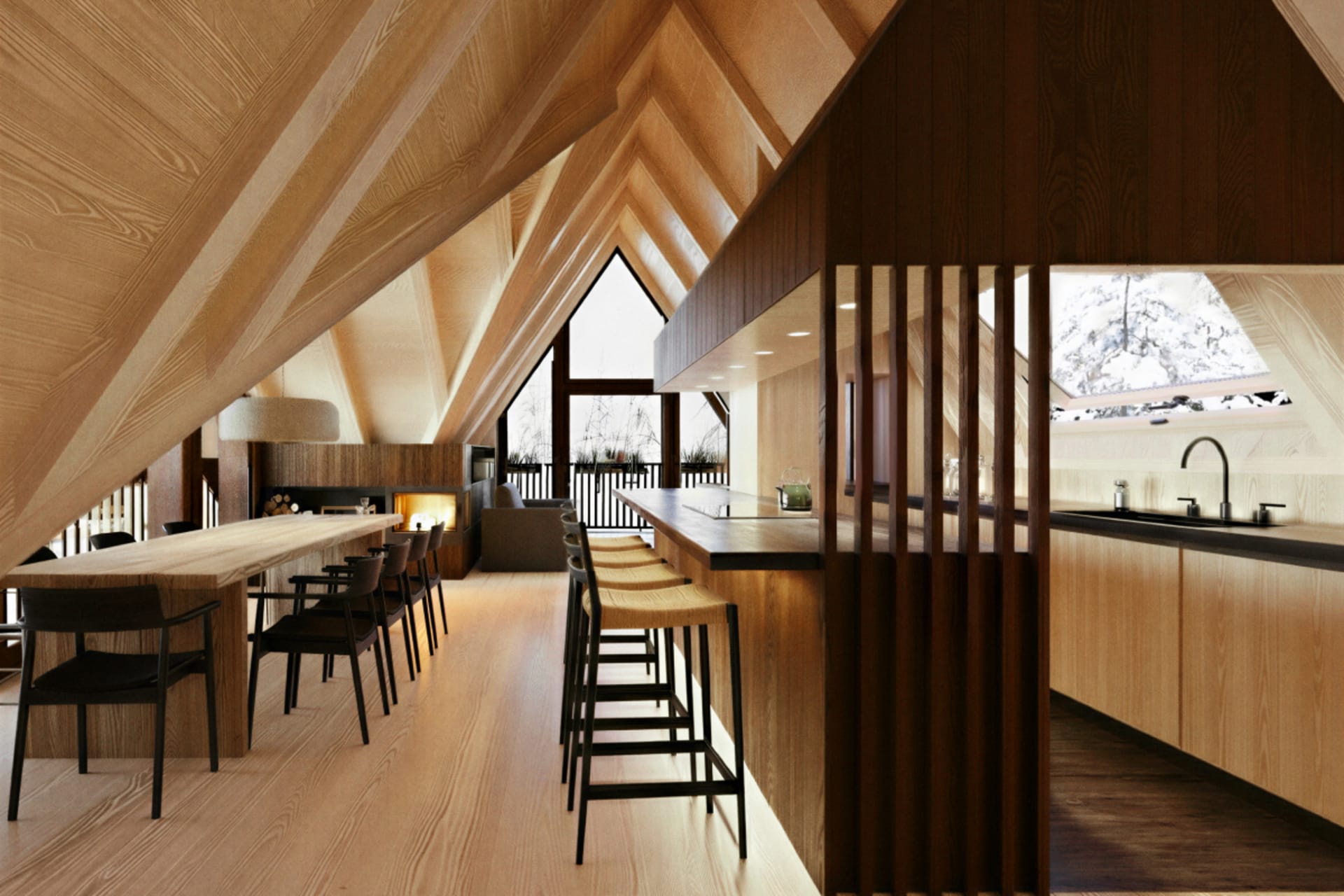
Baqueira, Val d'Aran, Spain — 4-Bed Chalet With Fireplace, Steps From Baqueira-Beret
€195,000
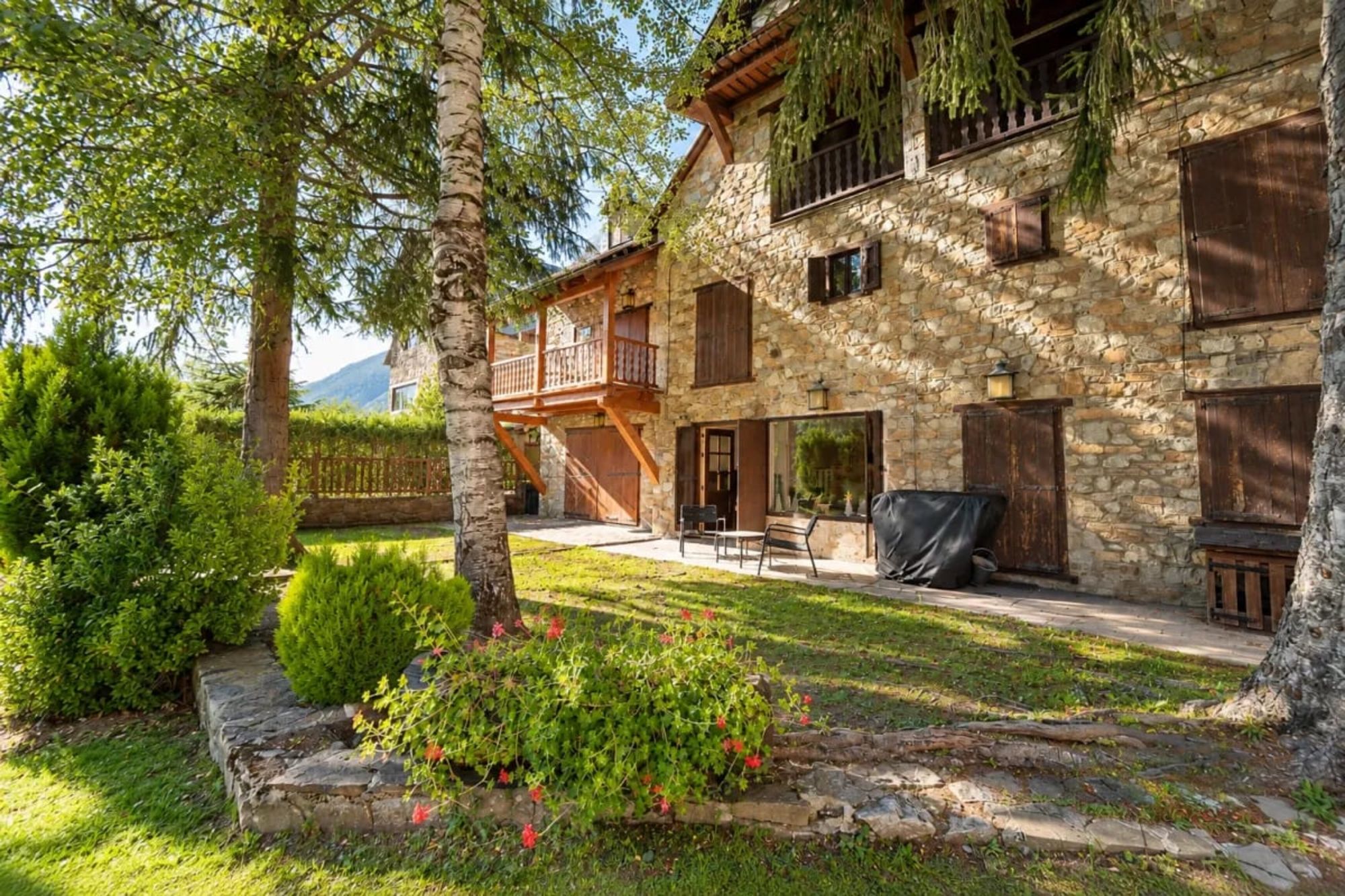
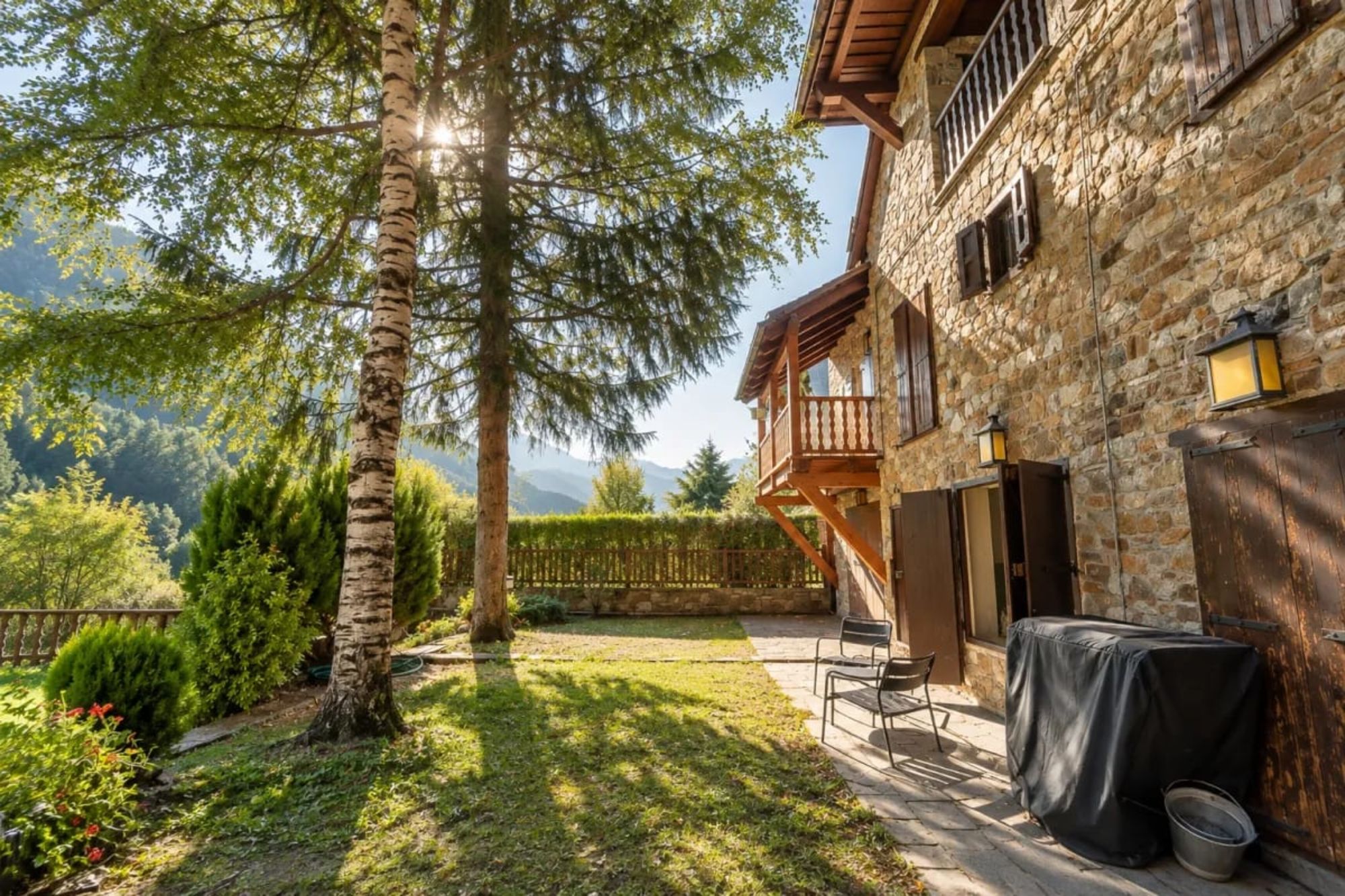
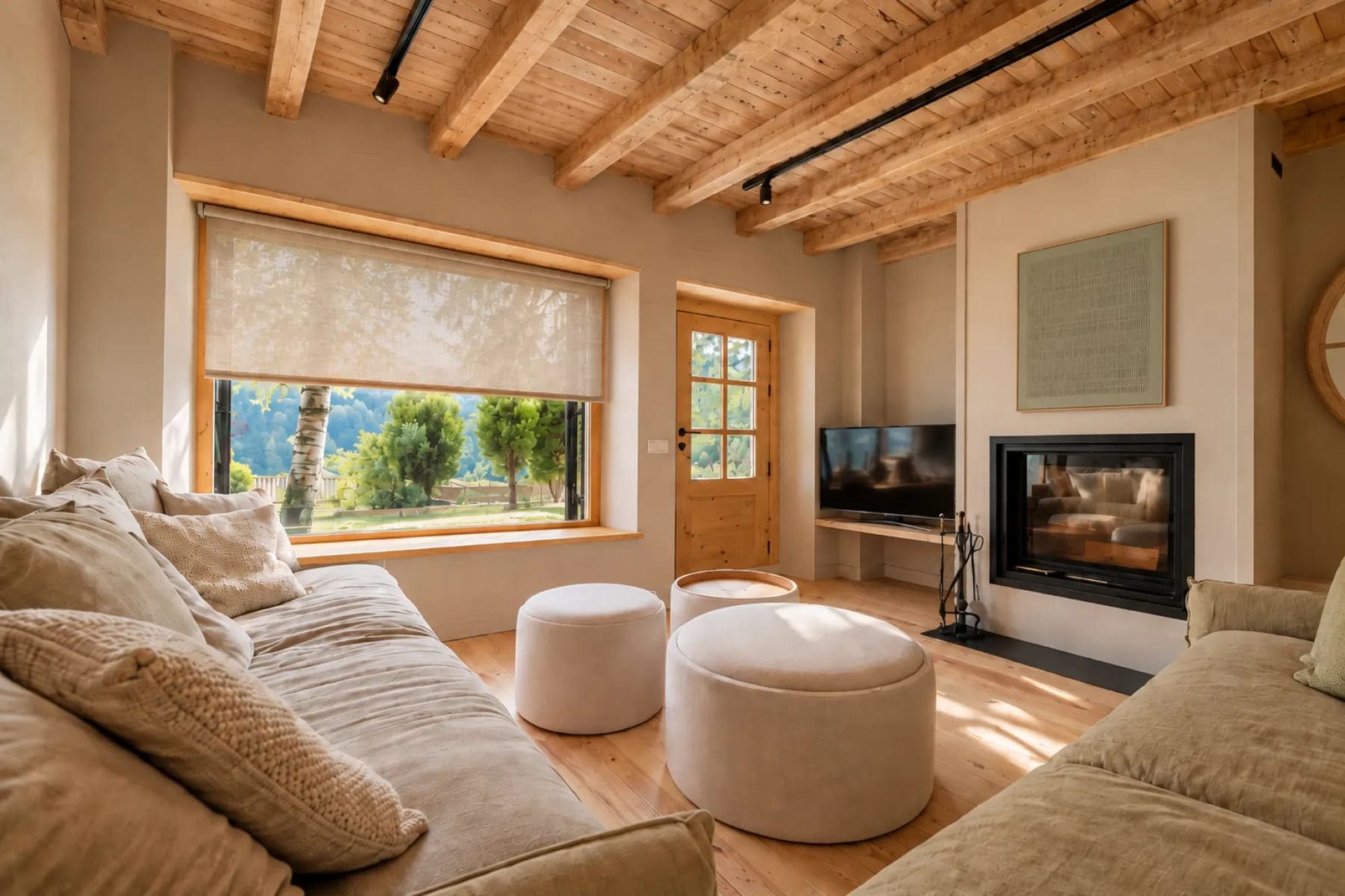
Garòs, Val d'Aran, Spain — 4-Bed Mountain House With Garden & Fireplace
€175,000
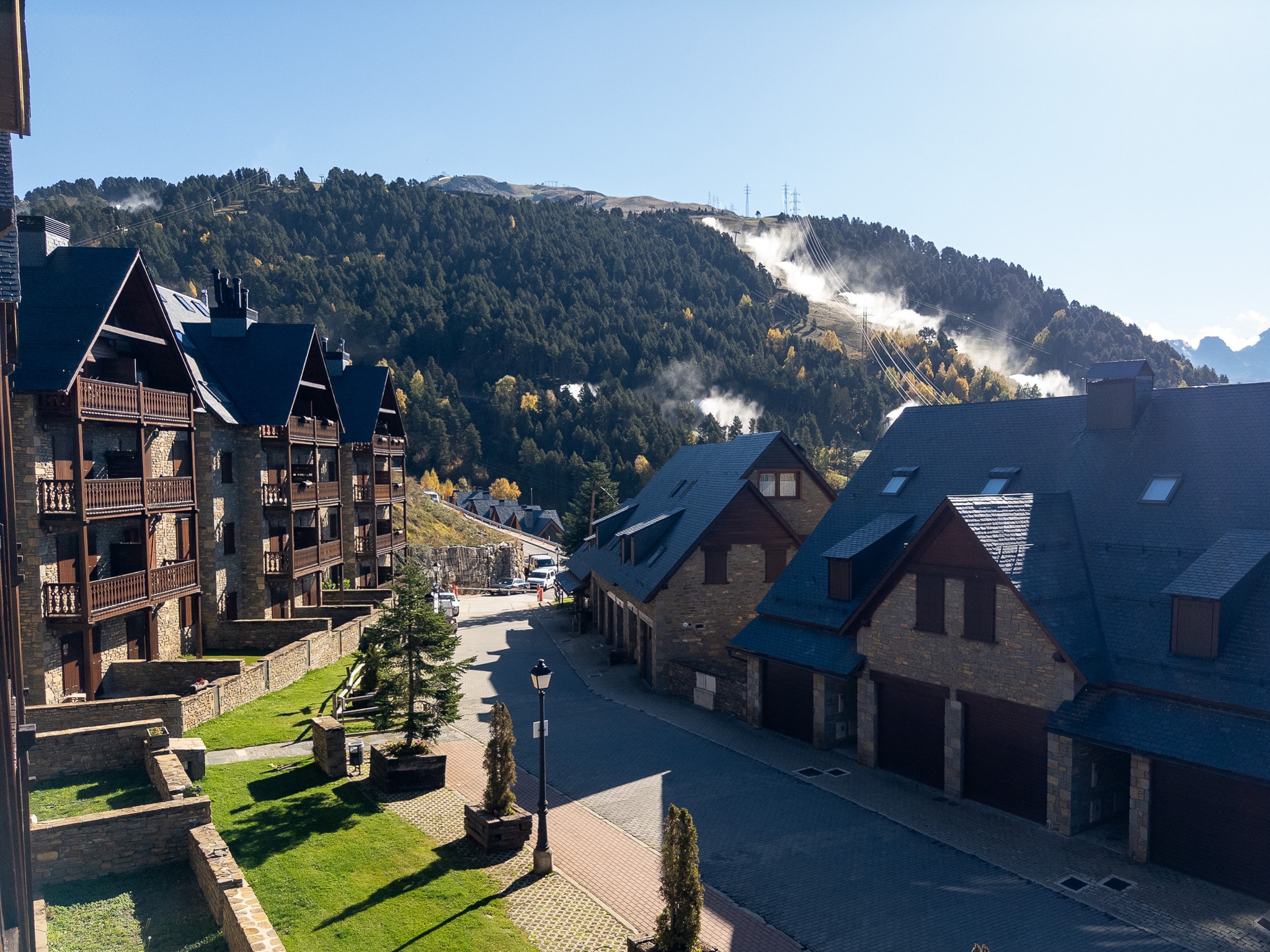
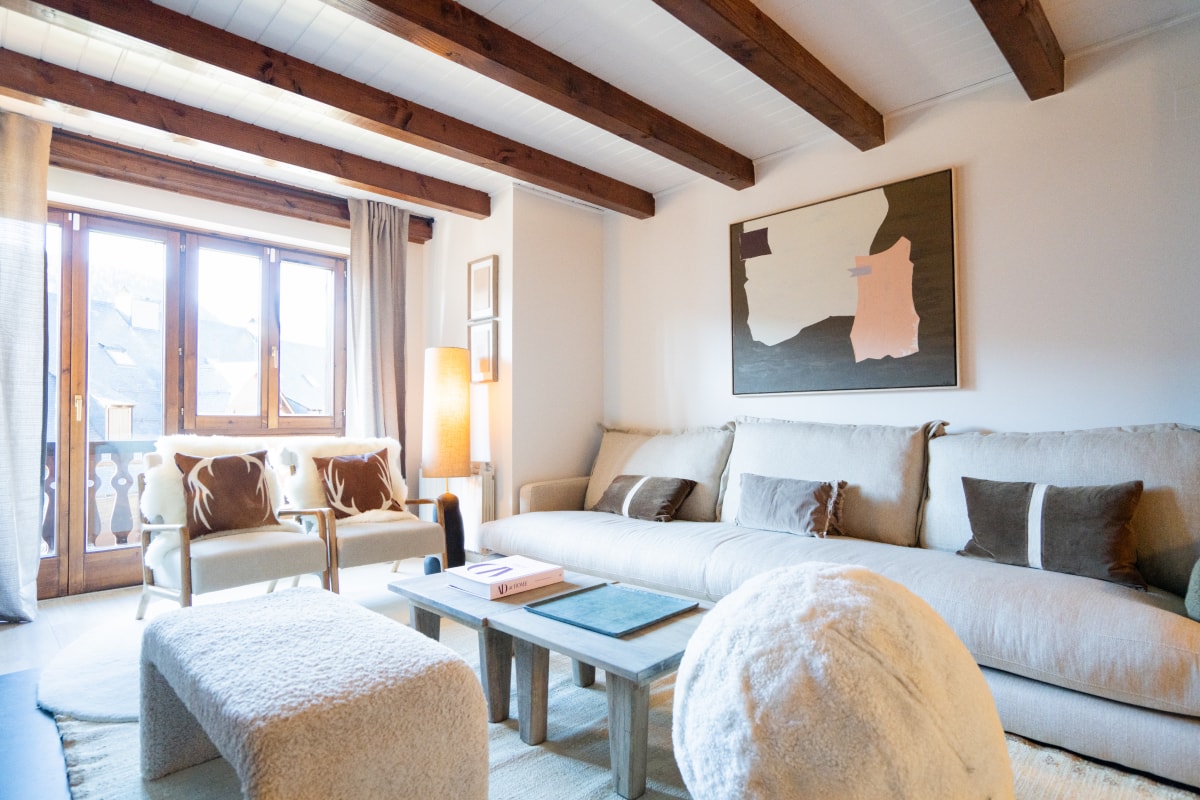
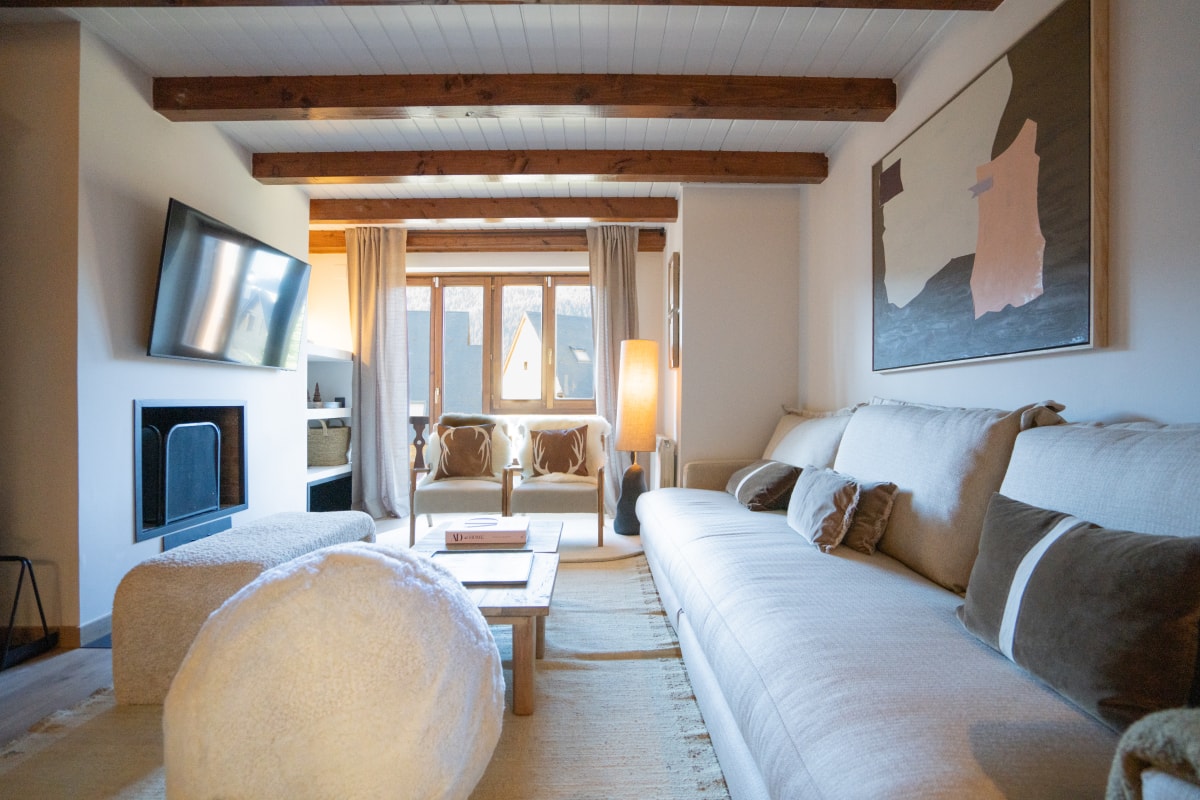
Baqueira, Spain — 3-Bed Apartment With Terrace
€140,000
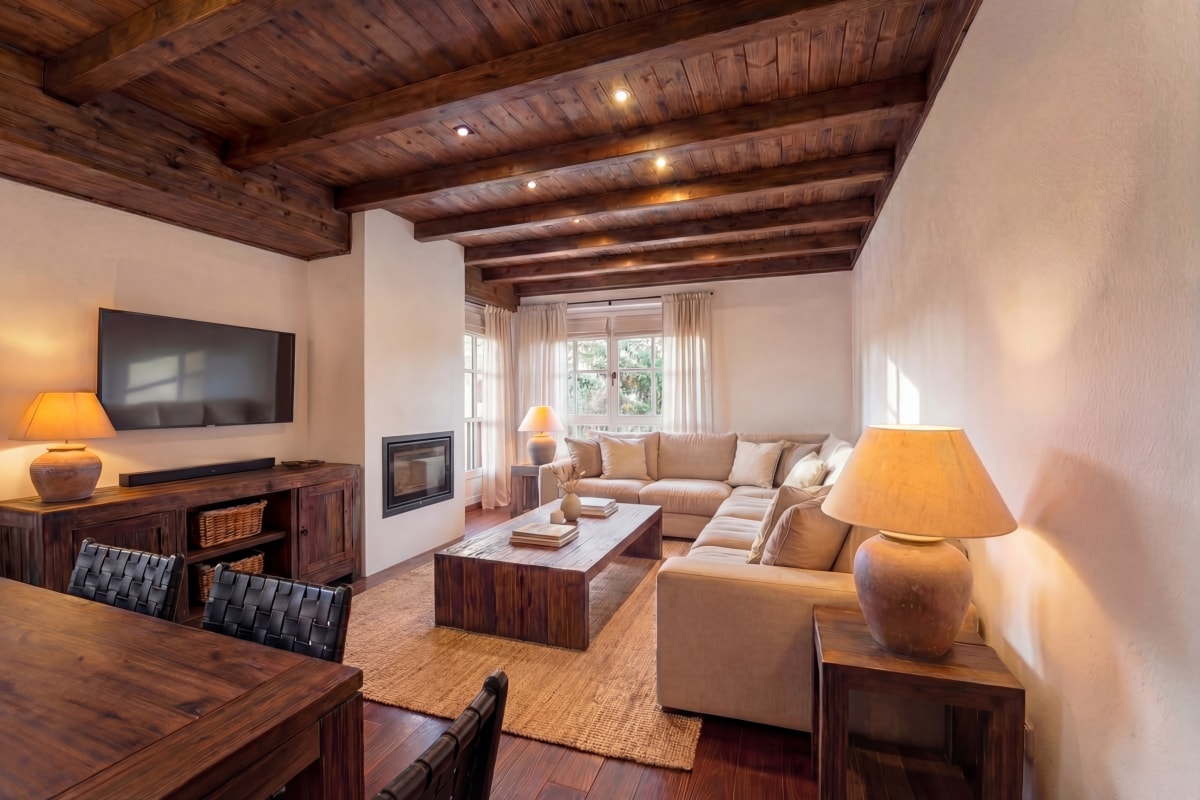
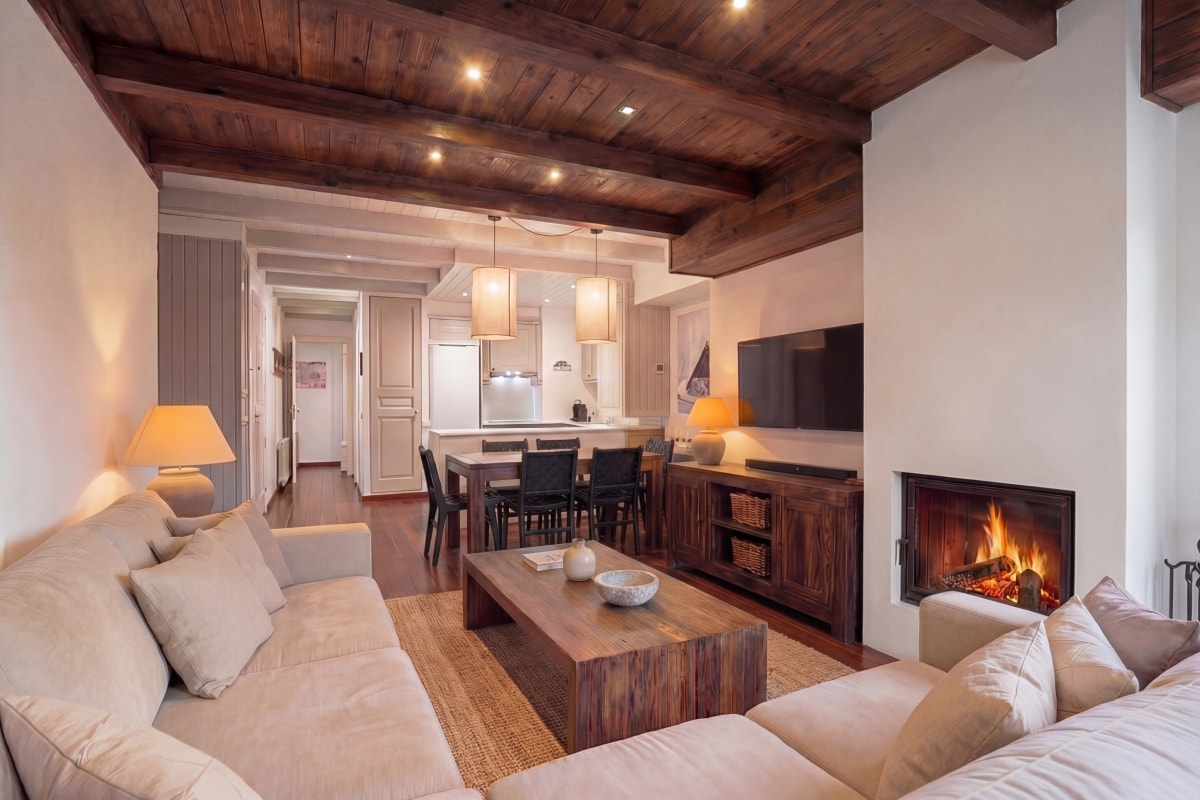
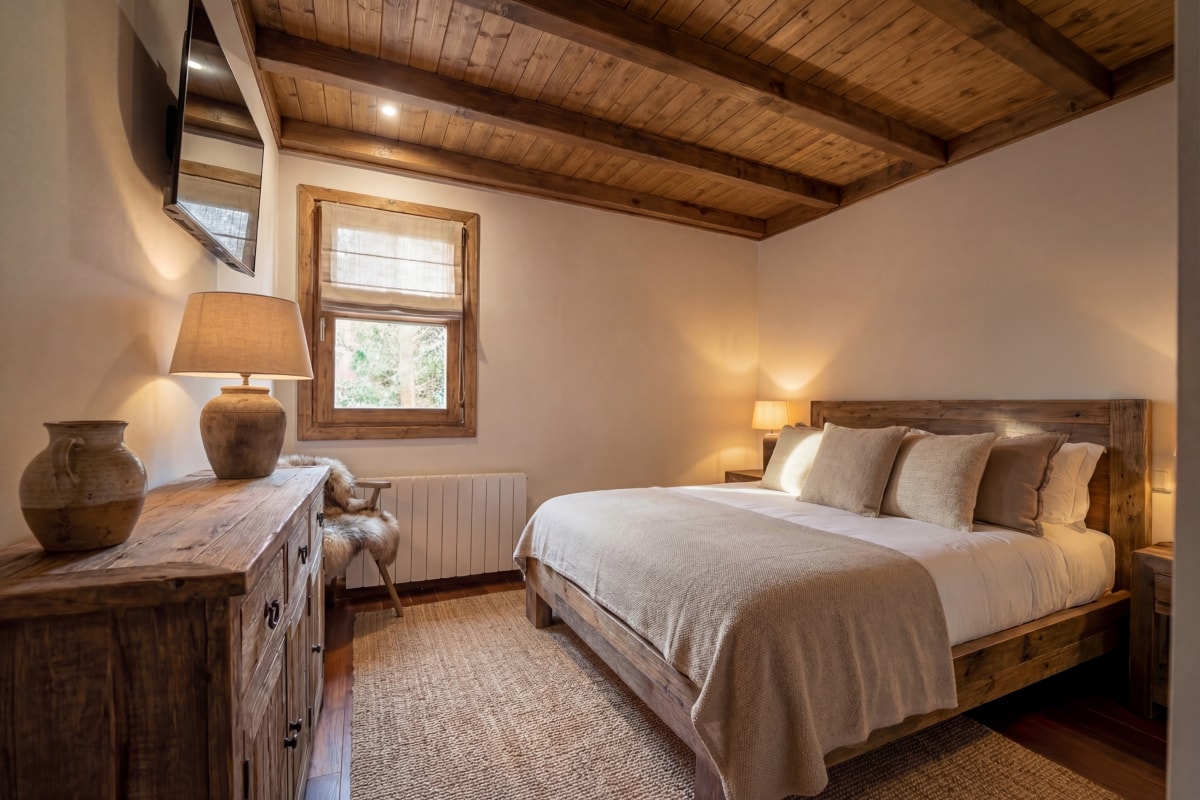
Baqueira, Spain — 3-Bed Apartment Ski-in/Ski-out
€185,000
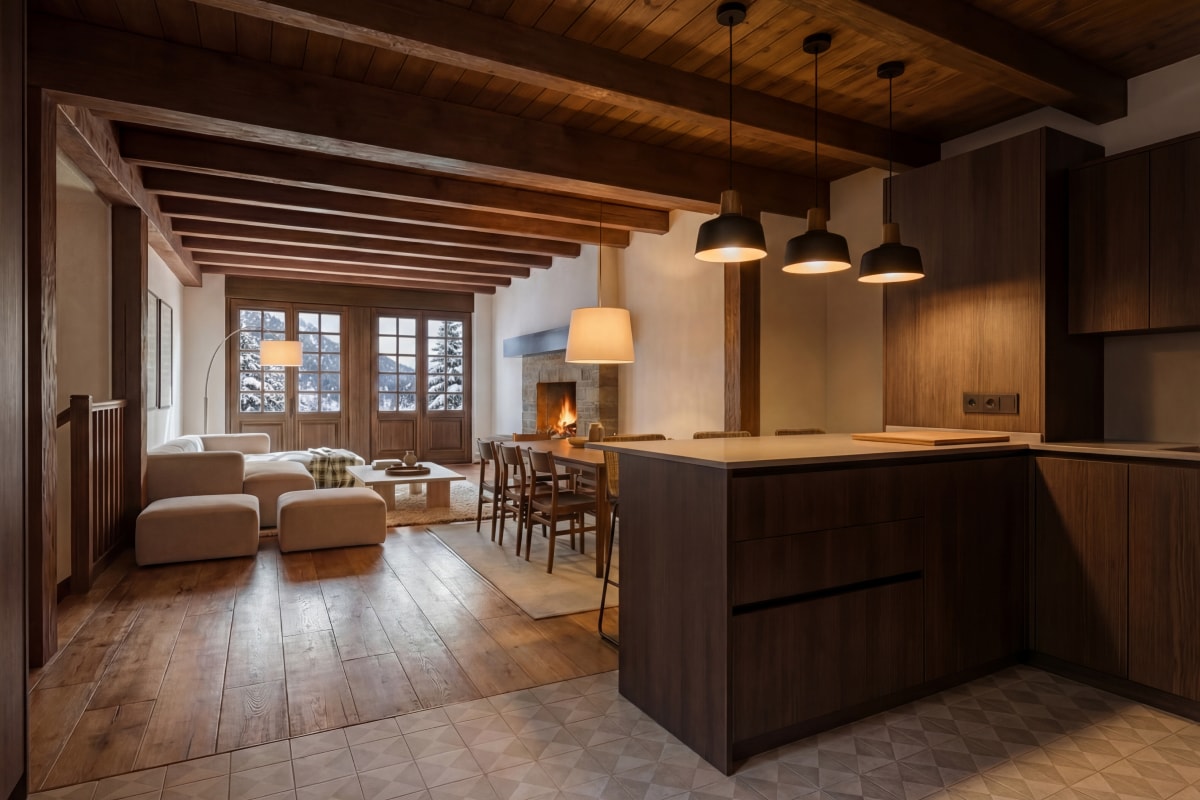
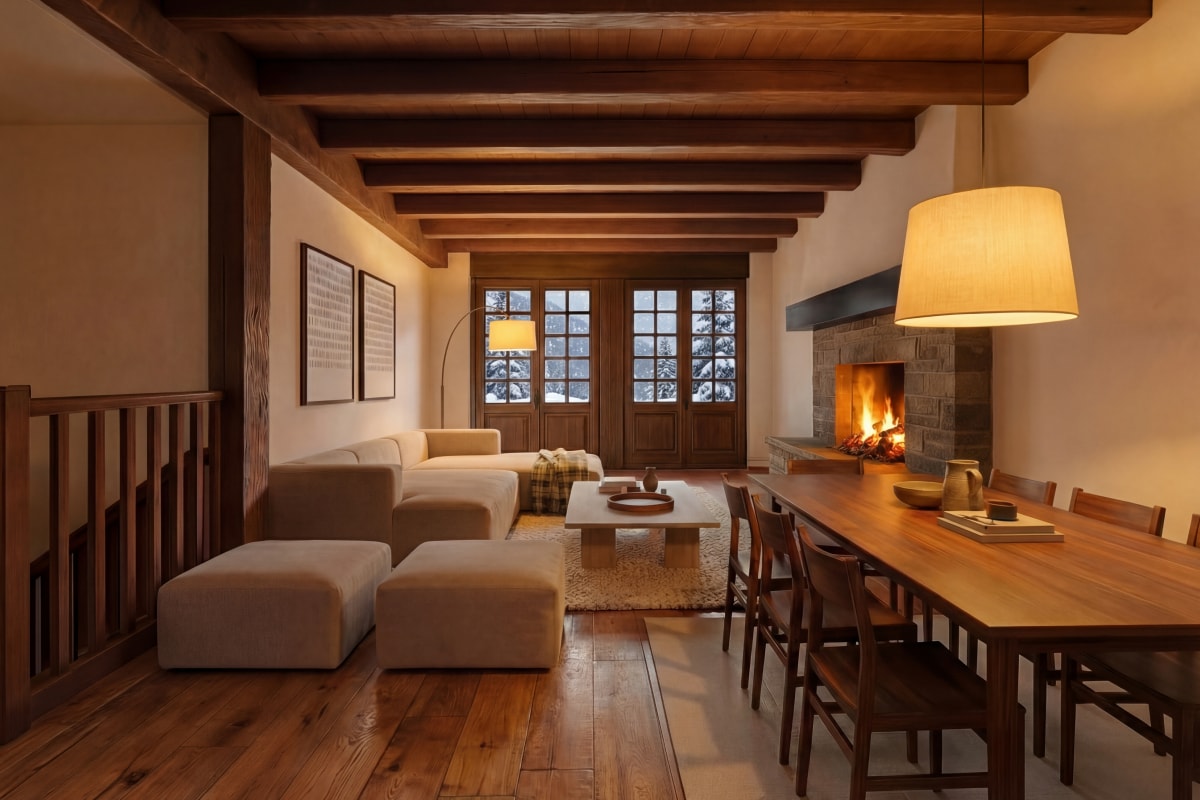
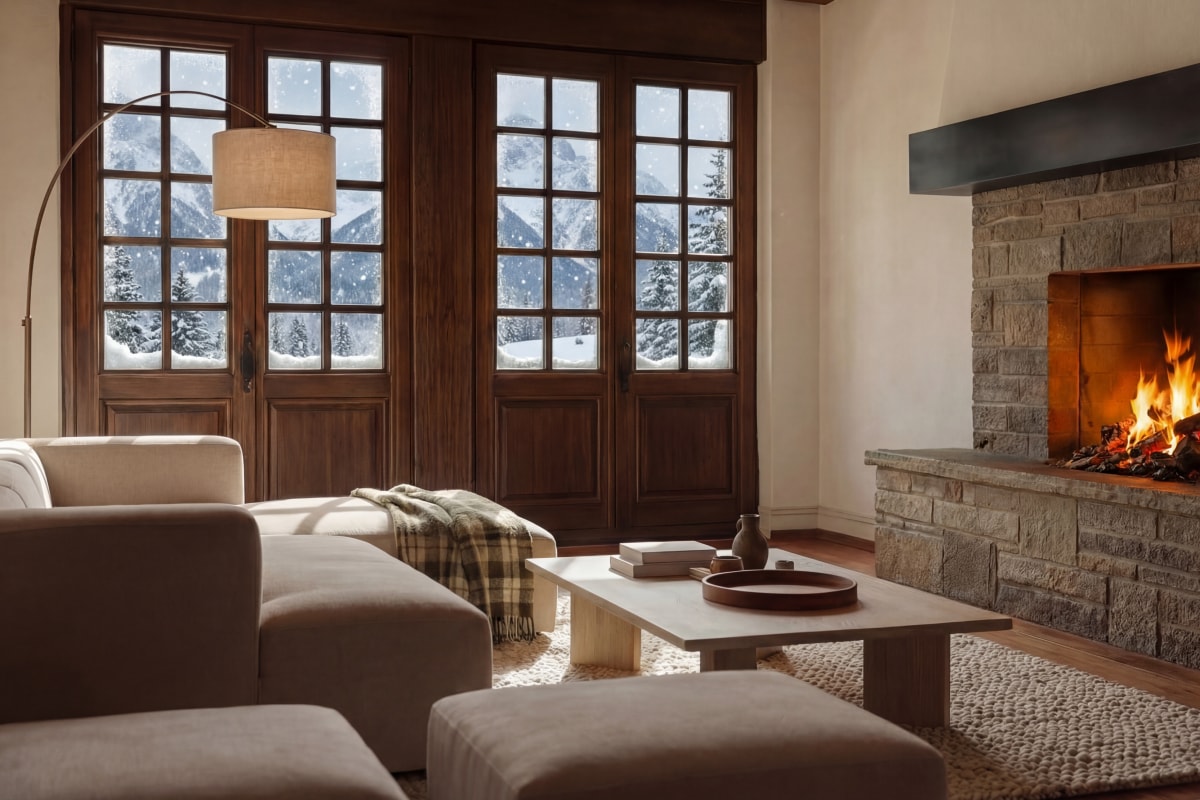
Baqueira, Spain — 4-Bed Chalet With Fireplace
€180,000
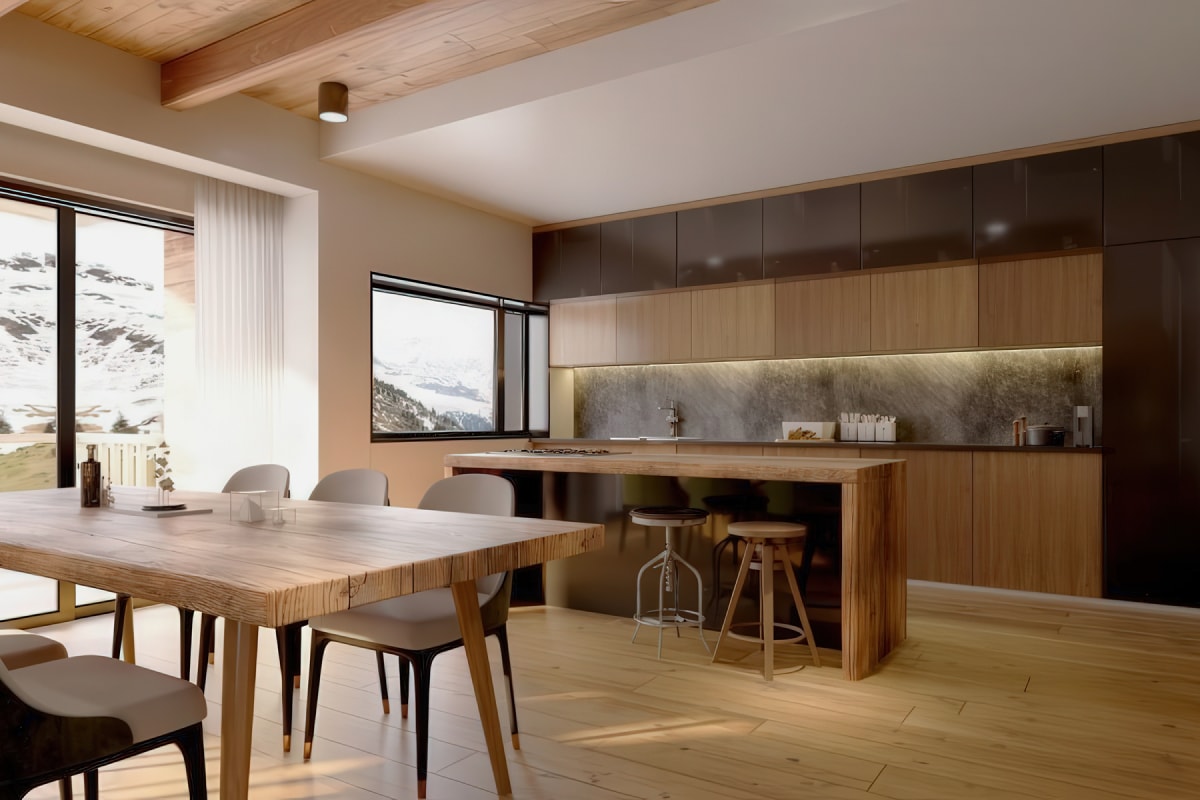
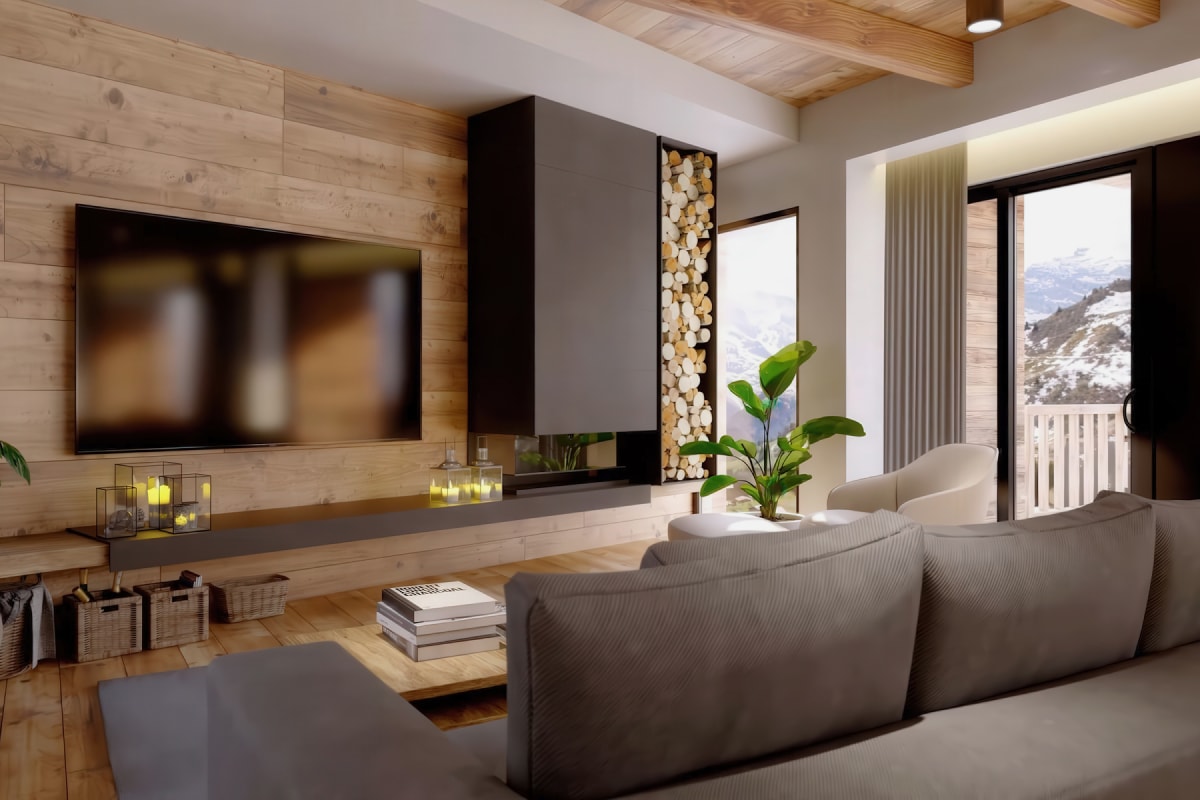
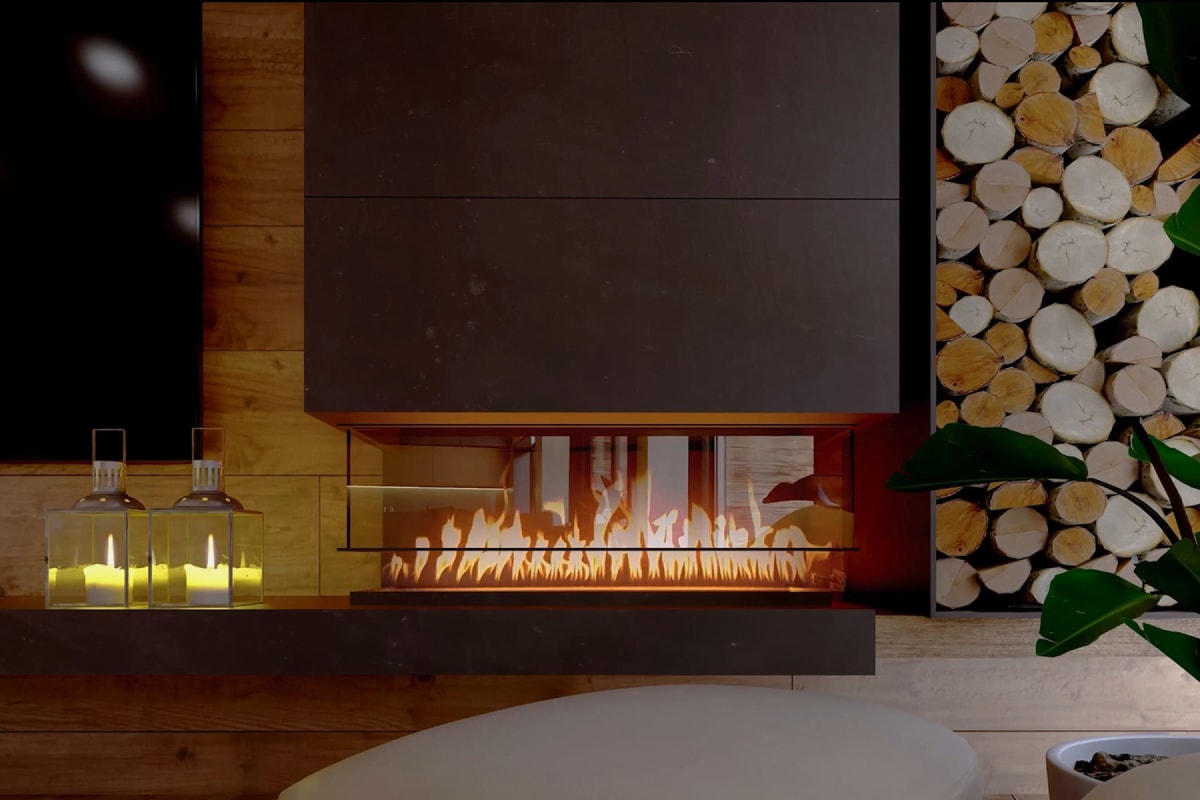
Baqueira, Spain — 3-Bed Chalet With Pool
€125,000
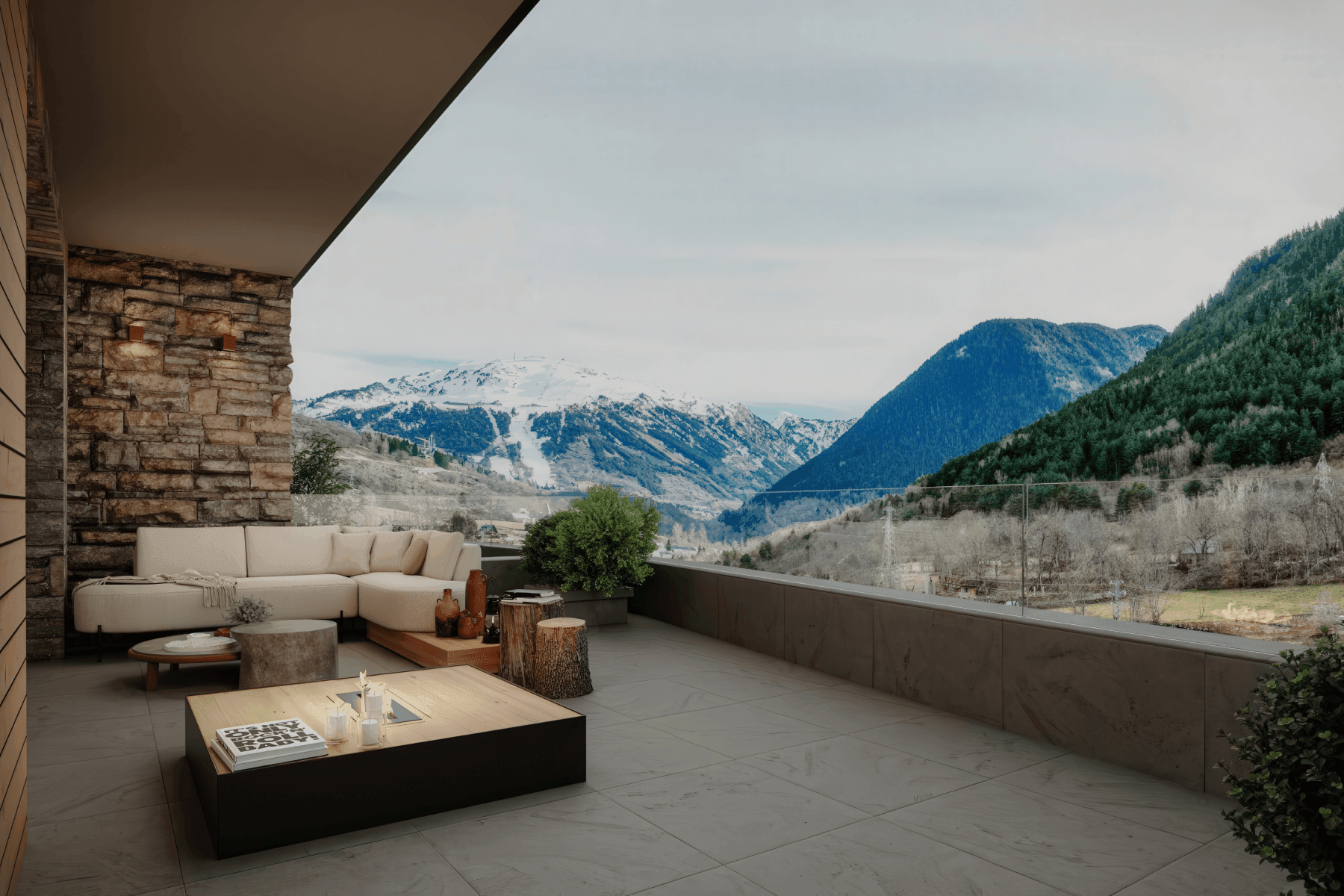
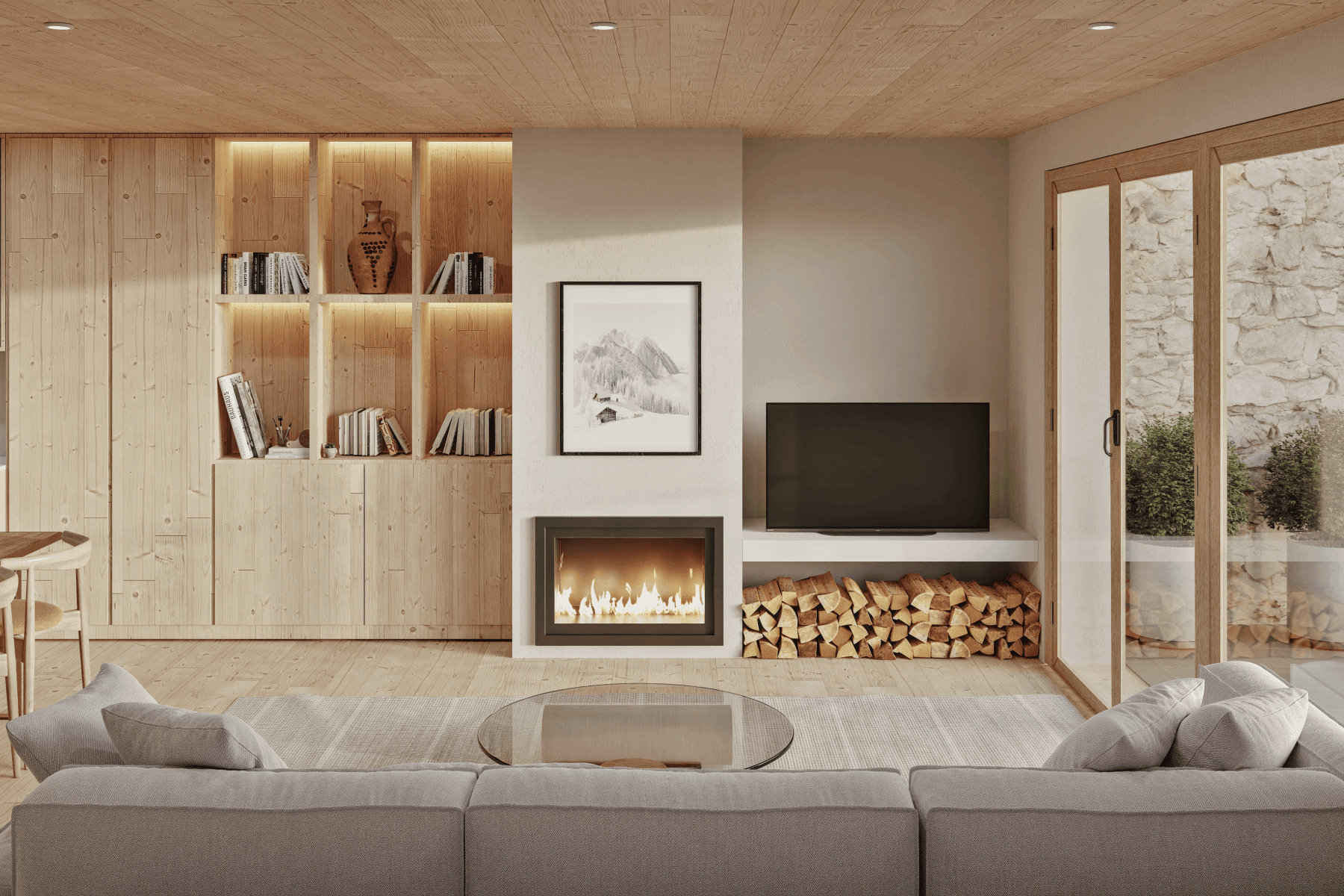
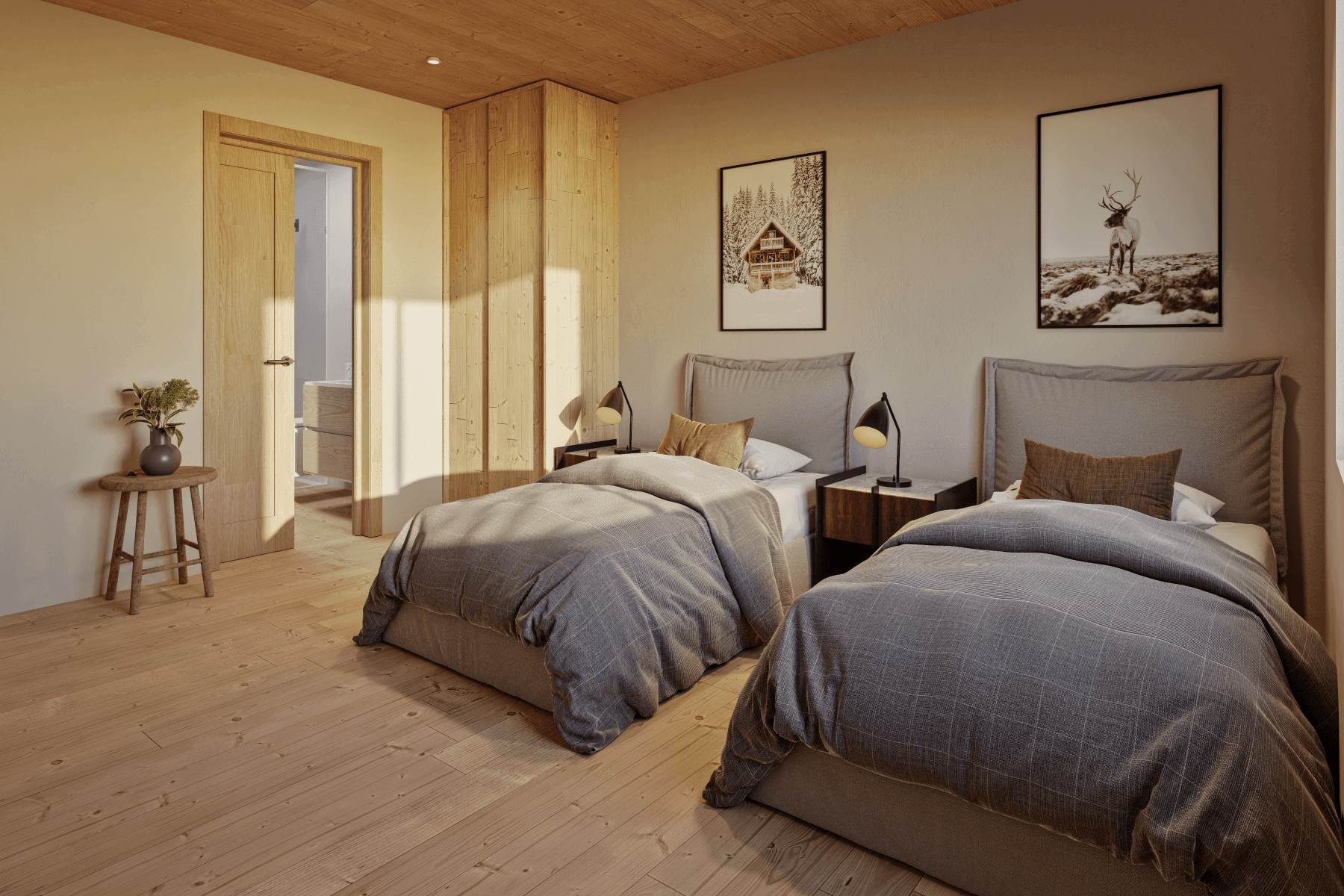
Baqueira, Spain — 3-Bed Chalet With Fireplace
€150,000
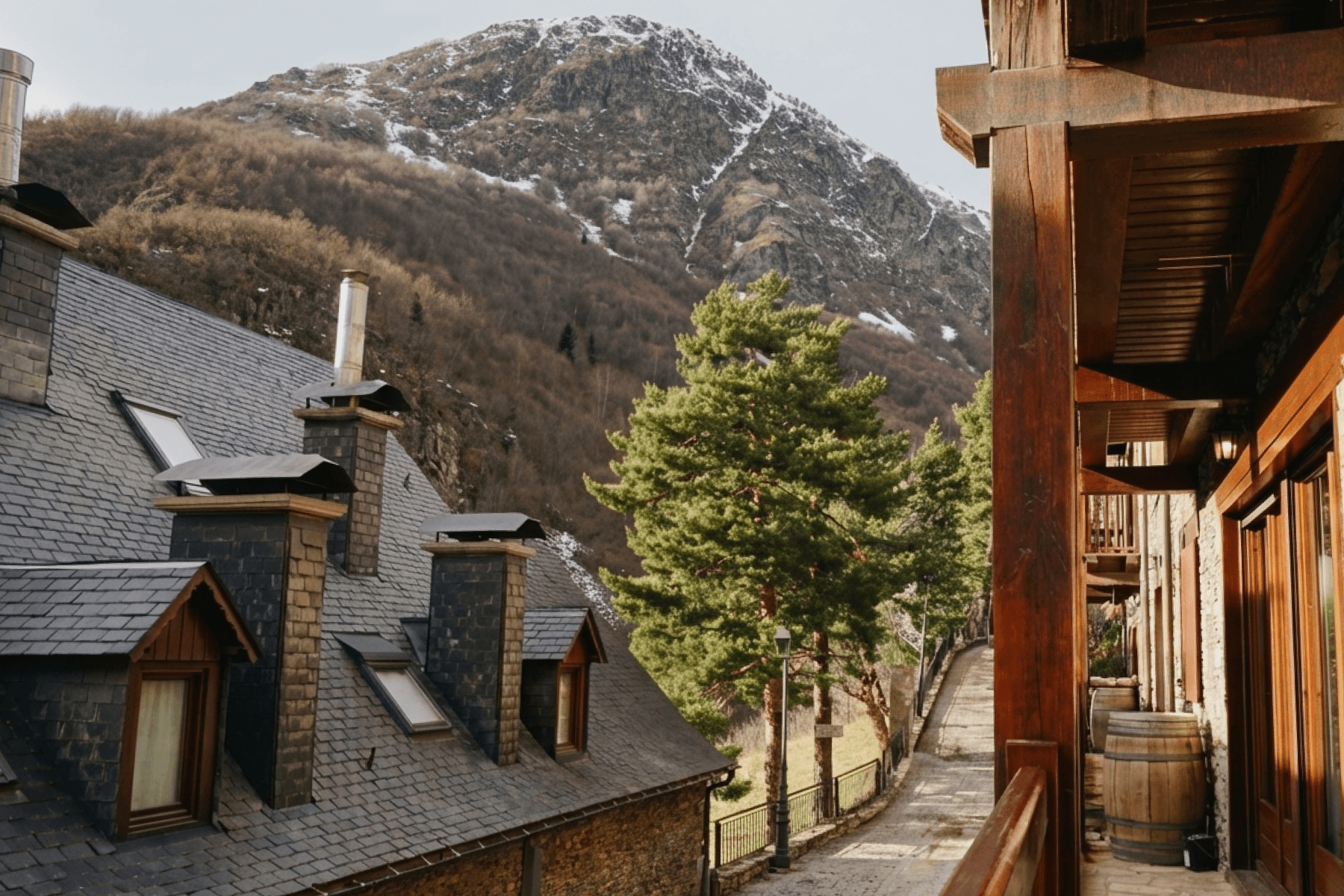
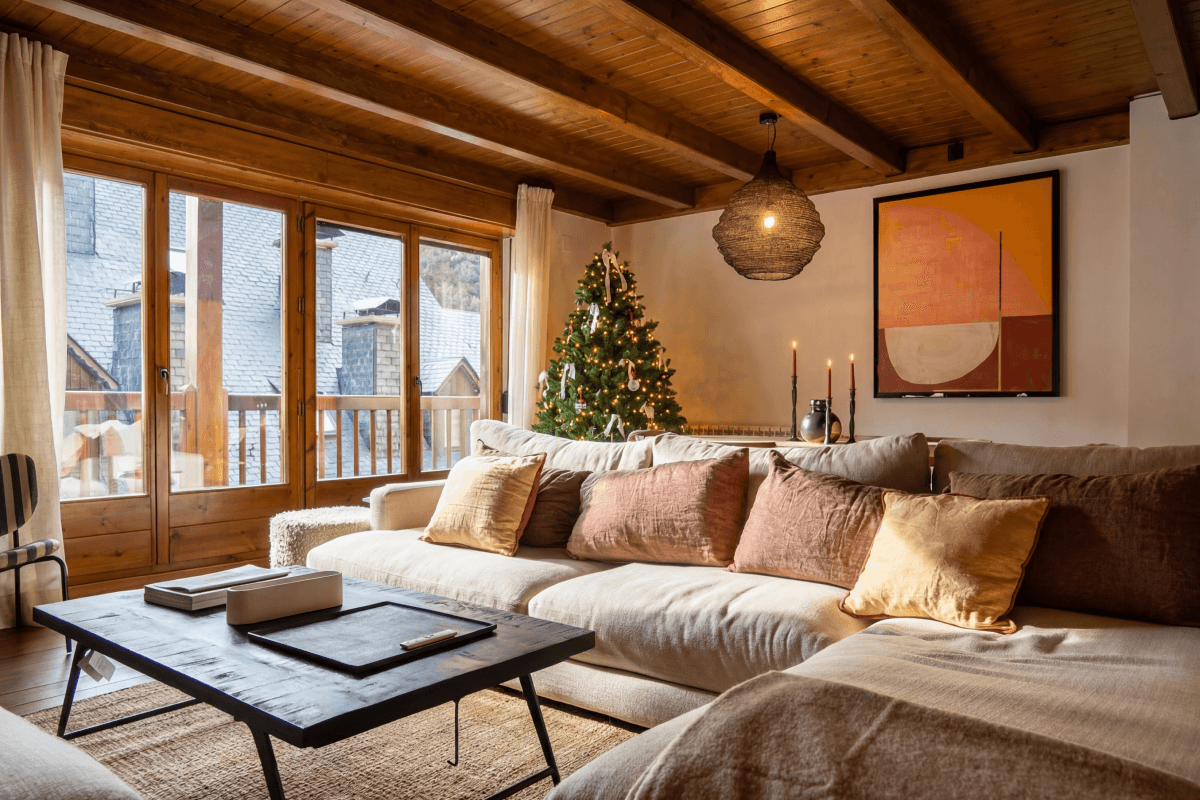
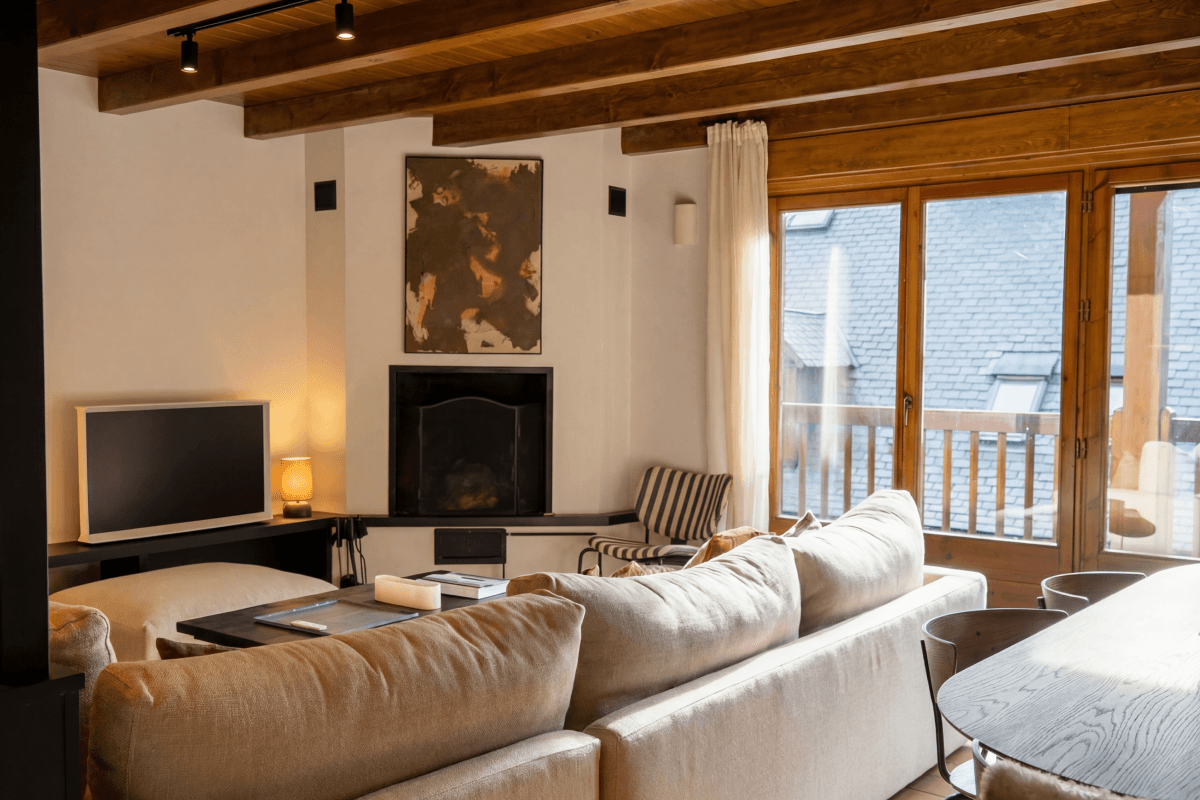
Baqueira, Spain — 3-Bed Chalet With Terrace
€120,000
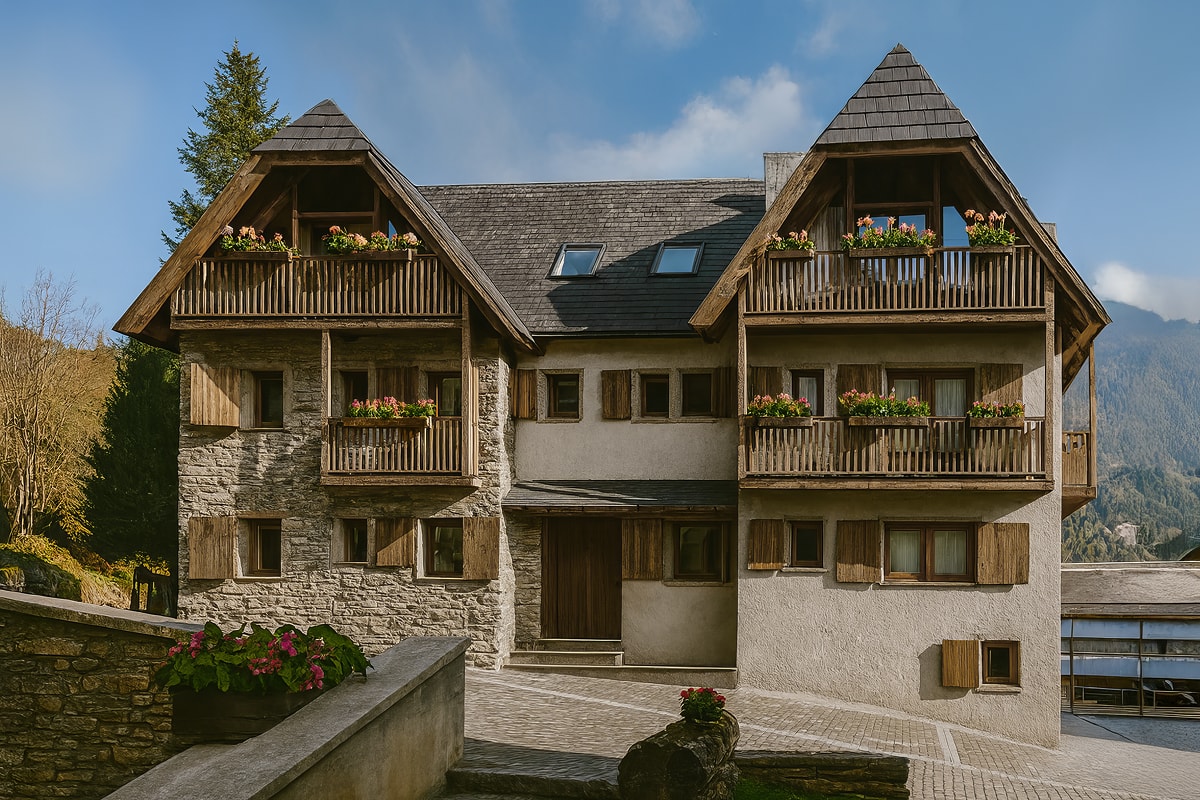
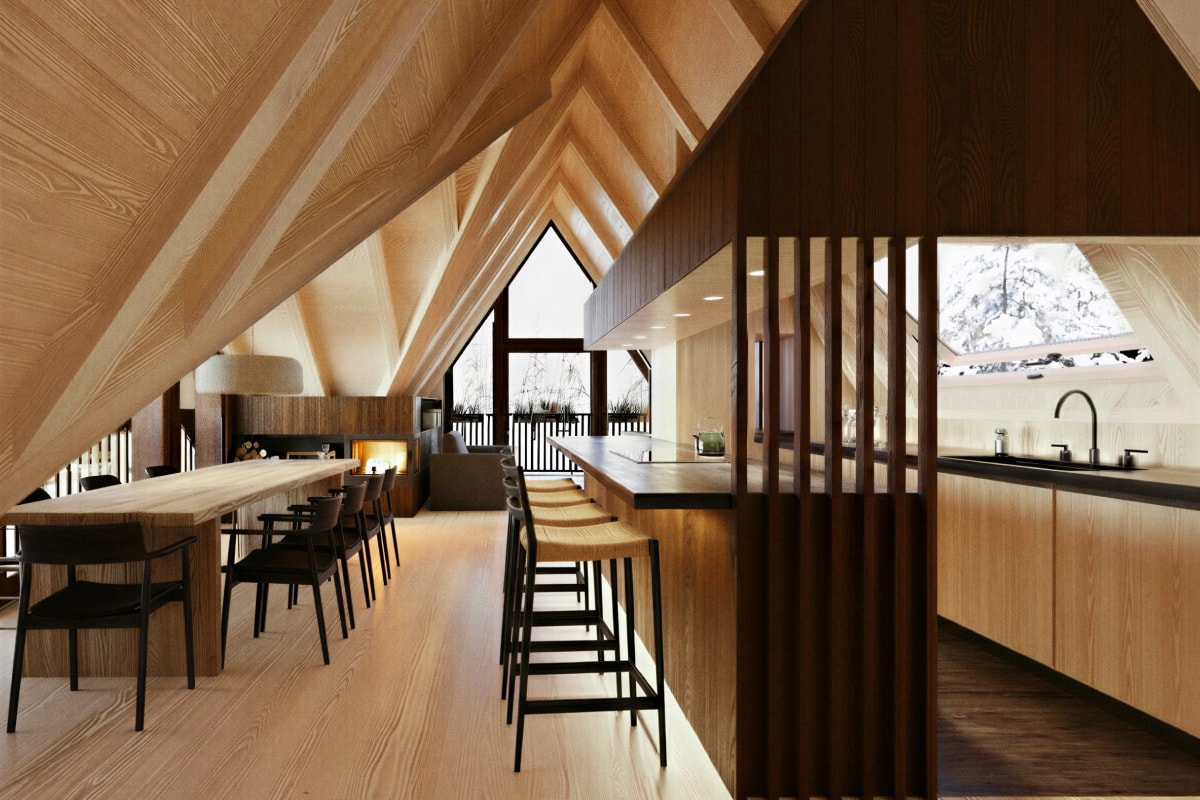
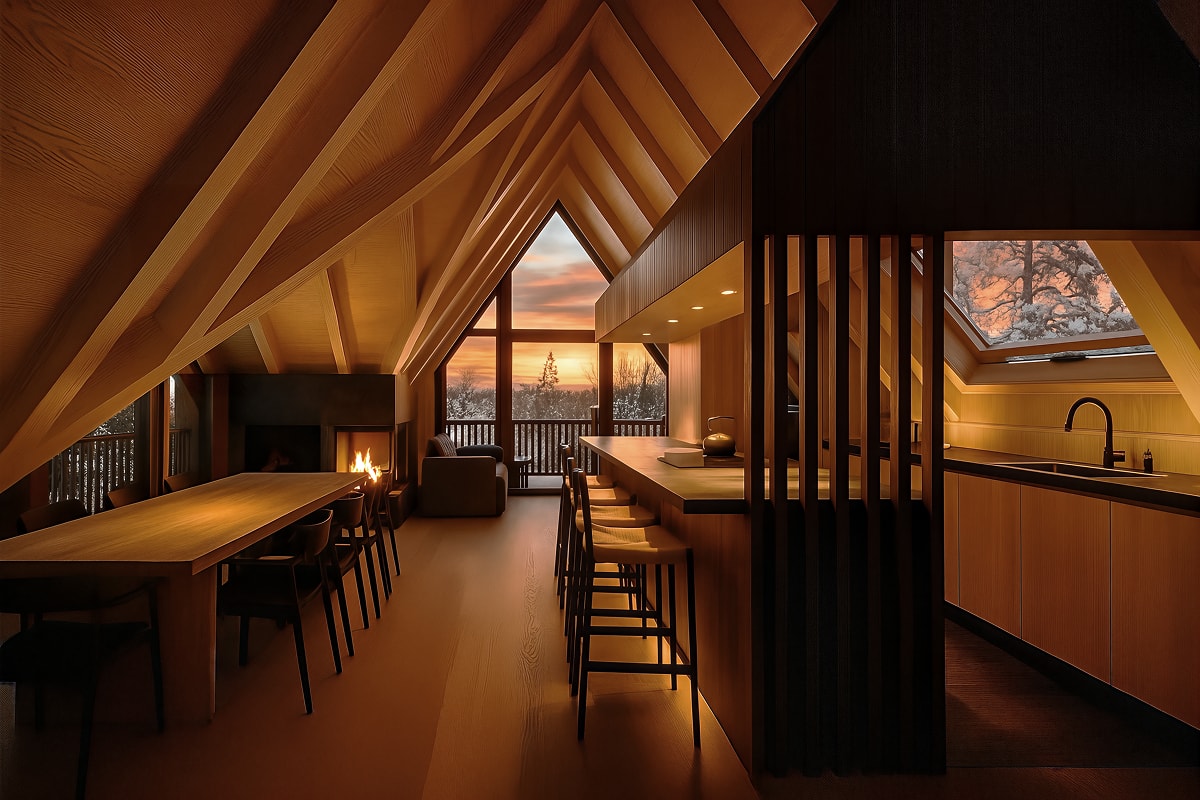
Baqueira, Spain — 4-Bed Chalet With Fireplace
€195,000
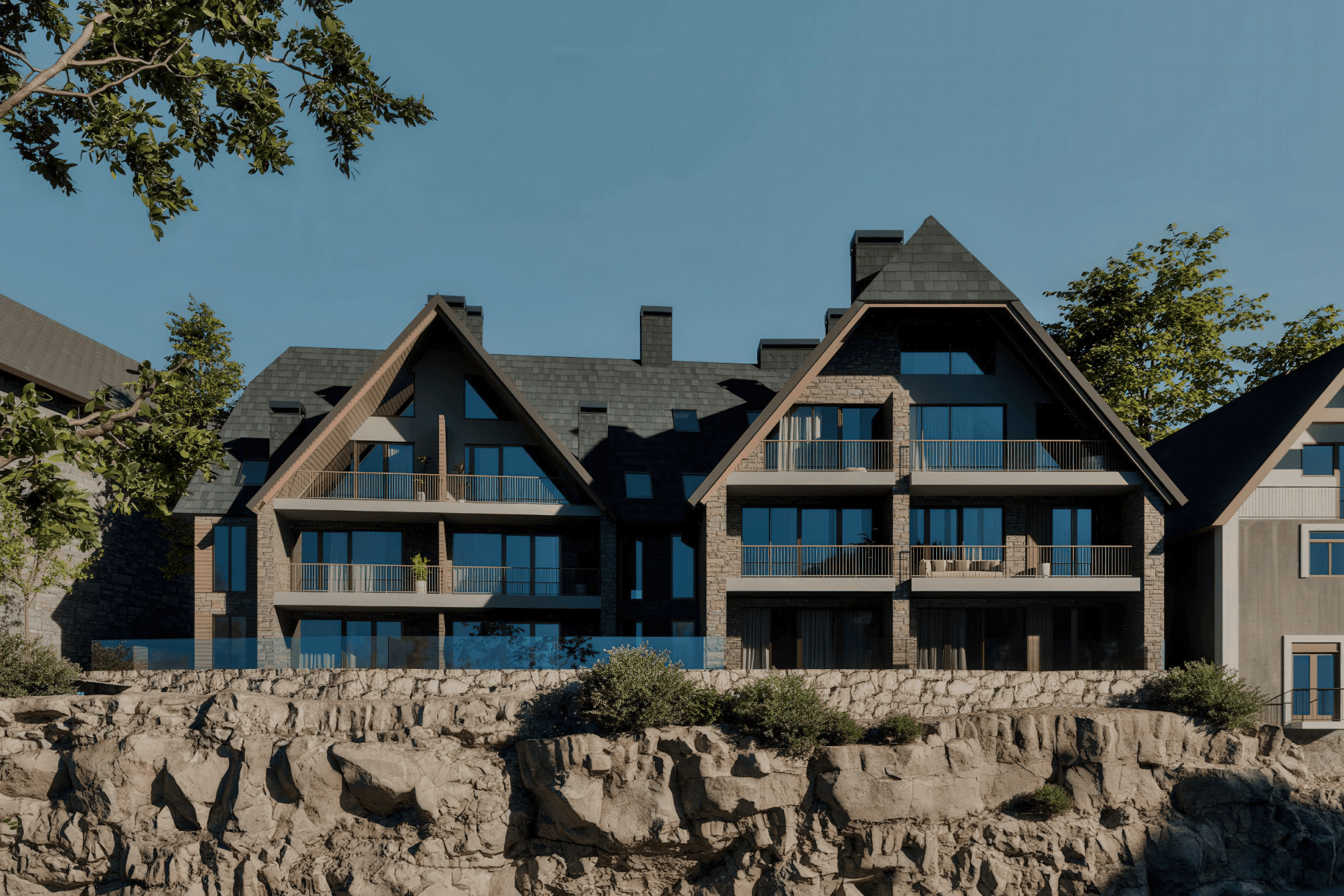
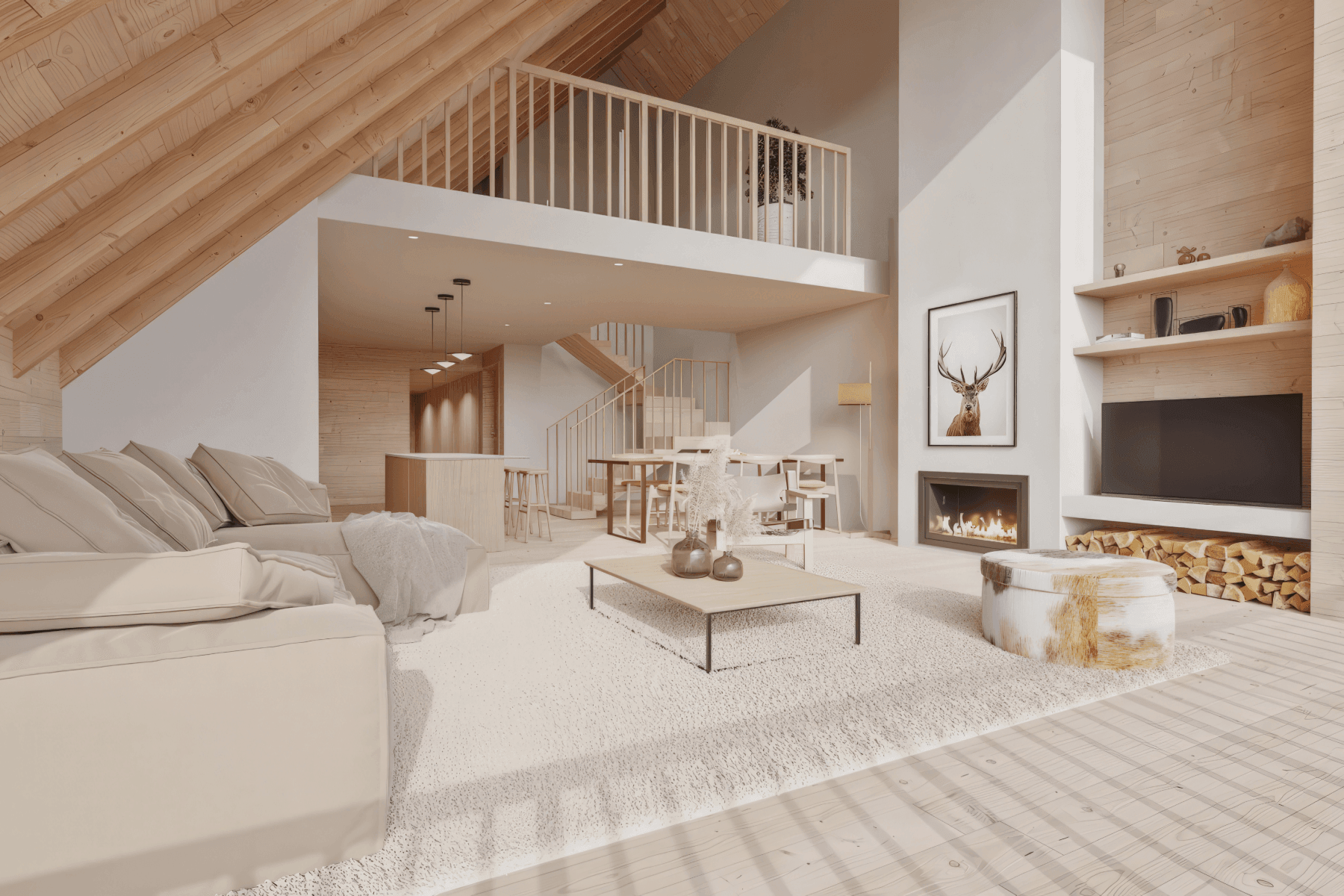
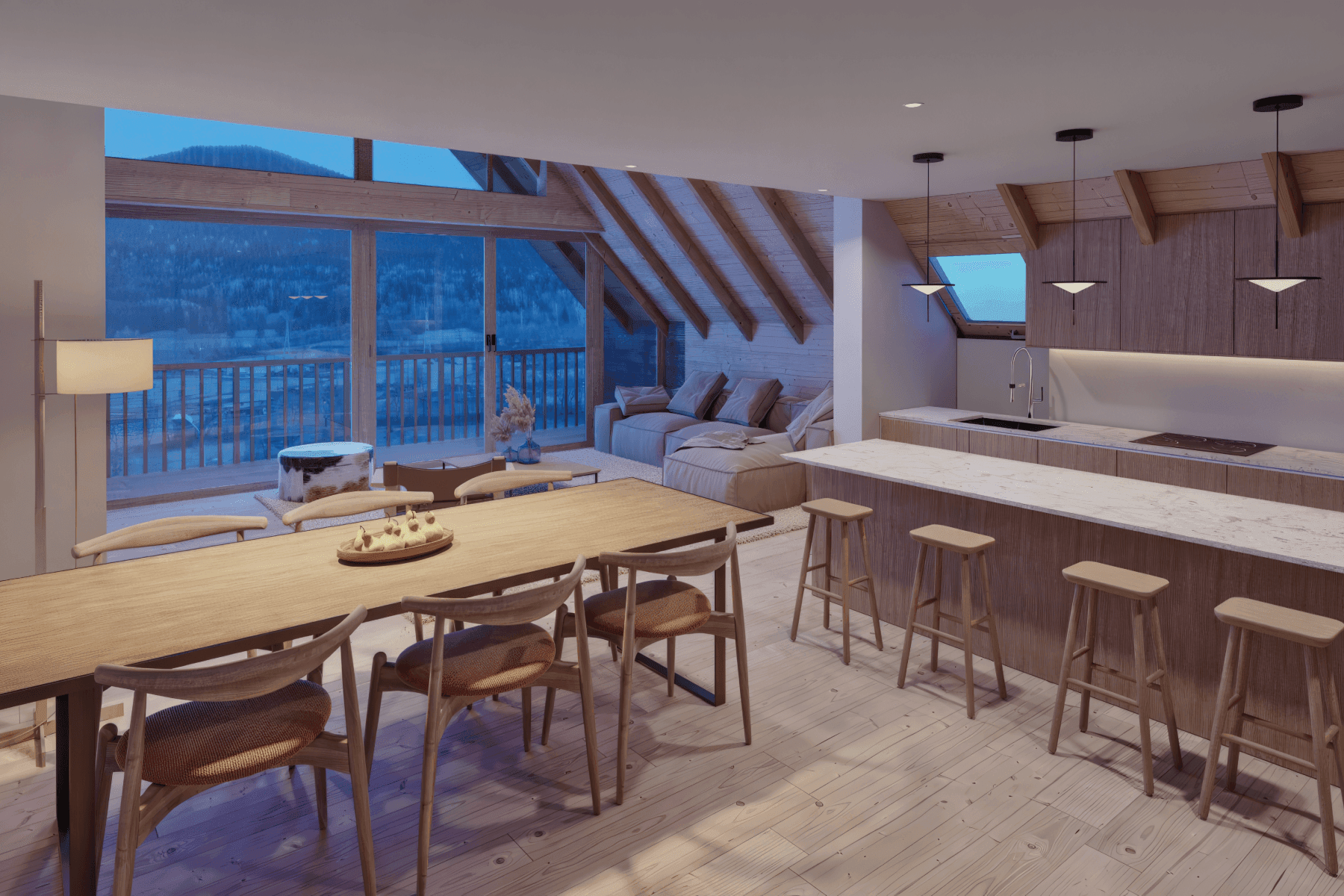
Baqueira, Spain — 3-Bed Penthouse With Fireplace
€195,000
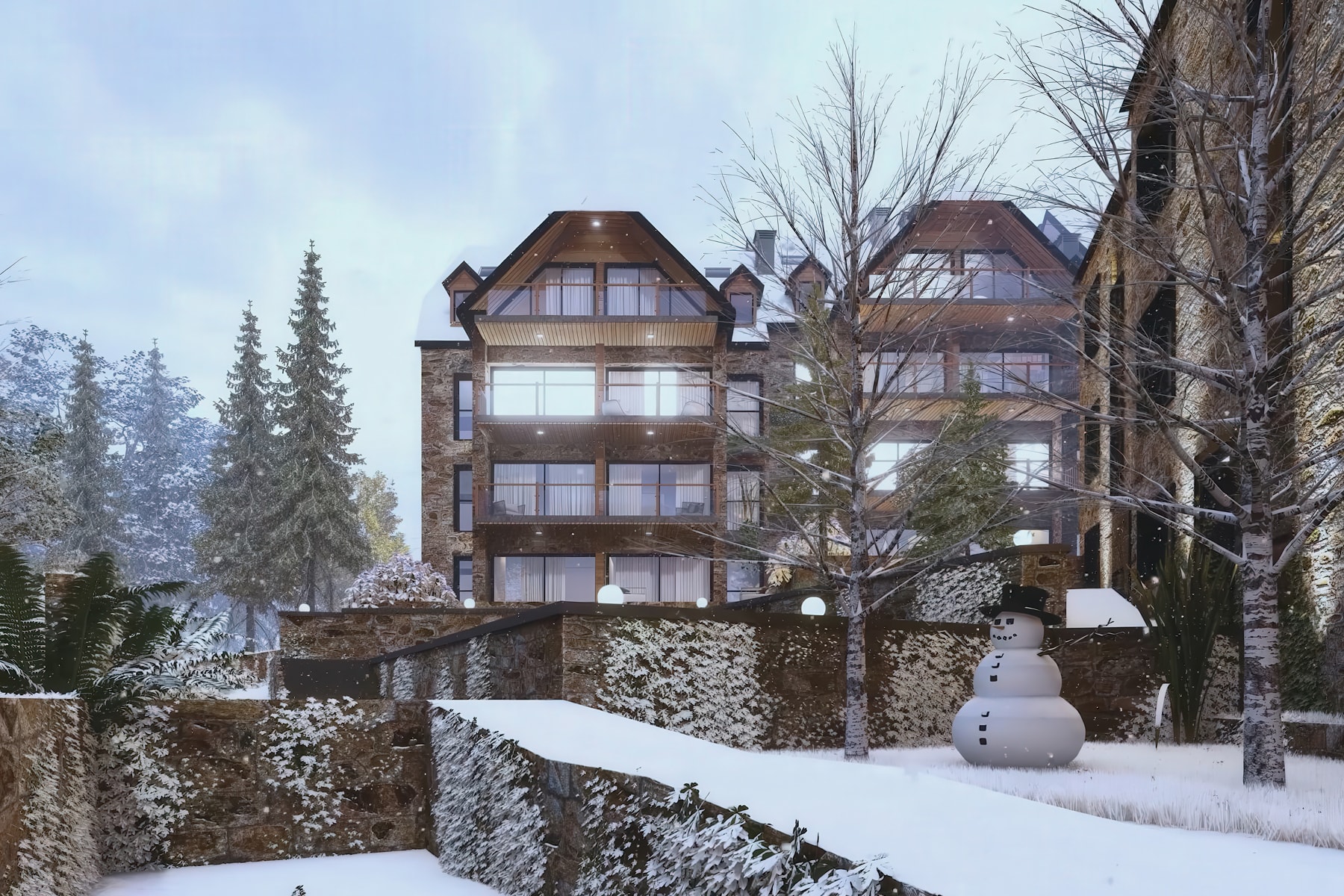
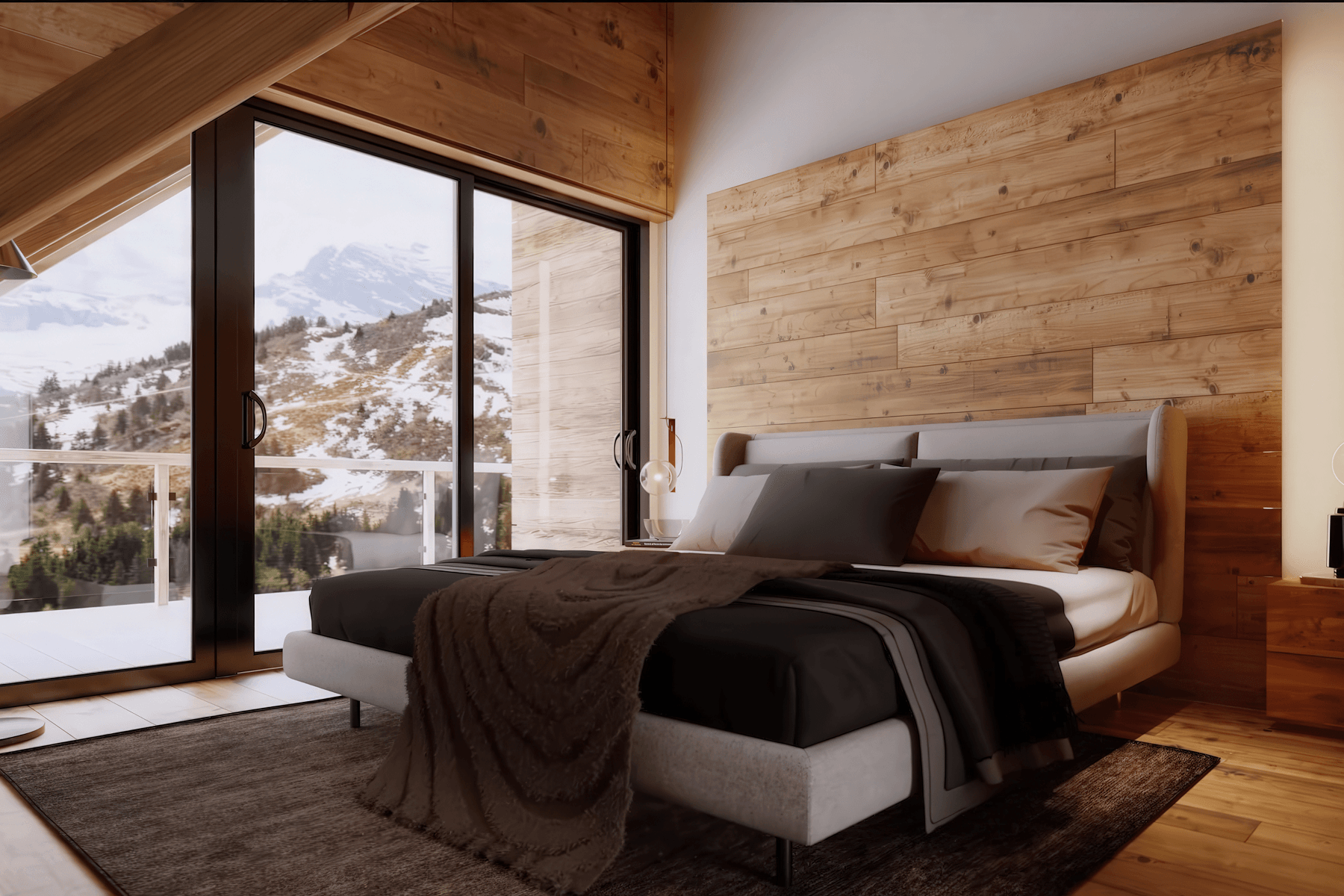
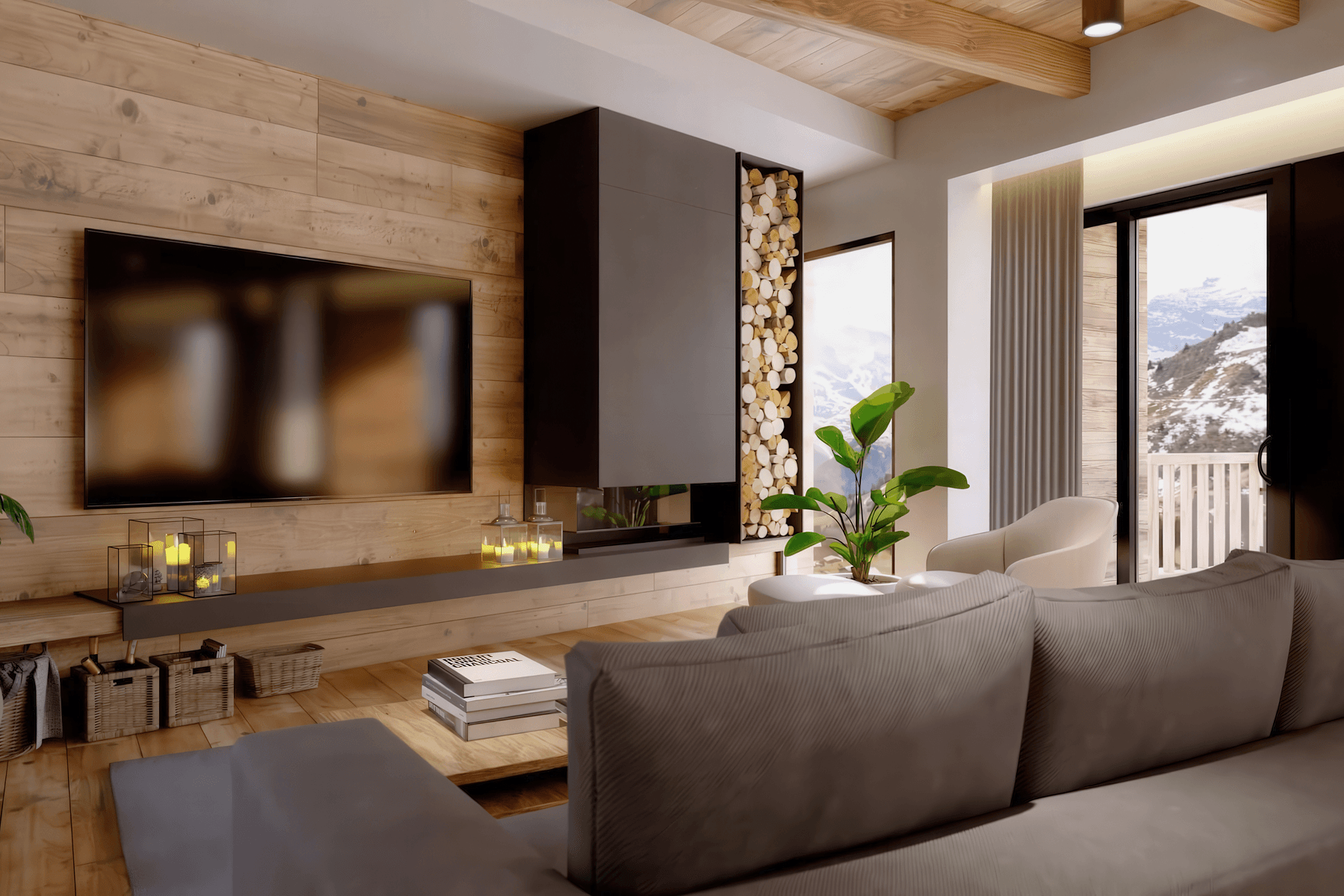
Baqueira, Spain — 5-Bed Chalet With Pool
€170,000
Spain's leading ski resort, owned the sensible way.
Thirteen fully managed homes across Baqueira 1500 and the resort core and Bagergue, above the valley — chalets, apartments and penthouses from three to five bedrooms, several ski-in/ski-out or steps from the lifts. Part of the wider Pyrenees and Spain portfolios.
Is Baqueira good for fractional ownership?
Yes — it is the strongest case in the Spanish Pyrenees. One-eighth shares of fully managed homes in Baqueira and Val d'Aran start from around €120,000 and carry roughly six weeks of use a year, in a resort where whole chalets run comfortably into seven figures and are used for barely more weeks than a single share provides.
That is the argument in miniature. What follows is the long version: what co-ownership actually is here, why Val d'Aran holds snow when the rest of the Pyrenees struggles, where in the valley our thirteen homes sit, what a share costs against buying whole, and how a purchase proceeds from first enquiry to notary. It is written for people who already ski Baqueira most winters and have started wondering whether renting the same apartment every February is the best they can do.
What is fractional ownership in Baqueira?
Fractional ownership means buying a real second home together with a small number of other households, rather than buying it alone. When you acquire a one-eighth share in one of our Baqueira properties, you become a part-owner of that specific, named home — not a member of a holiday club, not a points scheme, and not a promise of "similar accommodation" somewhere in the resort. The share is a real, transferable interest in one chalet or apartment, at one address, with the same bedroom, the same balcony and the same view every time you return.
In practical terms, a one-eighth share converts into a little over six weeks of use a year, spread across the seasons rather than delivered as a single block. This is what separates co-ownership from a conventional whole-ownership second home used for two or three weeks a year and left empty the rest of the time: the same bricks and mortar are used properly, by eight households who between them account for most of the year, while the property is looked after professionally when nobody is in residence. You are buying both more usage than a typical part-time second-home owner gets, and none of the burden of finding a caretaker, a plumber or a snow-clearing contractor from abroad.
The most important distinction to make — and the one buyers ask about most — is that this is ownership, not timeshare. A timeshare buyer typically purchases a right to use accommodation for a fixed week, administered by an operating company; the buyer does not own bricks, land or equity, the right is difficult to sell, and in many cases it depreciates to near zero. A fractional buyer owns a real share of the home — an eighth, a quarter — not a right to use it. Because it is real property rather than a use-right, it behaves like real property: it moves with the value of the home, it can be sold to a new buyer, gifted to a family member, or passed on through an estate, and its worth is tied directly to the value of the specific home and the desirability of the specific location — in this case, a resort with limited land and growing international demand.
The simplest way to think about it: a timeshare sells you a week. Co-ownership sells you the house.
How the weeks themselves are allocated matters more in a ski resort than it would at a beach house, because demand is heavily concentrated. A week in late February half-term or over Christmas and New Year is worth far more, to every one of the eight owners, than a week in early December or late March shoulder season. A well-run scheme therefore does not simply divide the calendar into eight identical blocks; it rotates the high-value weeks — Christmas, New Year, February half-terms, Easter — on a fair cycle so that every owner gets their share of prime snow over a period of years, rather than the same owner always drawing the quiet weeks. Alongside the rotating peak allocation, owners typically also have access to additional weeks on a fair-use or first-come basis, which is where a lot of the practical flexibility of the six-plus weeks comes from. This rotation is what makes a share feel fair and rewarding, year after year.
Between visits, the home is not simply locked up. A professional company manages the property on behalf of all eight owners: turning the accommodation around between stays, arranging cleaning, maintenance, and any repairs, handling the seasonal tasks specific to a mountain property — closing down and reopening for winter, servicing boilers and log fires, managing ski lockers and outdoor spaces — and coordinating the practical handover so each owner simply arrives to a ready, warm home rather than a maintenance project. Costs for all of this are shared in proportion to the share: each owner is responsible for one-eighth of the home's costs, rather than the full running costs of a property they might only use for a fraction of the year. This is also where fractional ownership earns its keep financially compared with renting a comparable chalet every season: instead of an annual outlay with nothing to show for it, an eighth of the purchase price buys a real asset that grows with the home's value, alongside comparable weeks of use.
On the legal side, Spain has well-established mechanisms for shared ownership of real estate, and co-ownership structures for resort property are not a novelty in a country with a large second-home market. The transaction passes through a Spanish notary, and the legal set-up is arranged by our partner for each home and walked through with you before you buy. What matters at this stage is the principle: this is a recognised form of property ownership, properly documented, not an informal timeshare arrangement dressed up in new language.
Put together, fractional ownership in Baqueira is best understood as the ownership economics of a whole second home, sized to match how many weeks a year most families can actually use one. Eight owners, one house, six-plus weeks each, professional management in between, and a real, saleable, inheritable share of Val d'Aran's most in-demand ski resort — at a fraction of the capital a whole property would require.
Why Baqueira – Val d'Aran, and why now?
A ski area built on Atlantic snow
Baqueira-Beret is Spain's largest and most-visited ski resort, and the reason is as much about geography as about investment. The resort spans around 173 km of marked piste served by around 35 lifts, with skiing between about 1,500m and 2,610m — a vertical range of over 1,000m — across three linked sectors (Baqueira, Beret and Bonaigua). A typical season runs from late November or early December into April, snow permitting. What sets it apart from most of its Pyrenean neighbours is its position at the head of the Garonne valley, on the Atlantic-draining, western side of the range: Baqueira catches the wetter frontal systems that sweep in off the Atlantic before they are wrung out by the mountains further east, giving it a more consistent snow record through the season than resorts further along the Pyrenean chain that depend more heavily on Mediterranean-influenced weather. It is this combination of scale and relative reliability that has made Baqueira the preferred winter address for the Spanish royal family for decades, and the benchmark against which every other Pyrenean resort is measured. Full technical data and live snow conditions are published by the resort itself.
Val d'Aran: a valley, and a culture, apart
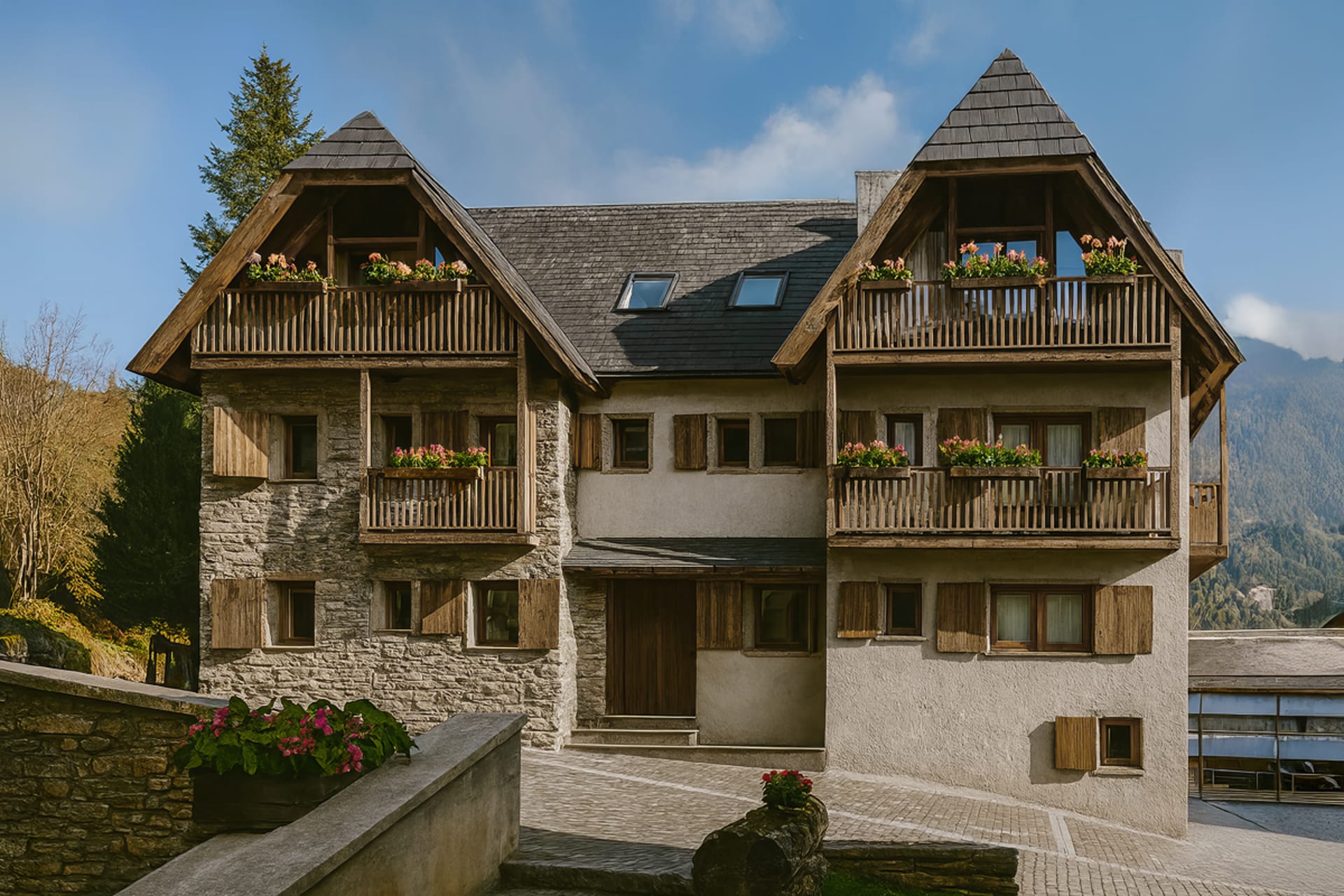
Val d'Aran is not simply "the Spanish Pyrenees" — it is a genuinely distinct place, and that distinctiveness is part of what makes it worth owning property in rather than just visiting. It is the only part of Catalonia that drains north into the Atlantic rather than south into the Mediterranean: the Garonne river rises here before flowing on into France and out through Bordeaux, which historically oriented the valley's trade, architecture and even its language towards Gascony rather than the rest of Catalonia or Spain. The valley has its own language, Aranese, a standardised form of Gascon Occitan, which has been co-official alongside Catalan and Spanish since 1990 and is still taught in local schools and spoken as a first language by a meaningful share of valley-born residents. Aran's autonomy is old: the Conselh Generau d'Aran traces its self-governing status back to a 1313 charter, suppressed for over a century and formally restored in 1990. Vielha, with a little over 5,000 residents, is the valley's capital and administrative centre, serving a population of around 10,000 spread across a string of stone-built villages — Salardú, Arties, Bossòst, Escunhau, Betrén, Unha — many still centred on a Romanesque church, part of a dense cluster of eleventh-to-thirteenth-century Pyrenean churches that also includes, in the neighbouring Boí valley just to the south, a set of Romanesque churches inscribed as UNESCO World Heritage. The result is a resort with genuine depth: a working, bilingual (in fact trilingual) mountain community with its own identity, not a purpose-built ski station.
Getting there: closer than the map suggests
Val d'Aran's position at the head of a valley that opens north towards France, rather than south towards Barcelona, makes it more accessible than its position deep in the Pyrenees might suggest. Toulouse-Blagnac, with its wide network of European and UK routes, is around 180km away, a drive of a little over two hours up the Garonne valley through Saint-Gaudens. Lleida-Alguaire, the regional Spanish airport, is a broadly similar distance and drive time, though its schedule is thinner and more seasonal. Barcelona-El Prat, the main international gateway, is considerably further — roughly 280km and the better part of four hours by road — which in practice makes Toulouse the more convenient arrival point for most international owners. All routes converge on the Vielha Tunnel, opened in 1948 and paired with a second bore in 2007, which carries the road under the 2,450m Port de Vielha pass in around 5km and does the single most important job in the valley's history: before it existed, deep winter snow could cut Val d'Aran off from the rest of Spain for weeks at a time. The tunnel is the reason a ski property here is a realistic, year-round proposition rather than a fair-weather one.
The property market: what ownership actually buys
This is the core of the argument for buying a share rather than a whole property. Specialist agents active in the valley put current asking prices for chalets and apartments in Baqueira and the wider Naut Aran area broadly in the region of €6,000 to €12,000 per square metre as of 2025/2026, rising towards €15,000 per square metre or more for genuinely prime, ski-in/ski-out or newly built stock. The direction of travel is clear: for a resort of Baqueira's stature, this remains meaningfully cheaper, square metre for square metre, than the headline French Alpine resorts it is most often compared with, where equivalent prime stock commonly changes hands well into five figures per square metre. On a typical Baqueira home of, say, 100–150m², that arithmetic implies whole-property values that, for many buyers, sit well beyond a sensible allocation to a property used for a handful of weeks a year — which is precisely the gap fractional ownership is designed to close. Buying one-eighth of a specific, well-located home for a fraction of its full value gives an owner exposure to that same property market, and the same scarcity dynamics, without committing the capital or the ongoing responsibility that a whole chalet demands.
Summer in the Pyrenees' wildest national park
Val d'Aran is increasingly a two-season proposition, and the reason sits directly on its southern boundary. The Aigüestortes i Estany de Sant Maurici National Park — Catalonia's only national park, and one of the last genuinely wild high-mountain landscapes in the Pyrenees — spreads across granite peaks and more than 200 glacial lakes reached from villages just south of Naut Aran. It draws serious hikers and increasing numbers of mountain bikers and trail runners through the summer and early autumn, alongside gentler valley walking, via ferrata and fly-fishing closer to the resort itself. For an owner, this matters practically as much as aesthetically: a Baqueira share is not a purchase that sits idle for eight months of the year waiting for snow, but a base for a genuine alpine summer as well as a ski winter, which materially improves how much use eight owners can realistically get out of six-plus weeks each. Details on trails and access are published by the park authority.
Scarcity by design: why supply won't catch up
The final piece of the case is structural, not cyclical. Val d'Aran is a narrow valley hemmed in by steep forested slopes and, to the south, by protected national park land — there is simply very little flat, buildable ground to begin with, and what exists is further constrained by planning rules designed to protect the valley's stone-built villages and their character. New large-scale development is difficult to bring forward, and existing stock in and around Baqueira, Naut Aran and Vielha turns over slowly. Demand, meanwhile, is broadening rather than narrowing: alongside long-established Catalan and Spanish buyers, the resort is increasingly on the radar of French buyers drawn by the short drive from Toulouse, and of British and other international buyers who have noticed the pricing gap with the French Alps. A housing stock that cannot expand much further, set against demand that is growing from more directions than before, is the basic mechanism behind property values in constrained alpine markets generally — and it is the reason the case for owning a share here now looks stronger than the case for waiting.
Skiing Baqueira-Beret: what owners are actually buying into
Baqueira-Beret is Spain's largest ski area and the reason a share in a Val d'Aran home is worth having in the first place. It sits in the far north-west corner of Catalonia, tucked against the French border in a valley that behaves more like the Atlantic Pyrenees than the rest of Spain. Below are the numbers and the texture that matter to an owner deciding how, and when, to use their weeks.
The ski area by the numbers, and by sector
For the 2025/26 season, Baqueira-Beret is offering around 173 km of skiable terrain across roughly 130 runs, served by about 36 lifts — a marked expansion on the resort's long-standing "around 160 km" description, after five new blue runs (Cargolh, Lebre 1, Arrianglo, Poric and Sautarèth) were added ahead of this winter. The area runs from a base of 1,500 m up to 2,610 m, a vertical range of around 1,110 m, and it is entirely lift-linked: the majority of runs are red or blue, so an intermediate skier can move between sectors without detouring onto terrain that's over their head.
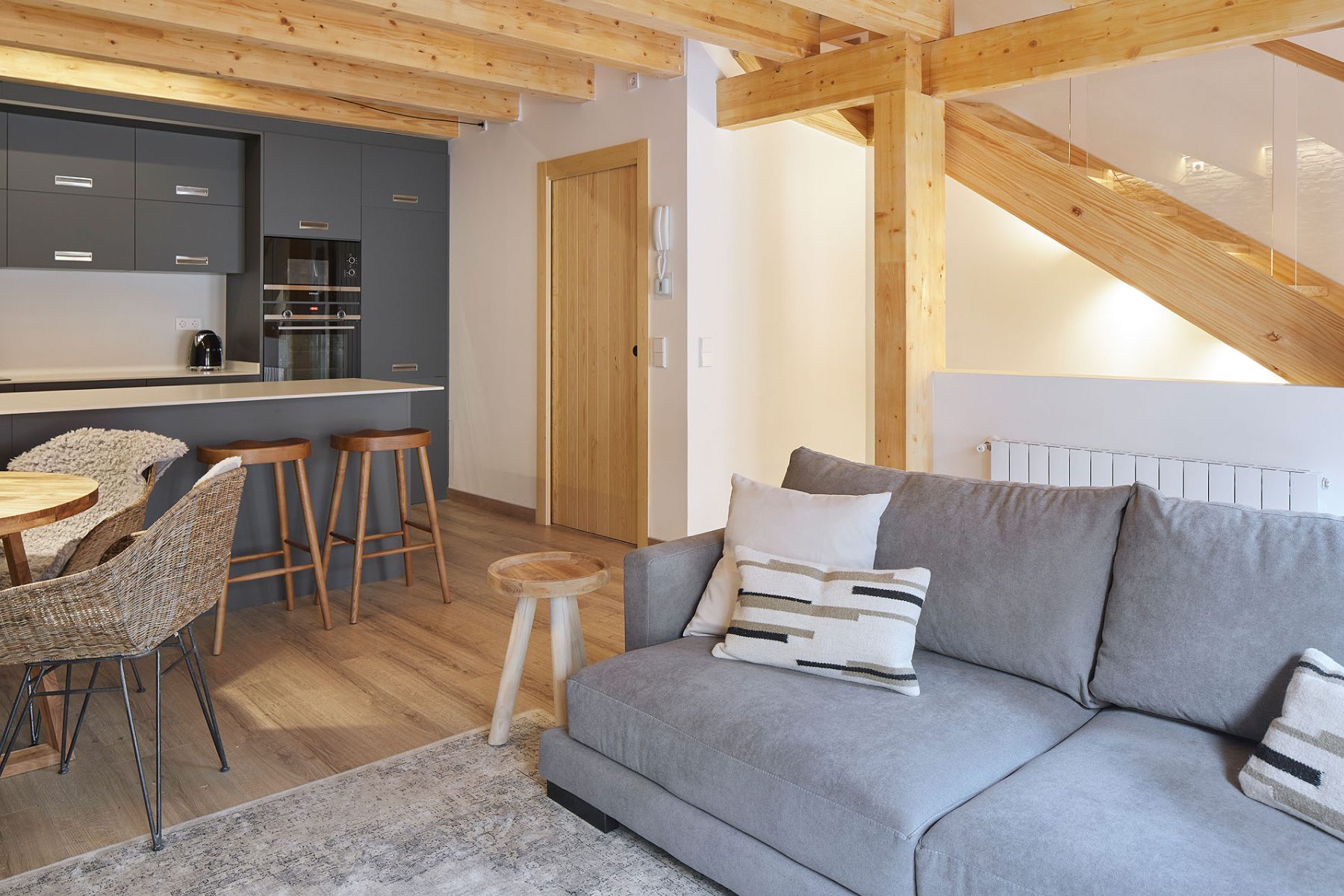
The three sectors in brief: Baqueira is the original base area and the hub for lodging, lessons and beginner terrain, sitting at 1,500 m. Beret is about 9 km further along the valley and roughly 350 m higher, a broad, open, largely treeless bowl good for long cruising runs and cross-country skiing. Bonaigua, 9 km in the other direction, has the highest base station in the network at around 1,900 m and tends to hold its snow latest into spring. All three connect by blue and red pistes, so most guests can ski the whole area on a single pass without needing a car.
This is a big, purpose-built area by Pyrenean standards, closer in scale to a mid-sized Alpine resort than to most of its Spanish or French neighbours.
Terrain by ability: who the mountain suits
Beginners generally learn around the Bosque area at 1,800 m in the Baqueira sector, where the nursery slopes sit close to ski schools and the base lifts, or on the gentler, lower-cost pay-per-ride beginner terrain up at Pla de Beret. Both sit close to the ski schools, so a first-timer's first few days are well looked after.
Where Baqueira-Beret earns its reputation is with intermediates. The bulk of the piste network is blue and red, wide and well groomed, and because the three sectors are so thoroughly interlinked, a confident intermediate can rack up long days of varied cruising without repeating runs or getting stuck on terrain that's too easy or too hard. It's a resort that rewards a skier who wants mileage and views rather than technical challenge on every run.
Advanced skiers have real options too, if they know where to look:
- Marked black runs including the well-known Luis Arias and the steeper La Passarellas.
- Official freeride itineraries and lift-served off-piste, notably around Tuc de la Llanca in the Bonaigua sector (relatively accessible) and the north face at Cap de Baqueira (steeper, with routes such as Escornacabres that carry genuine avalanche risk and should only be skied with local knowledge or a guide).
- A long-standing freeride reputation: Baqueira-Beret has hosted stages of the Freeride World Tour, and the surrounding Val d'Aran is one of the more established heliskiing bases in the Pyrenees, offering both classic heli-drops and "helirando" trips that combine a helicopter lift with a skinned climb, run by IFMGA-qualified mountain guides rather than the resort itself.
In short: strong beginner and intermediate provision close to the lifts, and a serious hike-to and heli-accessed off-piste scene a short taxi or helicopter ride away for those who want it.
The snow record: an Atlantic valley on the wrong side of Spain
The single most useful fact about Baqueira-Beret's snow is geographical rather than statistical. The Val d'Aran is the only valley in Spain whose rivers, via the Garonne, flow north into the Atlantic rather than south into the Mediterranean or the Ebro basin. That quirk of the watershed means the valley catches Atlantic weather systems that largely miss the rest of the Spanish Pyrenees, giving it noticeably higher and more evenly distributed rainfall (and, in winter, snowfall) than resorts on the Mediterranean-facing side of the range. Much of Baqueira's terrain also faces north or north-west, which helps preserve colder, drier snow for longer once it falls.
A strong start to 2025/26. The season opened on 29 November 2025 after heavy November storms — described by the resort as its best start since 2019/20 — with a provisional closing date of 6 April 2026.
The resort backs its natural snowfall with a substantial snowmaking system: around 850 snow cannons covering roughly 58% of the piste area, with continued investment for 2025/26 in newer, more energy-efficient generators and two new winch-equipped grooming machines for steep terrain. In practice, the season length — late November to early April in a typical year — is broadly comparable to many higher Alpine resorts.
Lift passes and ski school
Baqueira runs two main pass products: a pay-as-you-go rechargeable card for day-by-day visits, and a personal, multi-year card that carries a standing discount on window prices and is also the vehicle for buying a season pass. It is sold as a standalone resort pass. Multi-day tickets are, as at most resorts, considerably better value per day than a single day pass, and there is a separate, cheaper pass for beginner terrain only.
Prices move every season and should always be checked on the resort's own site before booking; as a dated snapshot, the published adult one-day pass for 2025/26 was around €71.50 (a modest rise of roughly 3.6% on the previous winter), with five-day passes working out at a little over €60 per day.
Ski and snowboard tuition is plentiful rather than centralised: several independent ski and snowboard schools operate in the resort, between them running to several hundred instructors, offering group and private lessons in Spanish, Catalan, French and English. Childcare provision starts young by Alpine standards — a crèche near the Baqueira 1500 base takes children from around three months to three years, and supervised snow gardens with their own beginner lifts operate across all three sectors for three-to-six-year-olds, with structured ski lessons typically from around age six.
Crowds and rhythm: when the resort fills and empties
Like every major resort within reach of Barcelona, Madrid and the south of France, Baqueira-Beret has a sharply seasonal crowd pattern. Christmas and New Year, the Spanish half-term weeks (timing varies by region), long weekends ("puentes") and, above all, Semana Santa around Easter bring the valley close to capacity, with queues at the main lifts and a full car park by mid-morning. Outside those windows, and especially midweek in January and early-to-mid March, the same 173 km of piste is skied by a fraction of the people.
This is where a rotating allocation works in an owner's favour. A share that moves through the calendar on a fair rota will, over a few seasons, land plenty of weeks in those quieter shoulder periods — so every owner enjoys Baqueira with short lift queues and empty pistes, alongside their turn at the festive peaks.
The resort's social scene reflects its clientele: this is a long-lunch mountain rather than a raucous après-ski one. There are close to thirty on-mountain restaurants and refuges, ranging from simple refuges to smarter slope-side dining, and the culture leans towards a proper sit-down meal in the early afternoon sun rather than dancing on tables at 4pm. A couple of terraces — at Beret and at the Baqueira 1500 base — do put on live music or a DJ at weekends — a civilised, sunlit alternative to the boot-stomping après of Ischgl or Val Thorens.
Beyond the pistes in winter
Non-skiers, or skiers taking a day off, have real options in the valley rather than a choice between the hotel spa and shopping. The Beret sector has a dedicated Nordic skiing area with groomed classic and skating loops that don't require a lift pass at all, plus a second circuit near Montgarri; between them they add up to a genuine cross-country network, and the annual Marxa Beret ski marathon each February draws well over a thousand participants. Guided snowshoeing is well established throughout the valley, with marked winter routes kept clear of avalanche terrain and a dedicated valley avalanche service publishing daily bulletins.
For a change of pace entirely, the natural thermal baths at Tredòs, a short drive from Baqueira, are fed by a genuine hot spring at around 33°C and combine an indoor thermal pool, jacuzzi and Finnish sauna. Down in the valley capital, Vielha has an ice rink (the Palai de Geu) and a public sports centre with a pool, useful for a family with children who don't ski every day. For a valley this size it is a remarkably complete winter offering, and the compactness of the Val d'Aran means none of it is more than twenty minutes or so from a Baqueira base.
Full technical data, live snow reports and current pass prices are published on the official Baqueira-Beret website, which is worth checking before any trip, since terrain, lift operation and pricing all shift through the season.
Where should you own in Val d'Aran?
Val d'Aran is not one place but several, strung along a single valley that runs north-west off the main Pyrenean watershed towards France. That geography matters more than it might in most ski destinations, because it means the valley faces the Atlantic rather than the Mediterranean, which is the reason its snow record is more dependable than resorts further east. It also means the choice facing a buyer is not simply "which apartment" but "which kind of Pyrenean life" — purpose-built resort convenience at the lift base, stone-village character a short drive above the valley floor, or the year-round practicality of the Aranese capital. Our current portfolio of thirteen one-eighth shares sits almost entirely in the first two categories: twelve in and around Baqueira, one in the village of Bagergue. The wider valley, including Arties and Vielha, is described below for context.
Baqueira 1500 and the ski-in/ski-out core
Baqueira-Beret is a purpose-built ski resort rather than a repurposed village, founded in the mid-1960s on bare mountainside rather than grown organically like Arties or Salardú below it. The ski area itself is substantial by Pyrenean standards — around 173 km of marked piste across three linked sectors, Baqueira, Beret and Bonaigua, served by around 35 lifts, with terrain running from about 1,500 metres up to 2,610 metres. Because the resort sits on the northern, Atlantic-facing side of the range, it tends to hold snow more reliably through a season than resorts on the drier Mediterranean-facing slopes further east, which is one reason it has become the preferred winter address for a large share of Spain's ski-owning public.
"Baqueira 1500" refers to the altitude of the main base nucleus — the cluster of apartment blocks, covered and underground parking, ski school meeting points, boutiques and restaurants gathered around the principal lift stations at 1,500 metres. This is where the resort's daily life happens: it is a five-minute walk, or often literally ski-in/ski-out, from an apartment door to a chairlift, and shops and restaurants stay open for the length of the season without needing a car. As of 2026, share prices for well-specified apartments in this bracket typically run from the low €100,000s to the high €100,000s for a one-eighth share, depending on size, floor and proximity to the lifts.
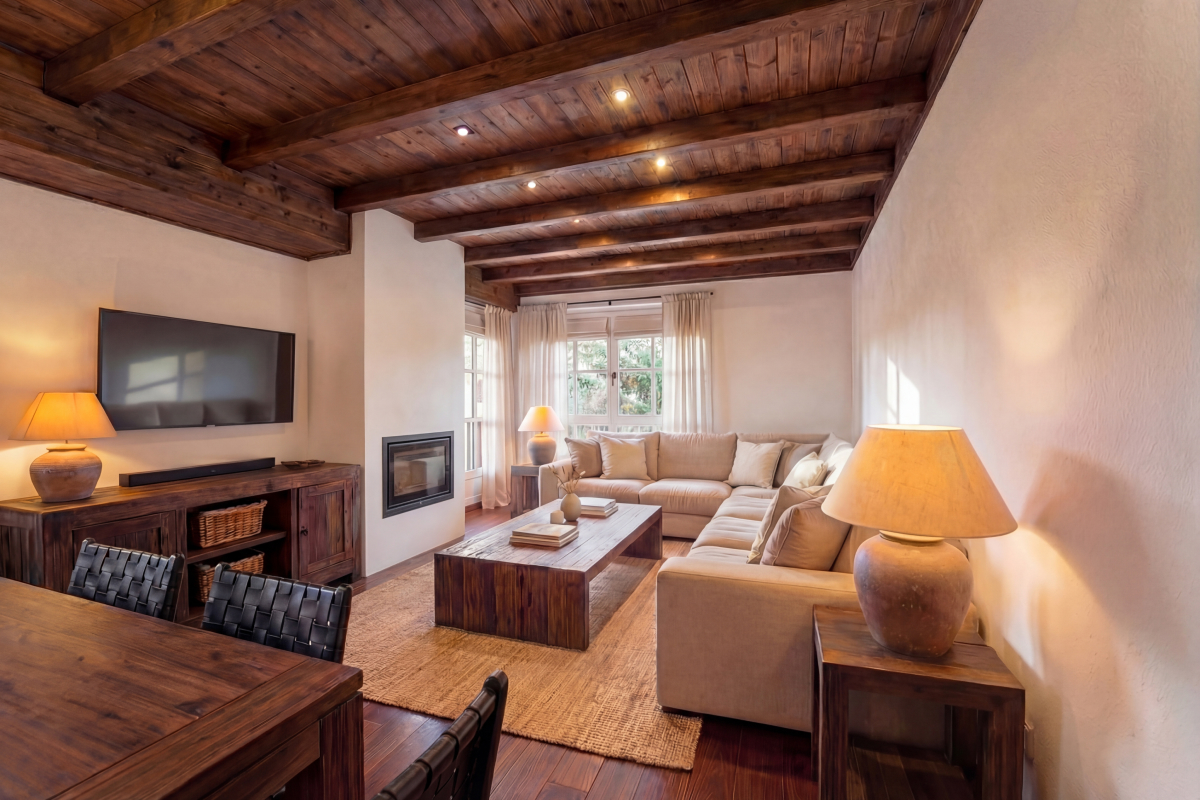
This is the address for buyers who want ski convenience above all else — no packing the car at 8am, no worrying about parking when the pistes are busy. The base is built around the ski season and comes fully alive when the lifts are turning. Most of our Baqueira listings sit within this ski-in/ski-out core or on the approach roads just below it, including several apartments with covered parking a short walk from the lift base, and a small number of larger chalets with fireplaces set slightly further out on quieter streets.
What "1/8 in Baqueira" actually buys: proximity to the lifts and the buzz of resort living — practical, social and geared around the ski season. Buyers who prefer a stone-village retreat should look at the listing in Bagergue.
Bagergue, Salardú and the high villages of Naut Aran
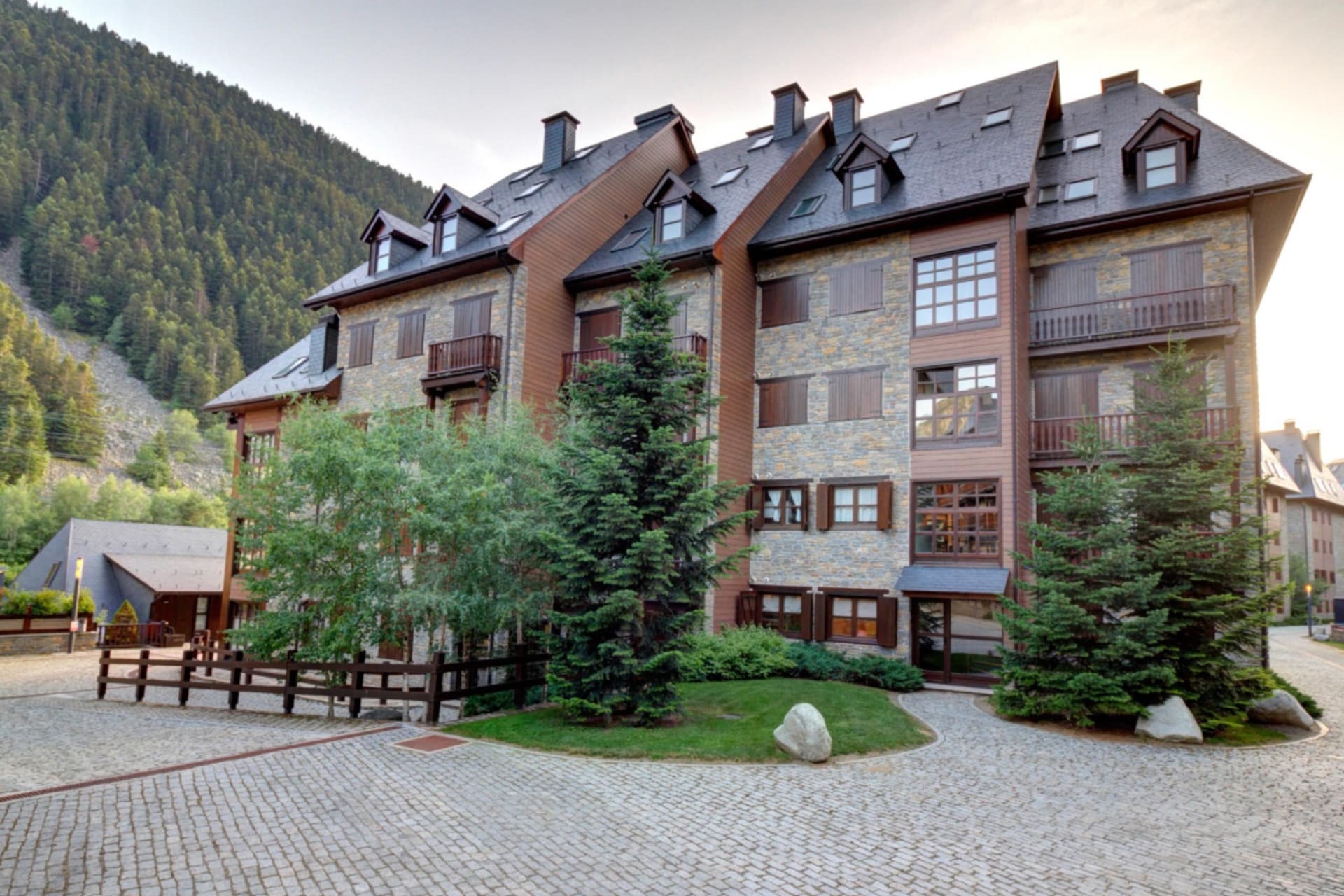
Above the main valley floor, in the district known as Naut Aran, sit a handful of stone villages that predate the ski resort by centuries. Bagergue is the highest of them, at around 1,419 metres, and among the smallest — a village of only a few dozen permanent residents, built in the traditional Aranese style of dark stone walls, slate roofs and carved wooden balconies, with a parish church, Sant Feliu, whose oldest fabric dates to the twelfth and thirteenth centuries. It is a member of the official Los Pueblos Más Bonitos de España association (the "Most Beautiful Villages of Spain" network), a recognition based on verified criteria around heritage, architecture and conservation rather than a marketing claim, and it has also been repeatedly honoured in Spain's "Flowered Towns" scheme for its window boxes and public planting.
Salardú, a short distance below Bagergue and closer to the valley floor, is the administrative centre of Naut Aran and a working village in its own right, with a fortified medieval history, an octagonal Romanesque bell tower on its parish church, and enough shops, bars and a seasonal golf course to function as a self-contained base rather than a satellite of the resort.
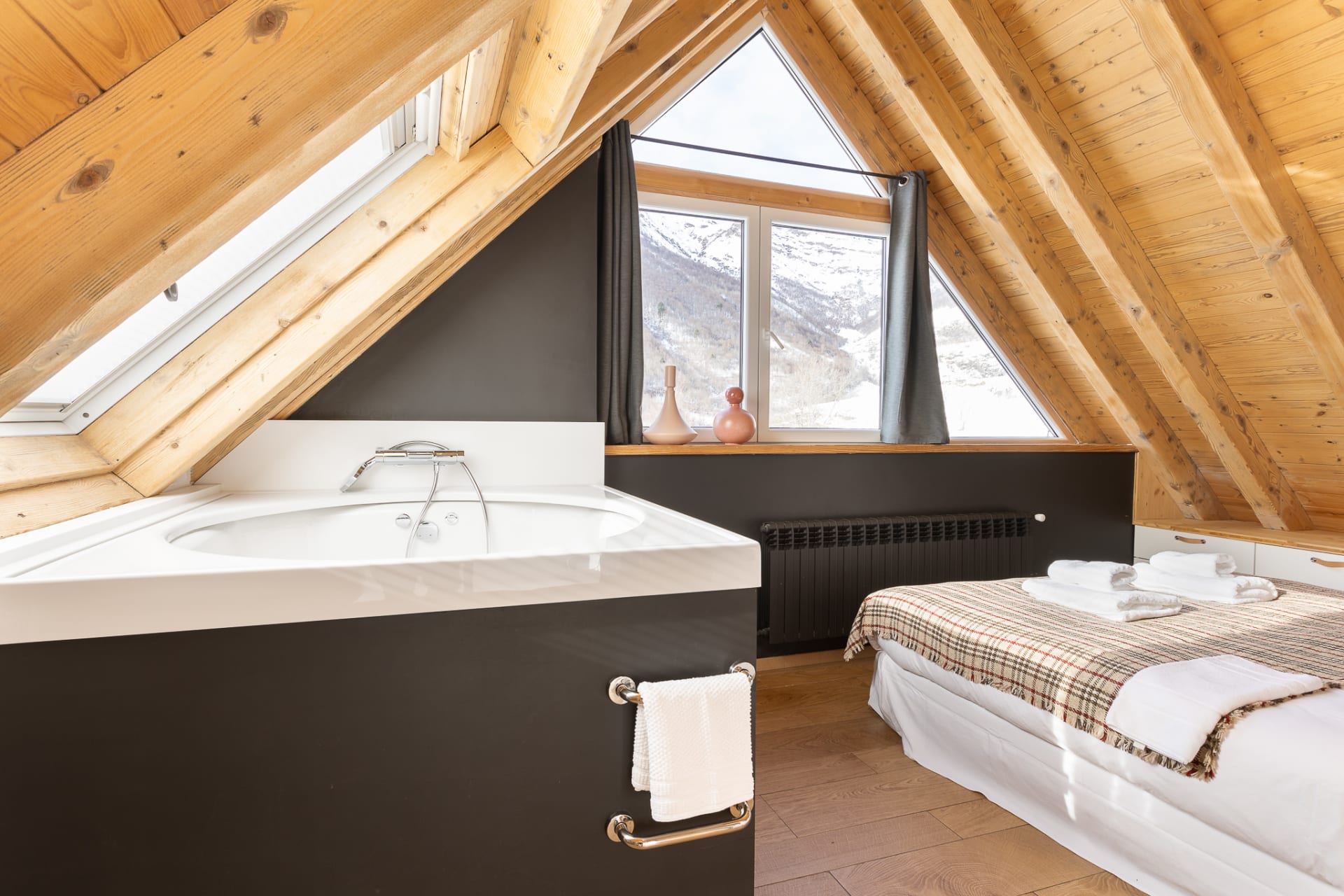
The appeal of buying here rather than at the resort base is straightforward: real streets rather than a car park and lift queue, a village bar and church rather than a retail concourse, and a sense of the valley's actual history rather than 1960s development. The lifts are a short drive away, and our one Bagergue listing makes that effortless: a four-bedroom duplex with its own wine cellar and dedicated parking at the ski station, which lets an owner keep a reserved space near the piste while living, day to day, in one of the valley's most characterful settlements. As of 2026, a one-eighth share of a larger village home of this kind tends to sit towards the upper part of our price range, reflecting the extra space and the rarity of village stock compared with the resort's apartment stock.
Arties and Tredòs
Between the resort and the valley capital sits a middle tier of villages that trade a little lift-side convenience for considerably more charm and better eating. Arties, a few kilometres below Baqueira, is itself now a member of the Most Beautiful Villages of Spain network, recognised in 2023, and combines a well-preserved Romanesque church and Renaissance-era centre with one of the valley's stronger concentrations of good restaurants — a village genuinely lived in, not simply passed through. It also has public thermal pools fed by the valley's natural hot springs, a facility that gives it a distinct identity beyond skiing: a place locals and visitors alike use to soak sore legs after a day on the mountain or a summer hike. Tredòs, its quieter neighbour, sits at the point where the road climbs towards the Aigüestortes National Park boundary and functions as one of the park's practical gateways.
This pocket of the valley is the best of both worlds for many visitors — closer to the lifts than Vielha, with more village texture than the resort base — and a lovely place to eat out from a Baqueira home. We do not currently list homes here; it is included for context on the valley as a whole.
Vielha and the valley floor
Vielha, the capital of Val d'Aran, is a genuine working town of roughly four to five thousand residents rather than a resort satellite. Sitting at around 970 metres on the valley floor, it has what the smaller villages and the resort base lack: a hospital (the Espitau Val d'Aran), schools, banks, a full range of supermarkets, and a historic centre built around the twelfth-century Sant Miquèu church and its prized Christ of Mijaran carving, alongside an ethnological museum housed in a seventeenth-century tower. Road access is via the Vielha tunnel, first opened in 1948 and since rebuilt, which is what makes the valley reliably reachable by car through the winter regardless of snow on the passes above.
For owners in Baqueira and the high villages, all of this is close at hand — invaluable for longer stays, for a family spending school holidays rather than a long weekend, for errands that need more than a village shop, and for the reassurance of proper medical care nearby. Vielha itself is around twenty minutes' drive from the pistes; we do not currently list homes there.
Beret and the high plateau
Beret is the highest and most exposed sector of the ski area, a broad open plateau above the treeline reached via the Bonaigua road rather than a residential district in its own right. It is where the resort's cross-country and nordic skiing terrain is concentrated — around seven kilometres of prepared tracks, historically — and its altitude makes it the most snow-sure part of the domain in a lean year, holding cover when lower slopes have thinned. There is no village at Beret and, accordingly, no ownership opportunity: it belongs to the experience of skiing at Baqueira, best understood as the mountain's high, wild upper storey rather than a place to buy a share of a home.
What is a year in Val d'Aran really like?
A one-eighth share is not a week's holiday; it is a claim on a home across an entire year, and Val d'Aran's year has a genuine rhythm to it — a long, serious winter, a bright and quiet late spring, a busy Pyrenean summer, and an autumn so quiet it can feel like a different valley entirely. Understanding that rhythm matters more for fractional ownership than for a single booked week, because part of what you are buying is access to the seasons you might not have thought to ask for.
Winter
The ski season at Baqueira-Beret typically runs from late November or early December through to late April — close to five months when conditions cooperate, among the longer seasons in the Pyrenees, helped by the resort's Atlantic-facing exposure. Within that span there are clear peaks: the Christmas and New Year fortnight, when the resort and its villages are at their busiest and liveliest; the Spanish "puente" long weekends built around December and February public holidays, when domestic skiers fill the slopes; the British half-term week in February, which brings a distinct wave of overseas visitors; and Semana Santa around Easter, which in most years still delivers reliable late-season snow at altitude even as the valley floor turns spring-green. January, between the New Year rush and half-term, is markedly quieter and often the best value in the calendar for anyone who can travel outside school holidays.
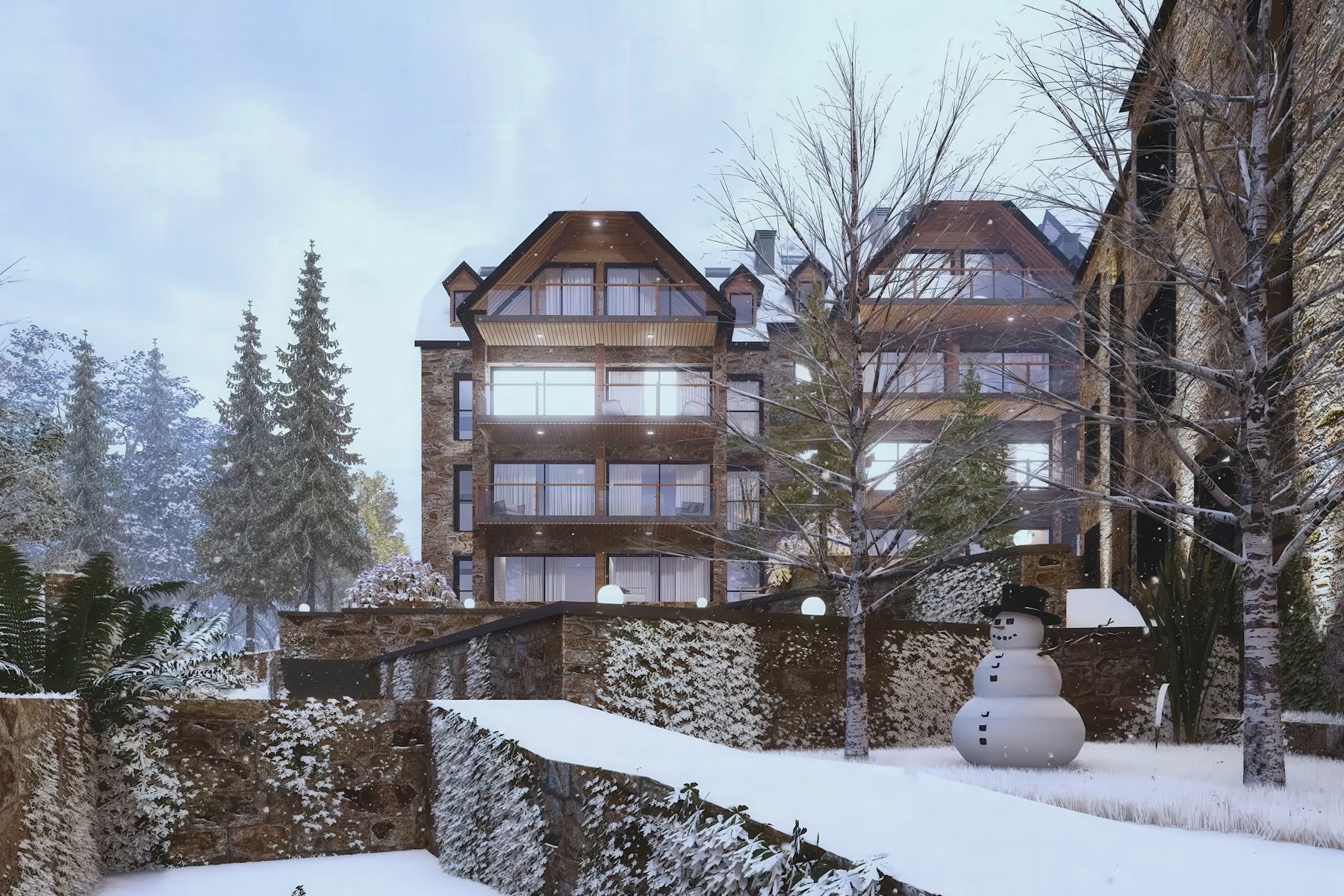
A one-eighth share, under the company's usage system, generally converts into a working allocation of several weeks a year, with peak and quieter weeks rotated fairly across the eight owners over time rather than any one owner being permanently locked out of Christmas or February. For most families it comfortably covers a proper ski season's worth of use without the cost, or the off-season dead weight, of owning the whole property. The resort's north-facing, Atlantic-exposed terrain and its altitude range up to 2,610 metres at Beret keep it more consistent through the winter than lower or more southerly Spanish resorts.
Spring
April is wonderfully underrated: the upper mountain around Beret can still be skiing well into the month while the valley floor is turning green, and crowds thin noticeably once the Easter holidays end. By early May the lifts close for the season and the valley slips into its quietest stretch of the year — hotels and restaurants at the resort base scale back or shut for a few weeks, hiking trails at lower altitude clear of snow well before the high passes do, and the pace of life drops sharply almost overnight. For owners who want the mountains to themselves, or simply a change of pace from a ski holiday, late spring is a genuinely peaceful time to be in the valley, with the Garonne running high on snowmelt and the meadows greening fast.
A note on usage patterns: most owners weight their time towards the winter weeks a share is bought for, but the villages and national park either side of the ski season are part of what a home in Val d'Aran actually offers across a full year — not an afterthought to the main event.
Summer
Val d'Aran's summer identity is built around the Aigüestortes i Estany de Sant Maurici National Park, Catalonia's only national park, whose glacial lakes and high meadows are reachable from gateway villages including Arties and Tredòs. It is serious walking country — multi-day routes between mountain refuges as well as gentler half-day lake walks — and it draws a different, quieter crowd from the ski season's international mix, weighted more towards Spanish and Catalan hikers. Baqueira itself runs an active summer programme on the mountain, with waymarked hiking and an expanding network of mountain-bike trails and circuits laid out across the ski terrain, taking advantage of lift-served access to reach the high ground without the winter's climb. The valley's thermal baths, quiet in the depths of winter, come into their own in summer as a place to recover after a long day on foot or in the saddle, and as a draw for visitors who have no interest in skiing at all.
Culturally, summer brings the valley's most distinctive tradition: the Sant Joan fire festivals around the summer solstice, in which torch-bearers descend from the surrounding peaks to light communal bonfires in village squares — a practice recognised by UNESCO in 2015 as part of the Summer Solstice Fire Festivals of the Pyrenees, and observed locally in villages including Les and Arties, where a great fir trunk known as the Taro is ceremonially burned. August is the busiest month on the valley floor, filled largely with Spanish domestic holidaymakers escaping the summer heat of the plains rather than the international crowd of the ski season, giving the valley a distinctly different, more local character — full restaurants and busy village fiestas rather than crowded pistes.
Autumn
Autumn is Val d'Aran's genuine off-season, and arguably its best-kept secret. The high meadows turn gold, the beech woods lower down the valley colour dramatically, and both the resort base and the smaller villages empty out almost completely between the end of the hiking season and the start of skiing. Restaurants and hotels use the period to close for refurbishment or simply to rest before winter; the thermal baths, again, are one of the few things reliably open, making a warm soak against a backdrop of turning leaves one of the valley's understated pleasures. For an owner who values solitude over social season, or who simply wants to see the mountains without either skis or hiking boots, autumn is worth building into a usage plan rather than treating as dead time.
What does a Baqueira fraction actually cost?
Val d'Aran is the Pyrenees' premier address, and a fraction should be judged against that rather than against a generic holiday-home price. Baqueira is Spain's most established ski address, built on a small, snow-reliable resort, a tightly limited stock of ski-in homes, and demand from Barcelona, Madrid, southwest France and increasingly the UK. What co-ownership changes is not the quality of the address but the size of the cheque and the amount of work involved in keeping it.
What our fractions cost, and what each end buys
Our current Val d'Aran listings run from €120,000 to €195,000 for a one-eighth fraction, across thirteen homes in Baqueira and Bagergue. Every fraction is one-eighth of a specific, named, fully furnished home, and carries roughly six weeks of use a year — around 42 days — allocated across the seasons rather than delivered as one block.
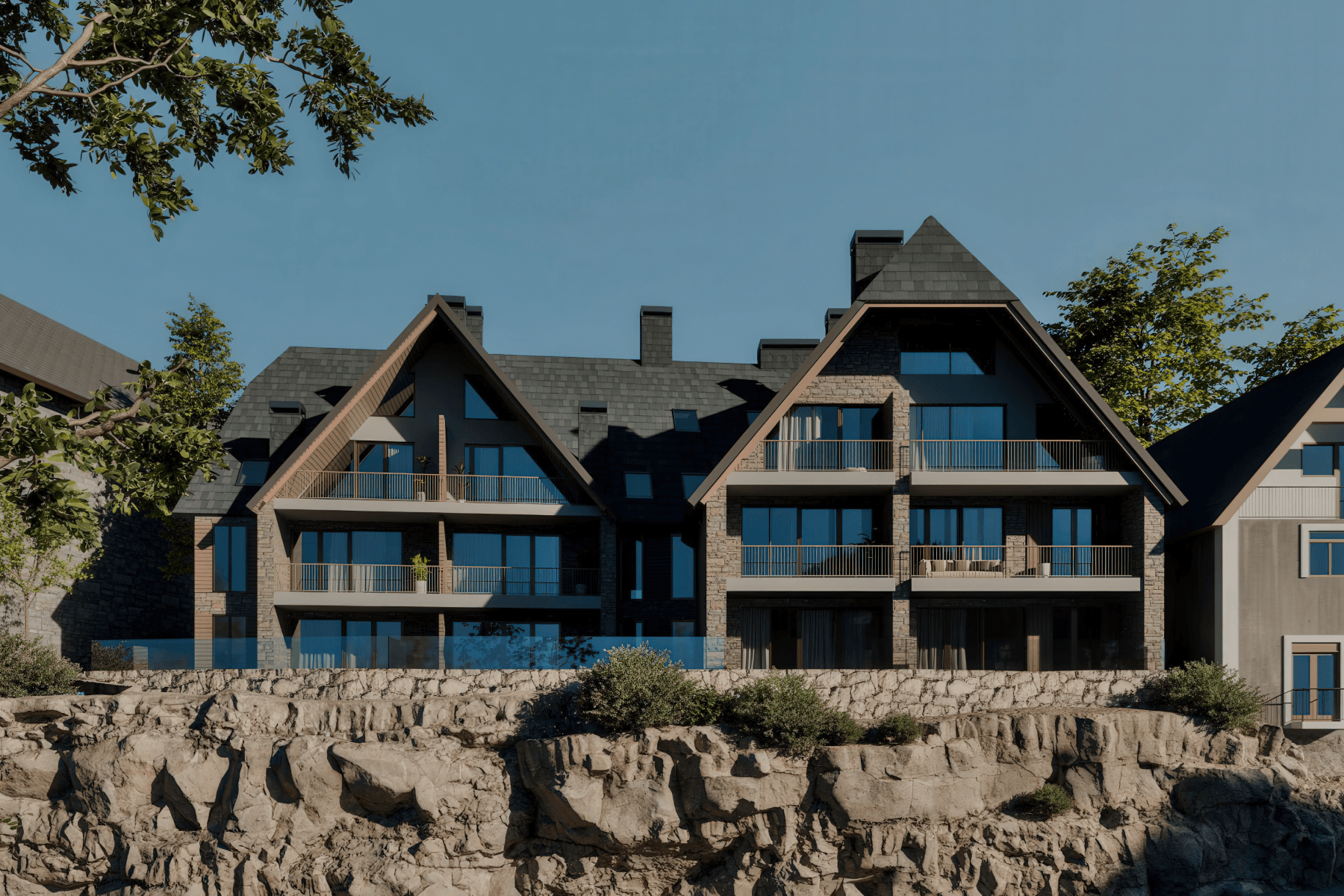
- Towards €120,000 buys into the smaller end of the range: apartments and chalets of roughly 95–125 m² with three bedrooms, either in Baqueira itself or in Bagergue, the stone village above the valley where our one non-resort home sits.
- Towards €195,000 buys into the largest homes on the list — four- and five-bedroom chalets and penthouses of up to 184 m², several of them ski-in/ski-out or a short walk from the Baqueira-Beret lifts, with fireplaces, ski lockers and covered parking.
Price tracks the underlying home rather than a flat rate per square metre: a compact apartment at the foot of the lifts can command as much as a larger house a few minutes' drive away, because in a ski resort proximity to the gondola is the scarce commodity.
What the whole property would cost
The comparison that matters is what it would take to buy the same home outright. Market data for Baqueira and the surrounding Naut Aran communes through 2025 and into 2026 puts asking prices broadly in the region of €3,500–€4,000 per square metre for houses and chalets and €4,500–€5,000 per square metre for apartments, with prime ski-in stock and new penthouses trading well above that. On those broad averages, a whole apartment of the size we list would sit somewhere around €450,000–€600,000, and a whole chalet comfortably into seven figures.
These are rounded market indications as of 2026, and the order of magnitude is the point: co-ownership turns a seven-figure decision into a five-figure one, and turns a house that sits empty for forty-six weeks a year into one that is used, maintained and warm all winter.
Purchase costs
Signing takes place before a Spanish notary.
A conventional resale purchase in Catalonia attracts the regional transfer tax (ITP), which since a reform in force from 27 June 2025 runs on a progressive scale beginning at 10% for values up to €600,000 and rising in bands above that. The treatment of a fractional purchase depends on the home's legal set-up, and our partner confirms the figure for your home before you sign.
Alongside the purchase tax, budget for notary and registry fees on the regulated Spanish scales, and for your own lawyer if you would like one — the company can quote for this, or you can arrange it yourself.
What a fraction does for you financially
A fraction in Baqueira is a lifestyle asset with sound cost logic. Val d'Aran property has held up well over the medium term, and shares in this market have generally resold at or above their purchase price. Where letting is permitted it is managed by the company under the local licensing regime, so treat any rental as a bonus rather than the reason to buy. Buy it because you will ski six weeks a year and would rather own the house than book it.
How fractional ownership works in Val d'Aran
Baqueira-Beret sits inside the Val d'Aran, a Catalan valley with its own language, its own legal traditions, and a snow record that keeps it open longer than most Pyrenean resorts. You own a real share of the home — an eighth, a quarter — not a right to use it. This section covers what you hold, how the calendar works, the taxes involved, and what happens at resale or on death.
How decisions are made
Every purchase completes before a Spanish notary, and every group of eight owners operates under a written agreement specific to that property — the real rulebook. It sets out how the home is used and maintained, how costs are budgeted and collected, how the company is appointed — and may be removed — as administrator, and the voting thresholds for each category of decision. Big decisions are decided together by the co-owners: routine matters, such as the annual budget or minor maintenance, are typically settled by simple majority, and the most fundamental decisions — selling the property or removing the company as administrator — require a supermajority. This power is real, and the thresholds for each home are set out in its agreement.
In short: you own a real share of a specific home in Val d'Aran — an eighth, a quarter — not a right to use it. You can sell it, pass it on to your heirs, and it grows in value with the house.
What you actually own, and why it is not a timeshare
You own a real share of the home — an eighth, a quarter — not a right to use it. You can sell it, pass it on to your heirs, and it grows in value with the house.
It is real property wealth, and the opposite of a timeshare. A timeshare sells you a week — the right to use a resort, or a bundle of points, shared with thousands of others, and typically worth a fraction of what was paid once you try to sell. What you hold here is a real share of one specific home, owned with a small group of up to eight co-owners: its value moves with the home, you sell it on the open market at the price you set, and where passing on a timeshare often means passing on the fees, a share is a home you can leave to your children. If Baqueira property prices rise, the value of your share should reflect that; if the co-owners decide together to sell the home, proceeds are distributed in proportion to each owner's holding. You carry real estate market exposure a timeshare owner simply does not, because you own a share of the home, not a right to occupy someone else's asset for a set period.
Scheduling: six weeks, shared fairly
A fraction carries roughly six weeks a year — around 42 days — spread across the calendar rather than taken as one block. The allocation is designed so that, over time, each of the eight owners gets a fair share of the weeks that matter most: Christmas and New Year, February half-term, and Easter, alongside a broader spread of weeks through the ski season and summer. Because there are only so many peak weeks and eight owners with equal claims on them, these headline periods rotate on a set cycle — an owner with Christmas one year would not expect it again the next — and the co-owners' agreement or the company's booking system sets out exactly how that rotation runs.
Outside the peak rotation, booking generally follows a defined horizon, with owners able to reserve allocated weeks well ahead of the season, and separate rules for non-peak availability. Most schemes also build in flexibility for shorter, spontaneous trips rather than only full-week blocks. The company sets out the specific mechanics for each home.
The Spanish taxes an owner meets
Most routine Spanish property taxes on the home are paid from the annual charge, with each owner bearing one-eighth of the home's relevant costs. Our partner sets out how they apply to you personally before you buy; here is what those taxes are.
- IBI (Impuesto sobre Bienes Inmuebles) is the Spanish municipal property tax, charged annually by the town hall on the property's cadastral value (valor catastral), at a rate set locally. It is paid from the annual charge to owners.
- Non-resident tax obligations. A non-resident individual holding Spanish property directly is typically taxed on imputed income even when unrented. How this applies to you depends on the home's legal set-up and your country of residence, and our partner sets it out before you buy.
- Spanish wealth tax (Impuesto sobre el Patrimonio) is a national tax on net assets, administered regionally. As of 2026, most of Spain applies a general allowance of roughly €700,000 for residents; Catalonia runs its own scale, with a general allowance nearer €500,000 plus a further main-residence allowance, and rates rising gradually with wealth. Catalonia, unlike some regions, has not adopted a full exemption, so its own scale applies here.
- The temporary solidarity tax on large fortunes is a separate national top-up tax that, as of 2026, applies only above net wealth of roughly €3 million, with wealth tax already paid credited against it — a threshold well above the value of a single fraction in a shared home.
For most people buying a single fraction, the value involved sits comfortably below the thresholds where Spanish wealth tax or the solidarity tax become material, and IBI is paid through the shared charge. Thresholds and regional scales are updated in each Spanish budget, so the figures above are a 2026 snapshot.
On transfer tax: buying a whole property in Catalonia currently attracts ITP on a progressive scale starting at 10% and rising with value, under a reform in force since 27 June 2025. That applies to a conventional purchase of a whole property; the treatment of a fractional purchase depends on the home's legal set-up, and our partner confirms it for your home before you sign.
Inheritance
Val d'Aran falls within Catalonia, which has its own civil law tradition and its own succession and gift tax rules, separate from the rest of Spain. Catalonia applies tiered tax relief for close family: a surviving spouse typically receives a very high bonification on the tax otherwise due, and descendants and ascendants also benefit from a bonification plus reductions to the taxable base — though for children and other close relatives the relief steps down as the value inherited rises, rather than staying flat. In practice, family transfers of this kind of asset within Catalonia are often taxed lightly relative to other parts of Europe.
Separately from tax, Spain — including Catalonia — applies forced heirship rules that can restrict how freely a will may dispose of assets, reserving a portion of an estate for close family. Catalonia's own civil law sets a comparatively flexible version of this reserved share for descendants, differing from the general Spanish Civil Code rule applied elsewhere in the country. Where an estate has cross-border elements, the EU Succession Regulation ("Brussels IV") lets a foreign national elect, in a will, for the law of their own nationality to govern succession instead of the law of their habitual residence or the asset's location — a meaningful planning tool that must be drafted correctly to be effective.
Given this interaction of Catalan tax and civil law, Spanish forced heirship, and EU succession rules, a Spanish will dealing specifically with Spanish assets — alongside, not instead of, a will in your home country — is the standard approach. It is a modest cost that materially simplifies matters for heirs, and typically how an election under the EU Succession Regulation is made.
Resale and exit
Fractions are designed to be sold, and they sell. After a typical first-12-months holding period you can sell whenever you choose, at the price you set, usually through the company's own resale channel, which matches sellers with buyers for that property or others like it. The co-owners' agreement typically gives the other seven owners first refusal — often the quickest buyers of all. Hundreds of shares in homes like these have already been resold—in just over three months on average, and nearly three in four for more than the owner paid.
Recent secondary sales of fractions in this market have, in a number of cases, completed quickly and at or above the original purchase price — reflecting the scarcity of well-located Pyrenean homes and rising demand for shared ownership.
Your share of the home does not depend on any single company: the co-owners keep the power to appoint and replace the administrator, and the agreement protects every owner by keeping the shared budget on track.
What a year of ownership actually looks like
Eight owners, one home, six weeks — about 42 days — each a year. Written down like that it sounds tidy, but lived through it feels less like one long annual holiday and more like a set of returns to the same base, scattered across the calendar at different points in the winter and the summer. Some of those returns are a full fortnight, others a long weekend bolted onto a work trip to Toulouse or Barcelona. The shape of an owner's year in Val d'Aran is worth walking through properly, because it's the part that's hardest to picture from a brochure.
How the weeks are chosen
With eight households sharing one property, first pick of the calendar rotates. In practice the company runs an annual rotation, so the weeks each owner holds move around from one season to the next — a family with the second week of February this year is unlikely to have it again next year, but should get a fair run at it again within a few seasons. Most owners end up with a mix: one "prime" week, such as a UK half-term or Christmas–New Year, and one quieter week, often in January or the shoulder weeks either side of the main season. Owners who know each other well sometimes swap privately if a date doesn't work, and the system is built to be fair to everyone over a run of years.
Half-term week versus a quiet January week
These are almost different holidays. In a February half-term week, Vielha's car parks are fuller, the better restaurants want a booking rather than a walk-in, and the pistes carry proper half-term energy — children's ski school groups, a livelier village in the evening, the odd queue at the main gondola on the busiest mornings, though still nothing like an Alpine resort at the same time of year. A quiet January week is a different register entirely: mid-week the resort can feel almost private, the roads are empty, and if there's been a decent dump over Christmas it's often still skiing beautifully with far less traffic on it. Owners who've done both tend to have a preference, and some deliberately angle for the quiet week precisely because it doesn't feel like sharing the mountain with anyone.
Arriving
Most owners fly into Toulouse and either hire a car or are collected, then drive the roughly two to two-and-a-half hours south along the Garonne valley and through the Vielha tunnel — a journey that, in the depths of winter, still has a slightly dramatic feel to it as the road climbs from Toulouse's flat outskirts up into proper mountain country. Others drive the whole way from the UK or from elsewhere in France, treating it as part of the holiday rather than an obstacle to it. Either way, most people build in a stop in Vielha on the way up — the supermarket, the weekly market if the timing lines up, bread, wine, the basics for the first night — before covering the last short stretch up towards Baqueira. Arriving at the home itself is usually the easy part: it's been cleaned and the heating turned on ahead of time, so the first hour is spent unpacking and getting boots and skis sorted for the morning, not scrubbing a kitchen that someone else left in a state.
What stays, and what doesn't
Owners typically keep skis, boots, helmets and other bulky kit in a locked storage area between visits, so there's no need to haul hardware through an airport twice a season. What doesn't stay is anything perishable — the fridge is cleared between owners as a matter of course — and most owners are careful not to leave the place cluttered with personal belongings, given seven other families are using the same rooms and cupboards through the rest of the year. The practical effect is that packing for a week is mostly clothes and toiletries; the boots that fit properly are already there waiting.
Summer is a different holiday altogether
A summer week in Val d'Aran has almost nothing in common with a winter one. There's no snow, obviously, but there's also a different pace to the whole valley — cooler mountain air than the Spanish coast, long light evenings, the Aigüestortes national park within easy reach for proper hiking, lift-served mountain biking on tracks that were pistes five months earlier, and a much quieter, more local feel than the ski season brings. Families who use their share across both seasons often say the summer week ends up being the one they didn't expect to love as much as they do.
Weeks plus spontaneity
In practice, most families treat their allocated weeks as the anchor and build around them. A February week and a quieter January or summer week might be booked months ahead, but many owners also pick up short, spontaneous trips when a gap in the shared calendar and a decent flight fare line up — a long weekend snatched at short notice rather than planned a year out. Over a run of seasons, that combination — a settled fortnight-ish of proper holiday plus the odd opportunistic long weekend — is closer to what six weeks a year in a shared home actually feels like than any single week could be on its own.
Baqueira, the Alps or Andorra: how they compare
Buying a share in a ski home is a different decision from booking a week's rental. You are choosing a valley you will return to for six weeks a year, most years, for a long time to come — so the comparison with the big Alpine names, and with Andorra, deserves a clear-eyed look. Here is how Baqueira–Val d'Aran compares with the major French Alps resorts, Andorra, and — more briefly — Italy and Switzerland. All figures are approximate as of mid-2026.
Ski area size
Baqueira-Beret's own published figures put the resort at around 173km of marked piste across its three linked sectors as of the 2025/26 season — Baqueira, Beret and Bonaigua — spread over roughly 2,166 hectares between about 1,500m and 2,610m. That makes it comfortably the largest ski area in Spain. Les Trois Vallées (Courchevel, Méribel, Val Thorens and their neighbours) links around 600km of piste on some 161 lifts; the Portes du Soleil around Morzine claims a broadly similar figure across a dozen resorts either side of the French–Swiss border; Paradiski (Les Arcs and La Plagne) is usually quoted at around 425km; and Espace Killy, the Val d'Isère–Tignes pairing, runs to roughly 300km. Grandvalira in Andorra, at around 215km, is also comfortably bigger than Baqueira and is the largest ski area in the Pyrenees. If sheer kilometres are your top priority, the biggest Alpine circuits are larger; Baqueira's 173km offers plenty of variety for six weeks a year, with far fewer people on it.
Altitude, snow record and season length
Where Baqueira shines is snow reliability relative to its latitude. It sits on the wetter, northern flank of the central Pyrenees, catching Atlantic weather systems that resorts further into Spain rarely see, and its snow record is genuinely well regarded among people who follow it closely — powder days are reasonably frequent and the resort's snow-cover ratings are consistently strong for a Spanish resort. The season typically runs from late November or early December to late April, broadly in line with mid-altitude Alpine resorts. Andorra's Grandvalira sits at a similar altitude band to Baqueira and leans harder on snowmaking to bridge thin spells; reliable rather than spectacular is the fair summary.
Property prices and the entry cost of a share
This is where Baqueira's case strengthens considerably. Val d'Aran property is currently trading at an average of around €3,700–3,800 per square metre (based on current listings, August 2026), a fraction of the headline Alpine resorts. Chamonix is typically quoted at roughly €8,000–15,000/m² depending on location; Val d'Isère at €12,000–30,000/m²; and Courchevel 1850, the most expensive of the lot, at €18,000–35,000/m² or more for prime addresses. Even mid-market French Alps property averages somewhere around €6,000/m². Andorra sits closer to Val d'Aran on the surface — the principality-wide average was around €4,500/m² at the end of 2025, with Grandvalira parishes such as Encamp and Canillo somewhat below that — but a non-resident buyer there faces a foreign-investment authorisation tax on top of transfer tax that can add up to roughly 10% of the purchase price, a friction that simply doesn't apply to buying in Spain or France as an EU national. Taken together, for a comparable budget a co-ownership share is likely to buy meaningfully more home — or a lower entry cost for the same size of home — in Val d'Aran than in almost any equivalent French or Swiss resort, and somewhat more cleanly than in Andorra once purchase taxes are factored in.
Getting there: flights and drives
The nearest useful airport is Toulouse–Blagnac, roughly 180km and around 2 to 2.5 hours' drive away, following the Garonne valley up through the Vielha tunnel. Barcelona is a further option at 3.5 to 4 hours, and Lleida–Alguaire is closer still, with a seasonal schedule. From the UK, Toulouse is served directly from Heathrow by British Airways several times a day, with some seasonal low-cost options from a handful of other airports. Geneva-served resorts have more UK flight choice; from Toulouse, the drive up the Garonne valley is a scenic start to every stay. For owners travelling from south-west France or Spain, Baqueira is closer to Toulouse than almost any French Alps resort, and closer to Barcelona and Madrid than Andorra's own access points, which mostly rely on the same two airports anyway.
Crowds and the character of the place
Baqueira's reputation among people who ski it regularly is that lift queues are close to non-existent even in peak weeks — a genuine point of difference from the Trois Vallées or Val d'Isère at February half-term, where sheer scale doesn't always save you from a slow access lift on a bluebird morning. Andorra, by contrast, can feel considerably busier: Grandvalira and Pas de la Casa pull heavy day-trip traffic from both Barcelona and Toulouse, plus duty-free shoppers who never put on skis, and Pas de la Casa itself is a purpose-built border town whose character leans towards nightlife and bargain shopping rather than valley life. Beyond the resort base, Val d'Aran is a real, historically distinct valley with its own language (Aranese, alongside Catalan and Spanish), working villages such as Vielha, Escunhau and Salardú, and a year-round population that isn't waiting for the lifts to reopen to have a reason to be there. That's a different proposition from a purpose-built resort, French or Andorran, that essentially shuts for six months of the year.
Food, and Italy and Switzerland in brief
Food is one of Baqueira's genuine strengths and is worth naming directly: the valley has a serious concentration of good restaurants for its size, drawing on Aranese and Catalan tradition rather than standard chalet fare, and it's often cited by people who know the Pyrenees well as one of the better places to eat in the range. Briefly, a fair comparison should at least mention the other two options: the Dolomites in Italy, where Dolomiti Superski links well over 1,000km of piste amid arguably the most spectacular scenery in the Alps, though the transfer from the UK or Spain is longer and more awkward, typically via Venice, Innsbruck or Munich. And Switzerland's big names, Verbier's 4 Vallées or Zermatt, offer superb high-altitude, glacier-backed reliability and genuine cachet, but come with the highest property prices in this comparison and Switzerland's own restrictions on foreign property purchase (the Lex Koller regime), which complicate buying there as a non-Swiss owner.
Ownership and tax, at a high level
One structural point favours Val d'Aran. Spain and France are both EU and Schengen members, so a share bought in Val d'Aran or in the French Alps sits inside familiar EU property law and, for EU nationals, familiar residence rules. Andorra is not in the EU and is not formally part of the Schengen area, even though its land borders with France and Spain function openly in practice; non-resident buyers there need foreign-investment authorisation and pay meaningfully higher purchase-related tax than they would in Spain or France. It is a real difference in the paperwork and the purchase tax bill.
| Destination | Ski area (approx.) | Altitude | Property price (approx., 2026) | Nearest airport & transfer | Character in short |
|---|---|---|---|---|---|
| Baqueira–Val d'Aran (Spain) | ~173km | 1,500–2,610m | ~€3,700–3,800/m² (Val d'Aran avg.) | Toulouse, ~2–2.5hrs drive | Quiet lifts, snow-sure for its latitude, a valley with its own life |
| Andorra (Grandvalira / Pas de la Casa) | ~215km | ~1,700–2,640m | ~€3,200–4,500/m² + non-resident purchase tax to ~10% | Barcelona or Toulouse, ~2.5–3hrs | Bigger and busier; non-EU; Pas de la Casa is a border/duty-free town |
| Trois Vallées (Courchevel, Méribel, Val Thorens) | ~600km | 1,100–3,230m | ~€18,000–35,000+/m² (Courchevel 1850), lower elsewhere in the valley | Geneva or Chambéry, ~1.5–2.5hrs | Vast terrain and prestige; still queues at peak; among Europe's priciest |
| Espace Killy (Val d'Isère, Tignes) | ~300km | up to ~3,450m | ~€12,000–30,000/m² | Geneva or Chambéry, ~2–2.5hrs | High-altitude, glacier-backed reliability; big-resort feel; high prices |
| Chamonix | ~170km on-piste, plus renowned off-piste/glacier terrain | 1,035–3,842m | ~€8,000–15,000/m² | Geneva, ~1hr | Real historic mountain town; freeride mecca; less piste variety than the Trois Vallées |
| Portes du Soleil (Morzine) | ~600km across a dozen linked resorts | ~1,000–2,275m | ~€6,000–9,000/m² (indicative) | Geneva, ~1hr | Big linked area, genuine village; lower altitude means more snow risk |
| Dolomites (Italy) | 1,000km+ (Dolomiti Superski) | ~1,000–3,000m | varies widely by valley | Venice, Innsbruck or Munich, ~2–3hrs | World's largest lift-linked network; spectacular scenery; longer, more complex transfer |
| Swiss Alps (Verbier / Zermatt) | ~410km (4 Vallées) or smaller but glacier-fed at Zermatt | up to ~3,900m | among the highest in the Alps; foreign-ownership restrictions apply (Lex Koller) | Geneva, ~1.5–2.5hrs | Superb snow-sure high-altitude skiing; the priciest and most restricted option here |
So where does that leave Baqueira?
The biggest Alpine circuits offer more kilometres, and Geneva more flights. What Baqueira wins on is harder to put a single number on but no less real for that: a snow record that outperforms its latitude, lift queues that Alpine owners would consider a small miracle, a genuinely good food scene, purchase prices that make a share go considerably further, and — perhaps the most underrated point of all — a valley that has its own life outside the ski season, rather than a resort built purely to be skied and otherwise switched off.
Who buys fractional property in Val d'Aran?
Val d'Aran has never been an anonymous ski valley. It is where the Spanish royal family has skied for decades — King Felipe VI, like his father before him, has been photographed at Baqueira most seasons — and that association helped make the resort a fixture for well-off Catalan and Madrid households long before co-ownership existed as a category. It still shapes who buys here.
Spanish families with a long tie to the valley
The largest group is domestic: families from Barcelona and Madrid who have skied Baqueira for a generation and want a permanent foothold rather than another winter of booking. For them a fraction solves a specific problem — a whole chalet in Baqueira is now hard to justify for six weeks' use and a long drive away, while an eighth of a good one is not.
French buyers, over the top of the Pyrenees
Val d'Aran drains north into France, and the Vielha tunnel puts Toulouse a little over two hours away — closer in practice than Barcelona for much of the winter. Families from Toulouse and the wider Occitanie have treated the valley as their nearest serious ski destination for years, and a fraction turns a familiar drive into an owned address.
British and northern European skiers looking past the Alps
A smaller but growing group knows the French and Swiss Alps well and comes to Baqueira for the Atlantic snow record, the shorter lift queues and prices that still read as sane next to Courchevel or Verbier. For a British buyer, the 90-day Schengen limit also makes a managed six-week allocation a rather neat fit rather than a compromise.
Long-term renters who have done the sums
The fourth profile is the family that has rented the same kind of Baqueira apartment for five winters running, knows it will keep coming back, and would rather hold an asset than keep paying peak-week rates for someone else's.
Two families buying together
A pattern we see often in the Pyrenees, and rarely elsewhere: two families who already ski together buy two of the eight fractions in the same home, coordinate their weeks so the children overlap in half-term, and treat the arrangement as a shared chalet without the awkwardness of jointly owning one. Because the fractions are separate interests, neither family is financially entangled with the other beyond the shared home, and either can sell without asking permission of the other.
Owners of a summer home adding a winter one
A meaningful share of enquiries here come from people who already hold a fraction on the Spanish coast or the Balearics and want the other half of the year. The logic is straightforward — a coastal home is used in July and August, a ski home in January and February, and between them a family covers most of the year's holidays without either property standing idle in its own high season. Where both are held through the same company, the practical business of scheduling and paying for two homes is handled in one place.
Is it right for you?
Co-ownership is for people whose winters already have a shape — families with a genuine, repeatable reason to be in Val d'Aran most seasons. If that is you, a share gives you the home, the weeks and the asset, without the cost of a whole chalet standing empty for most of the year.
How does buying through Co-Ownership Property work?
We are a specialist introducer, not the owner or manager of any home on this site. Our job is to help you compare what is actually available across the Pyrenees and beyond, and then put you in front of the company that owns and runs the home you want. You pay us nothing at any stage — we are paid by the company when an introduction results in a completed purchase.
- Browse and shortlist. Every listing here is a specific, named home with its own photographs, size, layout and fraction price — not a generic example of what might be available.
- Enquire and talk it through. Tell us what you need — how many bedrooms, how close to the lifts, which weeks matter most — and we will tell you which of the thirteen fit best.
- Introduction to the company. We register your interest and introduce you to the team that owns and manages the home. From there they lead on the detail: the legal set-up, the scheduling calendar, the documentation.
- See the home. In person if you can — ideally on a ski trip, so you can test the walk to the gondola — or by video walkthrough if you cannot. Ask to see the current owners' allocation calendar while you are at it.
- Reserve. A reservation takes the fraction off the market while documents are prepared.
- Complete before a notary. Signing takes place before a Spanish notary: the transfer of your share of the home, together with the co-owners' agreement that governs scheduling, costs and decisions. You will need a Spanish NIE number, which the company or your lawyer can arrange, and completion by power of attorney is routine if you cannot travel.
- Handover. You are added to the ownership and booking system, your first weeks are confirmed, and the company takes over the house between visits.
What you will need, practically
Three practical steps, all easily handled if you start them early:
- An NIE number — the Spanish foreigner's identification number, required for any property or company transaction. It can be obtained through the Spanish consulate in your country or in Spain itself; the company or your lawyer will normally arrange it, and it typically takes a few weeks rather than days.
- A Spanish bank account is not always essential but makes the annual charge and any local payments considerably simpler.
- Power of attorney — if you cannot be in Spain to sign, a notarised power of attorney lets your lawyer complete on your behalf. This is entirely routine for international buyers, and worth arranging in parallel with the NIE rather than after it.
What the company walks you through
Before you reserve, the company takes you through:
- How the week rotation works on this specific home, and who holds Christmas and February half-term in the first two years.
- What the annual charge covers, and how it has moved over the past three years.
- The tax position on the purchase of your share.
- Whether letting is permitted on this property, and on what terms.
- How many fractions in this home are already sold.
- How the resale process works, and what has sold in this building or valley.
How long it takes
From first enquiry to completion, a straightforward purchase in Val d'Aran usually runs to a few weeks rather than months — the home is already bought, furnished and operating, so there is no construction risk and no chain. The realistic timetable is set by how quickly your NIE comes through and how soon you can get to a notary, in person or by proxy. Buyers who start the paperwork while they are still deciding tend to complete a month or so sooner than those who wait.
Afterwards, a fraction can be sold on — typically through the company's own resale channel, with your co-owners getting the first chance to buy at your price — and can be left to your heirs like any other Spanish asset.
Where to go from here
Our thirteen Val d'Aran listings are shown above with their current fraction prices, sizes and locations, and each one links through to full details and photographs. If you would like to talk it through — which village suits you, which homes have real ski-in access, how the week rotation works on a specific property — send an enquiry on any listing, or contact us directly.
Baqueira sits within our wider Pyrenees and Spain portfolios, and pairs naturally with a summer share on the coast — several owners hold one mountain home and one by the sea. If you are still comparing ranges, the French Alps pages cover the obvious alternative, at a different price point.
Questions & Answers
Baqueira & Val d'Aran Fractional Ownership — Frequently Asked Questions
You view listings and floor plans, then register interest and are connected with the team managing the specific home. After a viewing, in person or virtual, you agree a price and pay a reservation deposit to take the property off the market. Your lawyer reviews the ownership documents, you obtain a Spanish NIE number, and completion takes place before a notary, either in person or by power of attorney. You acquire a real one-eighth share of the home — the legal set-up is arranged by our partner and walked through with you before you buy — and the company then takes over scheduling, maintenance and bookings for your weeks.
Yes. Spain places no nationality restriction on buying property, so Britons, Americans and other non-EU nationals buy a one-eighth share in Baqueira or Bagergue exactly as EU citizens do. You will need a Spanish tax identification number (NIE), which your lawyer or the company can help arrange. Non-residents have their own rates on income, capital gains and wealth tax, so a quick check with an adviser in your home country is worthwhile. Your weeks of use fit comfortably within the Schengen 90-in-180-day rule for British and American visitors.
Yes. Buyers typically grant a power of attorney to a Spanish lawyer — signed at a Spanish consulate or before a local notary and apostilled — so completion takes place at the notary's office in Spain without you needing to be there. Your NIE can often be obtained remotely or via the consulate, and funds are transferred ahead of completion. Some buyers enjoy attending in person for their first purchase, but remote completion is common and well established for cross-border Spanish purchases.
It is not required, but we warmly recommend it — and it is the perfect excuse for a ski trip. Photos and floor plans show the layout and finish; a visit lets you feel the walk to the lifts, the views and the village itself. The company can usually arrange a viewing alongside a ski trip. If travel is not possible, a video walkthrough and detailed floor plans work well, with your lawyer handling the legal checks.
The notary is an independent Spanish public official who authorises and witnesses the signing of your purchase. They check the identities of buyer and seller, review the documentation, read the deed aloud and confirm the taxes due, giving you a secure, officially recorded completion. Most buyers also instruct their own Spanish lawyer to carry out the checks beforehand.
Yes. A one-eighth share can be bought jointly by two or more people — spouses, civil partners or friends buying together. The purchase documents record joint ownership in equal parts or in the proportions you choose. Because Spanish inheritance law does not automatically mirror UK arrangements, agree with your lawyer how the purchase is recorded and make a will that reflects your wishes.
Both are wonderful; it comes down to whether you favour ski-in/ski-out convenience or village charm. Baqueira itself sits at the resort's core, often just steps from the lifts, and tends to command the higher end of the roughly €120,000–€195,000 share-price range (as of 2026) for its immediacy to the pistes. Bagergue is a small, traditional Aranese village a short drive or shuttle from the lifts, with stone architecture and a quieter, more local feel, and can offer relatively more space or a lower entry price for a similarly sized share. Both sit within the same Val d'Aran ski area, so the choice is really about lifestyle rather than access to skiing.
You own a real share of the home — an eighth, a quarter — not a right to use it. You can sell it, pass it on to your heirs, and it moves with the value of the house. It is not a timeshare or a membership: your share is real, transferable and inheritable, and its value tracks the home itself.
Your home stays yours. Each home belongs to its co-owners — you and the other seven — not to the company, so if a company ever ceased trading, the co-owners would simply appoint a new manager or arrange the running of the home themselves. The home, and your share of it, carries on independently of who manages it.
Yes. A one-eighth share is a real property asset and is inherited like any other Spanish real estate, under a Spanish will or an EU cross-border succession election. Catalonia has its own inheritance tax reliefs and rates for close family, so making a Spanish will alongside your UK one, with a cross-border specialist, keeps everything simple for your heirs.
The taxes on your share are confirmed in writing for your specific purchase before you sign, alongside notary, registry and legal fees. For context, buying a whole resale home in Catalonia attracts transfer tax (ITP) on a progressive scale starting at around 10%, under reforms in force since June 2025; a fractional share can be assessed differently, depending on how the home is set up, so your own figure comes from the company and your Spanish tax adviser.
Yes, and it is handled for you. IBI (Impuesto sobre Bienes Inmuebles) is the annual municipal property tax on Spanish homes, based on the official cadastral value. Rates are set by each Val d'Aran municipality, and the figure for your home is included in its budget.
Very unlikely from a share alone. As of 2026, non-residents have an individual allowance of around €700,000 against Spanish-sited assets before wealth tax applies, and a single share priced between roughly €120,000 and €195,000 sits well under that. If you or your spouse hold other significant Spanish assets, a Spanish tax adviser can confirm the combined position.
Tax is due only on a gain, and it is straightforward to plan for. The treatment depends on how the home is set up and on your country of tax residence, so keep a record of your purchase price and costs and have a Spanish tax adviser confirm the figure ahead of your sale.
Often, yes — through a different route from a conventional mortgage. Mainstream Spanish lenders do not usually lend against a fractional share, but companies in this market typically have financing partnerships that do, for example lending secured against an investment portfolio rather than the property, sometimes covering the full price of a share, similar in principle to a Lombard loan. Ask the company which options suit your home and circumstances.
On some homes, yes. Where letting is permitted, our partner manages the bookings for a commission and pays the income to you. Val d'Aran is limiting tourist rental licences to protect local housing, so most owners here buy for their own ski weeks rather than for income; each listing confirms whether letting is available on that home.
Yes. You let the company know in advance and they arrange access, cleaning and check-in exactly as they would for you. Lending or gifting your weeks to family and friends is one of the joys of ownership. Some companies ask for basic guest details for security and insurance, and the guest-use rules for your home are set out before you buy.
Pet policies are set home by home, in each home's ownership agreement. Some homes welcome well-behaved pets, others are pet-free — tell us early if you travel with a dog and we will confirm the policy for the homes you like.
Yes, often. Prime weeks rotate fairly between the eight owners year to year, and owners can usually swap dates directly with each other through the booking system. Where the company manages other homes, some also offer stays at another home — a lovely extra. Outside the busiest weeks, such as Christmas and February half-term, there is plenty of flexibility.
Yes. These homes are sold fully furnished and turnkey, so you arrive and start your holiday. Many include a dedicated ski or boot room, and some buildings offer lockers or shared storage where you can leave skis, boots and personal items between visits. Each listing shows what is included, and we can confirm storage for any home you like.
Easily. After an initial holding period of around 12 months, you set your own asking price and sell via the company's resale channel, with your co-owners usually having first refusal. Shares sell: a share in a sought-after market resells on the same timeline as a whole home there, and hundreds of shares in homes like these have already been resold — in just over three months on average, and nearly three in four for more than the owner paid.
Your share moves with the value of the home and the wider Val d'Aran market, which has seen strong demand in recent years thanks to limited new-build ski property and growing interest in Baqueira as a destination. Above all, a share gives you your own weeks in a superbly located ski home for a fraction of the cost of buying outright — and you benefit when the home rises in value.
For families who ski most years and love returning to the same place, yes. A one-eighth share gives you around six weeks, roughly 42 days, a year in your own home, with peak periods rotated fairly, and no more rebooking a comparable Baqueira chalet at market rates each season. Renting suits those still trying different resorts; owning suits those who already know this is where they want to keep coming back.
Toulouse is the main gateway airport, roughly two hours fifteen minutes' drive away, with a wide range of direct flights from UK airports and some seasonal budget routes; Barcelona is a secondary option, but the drive is longer, at around three hours forty-five minutes. Many owners fly into Toulouse and either self-drive or book a private transfer, which the company or local companies can usually arrange. A car is not essential if you are staying ski-in/ski-out and happy to stay close to the resort, since most accommodation is within walking distance of the lifts, and a car makes it easy to explore Vielha, Bagergue and the other villages.
The season generally runs from late November or early December through to early or mid-April, so roughly nineteen to twenty weeks in a typical year, though exact opening and closing dates depend on snowfall and are confirmed closer to each season. The busiest, most sought-after weeks are Christmas and New Year, the February half-term school holiday weeks, and the fortnight around Easter, when both snow conditions and resort atmosphere tend to be at their best. Outside those windows, particularly in January and late March, the slopes are quieter and lift queues shorter — a favourite with many owners.
A rotating calendar shares the most popular weeks fairly. Christmas and New Year, February half-term and Easter are split and rotated between the eight owners on a multi-year cycle, so over time everyone enjoys a fair mix of peak and quieter periods. Some homes combine the rotation with a request-and-priority booking window for remaining weeks, and you see the calendar for your home before you buy.
Val d'Aran turns into a genuine summer destination, with hiking, mountain biking, via ferratas, fishing and rafting on the Garonne river, plus the resort's own lift-served trails. The Aigüestortes i Estany de Sant Maurici National Park, Catalonia's only national park, is a scenic drive away in the wider Pyrenees, known for its glacial lakes and waterfalls, and makes for a popular day trip from Baqueira or Bagergue in the warmer months. Summer weeks tend to be quieter and more flexible to book than the ski season, and many owners use them for exactly that reason, alongside their winter weeks in the annual allocation.
Ski storage is often part of the shared facilities — typically a boot room or lockers close to the home or the lifts — so you can leave your equipment in Baqueira between trips. Lift passes are bought separately for the dates you stay, as on any ski holiday, and some resorts and companies offer discounted local passes for owners.
Also Explore
Get in Touch
Speak to an expert
Tell us what you're looking for and we'll be in touch.