Co-Ownership Basics
Cómo la PropTech está haciendo de la copropiedad la forma más inteligente de tener una segunda residencia
Descubra cómo la PropTech — desde las apps de reserva hasta los sistemas de hogar inteligente — está haciendo de la copropiedad la forma más fácil y rentable de tener una segunda residencia de lujo en 2026.

A decade ago, the biggest objection to co-owning a holiday home was logistics. How would multiple owners coordinate schedules? Who would handle maintenance calls at midnight? What happens when the dishwasher breaks and nobody is there? These were legitimate concerns — and for years they kept affluent buyers locked into the expensive, wasteful cycle of full second-home ownership. Today, those objections are obsolete. A wave of property technology — collectively known as PropTech — has transformed co-ownership from a logistical challenge into the most seamless form of luxury property ownership available.
The global PropTech market reached $47 billion in 2025 and is projected to hit $209 billion by 2035, according to Precedence Research — a compound annual growth rate of over 16%. Much of that growth is being driven by exactly the kind of tools that make co-ownership effortless: smart-home sensors, AI-driven property management, cloud-based booking platforms, and automated maintenance systems. For buyers exploring co-ownership properties, the technology story is no longer a footnote — it is the central reason why shared ownership now works better than sole ownership for the majority of second-home buyers.
The Problem PropTech Solves
Why Full Second-Home Ownership Was Already Broken
Before examining how technology enhances co-ownership, it is worth understanding the problem it solves. The average second home sits empty for more than 300 days per year. During those vacant months, owners still pay mortgage interest, property taxes, insurance, utilities, and maintenance — costs that Kiplinger estimates at $24,500+ annually on top of the purchase price. That is a staggering amount of money for a property that generates no income and no enjoyment for ten months of the year.
Maintenance is particularly brutal for absentee owners. Pipes freeze, gardens overgrow, appliances fail, and security systems need updating — all while the owner is hundreds or thousands of miles away. A 2024 study by Real Estate Witch found that American homeowners spend an average of $8,800 per year on maintenance and repairs, with luxury properties commanding significantly more. For a sole owner of a villa on the Costa del Sol or a chalet in the French Alps, these costs are borne entirely alone.
Co-ownership splits these costs proportionally — a 1/8th share means 1/8th of every bill — but it also introduces coordination complexity. This is precisely where PropTech steps in, automating every point of friction that once made shared ownership cumbersome.
$47B
Global PropTech market size in 2025, projected to reach $209B by 2035 (Precedence Research)
21.1B
Connected IoT devices worldwide in 2025, up 13% year-over-year (IoT Analytics)
$164B
Global smart home market value in 2026, expected to double by 2031 (Mordor Intelligence)
16.1%
Compound annual growth rate of the PropTech market from 2026 to 2035
Booking & Scheduling
One-Tap Booking Apps That Eliminate Owner Conflict
The most visible piece of co-ownership technology is the booking platform. Modern co-ownership providers use proprietary apps that allow each owner to reserve their stays from two days to two years in advance. There are no fixed weeks, no rotation schedules, and no awkward phone calls to other co-owners. The system balances access automatically, ensuring every shareholder gets their fair allocation of approximately 45 days per year for a 1/8th share.
These platforms use intelligent algorithms to optimise availability. If peak-season demand is high, the system can flag alternative dates, suggest shoulder-season stays, or notify owners when a preferred window opens up. The result is a frictionless experience that feels less like sharing a property and more like having a dedicated concierge manage your holiday calendar. When you explore properties through all our homes, every listing operates on this kind of smart booking infrastructure.
What makes this transformative is the contrast with sole ownership. A full owner of a holiday home must manage their own calendar, arrange key handovers if they lend the property to friends, and coordinate with any rental management company. Co-ownership apps handle all of this automatically — and the technology keeps improving. AI-powered scheduling tools now predict owner preferences based on past booking patterns, pre-loading suggestions before you even open the app.
PropTech Market Growth Projections (USD Billions)
2024 (Actual)
2025 (Actual)
2026 (Projected)
2028 (Projected)
2030 (Projected)
2035 (Projected)
Smart Home Systems
IoT Sensors and Smart Home Tech Keep Properties Perfect
The Internet of Things has fundamentally changed what it means to manage a property remotely. Today’s luxury co-ownership homes are equipped with a network of smart sensors and connected devices that monitor everything from indoor temperature and humidity to water leaks, energy consumption, and security breaches — all in real time.
According to a 2025 IoT Analytics report, the total number of connected IoT devices grew 13% year-over-year to 21.1 billion globally. In the property management space, this translates to smart thermostats that learn seasonal patterns and pre-condition homes before an owner arrives, leak detectors that alert maintenance teams before a drip becomes a flood, and noise-monitoring systems that reduce the risk of property damage by up to 40% in rental scenarios. Smart locks eliminate key management entirely — owners receive a secure digital code that activates only during their stay.
For co-ownership properties across destinations like the Balearic Islands or Colorado, these systems are not optional extras — they are standard. The smart home market reached $164 billion in 2026 according to Mordor Intelligence, and co-ownership providers are among the earliest adopters because the technology solves the core challenge of multi-owner property care. Every owner benefits from a home that is constantly monitored, regardless of who is currently in residence.
“Technology has not just improved co-ownership — it has fundamentally redefined what is possible. Today’s co-owner enjoys a level of property management, financial transparency, and booking convenience that most sole owners can only dream of.”
AI Property Management
How Artificial Intelligence Is Replacing the Caretaker Model
Traditional property management relied on a local caretaker — someone who would check on the house periodically, call a plumber when something broke, and hopefully remember to turn the heating on before the owner arrived. This model was expensive, unreliable, and entirely dependent on one individual’s attentiveness. AI-driven property management platforms have replaced this model entirely.
Modern systems use predictive maintenance algorithms that analyse sensor data to anticipate problems before they occur. A smart HVAC system that detects declining efficiency can automatically schedule a service appointment. A water usage anomaly at 3am triggers an immediate alert to a 24-hour maintenance team. Seasonal tasks — gutter clearing, pool winterisation, garden irrigation adjustments — are scheduled automatically based on local weather data and property-specific histories.
For co-ownership explained in practical terms, this means every owner arrives to a home that has been proactively maintained, not reactively patched. The property management company coordinates everything centrally using these AI tools, and the cost is split among all co-owners. A full owner would pay 100% of the management fee for a property they use perhaps 30 days a year. A co-owner pays 12.5% — and gets the same level of service, powered by better technology than most sole-owned properties will ever have.
| Technology | What It Does for Co-Owners | Available Now? |
|---|---|---|
| Smart Booking Apps | Reserve stays 2 days to 2 years ahead — no fixed weeks, no conflicts | Yes — standard |
| IoT Sensor Networks | 24/7 monitoring of temperature, humidity, leaks, and security | Yes — standard |
| AI Predictive Maintenance | Anticipates problems before they occur, auto-schedules repairs | Yes — leading providers |
| Digital Owner Dashboards | Real-time cost tracking, usage history, and rental income reporting | Yes — standard |
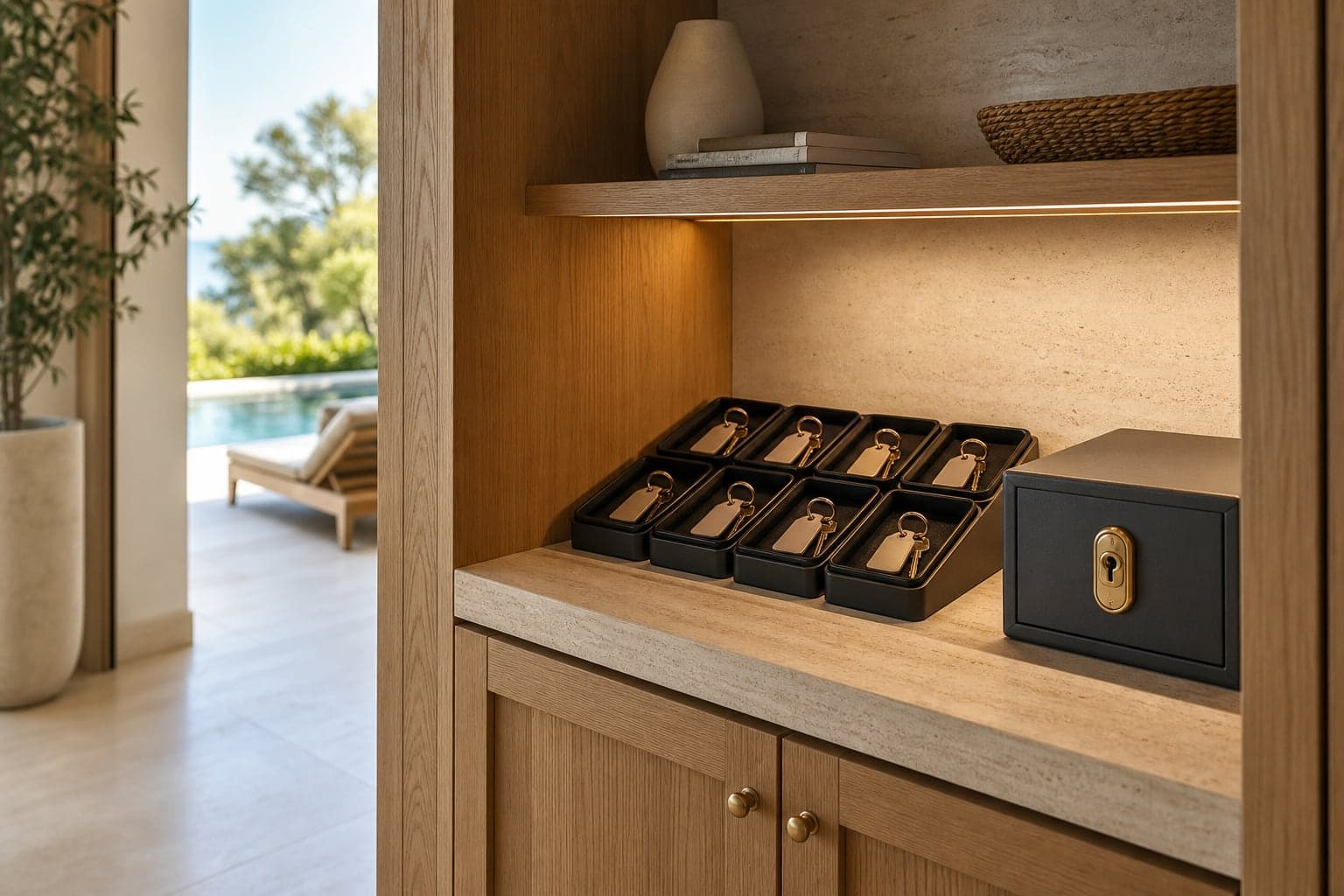
| Smart Locks & Access | Secure digital codes replace physical keys, activated per stay | Yes — standard |
| Blockchain Ownership Records | Immutable digital ledger for share transfers and transaction history | Emerging — pilot stage |
Market Intelligence
The PropTech Revolution in Numbers
The scale of PropTech investment tells its own story about where the real estate industry is heading. Venture capital funding into PropTech companies exceeded $14 billion in 2024, with property management platforms and fractional ownership infrastructure among the fastest-growing segments. According to Fortune Business Insights, the PropTech market is expanding at a CAGR of 11.9%, driven by adoption of AI, IoT, cloud platforms, and blockchain-based ownership records.
This investment is not speculative — it responds to clear demand. The National Association of Realtors identified PropTech adoption as one of the top trends real estate professionals cannot afford to ignore in 2026. For co-ownership specifically, technology has solved the trust problem: transparent digital records show exactly when each owner used the property, what maintenance was performed, and how costs were allocated. Everything is auditable, accessible, and automatic. Buyers considering the buying process can see precisely how technology underpins every step, from reservation to resale.
2015-2017
Early Digital Booking
First co-ownership platforms introduced online calendars, replacing spreadsheets and phone-call scheduling between owners.
2018-2019
Smart Home Integration Begins
IoT sensors and smart locks introduced to co-owned properties, enabling remote monitoring and keyless access for the first time.
2020-2022
The Pandemic Acceleration
Remote work and travel restrictions drove a surge in PropTech investment. AI property management tools became mainstream as demand for second homes exploded.
2023-2024
AI-Powered Management Matures
Predictive maintenance, automated owner dashboards, and integrated financial reporting became standard features across leading co-ownership providers.
2025-2026
The Seamless Ownership Era
PropTech market surpasses $47B. Smart homes, AI scheduling, and blockchain pilots converge to make co-ownership indistinguishable from sole ownership in experience — at a fraction of the cost.
Owner Experience
What Arrival Day Actually Looks Like With PropTech-Enabled Co-Ownership
Technology only matters if it improves the lived experience. Here is what arrival day looks like for a co-owner of a luxury property managed with modern PropTech: 48 hours before arrival, the smart-home system activates climate control, adjusting heating or cooling to the owner’s preferred temperature. The property management team receives an automated notification and dispatches a cleaning crew. Fresh linens are placed, the owner’s personal belongings are retrieved from secure on-site storage and arranged throughout the home.
On arrival day, the owner receives a digital access code on their phone. The smart lock opens the front door. Inside, every light, appliance, and entertainment system is ready. The Wi-Fi password, local restaurant recommendations, and emergency contacts are available in the booking app. If anything needs attention — a flickering lightbulb, a question about the espresso machine — a single tap in the app creates a maintenance ticket that is typically resolved within hours.
This is not a hypothetical scenario. This is the standard experience across co-ownership villas and chalets and co-ownership apartments listed through quality co-ownership providers. Technology has made shared ownership feel indistinguishable from staying in your own private home — because it is your own private home. You simply share the cost and the calendar with seven other owners who enjoy the same seamless experience.
Financial Transparency
Digital Dashboards and Real-Time Cost Tracking
One of the most underappreciated PropTech innovations for co-owners is financial transparency. Cloud-based owner dashboards provide real-time visibility into every cost associated with the property: quarterly maintenance expenses, annual tax obligations, insurance renewals, utility bills, and — where applicable — rental income from periods when the property is offered as a holiday let.
This level of financial clarity was impossible with traditional second-home ownership, where costs tended to arrive as unpleasant surprises. Co-ownership dashboards show each owner their precise share, with historical comparisons and projected annual costs. For buyers researching the running costs of a co-ownership property, this transparency is a decisive advantage. You know exactly what you are paying, every quarter, with no hidden charges.
Some platforms now integrate with personal finance apps, allowing owners to categorise their co-ownership expenses alongside other investments. For those building a diversified property portfolio — perhaps combining a mountain lifestyle ski property with a beach lifestyle coastal villa — this unified view helps assess total exposure and returns across multiple co-ownership shares.
Security & Trust
Blockchain, Digital Deeds, and the Future of Ownership Records
The next frontier for PropTech in co-ownership is blockchain-verified ownership records. The Deloitte Center for Financial Services projects that $4 trillion worth of real estate could be tokenised by 2035, up from under $300 billion in 2024. While co-ownership through established providers already uses robust legal structures — typically an LLC that holds the property deed — blockchain adds an additional layer of immutable, transparent record-keeping.
For co-owners, this means ownership stakes, transaction histories, and share transfers can be recorded on a permanent digital ledger that cannot be altered or disputed. It also opens the door to faster resale processes. Currently, selling a co-ownership share takes around one month on average — already dramatically faster than selling a full property. Blockchain-enabled transfers could reduce this to days. Buyers interested in selling a co-ownership share are already benefiting from digital-first processes that streamline the entire exit.
Institutional investors are taking notice. By 2026, institutional allocations to tokenised real assets are expected to reach 5.6% of portfolios, according to 4irelabs research. This institutional interest validates the co-ownership model and drives further technology investment into the platforms that support it.
Common Questions
Frequently Asked Questions
How does the booking app work for co-owners?
Each owner downloads a dedicated app that shows real-time availability for their property. You can book stays from 2 days to 2 years in advance. There are no fixed weeks or rotation schedules — the system uses intelligent algorithms to balance access fairly among all co-owners, typically allocating around 45 days per year for a 1/8th share.
What smart home technology is included in co-ownership properties?
Most professionally managed co-ownership properties include smart thermostats, IoT leak and humidity sensors, smart locks with digital access codes, security cameras or alarm systems, and energy management tools. These systems run 24/7 regardless of occupancy, ensuring the property is always monitored and maintained.
Do I need to coordinate with other co-owners about maintenance?
No. The property management company handles all maintenance centrally, using AI-powered systems to predict and schedule repairs. You never need to contact or coordinate with other co-owners — everything from cleaning to emergency repairs is managed on your behalf, and costs are split proportionally among all owners.
How transparent are the running costs in a co-ownership arrangement?
Very transparent. Digital owner dashboards provide real-time access to every expense — maintenance, taxes, insurance, utilities, and rental income. You can see your exact share each quarter, compare costs year-over-year, and track projected annual expenses. There are no hidden charges.
Is blockchain technology already being used in co-ownership?
Blockchain is in the early adoption phase for co-ownership records. Currently, most co-ownership structures use established legal entities (LLCs) with conventional deeds. Blockchain adds an extra layer of transparency and may accelerate share transfers in the future. The underlying legal ownership structure remains robust regardless of blockchain adoption.
How does co-ownership technology compare to managing a property myself?
Co-ownership technology typically exceeds what most individual owners implement. Professional co-ownership providers invest in enterprise-grade IoT systems, AI maintenance platforms, and dedicated booking infrastructure — tools that would be prohibitively expensive for a single property owner. You get better technology at a fraction of the cost.
Experience PropTech-Powered Co-Ownership
Every property in our portfolio is managed with cutting-edge technology — smart home systems, AI-powered maintenance, and seamless booking apps. Discover luxury co-ownership shares starting from under €100,000.
Browse PropertiesMás de Co-Ownership Property

Contáctanos
Habla con un experto
Cuéntanos qué buscas y uno de nuestros especialistas en copropiedad se pondrá en contacto contigo en menos de 24 horas.